
AI brought Black Ops 2 to the web, then it was taken down.

Developer Luckey Faraday used AI agents and Three.js to bring Call of Duty: Black Ops II’s multiplayer maps and Zombies mode to the browser, but the project was taken offline after Activision filed a DMCA complaint because it directly used the original maps, models, and animation assets.
An AI Agent Brought Call of Duty: Black Ops II to the Browser, but It Ran for Only a Few Days
A web-based port of Call of Duty: Black Ops II created with the assistance of AI agents was recently taken offline after Activision filed a DMCA copyright complaint.
According to a report from TweakTown cited by IT Home on October 12, two browser games developed by Luckey Faraday, Claude of Duty: Vibe Slops II and Kino der Toten, are currently inaccessible. The projects previously promoted a lightweight experience that could be played simply by opening a browser. Behind them were AI agents, Three.js, and extensive reverse-engineering and reconstruction work.
What makes this notable is not only that a fan project was removed by the copyright holder, but also that it demonstrates how AI programming tools are changing the barrier to game porting. Work that previously required collaboration among client engineers, graphics programmers, networking specialists, and level designers can now be assembled into a playable demo by a single developer in a relatively short period of time.
But another fact is equally clear: AI's ability to rapidly complete a technical implementation does not mean that developers have obtained the right to use the original content. A project being able to run and a project being able to exist long-term are two different things.
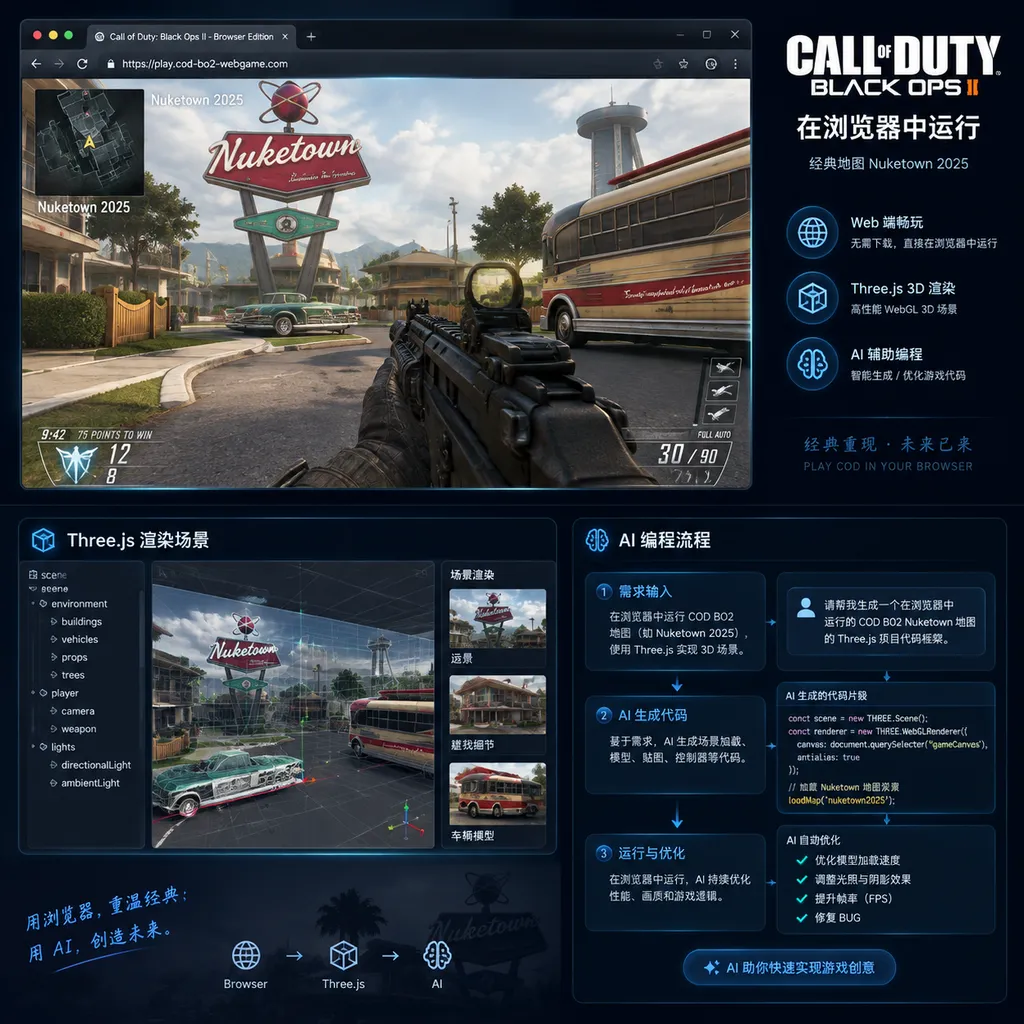
The Two Projects Recreated Multiplayer and Zombies Modes
Claude of Duty: Vibe Slops II primarily recreated Black Ops II's multiplayer mode. Players could battle on the Hijacked and Nuketown 2025 maps, with six AI-controlled bots configured in the scene.
In terms of its product form, it was not simply streaming the console or PC version to a webpage. Instead, it attempted to rebuild an interactive FPS runtime environment in the browser. Players had to move, aim, shoot, and navigate the map within the webpage, while the bots handled pathfinding, locating players, and participating in combat.
The other project, Kino der Toten, recreated a classic Zombies map from the Black Ops series and supported single-player gameplay. Its goal went beyond displaying a static map: the developer needed to implement basic game systems such as enemy spawning, collision detection, weapon logic, animation playback, and level progression.
Both projects used Three.js. For those familiar with web graphics development, Three.js itself is not mysterious. It is simply a JavaScript 3D framework that packages WebGL's low-level capabilities into a form more suitable for developers. The truly difficult part is not displaying a model, but making the model, collision volumes, animations, camera, and interaction logic all work together.
In other words, the challenge of a browser-based FPS is not moving the visuals to the web, but making them run like a game:
- The map needs to be broken down into renderable geometry and materials;
- Player movement needs to collide with walls, floors, and obstacles;
- Weapons need raycasting, recoil, ammunition, and reload logic;
- Bots need a navigation mesh, or they can only run aimlessly around the scene;
- The animation system needs to handle transitions between idle, movement, hit, death, and other states;
- The browser also has to contend with limitations involving device performance, input latency, resource loading, and memory usage.
If all of this were written entirely by hand, it would still require considerable game development experience. The value of AI agents lies mainly in their ability to continuously generate code, read error messages, modify implementations, and repeatedly fill in missing functionality based on natural-language descriptions from the developer.
“Vibe Coding” Lowers the Barrier to Porting, but Does Not Eliminate Engineering Difficulty
Luckey Faraday calls this development approach AI “vibe coding.” Its biggest difference from traditional software engineering is that developers do not necessarily begin with the project architecture and the implementation details of every function. Instead, they first give the AI a goal, then let the agent break down the tasks, write code, debug, and iterate on its own.
For example, a developer might make requests such as: let the player move around the Hijacked map; let the bots track the player on a navigation mesh; make weapons generate recoil when fired; make zombies spawn from designated entrances. The AI agent will attempt to modify multiple files, use tools to run the project, and then continue fixing issues based on the browser console and build logs.
These tools are particularly well suited to prototyping. Developers do not need to spend several days first building a complete entity-component system, nor do they need to finalize every resource-management strategy at the earliest stage. As long as the goal is specific enough, AI can quickly turn an “unrunnable idea” into a version that can be clicked through and tested.
Public information indicates that Faraday had previously demonstrated a project running Black Ops II's Hijacked map inside Minecraft. The early version merely placed the browser game inside a “computer” in Minecraft. Later, GPT Astra was used to rewrite the project in Java, allowing the map to run directly within Minecraft's OpenGL context. Demo footage showed the map running at approximately 45 FPS.
This process illustrates the strengths of AI agents particularly well: they may not be able to create a mature large-scale game from nothing, but they can help developers transfer and reconstruct existing systems across different technology stacks. Browsers, Fabric mods, Java, and OpenGL were originally several different development environments. AI can take on part of the “translation” and “glue code” work between them.
However, AI-generated code remains some distance from maintainable production code. It often piles on functionality quickly without necessarily addressing performance, synchronization, resource release, and security issues that emerge during long-term operation. For a game, being able to run in a demonstration video only means that “the shortest path has been completed”; it does not mean the project has the stability of a complete product.
A real project would typically still need to address the following issues:
- Resource loading: Large maps and textures cannot be loaded into the browser all at once, or initial loading and memory usage will become unmanageable.
- Performance optimization: Techniques such as instanced rendering, occlusion culling, LOD, and texture compression are needed to maintain a stable frame rate on ordinary devices.
- Input and latency: Mouse and keyboard input in the browser, the browser event loop, and rendering frames introduce additional latency, which is particularly sensitive in FPS games.
- AI behavior: Bot or zombie pathfinding must account for dynamic obstacles, target switching, and group behavior. Otherwise, the “scripted” nature of the behavior will quickly become apparent.
- Engineering maintenance: Repetitive code, implicit dependencies, and inconsistent data structures generated by AI all become maintenance costs as functionality expands.
- Distribution security: If the project supports online multiplayer, it must also address cheating, malicious requests, unauthorized resource linking, and server-side verification.
AI agents are therefore more like an extremely fast outsourced development team that requires human supervision. They can compress the prototyping phase from weeks to days, but they cannot take responsibility for architectural decisions, quality acceptance, or legal risks on behalf of the developer.
What Actually Got the Projects Taken Down Was the Original Assets, Not the AI
Faraday previously stated on the project page that the works were not affiliated with Activision, Treyarch, Microsoft, or Anthropic. However, such disclaimers do not solve the central problem: the two browser games actually used original maps, models, and animations from the Call of Duty series.
That was the key reason the projects disappeared so quickly after Activision filed its DMCA complaint.
If the developer had merely created an original FPS prototype inspired by Call of Duty, the risk assessment would have been completely different. Original maps, original characters, original textures, and self-produced sound effects generally would not directly constitute copying of specific work merely because the gameplay was similar. But Hijacked, Nuketown 2025, and Kino der Toten are all highly recognizable official content. Their models, map layouts, animations, and brand names are more easily identified by the copyright holder.
It is important to note that a “not official” statement on a project page can at most indicate that the developer is not pretending to be the copyright holder or an officially authorized project. It does not automatically grant the developer the right to copy, distribute, or publicly offer downloads of the material.
For copyright holders, browser projects like these create an additional concern: they turn content that would normally require purchasing the game, installing a client, or accessing official services into a publicly accessible browser experience. Even if the project is free, it may affect the commercial value of the original content and the copyright holder's control over its brand.
The takedown also occurred at a sensitive point in time. In July 2026, Activision and Treyarch confirmed that ports of Call of Duty: Black Ops and Black Ops II would be released for PlayStation platforms, with Iron Galaxy handling the ports and the campaign, multiplayer, and Zombies modes retained in full. While the official parties are repackaging the older games and extending their commercial life cycle, a third party has brought their classic maps to browsers for free. It is unsurprising that the copyright holder took action.
From a copyright perspective, AI is merely an accelerator. Without AI, developers could still complete similar projects through traditional reverse engineering, asset extraction, and WebGL reconstruction. With AI, projects have shifted from “long-term experiments that only a small number of experts can complete” to short-cycle projects that more independent developers can attempt. As copying becomes faster, copyright holders will also face increasing pressure to discover and deal with infringing content.
This Is Not a License to “Recreate Everything with AI”
Projects like these can easily create the illusion that as long as you feed the original assets to an AI and describe the desired functionality, you can quickly obtain a playable new version.
Reality is not that simple.
First, AI agents generally do not determine whether the resources have been legally licensed. They can help developers convert model formats, split textures, generate collision volumes, and even rewrite a client-side logic system in JavaScript, but they will not automatically stop working just because they discover that the materials belong to a commercial game.
Second, technical “reproducibility” does not equal commercial “publishability.” A developer may legally own a copy of a game, but that generally does not mean they have the right to extract, modify, or publicly distribute its models and maps. The legal and platform-related risks increase rapidly when a project is publicly accessible, offers downloads, or attracts substantial traffic.
Finally, AI-generated code itself may create new compliance issues. Code, textures, sound effects, and sample projects used by an agent during learning or retrieval may have unclear licenses, missing attribution requirements, or restrictions on redistribution. Combining assets from different sources does not automatically create a work that can be freely published.
A more prudent approach is to use AI for “original implementation” rather than “asset copying.” For example, developers can ask AI to help build an original browser-based FPS framework using self-produced or clearly licensed maps and models, while drawing inspiration from the gameplay structure of classic works. This preserves the value of the technical experiment without making the project's survival dependent on the copyright complaint process.
Practical Takeaways for Developers
There are at least three aspects of this incident that developers should pay attention to.
First, Keep the Prototype and Release Stages Separate
Validating map loading, collision, AI navigation, and rendering effects in a local test environment is a different stage from deploying the project at a public URL. The former primarily involves technical issues, while the latter introduces copyright, trademark, privacy, security, and platform-policy concerns.
Many projects disappear not because they were technically poor, but because developers publicly deployed a version containing complete commercial assets as soon as the prototype was finished.
Second, The Faster AI Generates Code, the More Important Human Review Becomes
In traditional development, resource inventories, code changes, and dependency sources are often recorded through team processes. After an AI agent continuously modifies multiple files, developers can easily focus only on the fact that “the functionality works” while overlooking where the code came from, whether the assets can be used, and whether the licenses are compatible.
Therefore, an AI programming project should at minimum retain:
- Records of the sources of the models, textures, sound effects, and animations used;
- A license list for third-party code and dependencies;
- The AI agent's major prompts, modification logs, and version history;
- Human review of trademarks, characters, maps, and original assets before release;
- Takedown, appeal, and replacement plans in case of a complaint.
Third, the Value of a Browser Port Is Not the Same as Recreating the Original
The real value of a browser-based implementation lies in lowering the barrier to access and demonstrating technical capabilities. Developers can use WebGPU, Three.js, WebAssembly, and modern browsers' multithreading capabilities to explore lightweight 3D games, cloud-based collaborative development, game-level editors, and cross-platform demonstration tools.
If a project can attract attention only by copying the assets of a commercial game, its technical value can easily be overshadowed by copyright issues. By contrast, a browser-based FPS that uses original assets while featuring similar system design is more likely to be maintained long-term and may even develop into an independently licensable product.
Conclusion: AI Makes “Can It Be Done?” Simpler, but Makes “Can It Be Published?” More Important
The takedown of the Black Ops II browser port was not a failure of AI agents in game development. On the contrary, it demonstrated that AI is already capable of enabling a single developer to perform work that previously required collaboration among multiple specialized roles. Asset processing, code restructuring, graphics rendering, AI navigation, and gameplay assembly can all move forward quickly with agent assistance.
But this incident also draws a boundary around “vibe coding.”
AI can bring a classic map into the browser, but it cannot obtain the map's copyright on behalf of the developer; it can generate FPS logic that appears to run, but it cannot guarantee that the project can be maintained over the long term; it can turn an idea into a demo, but it cannot automatically turn that demo into a legal product.
For developers, the next stage of competition will not simply be about “who can create a demo faster,” but “who can find the balance between speed, quality, and licensing.” As AI continues to lower the technical barrier, the truly scarce skills may shift away from writing code toward choosing the right assets, designing sustainable architectures, and identifying before release the risks that cannot be solved with a single line of prompting.
Sources
- IT Home: Developer uses AI agents to port Call of Duty: Black Ops II to the web, later taken down following an Activision DMCA copyright complaint — Covers the functionality, technology stack, and DMCA takedown of the two browser projects.
- IT Home: Official announcement that ports of Call of Duty: Black Ops 1/2 will arrive on Sony PlayStation consoles in July — Provides additional background on the release of the official ports of Black Ops 1 and Black Ops II.
- IT Home: Developer achieves native execution of Call of Duty: Black Ops II inside Minecraft — Provides additional background on Faraday's project to use AI to reconstruct the Hijacked map and port it to Minecraft. This link leads to the IT Home homepage; the specific page should be located through the site's search results.
This article was compiled from publicly available reports. As of October 12, 2026, there is no further reliable information about whether the projects had any undisclosed authorization, appeals, or subsequent restoration.