
Meta Returns to the Forefront with Muse Wonder

Meta has released Muse Wonder and the more powerful Muse Wonder Full, claiming they are approaching industry-leading models in tasks such as reasoning, writing, and coding. The real test is not just benchmark scores, but whether the models can complete long-running tasks and earn users’ trust to handle their personal affairs.
Meta Releases Muse Wonder, Rejoining the Flagship Model Race
Meta released two flagship models, Muse Wonder and Muse Wonder Full, on Monday local time. The company says the new models are approaching top competitors such as Anthropic in reasoning, writing, and coding tests. Wonder Full is the more capable version and, for now, is aimed primarily at subscribers to Meta’s own AI coding product, Muse Code.
The significance of this release is not that Meta has added two more model names. It is that the company is trying to answer a more practical question: Can the talent, computing power, and organizational changes it invested in over the past year and more produce a model capable of competing at the frontier again?
Meta had appeared to fall behind in the large-model race. After Llama 4 was released in 2025, the company faced criticism over its performance. Zuckerberg subsequently reorganized the AI division and, in June of that year, hired Scale AI founder Alexandr Wang as chief AI officer. Muse Wonder is the second-generation model launched after that reorganization, and the first Meta has positioned as a flagship to rival frontier products.
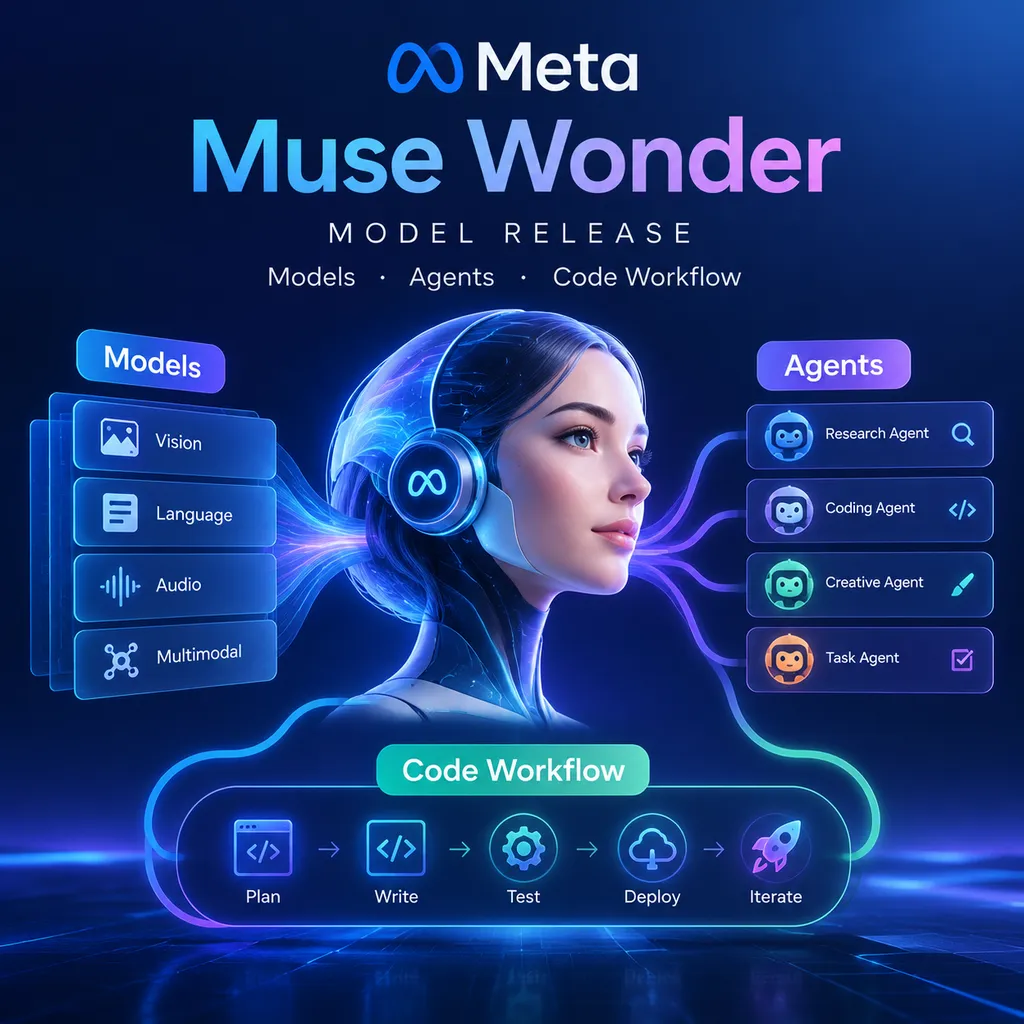
According to Meta, the two models were internally codenamed “Watermelon,” developed by the AI team led by Alexandr Wang, and trained using the company’s Prometheus data center. Wonder will soon power some features in the Muse app; Wonder Full is being made available first in Muse Code. Meta also says Wonder can be accessed through the Meta Model API, but the information released so far does not include complete model specifications, detailed external evaluations, or specific pricing.
From Answering Questions to Taking Action: Meta Bets on Personal Agents
Muse Wonder’s product direction differs from a simple focus on chat. Meta says the model is designed for “personal and professional agent” tasks: not just answering a question, but understanding a goal, working through steps, and trying alternative approaches when it encounters obstacles.
That sounds like a natural evolution of chatbots, but in practice it is a different level of difficulty. Asking a model “What restaurants are nearby?” is a single exchange. Asking it to compare availability, check your calendar, try to make a reservation, and find an alternative if your first choice is unavailable requires the model to maintain its goal across multiple steps, remember context, and handle failed tool calls. The longer the task, the more opportunities there are for the model to make a mistake. Producing a plausible-looking plan does not mean it can reliably carry it through.
Meta hopes to bring these capabilities to the Muse app and serve the billions of people who use Instagram, Facebook, and WhatsApp. This is a more distinctive point of differentiation than the approach taken by competitors that entered the market through developer tools and professional workflows: Meta already has massive consumer distribution and access to social, content, and messaging products. If its agents are reliable enough, users will not need to install a separate app to try them.
But distribution is no substitute for model capability. For a personal agent to be genuinely useful, it needs to do at least three things: understand a user’s long-term preferences; maintain state across multistep tasks; and accurately determine which actions it can take on its own and which require confirmation, especially when accounts, payments, files, or contacts are involved. If a model gets a knowledge question wrong, the user can ask a follow-up. Sending the wrong message or booking the wrong trip on the user’s behalf is a much bigger problem.
Near-Frontier Benchmark Results Do Not Mean the Product Has Caught Up
Meta says Muse Wonder is approaching Anthropic’s top models on reasoning, writing, and coding tests. Supplementary materials also highlight its performance in coding, memory, and long-horizon agent tasks. The clearest caveat for now is that these results are based mainly on Meta’s published evaluation methodology; independent, reproducible comparisons are still needed.
Benchmark scores are worth examining, but they do not translate directly into the developer experience. The scope of the test questions, inference-time compute, tool configuration, and scoring methods can all affect the results. A model that performs well on offline questions may still get stuck in a real codebase because of environment setup, failing tests, or missed details in a long context. This is especially true for coding models: generating code for a short problem and making changes across files, running tests, and tracking down regressions are different capabilities.
For developers, then, the next step is to verify a few specific things rather than ask which model has a slightly higher overall score:
- Can it bring long tasks to completion? Can the model finish a task after multiple rounds of edits and testing, rather than keep generating patches and pushing the problem to another round?
- Is the context actually useful? A large context window matters only if the model can retrieve key constraints accurately without being overwhelmed by irrelevant information.
- Are tool calls reliable? Agents need to use browsers, terminals, or business APIs. Tool selection and failure recovery often have more impact on delivery than the quality of the model’s prose.
- How do quality and cost trade off? More capable models usually come with higher inference costs and latency. If a full task requires multiple calls, the price of a single request does not represent the actual cost.
Meta has not yet disclosed whether Muse Wonder’s weights will be open-sourced. The company previously released weights for Muse Glitter-related models, but that does not mean the Wonder series will be made available in the same way. For teams that need local deployment, weight audits, or deep fine-tuning, this will directly affect whether the model makes their shortlist.
Muse Code Is the Entry Point; Commercial Viability Remains Unproven
Making Wonder Full available first to Muse Code subscribers suggests Meta does not intend to use its new model solely as the backend for a consumer assistant. AI coding is one of the model applications most likely to support paid subscriptions: developers can measure efficiency gains directly through code completion, editing, and debugging, and can more easily incorporate model capabilities into existing workflows.
However, Meta is entering a highly competitive market. Generating a code snippet in a demo is not a lasting advantage. What matters is whether the model can understand large codebases, follow project conventions, run tests reliably, and reduce manual rework over multiple iterations. Enterprise customers will also care about permission isolation, data handling, service reliability, and procurement support, none of which can be assessed from model rankings alone.
Meta says Wonder will be available through its own Model API, but the release information currently available is not enough for development teams to assess integration costs or production suitability. If the API becomes available, developers should verify the model version, context limits, rate limits, tool-calling protocol, data-retention policy, and service availability. For private code and internal materials, data boundaries and logging policies should be evaluated before benchmark scores.
If the model is later added to OpenAI Hub, developers could also compare it with other models through a unified, OpenAI-compatible interface. For now, however, that possibility should not be treated as confirmed availability. Model selection should be based on the platform’s published model list and the specific access permissions it provides.
The following example shows the form of a unified API call. The model name is a placeholder and does not indicate that Muse Wonder is available:
from openai import OpenAI

client = OpenAI(
    api_key="YOUR_OPENAI_HUB_API_KEY",
    base_url="https://openai-hub.com/v1",
)

response = client.chat.completions.create(
    model="meta-muse-wonder",  # Use the model ID actually provided by the platform
    messages=[
        {"role": "user", "content": "Review this code and identify potential edge cases."}
    ],
)

print(response.choices[0].message.content)
Meta’s Advantage Is Distribution; Its Challenges Are Trust and Validation
Meta is shifting its AI narrative from “what can the model do?” to “how can the model empower individuals?” That fits the company’s existing product structure: Muse can be integrated into social and messaging apps, and agents can help with everyday user tasks. If Meta can combine model capabilities, product access, and user memory, it has a real opportunity to offer an experience distinct from standalone chat products.
But the more a personal agent knows about its user, the higher the bar for security and privacy. It needs access to preferences, calendars, messages, and account permissions, and it may take actions on the user’s behalf. Meta says the models are intended to provide practical value and argues that AI labs should ensure safety themselves rather than broadly slow research and development. Whether that position earns users’ trust will ultimately depend on permission design, action confirmations, auditability, and recovery mechanisms when something goes wrong, not on safety promises made at a launch event.
For Meta, Muse Wonder is an important signal that its capabilities are returning, but it is not proof that the race is won. At a minimum, it shows that after rebuilding its AI team, the company has produced a model aimed at competing at the frontier again. Turning a model launch into a durable advantage will require independent evaluations, a stable API, manageable costs, reliable agent execution, and a product experience users are willing to keep paying for.
Over the next few months, what is worth tracking is not whether Meta announces an even larger model, but whether Wonder can deliver reliably in Muse and Muse Code. If it can reduce failures in long-running tasks, coding workflows, and personal-assistant scenarios while making good on Meta’s enormous distribution advantage, Meta will truly be back in the race. Otherwise, this launch will remain mostly an impressive benchmark scorecard.