Sora Is Set to Make a Comeback—This Time, It Won’t Be Short Videos

According to an October 12 report, OpenAI is in talks to hand the discontinued Sora over to a startup and shift its focus toward professional film and television production. The deal has not yet been finalized, and the model weights, API, and launch timeline have not been determined.
Sora May Be Revived, But Not This Time as a Short-Video App
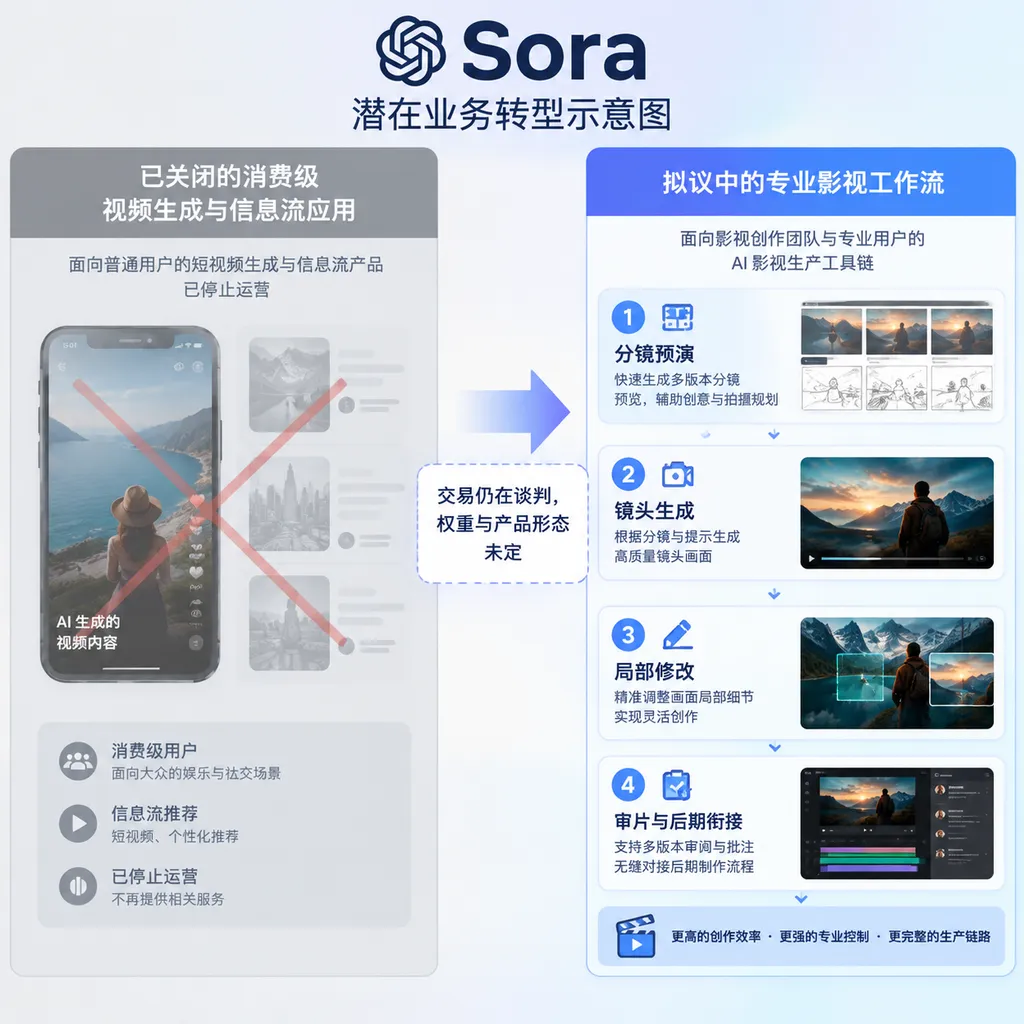
OpenAI is discussing bringing Sora back to the market, but not by relaunching the app that allowed users to generate and scroll through AI videos. Instead, it may hand Sora over to another company to develop a professional tool for film and television producers.
According to a report published yesterday by technology media outlet The Information, cited by IT Home on October 13, OpenAI is negotiating with a startup whose name has not been made public. The plan is for the startup to take over and transform the previously discontinued Sora platform, using its technology to develop and sell software or services for film and television production.
The company's founding team is highly relevant to this effort: Hollywood producer Jeffrey Katzenberg, former head of Sora research Bill Peebles, and former Dropbox CFO Sujay Jaswa. The company was founded several months ago and remains in stealth mode.
First, an important clarification: this is a potential deal under negotiation, not a sign that Sora has already relaunched. As of October 13, 2026, the two sides have not finalized the terms of their cooperation. It is also unclear whether the new company will obtain the model weights, and there is no publicly announced product release date, pricing, or API restoration plan.
The direction is nevertheless worth watching. If Sora returns in this form, the change will involve more than its operating entity. It will change the question Sora is trying to answer: from “Are ordinary users willing to pay to generate a video?” to “Are production companies willing to pay for a shot that can enter a production workflow?”
Not Restoring the Old Product, but Changing How the Technology Is Operated
Earlier this year, OpenAI stopped developing the Sora model and its TikTok-like video application. The consumer app and web platform were subsequently shut down, and a roughly $1 billion partnership with Disney was also terminated. According to related reports, OpenAI's main consideration at the time was to reduce spending on non-core projects with high computing requirements and redirect resources toward businesses such as enterprise AI and coding tools.
This context suggests that the current negotiations are more like a reorganization of a technology asset than an announcement that OpenAI is returning to the consumer video market.
The cost problem with video generation is straightforward. Every time a user clicks Generate, it may trigger an expensive inference task. If the result is unsatisfactory, they try again. Consumer products must also bear the costs of content distribution, moderation, and growth. A generation capability can be impressive without automatically generating enough subscription or advertising revenue to cover those expenses.
Professional customers have a different willingness-to-pay model. If a video can help a director determine camera placement, allow a production team to eliminate flawed concepts in advance, or replace part of the costly test-shooting process, its value does not need to be demonstrated through view counts. It can be measured through the time and budget saved.
This also explains why handing Sora to a more focused team has some commercial logic. OpenAI would not need to maintain a complete film and television product business itself, while the new company would not need to build the entire video-model foundation from scratch.
Supplementary reports have said that, if the deal goes through, OpenAI may receive potential returns by holding equity in the new company. However, this remains a reported deal structure and should not be treated as a confirmed equity arrangement. How technical licensing, ongoing services, and research and development responsibilities would be divided remains subject to finalized terms.
The appeal of this deal is that it would allow technology that has already absorbed substantial investment to keep pursuing revenue, rather than requiring OpenAI to rebuild the same consumer business.
Hollywood Needs More Than a “Cinematic Look”
Sora's shift toward film and television production sounds logical: a video model generates video, and film companies buy video. But the real difficulty lies precisely between “generation” and “delivery.”
An ordinary user may be satisfied with a short clip featuring beautiful lighting and smooth motion. A production team receiving the same material would first ask: Can the next shot connect smoothly? Will the actor's face remain consistent? Why did the background and clothing change when the director only wanted to adjust the camera movement?
Consider an example. A director needs a ten-second shot: an actor walks into a room, stops by the window, and the camera slowly pushes in. The first version is good overall, but the actor stops too early, and the weather outside the window is wrong.
A consumer tool can simply regenerate the clip and let the user try several times. A professional tool should ideally preserve the already approved performance, setting, and composition while changing only the timing of the pause and the weather outside the window. Otherwise, one modification creates more variables that need to be checked again, dragging the team into an endless screening cycle.
Professional film and television tools therefore need to address at least several specific requirements:
- Consistency across shots. Character appearance, clothing, props, and spatial relationships cannot change arbitrarily from one shot to another.
- Controllable shot design. Shot scale, camera position, movement trajectory, and action timing require more reliable controls than a single natural-language description.
- Localized editing and version management. Approved elements should be preserved as much as possible, and the editing process should be traceable and comparable.
- Post-production and collaboration handoff. Materials should be suitable for editing, compositing, color grading, and team review, rather than merely downloadable as a video file.
- Commercial-use boundaries. Production companies need to be able to review the sources of materials, performer permissions, copyright responsibilities, and project-data handling.
These are requirements of the professional market, not a published feature list for the new company. No public material currently proves that the proposed product already has these capabilities.
They do, however, offer a more useful evaluation standard than simply asking whether the visuals are impressive. Consumer generation is judged at first glance; professional tools are judged by whether they can still deliver after the fifth round of revisions.
Whether It Gets the Weights Will Determine How Far the New Company Can Go
The sentence in the report most worth developers' attention is not “take over Sora,” but “it is unclear whether the company will obtain the model weights.”
The platform, brand, model-access permissions, and model weights are different layers of assets. Taking over a product does not necessarily mean obtaining complete control over the underlying model.
If the new company primarily accesses Sora through a hosted API, it could build storyboarding, task orchestration, screening, and collaboration systems around the model. It might also receive deeper service privileges than ordinary customers. But the model's deployment, update schedule, inference pricing, and availability could still depend on OpenAI and the agreement between the two parties.
If it can obtain the weights along with the necessary rights to use and modify them, the new company would theoretically have more room for optimization, such as adjusting deployment methods and exploring adaptations for specific production tasks. But the weights alone would not constitute a complete handover. Training and inference code, rights to related data, engineering expertise, and the ability to maintain the system over time would also be important.
Moreover, autonomy is not free. It would also mean taking on the costs of procuring computing resources, optimizing inference, managing safety, and iterating on the model.
For film and television customers, the difference will ultimately be reflected in product commitments. Can a project reproduce the same look over the long term? Will a model upgrade change an established style? Where can sensitive materials be processed? Can the vendor provide stable service throughout the production schedule? All of these questions are connected to control over the underlying technology.
Therefore, evaluating the deal's value requires looking beyond whether the new company obtains the “Sora” name. It is also necessary to determine which layer of capabilities it receives and who will be responsible for keeping those capabilities available over time.
The Founding Team Fits the Market, but the Product Has Not Been Proven
The combination of Katzenberg and Peebles is the most persuasive part of the news.
The former understands film production and industry needs, while the latter has experience developing Sora. Compared with a team that has only model capabilities and must slowly search for industry use cases, this combination is more likely to identify real pain points in production workflows and better positioned to feed customer feedback back into the technology side.
Jaswa's background in finance and enterprise management may also help the team handle commercialization and operations. After all, a professional video service must not only be sold successfully; it must also explain how much inference cost each project generates, whether repeated revisions erode margins, and how different customers should be charged.
But a strong lineup cannot substitute for product validation.
A film company being willing to try a product and being willing to rely on it in an actual project are two different things. The former can tolerate surprises and occasional errors. The latter requires predictable schedules, accountability, and budgets. Industry relationships can help a product enter pilot projects, but customers will ultimately stay for deliverable results.
This means the new team may not need to pursue “generating an entire film” from the outset. Starting with narrower areas such as storyboard previsualization, proof of concept, or background materials may make it easier to demonstrate value. This is an analysis of a potential implementation path, not a disclosed product plan.
A tool that can reliably complete one specific task is often more likely to enter production than a platform that can demonstrate everything but cannot make reliable revisions.
Sora's Former Reputation Is No Longer Enough Against Competitors
The AI video market did not pause while Sora was shut down. Google and other companies have continued advancing video-model research, while other video-generation products are also competing for creators and professional teams.
If the new company takes over Sora, it cannot treat the technological shock it created in its early days as a current competitive advantage. There are no public test results for the new product and no like-for-like comparisons, so it is impossible to determine whether it leads competitors in image quality, motion coherence, or generation efficiency.
More importantly, competition among professional film and television tools is not limited to model rankings.
Production companies may not choose the product that produces the most beautiful result in a single generation. They may choose the one that preserves characters, shortens rework time, supports team review, and clearly defines responsibility for commercial use. For a team working toward a delivery deadline, occasionally generating one stunning shot may be less valuable than consistently producing acceptable material.
Costs should also be calculated differently. The generation price per second of video is only the starting point. A more practical metric is: How much money and time does it ultimately take to obtain one second of usable footage?
If a tool is cheap to use but requires repeated attempts, manual repairs, and renewed reviews, its overall cost may not be low. Conversely, a more expensive individual inference may be worthwhile if it significantly improves the approval rate.
Sora's opportunity lies in combining its model foundation with film and television workflows to create a narrower but more reliable product. The risk is that the industry-specific transformation may not yet be complete, while the underlying model already requires new large-scale investment. An asset arrangement intended to reduce costs could once again become a research-heavy business.
For Developers, It Is Not Yet Time to Bet on the API Again
This news contains no new API documentation, model identifier, service commitment, or migration plan. Developers who previously built applications around Sora cannot interpret a “possible return” as confirmation that the old API will be restored, much less assume that their previous data and product permissions will continue to apply.
At this stage, four things are more worth tracking:
- Whether the deal is formally completed. How the negotiating parties, scope of the technology handover, and long-term responsibilities are ultimately determined.
- Who the product is actually sold to. Whether it will be a workspace used directly by production companies or will also be opened to third-party developers.
- How control over the model is divided. Who will be responsible for the weights, hosted services, and subsequent research and development.
- How it performs in real production. Whether there are verifiable project examples, revision-efficiency metrics, and cost data, rather than only showcase clips.
From an architectural perspective, this is also a reminder about vendor risk. Video-model task submission, status queries, material storage, and business workflows should ideally not be tied too tightly to one vendor's product format. But an abstraction layer is not a universal solution either: when migrating across models, reference images, shot controls, output specifications, and licensing conditions may all differ. The change cannot be understood simply as replacing one model name with another.
This is not the formal release of a new model, and there is no information proving that the proposed professional version of Sora can already be accessed through OpenAI Hub. Waiting to assess integration until the product and API are actually announced is more responsible than making commitments in advance.
Sora Needs to Prove Something Different Now
The significance of this potential return does not lie in whether OpenAI has once again become enthusiastic about video generation. It lies in the possibility that it has found another arrangement: preserving the technology's commercialization opportunity while entrusting operation of the professional product to a more focused team.
The direction is worth watching, but it is far too early to declare success. The deal has not been finalized, control over the weights remains unclear, the product's capabilities have not been publicly validated, and the market is much more crowded than when Sora first appeared.
The genuinely valuable shift would be from “generating images that amaze people” to “delivering material that can be edited, collaborated on, and supported with commercial accountability.” This is not a matter of giving the old app a more professional interface. It means adopting an entirely new set of product standards.
If the new team can help production companies reduce rework and waiting while delivering consistently, Sora will have truly come back to life. Otherwise, it will merely have switched to a target market that is more willing to pay for video generation.
Sources
- IT Home: Reports Say OpenAI Plans to “Revive” Sora and Enter the AI Professional Film and Television Tools Market — A report published on October 13, 2026, citing The Information's October 12 report. It describes the potential takeover team, the professional film and television product direction, and key information such as the fact that the deal terms and model weights have not yet been determined.