
HelloBike Releases the Driving World Model HelloWorld

Hello Robotaxi has released the generative driving world model HelloWorld, which supports generating multi-view videos and LiDAR observations using natural language or by directly editing traffic participants and trajectories. Its goal is to reduce the cost of constructing long-tail scenarios and testing autonomous driving policies.
What Happened
On October 13, Hello Robotaxi announced the launch of HelloWorld, a generative driving world model. According to information disclosed by Hello, the system is designed for data construction and interactive policy testing in autonomous driving R&D. It can generate corresponding multiview video and LiDAR observations based on natural-language descriptions or direct edits by developers.
Its goal is not simply to “make videos look more realistic.” Rather, it aims to turn work that previously required repeated data collection, annotation, and scene modification into an interactive scene-generation workflow. Developers can insert a pedestrian crossing the road, change the route of the vehicle ahead, or switch clear weather to rain, snow, fog, or nighttime conditions, and then observe how the vehicle’s policy responds.
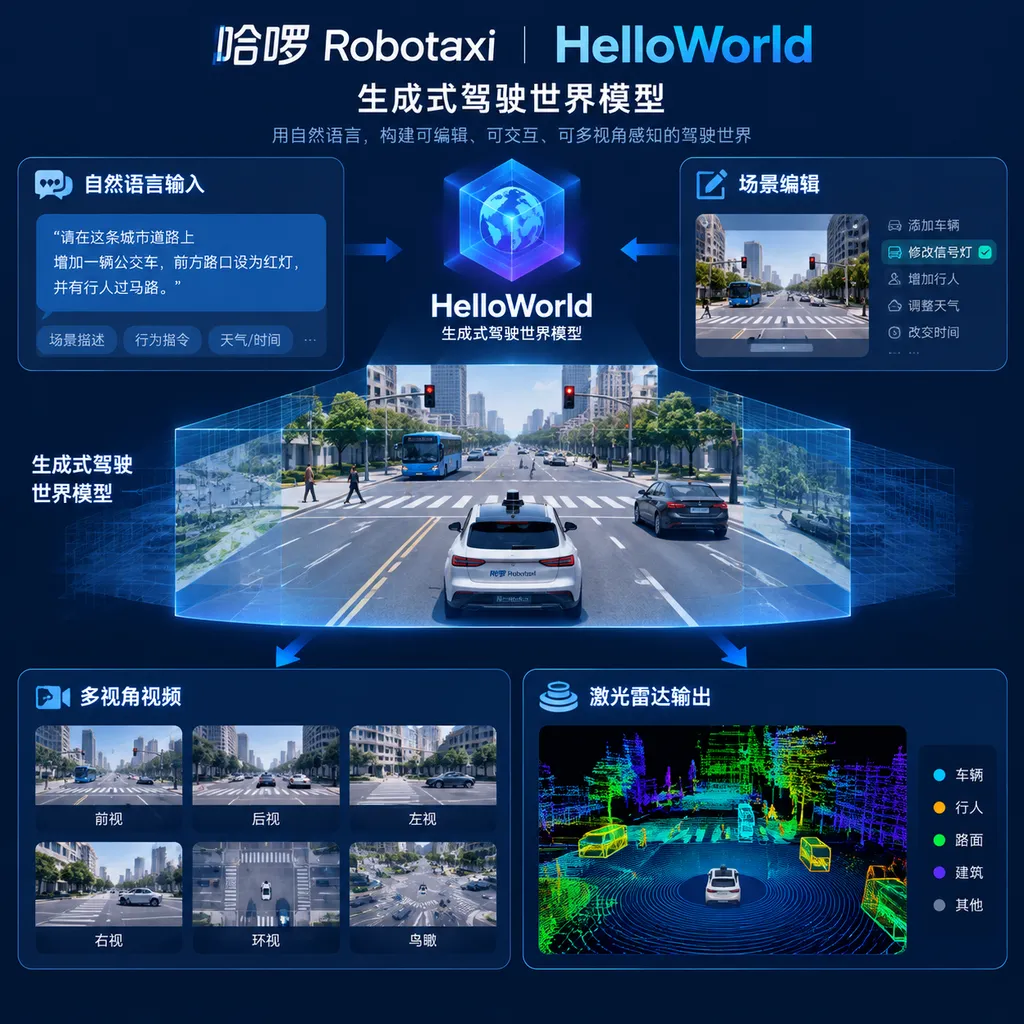
Hello says HelloWorld integrates scene control, continuous generation, multisensor observation, and efficient inference, exploring concrete applications for world models in autonomous driving R&D. Based on the information currently available, it appears more like R&D infrastructure serving simulation, data generation, and policy validation than a driving system directly intended for passengers.
From “Generating Videos” to “Generating Testable Environments”
Over the past two years, generative video models have continued to improve image quality. But in autonomous driving, visual realism is only the first hurdle.
A genuinely useful driving world model needs to answer several questions at the same time: What objects are present in the scene, and where are they located? How will these objects move next? Are the images captured by cameras consistent with the point clouds collected by LiDAR? After the vehicle accelerates, decelerates, changes lanes, or stops, does the environment continue to evolve according to reasonable physical and traffic logic?
If a model can generate only a video that looks plausible but cannot ensure that the positional relationships among pedestrians, vehicles, and road boundaries remain consistent across consecutive frames, it will be difficult to use directly for policy testing. Autonomous driving systems are not concerned with a single “good-looking image,” but with a continuous decision-making chain: After the vehicle ahead slows down, should the ego vehicle follow? When a pedestrian suddenly enters the lane, is the braking distance sufficient? When heavy fog reduces visibility, do the perception and planning modules behave abnormally?
The “continuous generation” emphasized by HelloWorld directly addresses this type of need. It must maintain scene consistency over time, allowing the states of vehicles, pedestrians, and the environment to evolve continuously rather than generating unrelated results for every frame.
From an R&D perspective, the value of this capability lies in expanding the test subject from single-frame perception results to complete interaction processes. The model can be asked to generate continuous scenarios such as “the vehicle ahead suddenly changes lanes before a construction zone,” “a pedestrian crosses the road from behind an obstruction,” or “dense traffic slows down on a rainy night.” Developers can then evaluate how autonomous driving policies perform under specific risk conditions.
Natural Language Is the Entry Point; Scene Control Is the Core
HelloWorld supports natural-language scene descriptions, but that does not mean developers can enter a single sentence and have the model automatically complete all testing tasks. More precisely, natural language provides a lower-barrier entry point for scene construction, while the underlying structured control capabilities determine whether the system can truly be used for engineering tests.
For example, the sentence “Generate a rainy nighttime construction zone with a pedestrian suddenly crossing ahead” can be broken down into at least several conditions:
- Environmental conditions: nighttime, rain, potentially accompanied by road reflections and reduced visibility;
- Road conditions: a construction zone is present, and lane boundaries or the drivable path have changed;
- Traffic participants: at least the ego vehicle, a lead vehicle, and a pedestrian;
- Behavioral conditions: the pedestrian enters the vehicle’s path from behind an obstruction;
- Test objective: observe the responses of the perception, prediction, planning, and control modules.
If these conditions exist only in textual form, the generated results may still be difficult to reproduce and quantify. Autonomous driving R&D requires repeatable experimental variables: From which direction does the pedestrian appear? How far is the pedestrian from the vehicle? What is the pedestrian’s speed? When does the lead vehicle begin to slow down? What are the rainfall and illumination levels? When does the vehicle receive the sensor input?
For this reason, HelloWorld’s support for directly editing vehicles, pedestrians, and motion trajectories is more important than a text-generation function alone. Natural language is suitable for quickly proposing a scene hypothesis, while trajectory editing is suitable for turning that hypothesis into controllable test conditions. Combining the two allows developers to first build a complex scene with text and then precisely adjust the trajectories of key objects.
This is also one of the differences between generative world models and traditional rule-based simulation. Traditional simulators are generally more mature in parameter control, reproducibility, and physical constraints, but building complex scenes often requires extensive engineering configuration. Generative models are better at rapidly organizing combinations of real-world conditions, but their generation stability and compliance with physical laws still require additional validation. HelloWorld attempts to place both capabilities within the same workflow.
Multiview Video and LiDAR: The Challenge Is Consistency
Another important signal from HelloWorld is that it produces more than one type of sensor observation.
Autonomous vehicles typically rely on multiple sources of information, including cameras, LiDAR, millimeter-wave radar, and positioning systems. Cameras provide texture, color, and semantic information, while LiDAR provides spatial structure and distance information. Real-world multisensor data is not independent across modalities: The same vehicle that appears at a particular location in a video should correspond to a similar geometric structure in the point cloud; after the same pedestrian enters an occluded area, the changes in visibility in the camera and LiDAR data should also be correlated to some extent.
If only video is generated, multisensor fusion modules in autonomous driving systems are difficult to test comprehensively. If only point clouds are generated, the texture, lighting, and weather changes on which visual perception depends cannot be covered. Generating multiview video and LiDAR observations simultaneously could, in theory, more closely approximate the input received by a real vehicle, extending testing from a single sensor to cross-sensor collaboration.
However, this also presents a significant technical challenge. The generative model must not only maintain spatial and geometric consistency, but also handle changes in camera perspective, occlusion relationships, object scale, and motion speed. If a vehicle moves forward in the front-facing camera but does not exhibit corresponding changes in the side views and LiDAR observations, the resulting data could distort the test results.
Public information has not yet disclosed HelloWorld’s model size, training data, generation resolution, point-cloud format, latency metrics, or the alignment mechanism used between video and LiDAR. At this stage, it is therefore more appropriate to view it as Hello’s attempt to productize generative driving data infrastructure, rather than as a complete solution capable of replacing high-fidelity simulators.
What It Could Change
The scenarios that autonomous driving systems have the greatest difficulty filling are often not ordinary road scenes, but low-frequency, high-risk, and highly complex long-tail scenarios.
Real-world road data can provide high-value information, but both collection costs and coverage are limited. Situations involving construction zones, sudden crossings, rain or snow at night, dense traffic, and multiple occlusions are difficult to collect at sufficient scale through natural driving alone. Even when such data is collected, it still needs to be cleaned, annotated, and segmented, then reorganized for different testing objectives.
The value of generative world models lies in transforming “data cannot be found” into “conditions can be defined and data can be generated.” An R&D team can modify one key variable in an accident reconstruction and observe whether the policy remains effective. It can also systematically vary weather, road structures, traffic density, and participant trajectories to build more comprehensive regression test sets.
Specifically, HelloWorld has at least three potential applications:
- Long-tail scenario expansion: Supplement real-world road data with situations that occur infrequently but pose significant safety risks, such as pedestrians suddenly appearing from behind an obstruction, abnormal lane changes, and passage through construction zones.
- Interactive policy testing: Run vehicle policies in continuously changing environments and observe whether the planning and control modules exhibit unstable behavior, rather than evaluating only static perception accuracy.
- Data generation and regression validation: After a version update, quickly regenerate the same types of test scenarios and compare the performance of different algorithm versions under identical conditions.
For autonomous driving teams, the third application may be the easiest to implement. A world model may not initially be capable of supporting large-scale closed-loop training, but if it can stably generate reproducible test scenarios, it can already reduce some of the manual scene-construction and data-organization workload.
Generated Results Cannot Be Treated Directly as the Real World
The engineering value of HelloWorld will ultimately depend on whether its generated data can pass rigorous validation.
Autonomous driving tests differ from ordinary video generation. If a video model occasionally produces object deformation, discontinuous trajectories, or abnormal lighting, users may simply consider the video imperfect. In autonomous driving tests, however, shifting a pedestrian’s position by several meters or assigning a vehicle an incorrect speed could change the decision outcome. More seriously, if the model generates sensor signals that appear plausible but do not actually exist, it could cause system evaluations to be inflated or misinterpreted.
Generative scenes therefore generally need to be combined with real-world data, rule-based simulation, and closed-course testing, rather than simply replacing any one of them. A relatively robust R&D pipeline might first use a world model to rapidly generate candidate scenarios, then filter them through checks for trajectories, collisions, visibility, and sensor consistency, and finally verify critical scenarios in a higher-fidelity simulation or real-vehicle environment.
In addition, HelloWorld has not yet released public evaluation results. Based solely on its support for multiview video and LiDAR generation, it is not yet possible to determine how it performs in the following areas: whether errors accumulate during long-duration continuous generation, whether geometric structures remain reliable in extreme weather, whether complex interactions comply with traffic rules, and how much generated data can improve the training of autonomous driving models.
These metrics, rather than demonstration effects, will determine whether a world model is genuinely suitable for production environments. For developers in particular, controllable model parameters, output formats, batch-generation capabilities, scene-reproduction mechanisms, and inference costs are often more important than a demonstration video.
World Models Enter the Engineering Phase
In the past, world models were discussed primarily as a general-purpose technology that could help AI “understand the environment and predict the future.” As autonomous driving companies begin using them for data construction and policy validation, the focus is shifting from conceptual capabilities to engineering closed loops: Can scenes be specified? Can they run continuously? Can multisensor data be generated simultaneously? Can inference be performed quickly? Can the system be integrated into testing workflows?
This is also where the significance of Hello’s HelloWorld release lies. Rather than focusing on a consumer-facing interactive product, it directly targets some of the most time-consuming and difficult-to-standardize aspects of autonomous driving R&D. Natural language lowers the barrier to expressing scenes, trajectory editing provides precise control, multiview video and LiDAR bring the output closer to real sensor inputs, and continuous generation attempts to advance from a single image to an interactive environment.
However, HelloWorld is still in the early stages of information disclosure. Hello has not released more details about its model architecture, performance metrics, or scope of use, and it is not yet possible to determine whether the system has entered large-scale internal production workflows. Whether it can become reliable driving-test infrastructure will depend on whether reproducible evaluation results are published and whether the generated data can continue to deliver value in actual autonomous driving systems.
What can be confirmed is that autonomous driving data production is expanding from “collecting data on the road” to “constructing data on demand.” The company that can truly connect generative capabilities, sensor consistency, and closed-loop evaluation may be the one that advances world models from demonstration tools to R&D tools. With this release, HelloWorld has at least put Hello’s answer to that challenge on the table.