GPT-6 Astra Extends AI Videos to 10 Minutes
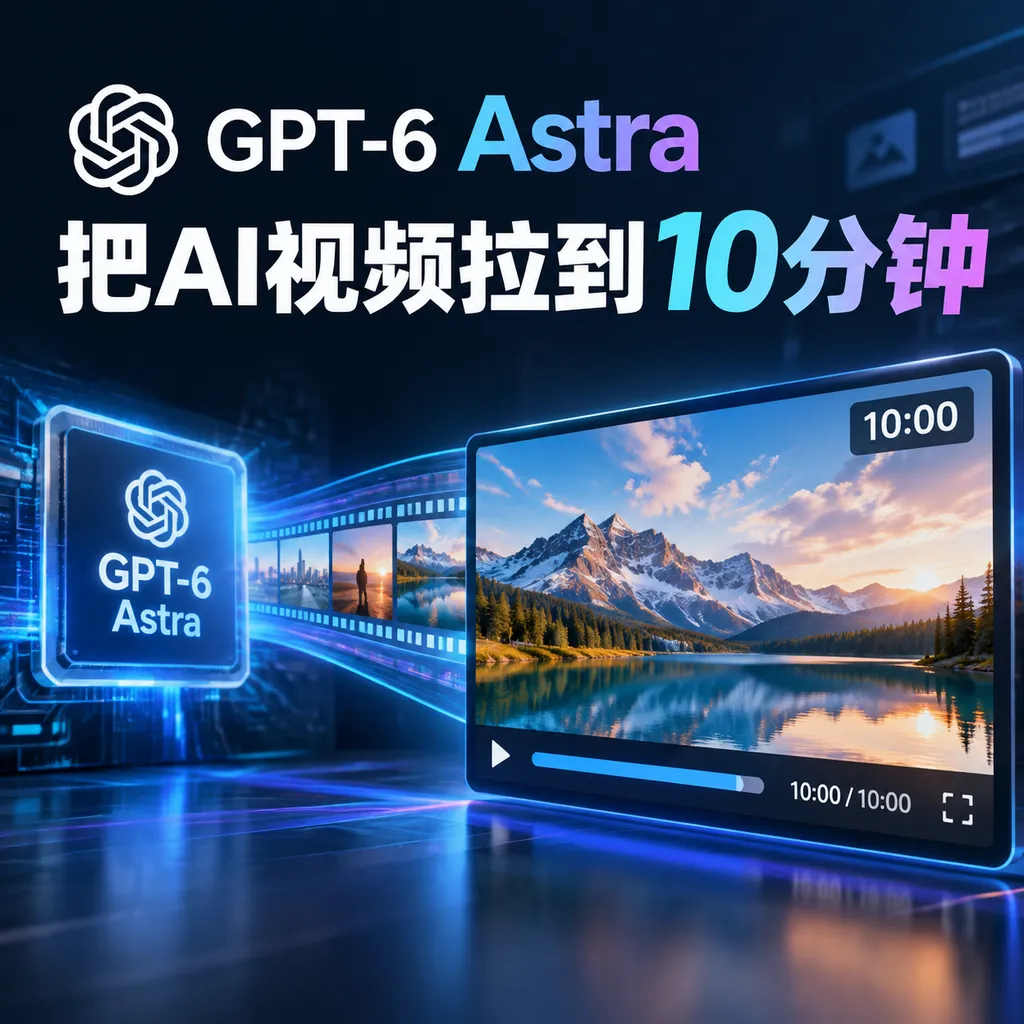
After integrating GPT-6 Astra, Higgsfield increased the maximum AI video length from 1 minute to 10 minutes. The real change is not simply generating nine additional minutes of video, but that the large language model has begun taking over scriptwriting, asset management, tool invocation, and consistency management.
AI Video’s Upper Limit Has Been Pushed From 1 Minute to 10 Minutes
After integrating GPT-6 Astra into its video production workflow, Higgsfield has increased the maximum length of AI-generated videos from 1 minute to 10 minutes. In a related case study, OpenAI said Astra can act as a creative agent that invokes external tools, handles complex tasks including 3D modeling, and coordinates scripts, characters, scenes, and visual assets.
This is not simply a matter of making a video model’s progress bar ten times longer.
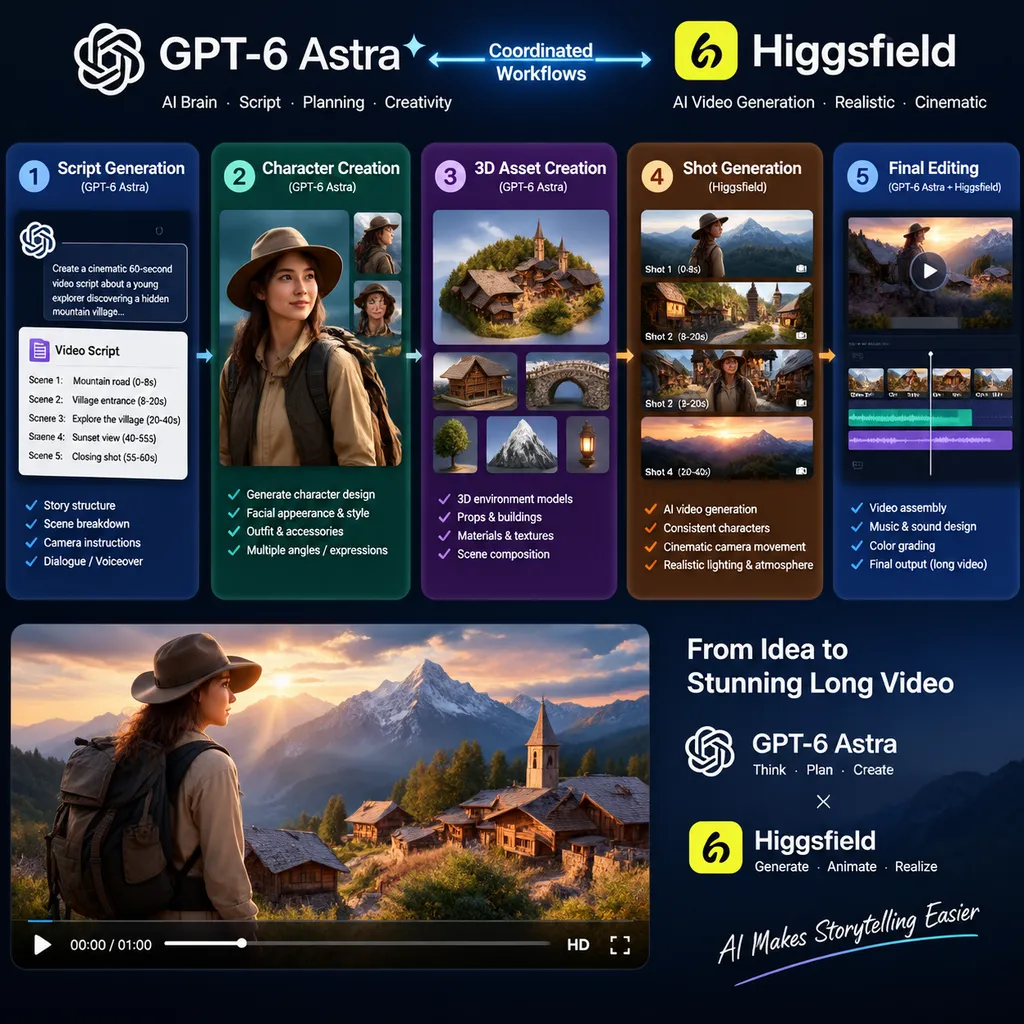
More precisely, GPT-6 Astra serves as the “director” and workflow orchestrator for video production. It may not personally generate every frame, but it breaks down creative objectives, organizes assets, invokes different models and tools, and checks whether continuity is maintained across shots. Higgsfield provides video generation, camera control, digital humans, and post-production output capabilities.
As of October 14, news of this collaboration is being widely publicized. One timeline detail should be clarified, however: the corresponding Higgsfield customer story on OpenAI’s website was first dated September 21. What emerged today is further disclosure and circulation of the relevant capabilities and the “1 minute to 10 minutes” result—not the first release of GPT-6 Astra.
The Hard Part About 10 Minutes Is Not Compute, but Preventing the Video From “Forgetting” Halfway Through
Short-form video generation can already produce some stunning shots lasting a few seconds, but once the timeline is extended to several minutes, problems quickly multiply.
A character wearing a blue coat in the first shot may be wearing black by the third. A cup held in the left hand may move to the right after a cut. The windows, furniture, and lighting in the same office may also keep changing. More challenging still, character motivations, causal relationships between shots, and voice-over pacing must all be preserved across numerous generation steps.
Long-form video generation must maintain at least four types of consistency at the same time:
- Character consistency: Faces, clothing, body types, voices, and movement patterns must not drift frequently;
- Scene consistency: Spatial layouts, prop positions, lighting directions, and temporal states must carry over;
- Narrative consistency: Shots must serve the same script rather than becoming a collection of unrelated, attractive clips;
- Visual-language consistency: Shot scale, color, composition, and transitions cannot switch styles every few dozen seconds.
Traditional video generation models are more like cinematographers who excel at shooting individual clips. They can turn a prompt into a video lasting a few seconds or tens of seconds, but they do not inherently understand the production plan for an entire film. The value of GPT-6 Astra lies in adding a production system that can read the global state, maintain an asset registry, and invoke tools.
For example, an instructional video might first be divided into five chapters: introduction, concept explanation, demonstration, case study, and conclusion. The agent creates a storyboard for each chapter, locks in the presenter’s appearance and background, calls an image model to create infographics, then invokes a video model to generate each segment before completing subtitles, voice-over, and editing. If a shot contains incorrect text or character drift, the system regenerates only that segment rather than recreating the entire video from scratch.
This approach is fundamentally closer to orchestration in software engineering: a long-form video is not a single output from one inference run, but a production pipeline composed of multiple models, tools, and intermediate artifacts.
A “10-Minute Video” Does Not Mean Generating a Continuous 10-Minute Shot in One Pass
The “10-minute” claim also needs to be tempered somewhat.
The currently disclosed information does not specify whether Higgsfield’s 10-minute limit means generating one continuous video end to end in a single run, or generating multiple shots and automatically assembling them into a finished video within the same agentic workflow. Given Astra’s role in invoking external tools, organizing inputs, and performing quality checks, the latter is more consistent with real-world video production.
That does not diminish the product’s value, but the two approaches have entirely different technical implications.
Generating 10 minutes of continuous footage in one pass tests the video model’s temporal modeling capabilities, GPU memory efficiency, and stability over extremely long contexts. Automatically producing a finished 10-minute video, by contrast, tests task decomposition, asset management, shot-to-shot consistency, failure retries, and post-production orchestration. The breakthrough demonstrated by Higgsfield is more likely focused on the second approach.
From a product perspective, this route is also more practical. Advertisements, tutorials, and product introductions already consist of multiple shots. What creators truly care about is whether the final video is usable—not whether the model insists on producing every frame in a single inference run.
Higgsfield has already applied the workflow to its own YouTube channel. The channel has nearly 500,000 subscribers, and the team uses GPT-6 Astra to produce instructional videos longer than 10 minutes. The publicly demonstrated process covers goal definition, input organization, script verification, digital-human testing, storyboard generation, visual asset creation, quality checks, and export—not simply entering a prompt and waiting for a finished video.
This is also the more credible form of “AI long-form video” today: humans define objectives and review key checkpoints, while agents handle repetitive and labor-intensive production tasks.
Astra Orchestrates the Process, While GPT-Image-2.5 Supplies Visual and Text Assets
Higgsfield has also integrated GPT-Image-2.5 to generate infographics and commercial visual assets containing readable text.
Text has long been a weak point for image generation models. If an ordinary promotional image contains only one English word, an error may not be obvious. But menus, price lists, feature comparison charts, and instructional diagrams need to produce multiple lines of text reliably. Any spelling or layout error can make the asset undeliverable.
If GPT-Image-2.5 can maintain a high level of text legibility in real-world production, its value to small businesses may be more immediate than improvements in visual quality alone. A restaurant without a design team could generate advertisements containing dish names, prices, and promotional information. A software company could combine product interfaces, feature descriptions, and brand elements into presentation assets, then hand them over to Higgsfield to turn into videos.
Long-form video production therefore no longer depends on a single video model. Instead, responsibilities are divided as follows:
- GPT-6 Astra understands the objective, breaks down the task, and maintains the global context;
- GPT-Image-2.5 generates infographics, backgrounds, and static visual assets;
- Higgsfield handles shots, digital humans, motion control, and video rendering;
- External tools handle 3D modeling, audio, subtitles, editing, and output;
- The agent checks the results and locally retries failed segments.
This architecture is easier to deploy than an “all-purpose video model.” When one stage is upgraded, the platform only needs to replace the corresponding component rather than retraining the entire system. If one model fails, it can also fall back to another provider or to manual processing.
Codex Is Bringing Creative Teams Into the Development Process
The collaboration also includes one easily overlooked detail: Higgsfield is using Codex to accelerate internal product development.
Higgsfield says its team consists of approximately 200 creative professionals and 100 engineers. In the past, when the creative team proposed an idea for a new tool, a product manager would typically need to organize the requirements before placing it in the front-end and back-end development queues. Now, creative staff can first use Codex to turn an idea into a working prototype. After validating the interaction and workflow, they can hand it over to the engineering team to complete access control, data handling, performance optimization, and production deployment.
This does not mean creative professionals can replace engineers. On the contrary, a gap still remains between prototypes and production systems in terms of reliability, testing, security, and maintainability. But it reduces the substantial communication costs associated with “building something only to discover that the direction was wrong.”
This is particularly important for AI creation platforms. User demands for camera control, asset management, and style templates change rapidly, and many features may have a life cycle of only a few weeks. Completing an internal prototype in a day is better suited to the competitive pace of such products than spending weeks writing requirements documents.
The Next Step Is “Creating Videos While You Talk”
Higgsfield says its next area of exploration is combining GPT-Live-1 with speech-to-video creation. Users would no longer need to fill out complex forms or adjust parameters one by one. Instead, they could describe their goals verbally, while the system asks follow-up questions and modifies the video in real time.
Ideally, the interaction might work like this: a user says they need a three-minute product demo aimed at developers, with a cool color palette and the existing brand typeface preserved. The agent first generates a script and storyboard. The user then says the second section is too long, asks to replace it with a screen recording, and requests pricing information at the end. The system understands which assets on the timeline correspond to these changes and regenerates only the affected portions.
Voice input itself is nothing new. The challenge lies in accurately mapping voice commands to the complex state of a video project. If every modification breaks shots that have already been approved, so-called real-time creation will only produce chaos faster. Whether the combination of GPT-Live-1 and Astra can maintain an editable state tree will determine whether this capability remains a demo or becomes a production-ready tool.
Four Metrics Developers Should Focus On Now
Higgsfield has not yet provided complete data on API pricing, generation speed, resolution limits, or failure rates in its current disclosures. For developers preparing to integrate similar workflows, video length is far from the only important metric.
The following deserve more attention:
- Cost per minute of finished video: The price of a single generation run is not what matters. What matters is how much it costs to deliver one usable minute of video after retries and discarded footage;
- Localized editing capabilities: If a character, subtitle, or shot contains an error, can only that portion be regenerated, or must the entire video be rendered again?
- Asset traceability: Whether script versions, character reference images, prompts, random seeds, and model versions can be recorded affects reproducibility and auditing;
- Consistency failure rate: The number of character, scene, or text continuity errors in a 10-minute video reveals more about the product’s quality than officially curated showcase clips.
In addition, public materials currently do not provide detailed information about the resolution, frame rate, average wait time, or concurrency limits for 10-minute finished videos, nor how many stages still require human confirmation. Before purchasing or integrating the system, enterprises would be better off conducting small-scale tests with their own real-world assets rather than relying solely on demonstration videos.
Verdict: The Inflection Point for Long-Form Video Has Arrived, but This Is Not “Press a Button and Make a Movie”
Moving from 1 minute to 10 minutes is a tenfold increase in numerical terms, but its significance as a product is even greater: AI video is beginning to evolve from a short-clip generator into a production system capable of handling complete content tasks. Tutorials, product introductions, brand advertisements, course videos, and corporate training will be among the first use cases to benefit, because such content has a clear structure, can be divided into shots, and is easier to check automatically.
But it is still too early to call this cinematic-quality generation. Films and high-quality narrative content require long-term character arcs, complex performances, precise staging, and consistent aesthetic judgment. These challenges cannot be solved simply by raising the duration limit to 10 minutes.
What makes GPT-6 Astra and Higgsfield truly noteworthy is that they demonstrate a more pragmatic path than “training a larger video model”: use a general-purpose large model as the orchestration hub, organize scripts, images, video, 3D, audio, and coding tools, and produce long-form content through a workflow that can be inspected and rolled back.
If this workflow can keep costs, latency, and consistency within acceptable limits, the next phase of competition in the AI video industry will no longer be about who can generate the most impressive five seconds. It will be about who can reliably deliver a 10-minute video that a client is willing to publish.
References
- ITHome: OpenAI’s GPT-6 Astra Helps Higgsfield Increase AI Video Length From 1 Minute to 10 Minutes — Includes information about the collaboration’s progress, long-form video consistency, GPT-Image-2.5, Codex, and the speech-to-video roadmap.