
APUS Open-Sources Reflex Agent
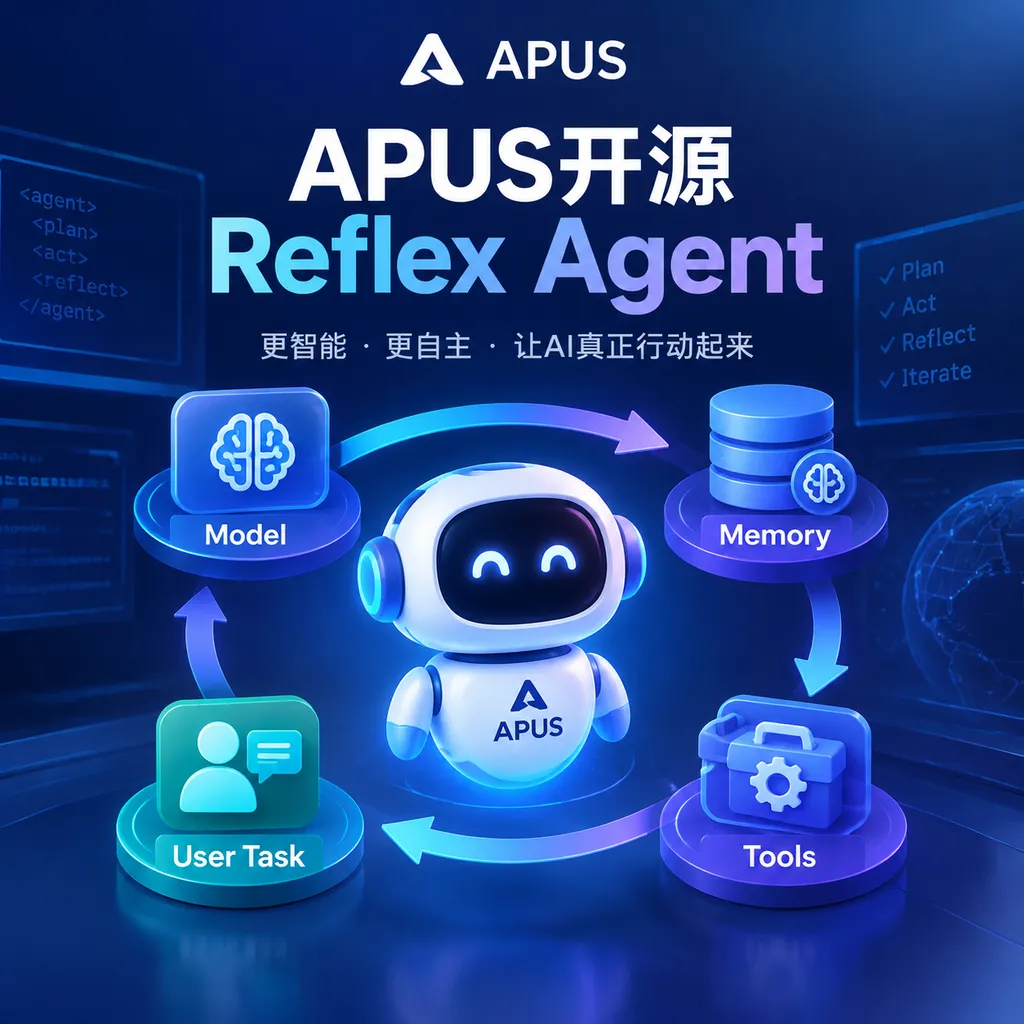
Yesterday, APUS AI open-sourced Reflex Agent for personal use cases, emphasizing faster responses and persistent memory. Its so-called “unlimited context” does not mean an unlimited model context window; what truly deserves attention is how it manages long-term task state.
APUS Open-Sources Its Personal Agent
On October 13, APUS AI (Qilin Hesheng Network Technology Co., Ltd.) announced that it had open-sourced its personal agent product, Reflex Agent. The project puts response speed and context management at its core. According to benchmark results disclosed by the company, it can respond about three times faster than Claude Code, while “truly unlimited context” is positioned as a key selling point.
This is a noteworthy direction among the recent wave of open-source agent projects in China. Rather than continuing to emphasize multi-agent orchestration, complex workflows, or yet another development framework, Reflex Agent focuses on the two most practical problems facing personal agents: waiting too long and forgetting once a task becomes lengthy.
However, both claims need to be examined more closely.
First, “three times faster” is a performance figure obtained in a specific test environment and does not mean that every task will see the same acceleration. Likewise, “unlimited context” generally does not mean literally extending the underlying large language model’s context window to infinity. Instead, it typically relies on external storage, task-state management, summary compression, and on-demand retrieval to enable an agent to keep processing material beyond the model’s context window for a single inference.
In other words, Reflex Agent is not really trying to build a larger model. It is trying to organize a limited model into a system capable of sustained work.
It Is Designed for Sustained Work, Not Chat
The difference between a personal agent and a conventional chatbot is not merely whether it can access a browser, terminal, or file system.
Chat products are usually centered on single-turn or limited multi-turn conversations: the user asks a question, and the model generates an answer. A personal agent, by contrast, must deal with continuously evolving task states. For example:
- Reading a software repository containing hundreds of files;
- Continuously tracking a research topic and organizing newly available materials;
- Revising the same report repeatedly over several days;
- Remembering the user’s tool preferences, project structure, and past decisions;
- Performing combined tasks across browsers, terminals, and local files.
The difficulty of these tasks does not lie solely in reasoning ability. Even if a model is highly capable in a single response, latency and cost will quickly increase if it has to reload large amounts of history every time it runs. If older content is simply discarded, the agent may forget previous constraints and repeat the same mistakes.
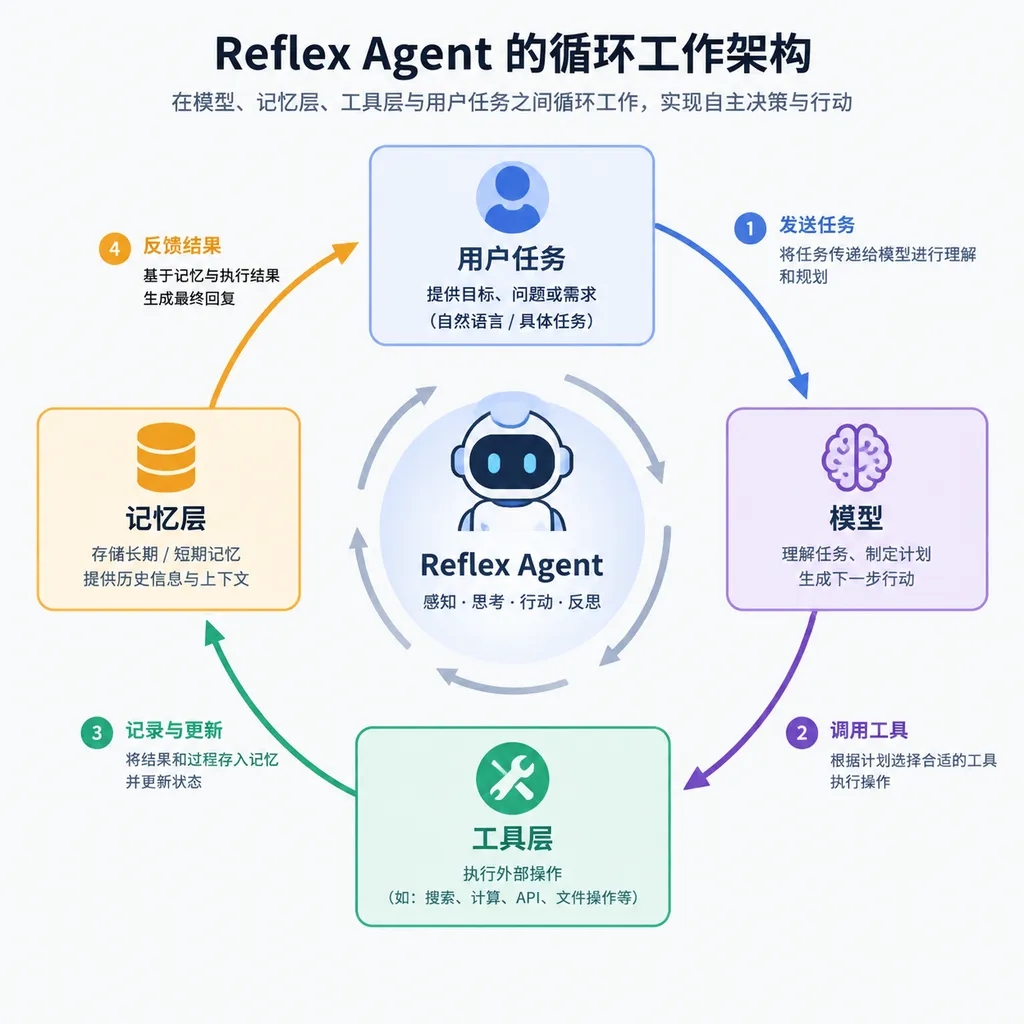
A personal agent is therefore more like a “small operating system” than an extended chat window. The model handles reasoning, external memory preserves state, the tool layer performs actions, and the scheduler decides what information to retrieve and when. The ultimate experience depends on whether the entire system can work together reliably.
From this perspective, Reflex Agent’s emphasis on context and response speed makes sense. Over the past year, agent products have shown that the ability to call tools is no longer scarce. What remains scarce is the engineering capability required to deliver low latency, recoverability, and reliable long-term operation.
“Unlimited Context” Does Not Mean Unlimited Tokens
First, it is necessary to clarify a concept that marketing language can easily obscure: every specific large language model has a clearly defined context-window limit for each inference. Whether that limit is hundreds of thousands or millions of tokens, it is not infinite in the mathematical sense.
When agents claim to offer “unlimited context,” a more accurate description would be that their logical context is not constrained by a single inference window.
This can be understood by considering how developers use Git and search engines to work with large codebases. People do not keep an entire repository in their heads at once. Instead, they retain the project structure, current branch, key changes, and indexes, opening specific files only when necessary. Agents can adopt a similar strategy:
- Store complete conversations, files, and tool-execution results in external storage;
- Maintain the current task objectives, plans, and constraints as structured state;
- Generate hierarchical summaries of older content rather than inserting everything back into the prompt;
- Before taking the next step, retrieve only the fragments relevant to the current action;
- Assign higher priority to critical facts so they are not drowned out by ordinary conversation;
- Resume from checkpoints after interruptions instead of reasoning from scratch.
The workflow can be abstracted as follows:
User request
   ↓
Task-state update ──→ Write to long-term memory
   ↓                        ↑
Retrieve relevant context ←─┘
   ↓
Model planning or generation
   ↓
Invoke tools and save results
   ↓
Validate results, compress history, and proceed to the next cycle
This type of architecture allows a system to keep processing tasks of effectively arbitrary length, but it does not come for free.
If retrieval misses a critical constraint, the agent will still “forget.” If a summary contains errors, those errors will propagate into subsequent steps. If each cycle retrieves large amounts of content, so-called unlimited context will ultimately become unlimited latency and an unlimited bill. A genuinely valuable implementation must strike a balance among recall, context length, response speed, and inference cost.
When evaluating Reflex Agent, developers therefore should not merely ask, “How much can it remember?” They should ask three more specific questions: How does it decide what to remember? How does it find old information? And how does it correct inaccurate memories?
Three Times Faster Than Claude Code—But the Number Needs More Context
Another key claim disclosed about Reflex Agent is that its response speed is approximately three times that of Claude Code. The figure is certainly eye-catching, but it should not yet be interpreted as proof of across-the-board performance leadership.
An agent’s response time can be divided into at least four components:
- Time to the model’s first token;
- Number of model calls required for planning and tool selection;
- Time spent on file retrieval, browser operations, and command execution;
- Cost of retries and validation after task failures.
If Reflex Agent reduces the context included at each step, uses lightweight models for simple decisions, or executes independent tool calls concurrently, it could indeed reduce perceived latency significantly. This is particularly true for frequently repeated actions such as code retrieval, file classification, and web-page element selection. If a large model spends several extra seconds thinking through each action, the accumulated difference can reach several minutes.
However, the “three times faster” claim still depends on the benchmark methodology: Does it compare time to first response or total task completion time? Which models were used? Were the tasks identical? Was network latency included? And were the final results comparable in quality? If one system is faster but requires the user to correct it frequently, the speed advantage can easily be erased by rework.
The more prudent conclusion at this stage is: Reflex Agent treats low latency as an architectural objective rather than a secondary optimization; the threefold improvement is an official result worth reproducing, not yet a broadly validated conclusion.
For developers, the most meaningful evaluation is not to have two agents answer ten questions each, but to ask them to complete the same real-world task—for example, modifying an interface in a medium-sized repository, running tests, diagnosing failures, and submitting the changes—and then compare the following:
| Dimension | Metrics to Monitor | | --- | --- | | Response speed | Time to first meaningful action, end-to-end completion time | | Model overhead | Number of calls, input and output token volume | | Task quality | Test pass rate, number of manual corrections | | Context capability | Constraint-retention rate during long-running tasks | | Reliability | Recovery capability after tool failures | | Controllability | Whether memories can be viewed, modified, or deleted |
Only when quality is comparable does a speed multiplier become truly meaningful.
APUS’s Technical Strategy Is Becoming More Coherent
Reflex Agent is not the first project APUS AI has open-sourced this year around the execution efficiency of agents.
In September, APUS AI Lab published an independent reproduction of the Jev decision model and packaged it as fast-browser-use for browser automation. The project’s approach is to skip token-by-token generation and have a lightweight local model directly score candidate actions, answering the question “Which element should be clicked?” with a single forward pass.
When conventional large language models perform browser tasks, they often first read the page, generate a natural-language analysis, and then output a selector or tool-call parameters. This process is slow and may also produce formatting hallucinations. Directly scoring a limited set of candidates is closer to using a classifier: rather than writing an essay, the model simply answers a multiple-choice question.
APUS stated at the time that fast-browser-use could be integrated as a standard Agent Skill into coding agents such as Claude Code, Codex, and OpenCode, with support for macOS, Linux, and Windows. Its local execution model also means that some page content and interaction data do not need to be sent to the cloud.
Viewed together, fast-browser-use and Reflex Agent reveal a relatively clear APUS strategy:
- Assign complex planning to more capable models;
- Assign frequent decisions to lighter and faster decision models;
- Manage historical information through an external memory system;
- Integrate browser, desktop, and local-system capabilities as Skills;
- Finally, organize these components into a personal agent product.
This is a classic “fast and slow” division of labor. Rather than trying to make one large model handle every step, it assigns different types of work to different components, much like a computer system distinguishes among the CPU, cache, storage, and peripherals.
This approach may not attract as much attention as releasing a new model, but it is more practical for real-world agent deployment. The problem with many current agents is not that their models are insufficiently intelligent, but that every action invokes an expensive model, making the system slow, costly, and unstable.
The Value of Open Source Depends on Whether Developers Can Take Control of Critical Components
Personal agents typically handle more sensitive data than conventional chat products. They may access code repositories, browsing histories, documents, account information, terminal output, and even long-term behavioral preferences.
For this reason, open source is not merely a customer-acquisition strategy for such products; it directly affects whether they are trustworthy. At a minimum, developers need to determine:
- Whether memory data is stored locally or in the cloud;
- Whether permission must be confirmed before tools are executed;
- Whether complete operation logs are retained;
- Whether the agent can be restricted from accessing specific directories and commands;
- What context third-party models are able to see;
- Whether deleting a memory also removes it from vector indexes, summaries, and caches;
- Whether permissions are isolated among plugins or Skills.
“Supports local deployment” also does not automatically mean “data never leaves the device.” If the underlying system still calls cloud-based models, file fragments included in requests may still leave the local machine. If browser tools store cookies, the agent process itself becomes a high-value target for attackers.
Prompt injection is a particular concern. When a personal agent browses the web, malicious text on a page may induce it to ignore its original task, read local files, or invoke high-risk tools. System prompts alone cannot fully solve this problem. The product must provide permission boundaries, action approval, and sensitive-information filtering.
Whether Reflex Agent ultimately gains developer adoption will depend heavily on the transparency of these engineering details—not merely on whether it can complete tasks continuously in a demo.
It Is Entering a Crowded but Still Unsettled Market
The open-source agent ecosystem is not short of projects. From autonomous-loop agents such as AutoGPT, to orchestration frameworks such as LangGraph and AgentScope, to coding-oriented products such as OpenCode and Claude Code, developers already have many options.
If Reflex Agent merely combines a model, MCP, and a vector database, its differentiation will be limited. Today, almost any team can build a demo in a few days that can search, write files, and invoke tools.
There are two areas in which it may be able to establish a genuine advantage.
The first is long-term state management. If the agent can accurately resume tasks after days or even weeks, retain project constraints, and avoid resending the entire history to the model, then “unlimited context” will become a real productivity feature rather than a slogan.
The second is end-to-end latency. If APUS can integrate its previous work on fast decision models into Reflex Agent, enabling steps such as file selection, page clicking, and result classification to be completed locally within seconds, the system may be better suited to high-frequency personal tasks than solutions that depend entirely on general-purpose large language models.
Conversely, if the claimed threefold speed improvement comes primarily from shorter prompts or more aggressively omitting validation steps, the advantage will not be durable. Ultimately, agent products are judged by task-completion rates—not by which one displays the first line of text in the chat box sooner.
Worth Trying for Now, but Don’t Rush to Migrate Your Workflow
For developers interested in studying agent memory, long-running task scheduling, and local tool execution, Reflex Agent deserves a place on the testing shortlist. It addresses genuine problems, and APUS’s previous work on fast browser decision-making provides technical continuity with its current direction in personal agents.
For now, however, it is better viewed as a promising engineering approach that warrants validation, rather than a finished product already proven capable of replacing Claude Code or other mature tools.
Testers should not limit themselves to running the official demos. Instead, they should prepare a set of tasks that more closely resemble everyday work:
- Import a real repository containing hundreds of files;
- Perform multiple interdependent modifications in sequence;
- Interrupt the process and check whether it can resume;
- Deliberately introduce conflicting historical requirements;
- Test web-based prompt injection and the blocking of high-risk commands;
- Measure total task duration, model-call volume, and the number of manual interventions;
- Check whether long-term memories can be exported, edited, and completely deleted.
If Reflex Agent can maintain contextual consistency in these tests while genuinely reducing waiting time and model-call costs, its value will extend beyond being “yet another open-source agent.” It may demonstrate that the next stage of competition among personal agents is shifting from model capability to system efficiency.
This is also the most noteworthy aspect of the open-source release: large-model context windows remain limited, but a well-designed agent does not have to be constrained by a single window. Large-model inference remains expensive, but not every click, classification, or retrieval operation requires the most powerful model.
As of October 14, Reflex Agent had been open source for only one day. Its official performance figures and “unlimited context” capabilities still need to be reproduced by the community. The direction is right, but it is too early to draw conclusions. The next question is not whether it can complete an impressive demo, but whether it can work continuously on a real computer for a week and still remember why it started.
References
- GitHub: Search for open-source repositories related to APUS Reflex Agent—For finding project code, README files, license information, and community reproduction efforts. Specific installation procedures should follow the latest instructions in the official repository.
- Zhihu: Overview of the open-source AI agent ecosystem—For understanding the industry context surrounding open-source agent projects such as AutoGPT and MetaGPT; not used as a primary source for Reflex Agent performance data.