
GPT-5.6 Breaches the Chrome Sandbox in Six Days

With GPT-5.6 Sol and a team of just four researchers, XBOW completed a full-chain Chrome exploit in only six days, earning a $250,000 reward from Google. AI is transforming vulnerability research from a manual craft into a compute-driven industrial process.
Six Days, Four People, and $40,000 Worth of Compute
AI has dramatically accelerated the compromise of Chrome’s security sandbox.
According to a recent disclosure by XBOW, its security research team used models including OpenAI’s GPT-5.6 Sol to discover and build a full-chain exploit targeting the Chrome browser. With four researchers involved, the team needed just six days to ultimately gain system-level access. The vulnerabilities are estimated to affect roughly one billion users. All have now been reported to Google and patched.
Google paid XBOW a $250,000 bug bounty, equivalent to approximately RMB 1.676 million. The team spent around $40,000—roughly RMB 268,000—on model inference and related computing resources.
On paper alone, this was highly cost-effective security research: compute expenditure amounted to about one-sixth of the bounty. But the more noteworthy factor is not the payout—it is the time. According to industry estimates, similar work performed primarily by humans would typically take around six months.
Six days versus six months: this is not simply an improvement in coding efficiency. It represents a change in how vulnerability research is conducted.
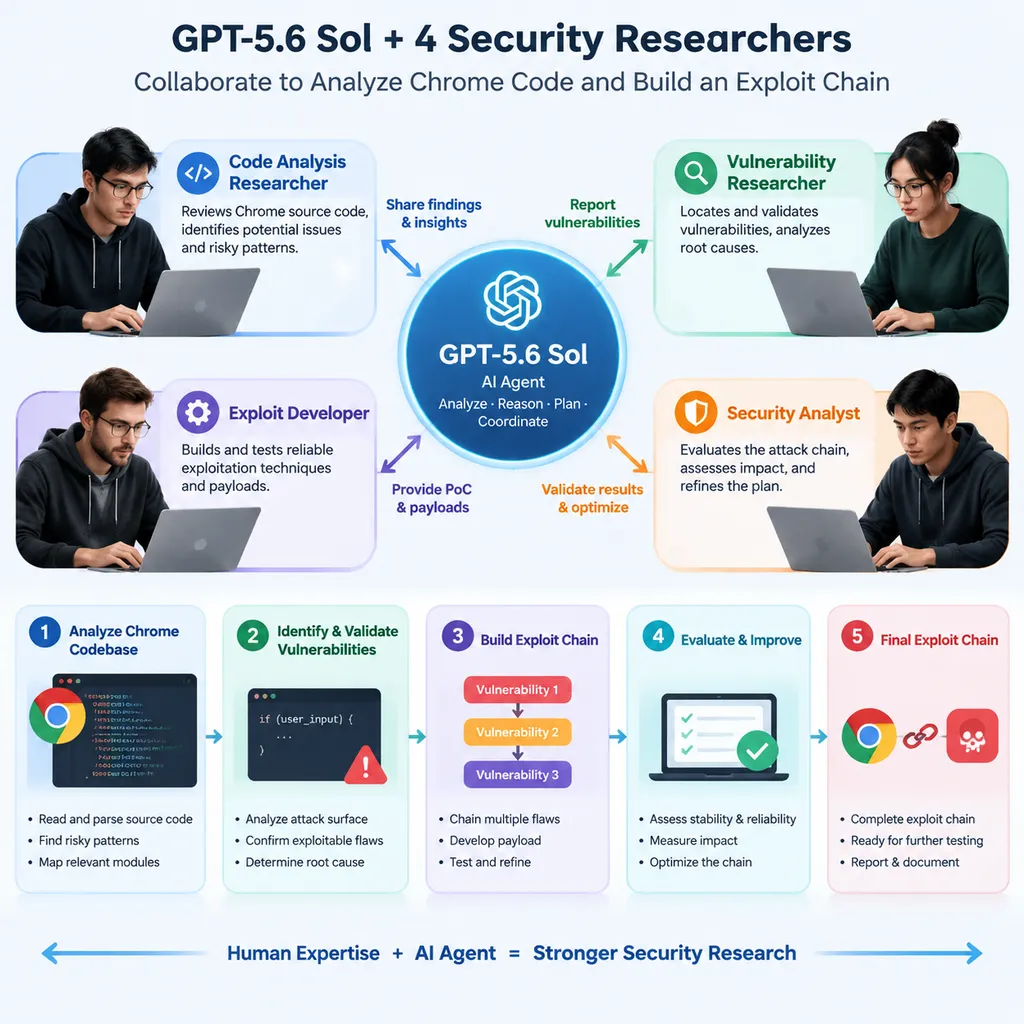
AI Did Not Carry Out the Attack Independently, but It Took Over the Most Time-Consuming Work
Based on the information disclosed by XBOW, GPT-5.6 Sol did not receive a one-line prompt to “break into Chrome” and then independently deliver a complete exploit chain. In practice, the effort more closely resembled a hybrid research team led by humans, with models handling large-scale execution tasks.
AI was primarily responsible for four categories of work:
- Searching and reading Chrome’s enormous source codebase;
- Writing tests and running experiments based on research hypotheses;
- Building proof-of-concept programs, or PoCs;
- Writing initial versions of exploits and repeatedly revising them based on feedback.
The four human researchers were responsible for setting the overall strategy, selecting promising directions for deeper investigation, reviewing the agents’ output, and reallocating tasks based on interim results.
This division of labor is critical. The most time-consuming part of vulnerability research is often not the flash of insight that identifies a suspicious function. It is the repeated verification across millions of lines of code and countless runtime states: whether an input can trigger an anomaly, whether a crash is reproducible, whether the memory layout can be controlled, whether one vulnerability can be chained with another, and whether an exploit still works on a different machine.
In the past, this work required researchers to spend weeks continuously auditing code, debugging, and conducting trial and error. The value of models is that they can tirelessly search in parallel, generate tests, read crash logs, and return useful leads to humans. They are more like a group of fast, predictably priced junior security engineers who still need to be managed by experienced researchers.
It is therefore inaccurate to describe this incident as “AI independently breaking into Chrome.” A more accurate description is that AI took over the highly repetitive, search-intensive, and trial-and-error-heavy portions of vulnerability research, while humans retained control over target selection, evidence assessment, and risk management.
That alone is enough to transform the industry.
Breaking Out of a Sandbox Is Not as Simple as Finding a Crash
Chrome uses a multi-process architecture and a sandbox to restrict the permissions of webpage-rendering processes. Even if an attacker causes a webpage to trigger a memory error, the impact is usually confined to the restricted renderer process. The attacker cannot directly read files across the entire device, let alone automatically gain system-level privileges.
Moving from a malicious webpage to “full system access” generally requires combining multiple capabilities into an exploit chain. At a high level, the process looks like this:
- Gain code execution or controlled memory read/write capabilities inside the browser. This usually occurs in the JavaScript engine, rendering components, media parsers, or other complex modules.
- Break through process isolation or the browser sandbox. The attacker must continue searching for flaws in IPC interfaces, privileged services, operating-system components, or permission checks.
- Reliably chain multiple vulnerabilities together. Succeeding once in a laboratory is not enough. The exploit must also handle version differences, changes in memory layout, and various failure paths.
- Verify the real-world impact and complete responsible disclosure. The research team must demonstrate the risk without releasing attack details that could be abused before a patch is available.
According to currently available reports, XBOW discovered three vulnerabilities and combined them into a full-chain exploit. Google has now patched all three. However, public materials have not yet fully disclosed each vulnerability’s identifier, affected component, exploitation sequence, or reliability data. It is therefore not yet possible to determine whether the model achieved a breakthrough at one specific point or played an equally important role throughout the process, from code auditing to exploit-chain construction.
This distinction matters.
There is a great deal of engineering work between finding an input that crashes a browser and completing a repeatable, portable sandbox escape. Google’s $250,000 bounty indicates that the work was worth more than an ordinary crash report. But until the technical details are formally published, it would also be inappropriate to portray it as an off-the-shelf weapon capable of taking over every Chrome device with a single click.
The $40,000 Bought Search Breadth, Not an Answer
The research cost approximately $40,000 in compute. That is not a small sum for an individual developer, but it is remarkably inexpensive for a browser vendor, security company, or nation-state cyber operation.
What that money primarily purchased was search breadth.
A traditional researcher can investigate only a limited number of code paths, run a limited number of tests, and maintain a limited number of hypotheses in a single day. Long-running AI agents can track many candidate directions simultaneously, quickly discard failed experiments, and continue iterating around the small number of productive leads. Even if a model’s individual judgments are inferior to those of a top researcher, it may still gain an advantage in overall output through scale and speed.
However, it would be too simplistic to subtract $40,000 from the $250,000 bounty and conclude that the project earned a net profit of $210,000. In addition to compute expenses, the following costs were not included:
- The time and professional expertise of four researchers;
- Agent orchestration, isolated environments, and debugging infrastructure;
- Numerous failed experiments and preliminary tool development;
- Vulnerability reproduction, report writing, and vendor communications;
- Legal compliance, data management, and security reviews.
Bug bounties also exhibit a clear winner’s bias. Successful projects receive payouts, while many searches that produce no results generate only bills. AI makes vulnerability research more like venture capital: teams can place bets on more directions at once, but returns are never guaranteed.
The real change is that organizations can now use GPU budgets to obtain more of the expert time that was previously extremely difficult to scale.
The Security Industry Is Moving From “Tool-Assisted” Work to “Agent Pipelines”
Static analysis, fuzz testing, and symbolic execution are not new technologies. They have long been able to automatically discover crashes and anomalous execution paths, but they generally require researchers to configure targets manually, interpret results, and turn isolated issues into exploitable attack chains.
Frontier models fill the gaps between these tools.
Models can read source code and documentation, invoke compilers, debuggers, and fuzzing tools, adjust the next round of experiments based on logs, and then generate new PoCs. The “review results—form a hypothesis—modify code—run again” loop that researchers previously performed manually can now be executed continuously by agents hundreds or even thousands of times.
This means the fundamental unit of security automation is changing:
- In the past, automation covered a single scan;
- Later, it covered an individual testing task;
- Now, it is beginning to cover multi-day research processes involving decisions and backtracking.
This is also where the primary significance of XBOW’s accomplishment lies. It demonstrates that AI can do more than explain known vulnerabilities, complete scripts, or generate scanning rules. It can also participate in long-term exploration toward open-ended objectives and advance that work into complete results worthy of substantial bounties.
Of course, this is still not “unmanned security research.” Models can misinterpret code semantics, repeatedly pursue unproductive paths, or mistake an intermittent crash for a reliably exploitable issue. The closer the work gets to a complete attack chain, the more indispensable human verification becomes. But the human role is beginning to shift from personally executing every step to designing experimental systems, managing the search space, and reviewing critical results.
For Attackers and Defenders, This Is the Same Lever
For browser vendors, systems like these are first and foremost defensive tools. Chrome, operating-system kernels, databases, and cloud infrastructure all contain enormous codebases, and human auditing can never keep pace with the rate of new commits. Having agents continuously inspect high-risk modules and automatically generate regression tests creates an opportunity to find vulnerabilities before they enter stable releases.
But the same capabilities will also lower the barrier for attackers.
In the past, constructing a full-chain browser exploit often required experts from multiple domains: some who understood JavaScript engines, some who studied heap layouts, and others who analyzed operating-system privilege boundaries. AI cannot immediately replace these experts, but it can enable smaller teams to access similar knowledge and workflows.
The more realistic risk is not that people with no technical background will suddenly become elite hackers. It is that attackers who already possess some capability will gain several times—or even dozens of times—the search efficiency. This acceleration is especially dangerous during the vulnerability window: after a patch is released, attackers can have models automatically compare old and new versions, locate the patched code, and attempt to reverse-engineer the underlying vulnerability. Enterprises that once had several weeks to deploy updates may soon have only a few days.
For that reason, governance of AI security models cannot focus solely on prompt filtering. Checking whether a user entered “write malicious code” will not stop a long-running task composed of tens of thousands of seemingly ordinary code-analysis, compilation, and debugging steps. More effective controls must be implemented in the runtime environment and at permission boundaries, including:
- Providing agents with minimal, narrowly scoped credentials;
- Denying access by default to unapproved external networks and production systems;
- Establishing human checkpoints for high-risk actions such as downloading binaries, escalating privileges, and exporting data;
- Retaining records of tool calls, file changes, and network access—not merely chat content;
- Setting compute budgets, rate limits, and emergency stop mechanisms;
- Completely isolating research environments from corporate production infrastructure.
In other words, an agent should not be managed like a chatbot simply because it “looks like it is chatting.” A model that can continuously invoke terminals, compilers, and browser debuggers is effectively an automated operator with access to a machine.
What Development Teams Should Do Now
For ordinary users, the most direct action remains updating Chrome. XBOW explicitly stated that all three vulnerabilities discovered in this effort have been patched. Because public reports do not provide a specific security version number that applies uniformly across all platforms, users should rely on Chrome’s built-in update page and the latest stable version released by Google for their platform, then restart the browser after updating.
For enterprises and development teams, however, updating desktop Chrome alone is not enough.
1. Inventory Every Chromium Entry Point
Enterprise assets often include more than Chrome. They may also include Chromium-based desktop clients, Electron applications, embedded WebViews, automated testing images, and containers that have not been rebuilt for extended periods. These components may carry different versions of the Chromium engine and may not update automatically alongside Chrome.
Security teams need to establish a queryable software bill of materials and include browser-engine versions in asset management rather than checking only an application’s outer version number.
2. Shorten Browser Patch Deployment Cycles
Browsers are highly exposed software. Email, instant messaging, advertisements, and third-party documents can all deliver untrusted content to rendering processes. For high-value vulnerabilities that have already been patched, monthly update cycles are often too slow.
Enterprises should consider enforcing automatic updates, implementing version-compliance policies, and warning or blocking endpoints on which browsers have not been restarted for an extended period.
3. Do Not Treat the Browser Sandbox as the Only Line of Defense
A sandbox is intended to increase the cost of an attack, not to guarantee that escape will always be impossible. Sensitive back-end systems should continue to use hardware security keys, multifactor authentication, short-lived tokens, and least-privilege designs. High-value operations should ideally require secondary confirmation, preventing a compromised browser process from automatically inheriting all available privileges.
4. Put Internal Security Agents in a Real Sandbox
More development teams are allowing agents to run code, open webpages, and analyze dependencies automatically. Such tasks should be performed in disposable environments, with production credentials disabled, outbound network access restricted, and instances destroyed when the work is complete.
The most dangerous configuration is one in which a long-running model simultaneously has write access to code repositories, cloud-platform credentials, internal network access, and permission to execute arbitrary commands. This effectively hands multiple previously independent security boundaries to a system that may still be vulnerable to prompt injection.
The Real Inflection Point: Vulnerability Research Is Becoming Compute-Constrained
In the past, the primary bottleneck in elite vulnerability research was talent. In the future, the bottleneck may gradually become the combination of high-quality models, agent infrastructure, available compute, and rigorously isolated environments.
The fact that XBOW completed full-chain Chrome vulnerability research with four researchers in six days does not mean experienced security experts will soon be replaced. Quite the opposite: people who can choose directions for models, identify false leads, design reliable experiments, and take responsibility for the results will become even more valuable.
What is being compressed is the large middle segment of mechanical but highly demanding work: reading vast quantities of code, maintaining large numbers of hypotheses, repeatedly generating tests, and debugging failed samples.
This incident also raises a more practical question for evaluating model capabilities: in the future, assessing a model’s cybersecurity capabilities cannot be limited to whether it can answer questions about vulnerabilities or complete an individual security challenge within a few dozen minutes. What truly needs to be evaluated is whether, given tools and a compute budget, it can autonomously advance a complex attack chain over several days of continuous operation.
Breaking out of Chrome’s sandbox in six days is not evidence that “AI hackers have comprehensively surpassed humans.” But it is an unmistakable industry signal: frontier models are transforming vulnerability research from a craft workshop dependent on individual expertise into an industrialized process in which humans set the strategy, agents execute the search, and compute scales the output.
For defenders, the window is now open. The question is no longer whether to use AI for security research, but who can deploy it faster—before attackers find the vulnerabilities.
References
- ITHome: XBOW Uses GPT-5.6 Sol to Break Out of Chrome’s Security Sandbox — Reports on the size of the XBOW team, the six-day research period, approximately $40,000 in compute costs, the $250,000 bounty, and the status of the vulnerability patches.
- Zhihu: Background on OpenAI Cybersecurity Models and Chrome V8 Vulnerability Research — Provides background on frontier models participating in V8 vulnerability discovery and exploit validation, serving as supplementary material on the evolution of AI-assisted security research capabilities.