Qwen Office Brings Agents into E-Commerce Back Offices

Qwen Office E-commerce Edition began invite-only testing on October 14, aiming to transform general-purpose AI into an e-commerce agent capable of participating in business decision-making through cross-platform data integration, content generation, and campaign optimization.
Qwen Office Launches an E-Commerce Edition, Starting with Cross-Platform Operations
On October 14, Alibaba officially launched the Qwen Office E-Commerce Edition for online merchants and opened it for invitation-only testing. It is not a standalone app: invited users can switch directly to E-Commerce Operations mode in the Qwen Office web or desktop client.
The product is positioned neither as a chatbot nor merely as a tool for replacing product-image backgrounds or generating marketing copy in batches. Instead, it is an e-commerce agent designed to connect to real operational data and cover the entire store operations workflow.
Qwen Office CEO Chen Yusen defines it as an “independent third-party e-commerce agent”: it is open to all e-commerce platforms and merchants, while merchant tools and industry software are also welcome to integrate with it. The product is currently connected to operational and management tools including Business Advisor, Youzan, Qianniu, Alimama’s Wanxiangtai, FastMoss, and LinkFox.
The term “third party” requires some clarification. Qwen Office remains an Alibaba product, so it is not a third party in terms of corporate ownership. Instead, the term describes its product role: rather than limiting its capabilities to a single store backend or e-commerce platform, it aims to become a unified operating layer above merchants’ various channels.
For merchants operating simultaneously across Taobao, Douyin, Xiaohongshu, private-domain storefronts, and even cross-border channels, this positioning is more valuable than adding yet another AI copywriting tool. What e-commerce operations truly lack is usually not the ability to generate a paragraph of text, but the ability to connect data, assets, and execution steps scattered across different backends.
The First Four Capabilities Focus on Connecting Data with Action
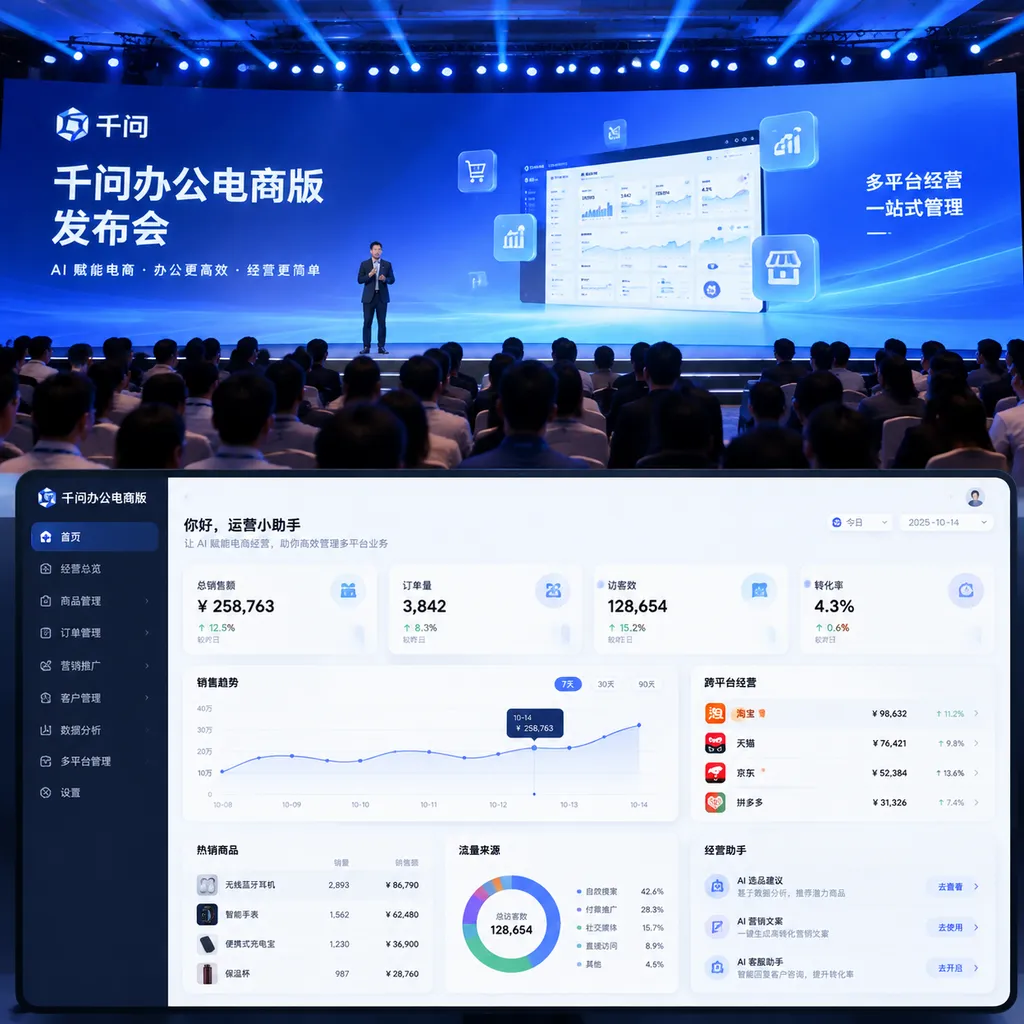
The first release of Qwen Office E-Commerce Edition includes four specialized capabilities:
- Cross-platform operations dashboard: Centrally manages sales, inventory, advertising spend, and target progress across multiple platforms and stores;
- Trend insights and selling-point analysis: Identifies trends from popular keywords and viral content on social platforms, then connects them with product selling points;
- Batch generation of high-performing creative assets: Generates product hero images, lifestyle images, and advertising copy in batches based on product images, brand style, and platform requirements;
- Intelligent cross-platform ROI optimization: Continuously tracks advertising campaigns across platforms, identifies anomalies, and recommends adjustments.
The product also covers areas such as identifying promising new products, generating asset variations, diagnosing creative performance, monitoring budgets, and customer service.
The most noteworthy capabilities are not asset generation, but the cross-platform operations dashboard and ROI optimization. Generating product images, titles, and advertising copy has already become highly commoditized, and merchants can find alternatives among a large number of models and SaaS products. What is truly difficult to replicate is the combination of data connectivity, business semantics, and a closed execution loop.
For example, when preparing for a major sales campaign, a merchant can give the agent a complete objective: use data from the same period last year and the past 30 days to create product, advertising, and livestreaming plans around this year’s Double 11 revenue target, then update progress daily. The system subsequently generates an operations command center, regularly consolidates sales, inventory, and advertising spend across stores, and identifies underperforming channels and actions that must be prepared in advance.
This process may look like simply “asking AI a question,” but it involves far more than a single model inference. At a minimum, the system must:
- Identify the user’s objectives, time frame, and business constraints;
- Retrieve differently structured data from multiple operational systems;
- Standardize definitions across products, stores, channels, and advertising campaigns;
- Generate plans based on historical performance instead of merely restating reports;
- Continuously execute scheduled tasks according to the plan and reassess the situation as data changes.
In other words, the model is only one layer of the system. Connectors, permission systems, data cleansing, task orchestration, and business rules ultimately determine whether it can move from a demo into a production environment.
Why Start with E-Commerce: Demand Is Frequent and Results Are Easy to Measure
Qwen Office disclosed that approximately 20% of its paying users currently come from the e-commerce industry. Their most common tasks include store inspections, operational analysis, order and inventory management, asset design, and market monitoring.
This makes e-commerce an industry well suited for the initial adoption of agents.
On the one hand, e-commerce work is highly digitalized. Sales volume, inventory, click-through rates, conversion rates, advertising costs, and refund rates are all represented by explicit data. The quality of an agent’s output can therefore be validated directly against business results rather than relying on subjective judgments that it merely “feels smarter.”
On the other hand, e-commerce operations involve extensive repetitive work. Operations staff must log in to multiple backends every day, export reports, verify product information, track advertising campaigns, and consolidate the results into spreadsheets. Traditional automation tools can handle fixed procedures but struggle with ad hoc objectives and changing business conditions. Large models, with their semantic understanding and planning capabilities, have an opportunity to fill this gap.
The first user case studies further support this direction. One women’s footwear merchant used Qwen Office to prepare a new store for 3D-printed shoes, shortening the store setup period from approximately 30 days to seven days and reducing the associated investment from tens of thousands of yuan to only a few hundred yuan in token fees.
However, cases like this are better viewed as demonstrations of the upper limits of the technology rather than standard outcomes that every merchant can directly reproduce. The cost of opening a store includes not only planning, research, and asset creation, but potentially also supply-chain expenses, samples, channel deposits, and human collaboration. AI can substantially reduce the cost of information processing and content production, but it cannot automatically eliminate every business expense.
“Proactive Operations” Will Be the Real Product Watershed
Most of the capabilities announced so far still exhibit clear copilot characteristics: users submit tasks, and the AI analyzes data and generates plans. In its next phase, Qwen Office plans to add “proactive operations” capabilities, enabling the agent to independently identify anomalies in inventory, advertising, conversion, and after-sales service; explain their impact and the reasoning behind its conclusions; and assist with resolving them once authorized.
This means the product aims to evolve from a passive responder into a continuously operating business agent. For example:
- If a product’s inventory is declining significantly faster than the replenishment cycle, it could issue an early warning about the risk of running out of stock;
- If advertising spend on a channel continues to rise while its conversion rate declines, it could recommend reducing the budget or pausing the campaign;
- If a store’s refund rate suddenly rises, it could correlate product reviews and customer service records to identify the cause;
- If a trend rapidly gains momentum, it could identify products capable of capitalizing on it and prepare the corresponding creative assets.
If these capabilities are fully realized, the e-commerce agent will no longer be merely a “more natural-language-friendly data dashboard.” It will function as an operations manager on duty 24 hours a day.
Yet a wide reliability gap separates anomaly alerts from automated execution. Pausing advertisements, changing prices, adjusting budgets, delisting products, or triggering replenishment can all directly affect revenue and costs. A single incorrect model decision could wipe out months of labor savings.
Proactive operations therefore cannot be evaluated solely by model inference accuracy. The entire engineering control system must also be assessed:
- Can permissions be configured at the level of individual stores, tools, and actions?
- Do high-risk operations require secondary human confirmation?
- Which data points support each judgment, and are they traceable?
- Can the system roll back safely when external APIs time out or return errors?
- Are hard limits imposed on budget, pricing, and inventory operations?
- When multiple agents or automated tasks conflict, how does the system determine priority?
A mature e-commerce agent should resemble a financial system rather than an improvisational chatbot: it may be automated, but every step must be logged, and critical actions must be auditable and reversible.
Cross-Platform Support Is Both a Selling Point and the Hardest Promise to Fulfill
Qwen Office E-Commerce Edition emphasizes that it is not tied to any single platform, which is a smart strategy. Today, medium-sized and large merchants generally operate across multiple channels. What they truly need is not a separate AI assistant on every platform, but a higher-level view of products, inventory, content, and advertising across their entire business.
The problem is that platforms do not define their data in the same way. Even common metrics such as “completed transactions,” “refunds,” or “advertising ROI” may differ in their reporting periods, attribution windows, and order statuses. Simply placing these figures in the same table amounts to aggregation, not understanding.
To build a trustworthy cross-platform agent, Qwen Office must resolve at least three categories of issues:
1. Standardizing Data Definitions
The same product may have different SKU codes, prices, and promotional mechanisms across platforms. The system must establish stable mappings; otherwise, cross-platform inventory and profit analysis can easily become distorted.
2. API Stability
E-commerce platforms and third-party tools regularly change their APIs, permissions, and rate limits. A connector that works during a demonstration may not remain stable over the long term. For an agent product, maintaining integrations is itself an operationally intensive business.
3. Platform Neutrality
Alibaba’s extensive e-commerce infrastructure is an advantage for Qwen Office, but it will also lead other platforms and merchants to scrutinize data boundaries. Whether its claimed third-party positioning can ultimately hold depends on whether it can obtain sufficiently broad and equitable data access—not on how that positioning is described at a launch event.
The product’s greatest competitive advantage at present is therefore not its model parameters, but Alibaba’s accumulated expertise in e-commerce operations, merchant tools, and service ecosystems. Its greatest challenge is precisely whether it can extend beyond the Alibaba ecosystem and obtain equally comprehensive connectivity and execution capabilities on other platforms.
During Invitation-Only Testing, Focus on Integration Quality Rather Than “Full Automation”
Qwen Office E-Commerce Edition remains in the invitation-only testing stage, and its initial capabilities are still being refined. For merchants, the most practical way to evaluate it at this stage is not to demand that it completely replace their operations teams, but to first test several clearly bounded, high-frequency tasks:
- Can it reliably generate daily reports for multiple stores, and do the figures match those in each platform’s backend?
- Can it identify inventory and advertising anomalies earlier than human operators?
- Do batch-generated assets genuinely comply with the requirements of different platforms, rather than merely being resized?
- Can its analytical conclusions provide supporting data and actionable next steps?
- After human edits, can the system remember brand rules and business preferences?
Only if these foundational capabilities prove reliable should the agent be granted higher levels of access. Conversely, if cross-platform data is frequently misaligned, even the most polished natural-language interaction amounts to little more than a chat interface layered on top of inaccurate reports.
Overall, Qwen Office E-Commerce Edition is moving in the right direction. Instead of continuing to compete over isolated AI writing or image-generation interfaces, it is moving closer to operational data and business execution. Its four initial capabilities cover data analysis, trend discovery, asset creation, and advertising optimization, forming a preliminary end-to-end workflow.
However, it remains some distance from true “autonomous operations.” The product’s success will depend not only on whether the Qwen model is sufficiently intelligent, but also on whether its connectors are stable, its permissions granular, its metrics standardized, and every recommendation capable of withstanding validation against financial results.
In e-commerce, the ability to speak and write is merely the price of admission. An agent truly begins working only when it can connect to real accounts, understand real data, and take responsibility for the results of its actions.
References
- ITHome: Alibaba Launches Qwen Office E-Commerce Edition and Opens Invitation-Only Testing—Information from the launch event covering the product’s positioning, initial capabilities, user composition, ecosystem integrations, and roadmap for proactive operations.