
Claude Code Was Already in the Blueprint Five Years Ago
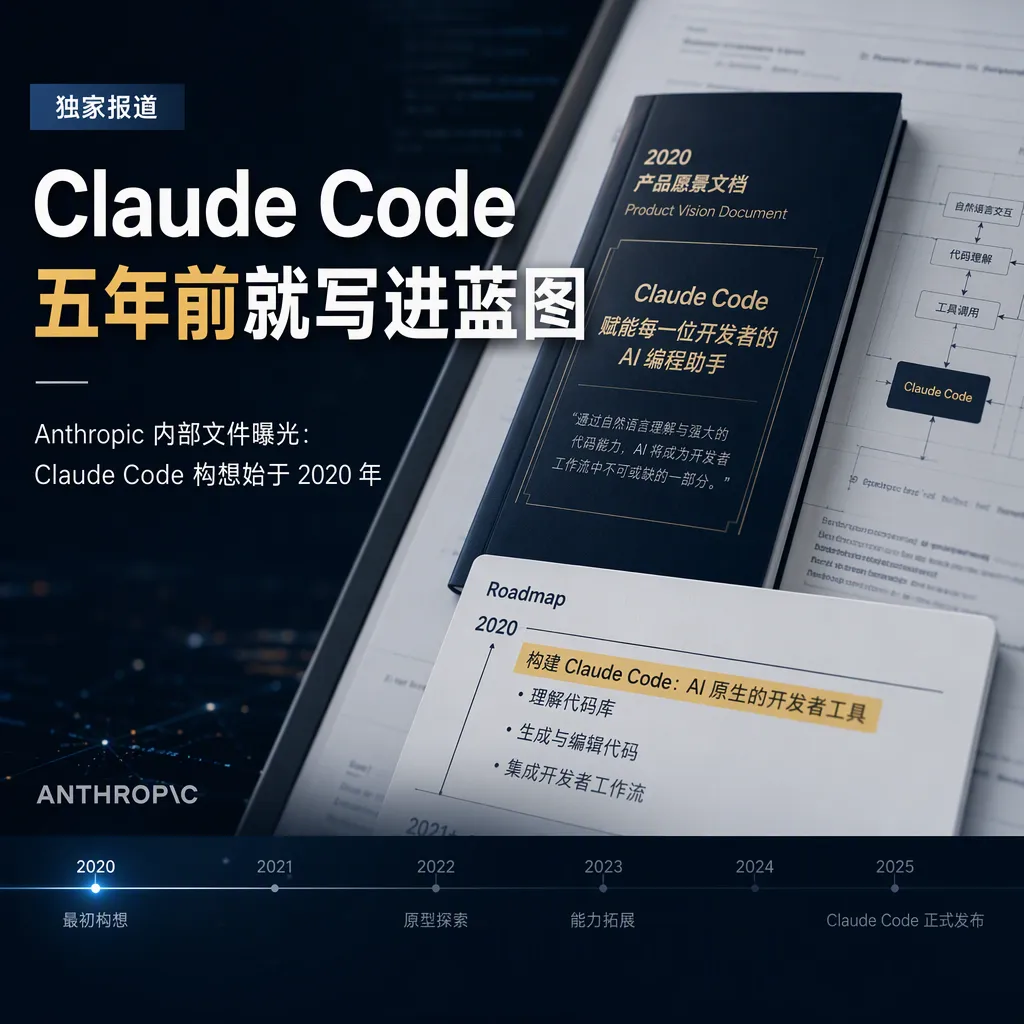
A 2021 internal roadmap disclosed in a copyright lawsuit shows that Anthropic had long planned for software engineering agents, tool use, self-evaluation, and ultra-long context windows. Claude Code is not a hastily built response to a trend, but the culmination of a five-year technical roadmap.
Anthropic Was Planning “AI Engineers” Five Years Ago
Claude Code may not have been a spur-of-the-moment idea conceived only after large language models had matured. Instead, it may be the result of a long-term effort at least five years in the making.
Recently, an internal Anthropic research roadmap reportedly created in July 2021 entered the public eye through materials related to a copyright lawsuit. According to publicly reported details, Anthropic—then a newly founded company with a team of only a dozen or so people—had already written a fairly specific goal into its research plan: build a general-purpose AI assistant capable of collaborating with humans through natural language to create, edit, and explain software.
It would not merely complete the next line of code. It would also answer technical questions, modify projects across multiple files, find bugs, design APIs, and discuss code style and engineering best practices. The roadmap described the ultimate form even more directly: demonstrating the full capabilities of a software engineer colleague.
If the contents of the relevant document are accurate, then Claude Code’s current product form does indeed look like an engineered implementation of this blueprint.
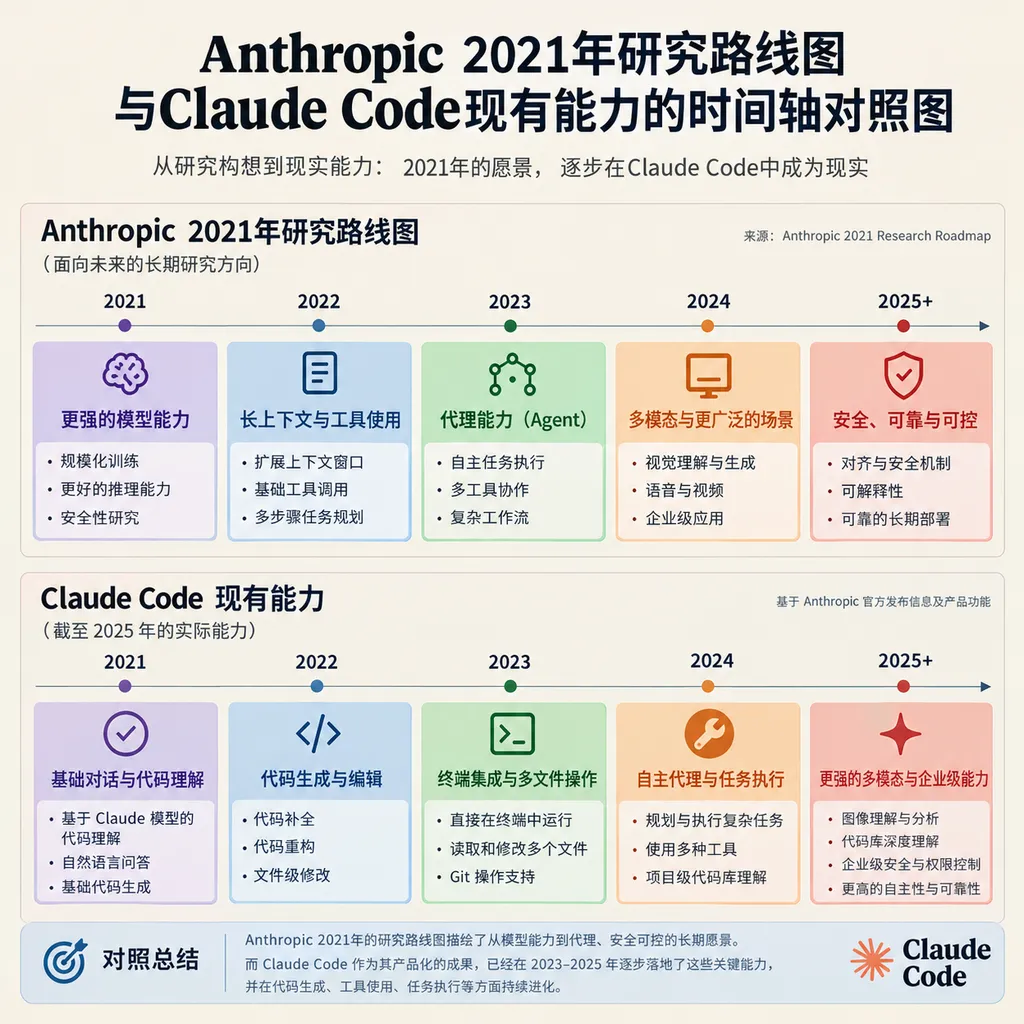
One point needs to be clarified first: the newly disclosed 2021 research roadmap and the accidental inclusion of internal source code in a Claude Code release package this April are two separate incidents. The former is a historical research document surfaced through litigation materials and addresses what Anthropic “wanted to build” five years ago. The latter was a release-packaging accident that exposed parts of the Claude Code client implementation, feature flags, and some still-unannounced product directions. Taken together, the two incidents have allowed outsiders to see a continuous trajectory from the company’s research vision to its product implementation.
The Debate at the Time: Build a Product First, or Prove Agents Are Viable First?
What developers should find most noteworthy about this roadmap is not that it “predicted the future,” but the team’s discussion at the time about the order of implementation.
According to the exposed annotations, Anthropic was broadly considering two approaches:
- The practical approach: get code repository retrieval right first. Let the model browse repos, understand directory structures, and locate type definitions, function calls, and dependencies. Tom Brown, the lead author of the GPT-3 paper, reportedly also participated in the discussion and recommended starting with repo browsing.
- The research approach: first verify whether models can reliably use tools.
For example, execute commands, debug with
printf, read runtime results, operate an editor, and then determine the next action based on feedback from the environment.
The difference between these two approaches is similar to deciding whether to first build a car that can be driven on the road or first solve the problem of making the engine and transmission work together reliably.
Repository retrieval can improve the user experience more quickly. As long as a model can find the correct files and retrieve the relevant context, it will be more useful than a single-file completion tool even without a qualitative leap in reasoning ability. Tool use, however, raises a different question: can a model evolve from “generating a one-shot answer” into a loop that “observes the environment, takes action, reads the result, and revises the plan”?
Anthropic co-founder and CEO Dario Amodei reportedly favored proving that tool use was viable in the short term, then evolving it into a genuinely useful programming assistant over the long term.
In retrospect, that sequence was crucial.
Claude Code’s core competitive advantage is not merely that the Claude model is better at writing code. It is that Claude Code places the model inside the terminal and the code repository: it can search files, read configurations, run tests, inspect Git diffs, and then modify multiple files in succession. Users no longer ask it simply to “write a function,” but to “locate this regression, fix it, run the tests, and do not break the existing interface.”
That is the dividing line between coding agents and code completion.
The typical interaction with early GitHub Copilot involved predicting the next block of code from the context around the cursor. AI IDEs such as Cursor went further by putting repository retrieval, chat, and multi-file editing into the editor. Claude Code, meanwhile, adopted a terminal-first approach, giving the model direct access to the shell, Git, test commands, and build tools that developers already use.
The interface looks more austere, but it feels much more like an agent.
Claude Code Was Not the Only Thing the Roadmap Got Right
Software engineering agents are merely the part of the document most readily validated by an actual product. The roadmap also covered several technical directions that later became central industry trends.
1. Tool Use: From “Able to Talk” to “Able to Act”
In 2021, large language model applications revolved primarily around text generation. GPT-3 could write articles, perform few-shot classification, and generate code snippets, but reliably getting a model to select tools, construct parameters, and read execution results was still a highly experimental research problem.
What tool use truly changes is the boundary between the model and software systems.
Without tools, a model can only guess answers based on its training data. Once connected to search, a terminal, databases, and code execution environments, it can actively obtain missing information. For programming tasks, this means the model does not have to guess the signature of an internal function from thin air—it can look it up in the repository. It does not have to claim that “the change should work”—it can run tests and inspect the errors.
But tool use amplifies risks as well. A chatbot that answers a question incorrectly will usually only output incorrect text. An agent with shell, file-writing, and network permissions may delete files, leak secrets, or execute prompt-injection instructions embedded in repository content.
The roadmap reportedly already addressed the security boundaries of code execution. This also helps explain why Anthropic later continued to emphasize permission confirmations, tool allowlists, and alignment research: when model output can be translated directly into system actions, safety cannot stop at refusing certain requests.
2. Self-Judging: Having Models Help Evaluate Models
The document also discussed “model self-judging”—having a model assess its own behavior and output quality, or that of other models, and converting those judgments into feedback signals.
This idea is no longer unfamiliar today. Developers already ask models to act as reviewers and perform static checks on generated code. Reasoning systems also use techniques such as candidate sampling, verifier scoring, and self-reflection to select more reliable results from multiple answers. Similar research threads can be seen in Anthropic’s later work on AI feedback and Constitutional AI, which uses rules to constrain model judgments.
However, a model saying it did something correctly does not mean it actually did.
The main value of self-judging lies in reducing human annotation costs and expanding feedback coverage, not in replacing external verification. For coding agents, simply asking the model to evaluate a patch is far less reliable than running a compiler, unit tests, and type checks. The most robust architecture still combines subjective judgment with objective tools: the model handles explanation and selection, while the test system provides indisputable feedback from the environment.
3. Test-Time Compute: Compute Is Not Spent Only During Training
The roadmap also mentioned test-time compute—investing more computational resources when the model responds to a user request. At the time, this concept was discussed mainly in the context of alignment, discriminators, and candidate evaluation. It was still clearly removed from later reasoning models, which trade longer thinking, search, and verification for higher-quality answers.
But the direction was already visible: model capability would no longer be determined solely by parameter count and pretraining compute, but also by how much compute one was willing to spend at inference time.
This is especially important for coding agents. Complex software tasks can rarely be solved with a single sample. A model must browse the repository, generate a plan, modify code, run tests, and then continue adjusting based on failures. A single task may run for dozens of minutes and produce many intermediate steps. In agent products, so-called test-time compute ultimately manifests as longer execution chains, more frequent interactions with the environment, and higher token and tool-use costs.
It also creates very practical product questions: Is the latency acceptable? How should a task resume after interruption? Should users pay by token, by duration, or by task outcome?
4. Trillion-Parameter Models and Ultra-Long Memory
In 2021, when GPT-3’s 175 billion parameters were still considered enormous, Anthropic was already discussing trillion-parameter models in its roadmap, along with very large contexts or other mechanisms capable of accommodating vast amounts of memory and experience.
This should not be read as a prediction that “more parameters are always better.” The past several years have shown that data quality, training recipes, inference compute, sparse architectures, and distillation are equally important, while vendors have become increasingly reluctant to disclose actual parameter counts.
What was truly forward-looking was Anthropic’s early recognition that if AI was to handle software engineering tasks, seeing only the user’s current input would be nowhere near enough. It would need to understand an entire codebase, commit history, issues, test logs, and team conventions, while also remembering what it had already done during long-running tasks.
Long context addresses “how much information can fit into this round,” while cross-session memory addresses “whether it will still remember in the next round.” The two are often conflated, but they correspond to different systems challenges. The former is primarily constrained by context windows, attention mechanisms, and inference costs. The latter additionally requires memory selection, persistence, permission isolation, and expiration mechanisms.
This Was Not a Prophecy, but a Long-Term Strategic Choice
Calling this document a “book of prophecy” is attention-grabbing, but inaccurate.
Software engineering was always one of the fields in which large language models were most likely to generate economic value first. Code is structured, executable, and testable. Developers are willing to pay for greater efficiency, and errors can be promptly surfaced by compilers and test environments. OpenAI, Google, GitHub, Cursor, and many startups later moved in similar directions.
What Anthropic truly got right was organizing these judgments into a coherent roadmap at an early stage and then staying largely on course for years:
- Use coding tasks to study model capabilities;
- Connect models to real environments through tool use;
- Improve behavioral quality through feedback and self-judging;
- Use longer context and memory to support complex tasks;
- Research permissions, safety, and alignment in parallel;
- Ultimately package these capabilities into a software engineering agent suitable for everyday use.
Many labs have written down similar visions. The difference is that Anthropic turned its research direction, foundation models, and Claude Code product into a single chain instead of leaving the idea in a demo or research paper.
This is also its advantage over startups that merely build IDE shells. Those companies can rapidly iterate on interactions and workflows, but they cannot directly change the underlying model’s tool-use behavior, long-context capabilities, or safety training. Anthropic, by contrast, can feed product failures back into model training and then bring new model capabilities back into Claude Code.
Of course, this vertical integration is not without cost. The more deeply the model, agent framework, terminal client, and cloud execution environment are coupled, the higher the migration costs become. Development teams that place critical workflows entirely in the hands of a single vendor must still consider pricing, usage limits, model fallbacks, log visibility, and data governance.
What Developers Should Really Pay Attention To
The practical significance of this roadmap is not that it proves Anthropic was “five years ahead of everyone else.” It shows that competition among coding agents has moved beyond model benchmark scores and into the systems engineering stage.
The following factors will truly determine the user experience going forward:
- Whether repository understanding can stay continuously up to date. Indexes must keep pace with changes to branches and workspaces rather than reasoning over stale code.
- Whether tool use is controllable. Permissions should be granular at the command, directory, network, and credential levels, rather than reduced to a single broad “allow execution” option.
- Whether long-running tasks can be resumed. If an agent fails after running for an hour, it should not require the user to start over, nor should it forget its previous decisions.
- Whether evaluations reflect real-world engineering. Passing benchmarks does not mean an agent can handle private repositories, messy dependencies, and incomplete documentation.
- Whether costs are transparent. Repeated searching, editing, and testing by agents can rapidly magnify token consumption and execution costs.
- Whether failures are auditable. Developers need to know which files the model read, which commands it executed, and why it changed its plan.
This is also why Claude Code’s moat is not the Claude model alone. Models can be integrated into various editors through APIs, and developers can use OpenAI-compatible platforms such as OpenAI Hub to access Claude, GPT, Gemini, and other models through a unified interface. But replicating a mature coding agent also requires context management, tool orchestration, access control, task recovery, and an evaluation framework.
The model is the engine; the agent product is the entire car. The engine matters, but it is not everything.
Anthropic’s Strengths and Risks Stem From the Same Long-Termism
Looking back today, Anthropic’s judgment five years ago was sufficiently ahead of its time. But this blueprint also exposes another side of the story: when a company defines its long-term goals clearly enough, its research documents, source code, and feature flags become extremely valuable commercial assets.
Since the beginning of this year, Anthropic has repeatedly exposed internal materials through configuration or release-process mistakes. The company can emphasize that no customer credentials or model weights were leaked, but model weights may not be what competitors most want to see. They may be more interested in how Anthropic organizes tools, memory, multi-agent collaboration, and its product roadmap.
For a company that has long made “safety” central to its brand, these human errors are particularly conspicuous. Whether the model itself is safe is one issue. Whether the company can securely manage its code, documents, and release processes is a more fundamental one.
The conclusion from this incident should therefore be divided into two parts.
On the one hand, Claude Code was not a product created to chase the agent boom after 2024. At least according to the exposed 2021 roadmap, Anthropic had already placed full-fledged software engineering agents, tool use, self-judging, test-time compute, and long-term memory on the same map at an early stage. Its current product advantage in coding agents is supported by a clear foundation of accumulated research.
On the other hand, having the right strategic direction early does not guarantee victory in the product market. OpenAI, Google, Cursor, and the open-source agent ecosystem are all catching up rapidly, while the capabilities of underlying models are converging. Whether Claude Code can maintain its advantage will ultimately depend on whether it can translate “greater intelligence” into engineering outcomes that are more reliable, less expensive, and more controllable.
Five years ago, Anthropic bet that models would eventually become colleagues to software engineers. By 2026, the question is no longer whether this will happen, but who can first make that “colleague” genuinely worthy of being granted production-environment access.
References
- Official Anthropic Claude Code GitHub repository: Used to verify Claude Code’s public product positioning, installation methods, permission mechanisms, and feature descriptions.
- Claude Code public issue list: Provides insight into the tool-use, context, stability, and cost issues developers encounter in real-world projects.
Note: The facts in this article concerning the 2021 internal research roadmap and the background of its disclosure through litigation were compiled from public reporting provided by the user. Due to link-domain restrictions, media links outside the allowlist have not been included in the references.