
Google Deep Research Upgrade: The Max Version Is Here
In April 2026, Google launched two brand-new Deep Research models — **deep-research-max-preview** and **deep-research-preview** — which are invoked via the Interactions API, marking another major upgrade in its autonomous research agent initiative.
Google swapped out the foundation of Deep Research without any notice.
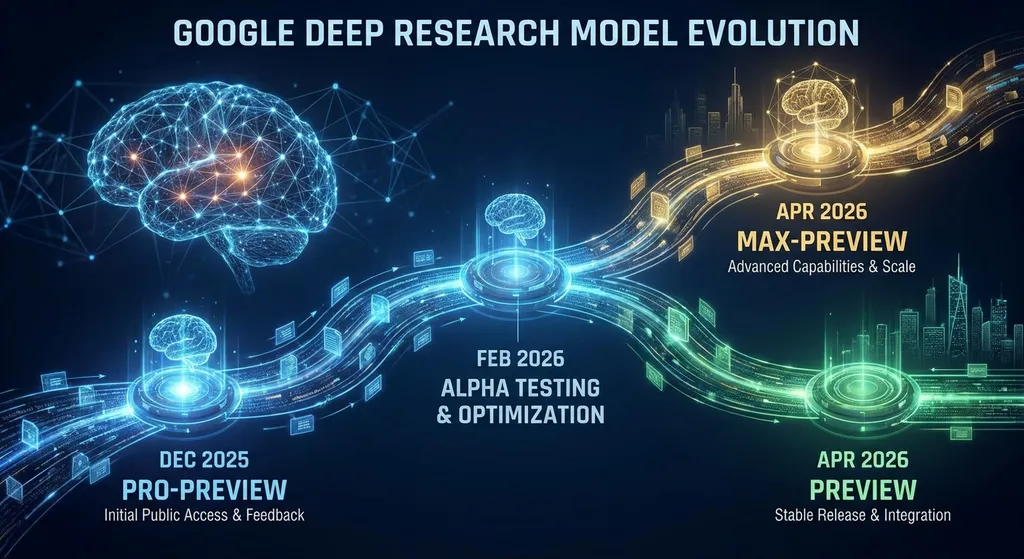
On April 21, many developers found that their Gemini Deep Research feature suddenly showed as “busy.” They thought the service had crashed again. But instead of a recovery notice, what arrived were two brand-new models:
- deep-research-max-preview-04-2026
- deep-research-preview-04-2026
One with Max, one without. The naming style follows the same tiered logic as Gemini 2.5 Pro / Flash — the Max version probably offers stronger reasoning and longer execution chains, while the standard version balances speed and cost. This time, Google held no launch event, no long blog post — it just quietly pushed the models online.
Very Google-like.
From “Feature” to “Model”: Deep Research’s shifting role
Let’s recap the timeline.
In December 2025, Google released deep-research-pro-preview-12-2025, Deep Research’s first appearance as a standalone model in the Gemini API. Before that, Deep Research was more like an “advanced feature” inside the Gemini product — you clicked a button, it ran a deep search, and then produced a long report with citations.
But starting late last year, Google clearly wanted to turn it into a programmable agent. Separate model ID, separate API interface, separate invocation method — meaning developers can embed Deep Research directly into their workflows, rather than using it only in Google’s frontend.
The two new models continue down that path — and go even further.
Interactions API: not your usual chat interface
The most noteworthy technical detail for developers this time is: the new DR models only support Interactions API calls, not the traditional generateContent interface.
That’s not a small change.
Interactions API is a new paradigm Google introduced in the latest Gemini API, designed specifically for long-running agent tasks. Unlike the traditional “send a message, wait for a reply” request-response pattern, the Interactions API is more like launching an asynchronous task: the model autonomously plans a research path, executes searches, reads and analyzes information step-by-step, possibly running for several minutes or longer, then finally returns a structured research report.
Think of it this way: a traditional API call is like sending a voice message — you say something, it replies once. Interactions API is more like emailing a research assistant, saying “Please research this topic,” and the assistant spends half an hour gathering sources, organizing, and writing a report before sending the results back.
This design makes sense for Deep Research scenarios. A single deep research task may involve dozens of web searches and reading hundreds of pages of documents for cross-verification — cramming that into a synchronous HTTP request would be neither practical nor elegant.
Previous-generation parameters showed Deep Research supports an input context window of 1,048,576 tokens (about 1 million) and up to 65,536 output tokens. It accepts text, images, PDFs, audio, and video inputs. The new versions will likely maintain or expand these specs, though Google has not disclosed details.
Here’s the basic way to call the new models via Interactions API (inferred from Google’s official docs):
import google.genai as genai

client = genai.Client()

# Create a Deep Research interaction task
interaction = client.interactions.create(
    model="deep-research-max-preview-04-2026",
    messages=[
        {
            "role": "user",
            "content": "Research global large-model market trends in Q1 2026, focusing on competition between open and closed-source models, and output a referenced analysis report."
        }
    ]
)

# Poll or use a callback to get results
result = client.interactions.get(interaction.id)
print(result.output)
If you’re used to OpenAI-compatible APIs, you can also call Gemini models via aggregation platforms like OpenAI Hub, avoiding SDK adaptation hassles — switching models across vendors with a single key saves time for developers comparing multiple Deep Research capabilities.
Max vs Standard: What is Google betting on?
Releasing two versions simultaneously makes Google’s intent clear: tiered coverage for different scenarios.
Based on naming patterns:
deep-research-max-preview-04-2026 is likely the “no-cost-limit” flagship — with longer reasoning chains, more search iterations, and stronger factual cross-verification. Ideal for scenarios where report quality matters more than speed — such as investment research, academic literature review, or deep competitive analysis.
deep-research-preview-04-2026 might balance speed and quality — fewer search rounds, shorter reasoning, but faster results and lower cost. Suitable for daily information gathering and quick summaries.
This tiered strategy is now standard in the LLM industry. OpenAI has o3 and o4-mini, Anthropic has Claude Opus and Sonnet, and Google’s own Gemini series distinguishes Pro and Flash. But Google is the first to apply this kind of tiering within the Deep Research niche.
That shows Google sees Deep Research not as a peripheral feature, but as a product line worth serious investment.
Competitive Landscape: The Deep Research race is crowded
Google’s push into Deep Research comes as this market has become extremely crowded over the past six months.
OpenAI’s Deep Research runs on its o3 model, handling web browsing and data analysis with multimodal inputs (text, images, PDFs). In practice, OpenAI’s version performs well in structured reports and citation accuracy but sometimes suffers from “over-research” — taking too long and returning heaps of information without effective filtering or judgment.
Perplexity approaches the problem from a search-engine angle; its Deep Research is more like a “supercharged search,” fast but shallow. Grok is also working on similar capabilities but remains less complete.
Google’s advantage? In two words: data access.
The previous generation of Deep Research models could already access Gmail and Google Drive workspace data. That means it can search not only the public web but also your emails and documents. For enterprise users, that’s a killer differentiator — your AI assistant can research both online sources and your internal files, integrating everything into one comprehensive report.
Another strength lies in Gemini 3 Pro’s factual accuracy. In introducing the previous DR model, Google emphasized that its reasoning core used “the most factually accurate Gemini 3 Pro model to date.” In Deep Research scenarios, factual accuracy matters far more than creativity — you need reliable synthesis, not imaginative divergence.
Of course, Google’s weakness is also clear: developer ecosystem. OpenAI’s API format has become a de facto standard, with many toolchains and frameworks built around it. Google’s independent Interactions API may be technically superior but raises migration barriers.
From a technical standpoint: Core challenges for Deep Research agents
Beyond product competition, Deep Research as a type of intelligent agent shares several fundamental technical challenges:
1. Search Planning Ability
A good Deep Research agent doesn’t win by volume. It knows what to search, in what order, and when to stop — essentially a dynamic planning problem requiring real-time strategy adjustment based on existing information.
2. Information Deduplication and Conflict Resolution
Online information is highly repetitive and often contradictory. Deep Research must identify primary sources versus reposts, and decide which source to trust when inconsistencies arise. That’s much harder than simple text comprehension.
3. Citation Reliability
Generating reports with citations sounds easy, but ensuring every citation precisely points to an actual passage — rather than hallucinated content — demands a very high degree of fidelity from the model.
4. Long-Task Stability
A Deep Research task may run for several to over ten minutes, involving dozens of tool calls. Any failure — search timeout, page parsing error, context overflow — can crash the entire task. Engineering stability requirements far exceed those of ordinary chat models.
Google’s Max version likely focuses on optimizing the first and third challenges — more search cycles for broader coverage, stronger reasoning for more accurate citations and factual judgment.
What This Means for Developers
If you’re building any application involving “automated information collection and analysis,” this update deserves your attention.
Some concrete scenarios:
- Investment and due diligence tools: Have Deep Research perform industry research automatically, generating a draft for analysts to revise and expand — multiplying efficiency.
- Competitor monitoring: Regularly run Deep Research reports to compare product changes, pricing updates, and user feedback.
- Academic assistance: Initial literature screening and organization — not replacing scholarly judgment but shortening the information-gathering stage dramatically.
- Customer support knowledge base updates: Automatically research industry trends and update internal knowledge bases to keep responses current.
But note, both models are still previews — meaning APIs may change, pricing may shift, and model behavior itself may evolve. For production use, implement fallback strategies.
A Trend Worth Reflecting On
Zooming out, Deep Research’s rise marks an important shift: large models are transforming from “conversation tools” into “work agents.”
In 2024, we cared whether a model could “chat well.”
In 2025, we asked whether it could “help get work done.”
By 2026, the question is whether it can “independently execute an entire workflow.”
Deep Research exemplifies this trend. It doesn’t chat with you — it works for you: planning, executing, integrating, and finally delivering a result.
Competition among Google, OpenAI, and Perplexity in this space is ultimately a battle for the gateway to the AI work-agent market. Whoever builds agents that are more reliable, accurate, and easily integrated will gain an edge in the next phase.
Google’s latest update may not be revolutionary, but it points in the right direction. Making Deep Research a tiered, programmable, integratable agent product line is far more promising than hiding it as a fancy Gemini interface feature.
As for how much stronger the Max version is compared to the standard one, or how it stacks up against OpenAI’s Deep Research — we’ll have to wait for real-world developer testing. It’s still preview stage, and anything can change.
References:
- Google releases two new Deep Research models - Linux.do — Community discussion thread with model names and Interactions API call details
- Google’s latest “Deep Research” strikes back at GPT-5.2 - Zhihu — Analysis of Gemini Deep Research architecture and Gemini 3 Pro reasoning core
- In-Depth Analysis of Deep Research Technology - GitHub — Technical overview comparing major players’ approaches in Deep Research


