
Elephant Alpha Revealed: Ant Ling 2.6 Flash is Here

The mysterious Elephant Alpha model on OpenRouter has officially revealed its identity—it’s Ling 2.6 Flash, launched by Ant Group’s inclusionAI team. This MoE model features a total of 104B parameters with only 7.4B activated parameters, primarily targeting low-latency agent scenarios. However, community testing feedback has been highly polarized.
The mysterious model "Elephant Alpha", which had been lurking on OpenRouter for a while, finally took off its mask today—it’s Ling 2.6 Flash, released by Ant Group’s inclusionAI team.
A model built by Ant, but codenamed after an elephant. The community’s initial reaction was unanimous: Is the ant trying to turn into an elephant? The name does carry a bit of dark humor.
First, the specs: 104B total parameters, 7.4B active
Ling 2.6 Flash adopts an MoE (Mixture of Experts) architecture with a total of 104B parameters, but only 7.4B active parameters during inference. The design is clear: trade the knowledge capacity of a large model for the inference speed of a small one.
Let’s compare it to other models on the market:
| Model | Total Parameters | Active Parameters | Architecture | |--------|------------------|-------------------|--------------| | Ling 2.6 Flash | 104B | 7.4B | MoE | | DeepSeek-V3 | 671B | 37B | MoE | | Qwen2.5-72B | 72B | 72B | Dense | | Gemma 4 26B | 26B | — | MoE | | Mistral 8x7B | 46.7B | 12.9B | MoE |
From a positioning perspective, Ling 2.6 Flash isn’t designed to go head-to-head with heavyweights like DeepSeek-V3 or Qwen2.5-72B. It targets the “lightweight and fast” niche—7.4B active parameters mean extremely low deployment costs and very fast response times, making it suitable for latency-sensitive applications.
The official label calls it an “instruct model,” designed to serve “real-world Agents that require rapid responses, strong execution, and high token efficiency.” In plain terms: this isn’t a model for writing novels or creative work—it’s a tool for getting things done—calling APIs, executing commands, and running workflows.
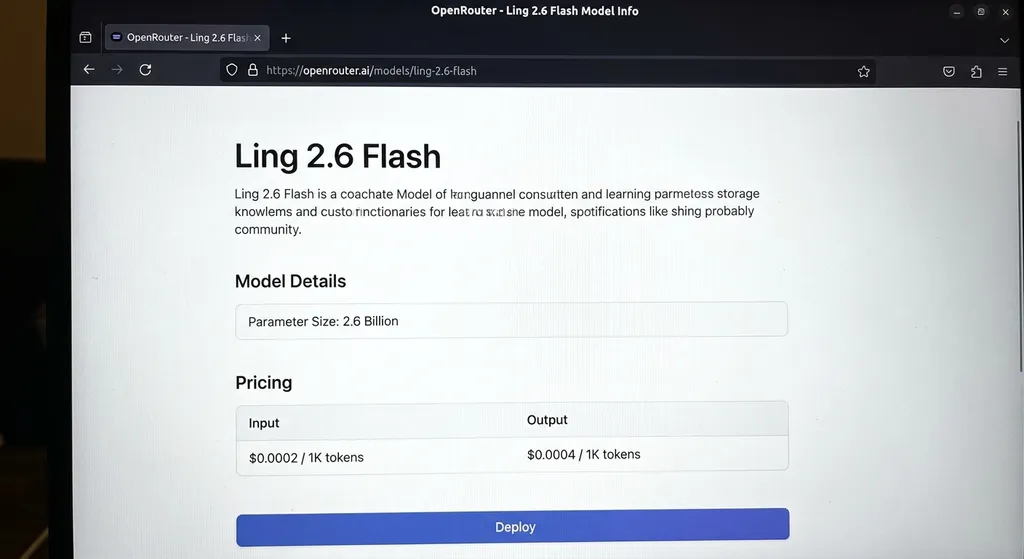
Elephant Alpha: a not-so-successful anonymous test
Before its identity was revealed, Ling 2.6 Flash ran anonymously on OpenRouter for a while under the codename “Elephant Alpha.” Such a move isn’t new in the industry—OpenRouter’s Arena feature allows models to participate in blind testing, letting users rate them without knowing their identities, theoretically for more objective feedback.
But judging from community reactions, the outcome of this anonymous trial wasn’t very flattering for Ant.
Once its identity was revealed, discussions in the developer community heated up quickly—and most of them were complaints.
One developer who tested it in Cursor (CC) gave a highly specific negative review: the model couldn’t even correctly understand the “workspace” concept in the prompt—it ignored project context and created a workspace folder in the root directory of the hard drive. The developer added a jab: “Even Qwen and Gemma with far fewer parameters don’t act this dumb.”
This points to a key issue: in coding scenarios, a model needs not only language understanding but also a basic contextual awareness of the development environment, file system, and project structure. With 7.4B active parameters, this model struggles in that respect.
Another developer was more blunt: “At 100B scale or not, it just can’t code. It’s barely good enough for simple tasks.”
That may be overly harsh, but it highlights a real contradiction—MoE’s 104B total parameters sound impressive, yet only 7.4B actually work during inference. For complex reasoning and multi-step programming tasks, that activation scale simply falls short.
Can Ant really make large models?
One community comment cut deep but rang true: “Forget Ant—they’re bottom-tier in AI. They’re mainly focused on healthcare and Alipay these days.”
That’s harsh, but reflects reality: in China’s LLM competition, Ant (or inclusionAI) isn’t in the top tier.
Who is? DeepSeek has become legendary in the open-source world with its V3 and R1 series. Alibaba’s Qwen series has solid reputations across parameter scales. ByteDance’s Doubao is widely used in applications. Baidu’s ERNIE may be controversial but maintains a complete ecosystem. Internationally, Mistral, Meta’s Llama, and Google’s Gemma dominate open source.
Ant’s inclusionAI team had previously released earlier versions of the Ling series, but their community presence was weak. The use of the “Elephant Alpha” codename was likely an attempt to bypass brand bias and let performance speak for itself.
Unfortunately, performance didn’t impress the community either.
That said, the model shouldn’t be dismissed entirely. Ling 2.6 Flash isn’t meant to be a general-purpose model—it’s a lightweight agent execution model. For tasks like simple command execution, data extraction, or format conversion, its 7.4B activation with low inference cost could offer good value for money.
The issue is: this niche is already crowded.
Qwen2.5-7B, Gemma 4 E4B, Llama 3.1-8B—there’s no shortage of models with similar active sizes, complete with mature ecosystems, fine-tuning tools, and deployment pipelines. For Ling 2.6 Flash to stand out here, it needs some clear differentiator—and that hasn’t been seen yet, based on current feedback.
The “parameter illusion” of MoE architecture
Let’s take a moment to discuss MoE.
MoE’s core idea is to split a large model into multiple “expert” modules, activating only a few during inference. The advantage is obvious: lower compute costs while retaining exposure to a broader dataset. DeepSeek-V3’s success largely stems from mastering this—671B total, 37B active—striking a great balance between performance and efficiency.
But MoE isn’t a magic bullet.
A large total parameter count means the model learned a lot during training. But since only a portion activates at inference, its thinking depth per task is limited. Imagine someone who’s read 10,000 books but can recall only seven at a time—compared to someone who’s read 70 and can use them all. Who performs better? It depends on task complexity.
For simple tasks—like “translate this text” or “extract a field from this JSON”—MoE’s efficiency shines. But for complex tasks—like “understand a project’s structure and create files in the right directory”—limited active parameters become a bottleneck.
7.4B active parameters might have been competitive in early 2024, but by April 2026, that number seems thin—especially with competitors like Qwen and Gemma offering highly optimized small models.
The naming Easter egg: Ant and the Elephant
Now, about that name—it’s pretty interesting.
An Ant Group model with the codename “Elephant Alpha.” The community immediately got the joke: “Ant wants to be an elephant.”
Is this self-deprecating humor or a metaphor for ambition? Probably both. Judging from the “inclusionAI” brand name (“inclusion”), Ant’s AI strategy seems focused more on accessibility and practical applications, rather than a parameter arms race.
But reality is harsh. In the LLM track, there’s still a technical gap between “affordable” and “effective.” You can make a model cheap and fast—but if it can’t reliably follow instructions, “cheap and fast” doesn’t matter.
For Ant to turn from an ant into an elephant, a codename alone won’t do it.
What it means for developers
Let’s get practical. Should developers pay attention to Ling 2.6 Flash?
My take: keep an eye on it, but don’t rely on it in production yet.
Here’s why:
First, poor instruction-following is a dealbreaker. A model that can’t handle workspace paths correctly is risky for agent workflows. Such scenarios require strong fidelity—if you tell it to call an API or manage a file, it must not mess up. So far, Ling 2.6 Flash doesn’t inspire enough confidence.
Second, there are too many alternatives at this scale. For lightweight execution models, Qwen2.5-7B is far more mature, and Gemma 4’s smaller models are worth exploring. These have thriving fine-tuning communities and deployment solutions—easier to adopt overall.
Third, the model just got unveiled—updates may come. If Ant responds to community feedback effectively, this model could evolve within its niche. After all, with 104B total parameters, there’s no lack of knowledge—just a need to better utilize it.
Ling 2.6 Flash is already available for free on OpenRouter. Developers can easily test it. If you use OpenAI Hub or similar platforms to manage multiple model endpoints, keep an eye out in case it gets added—it’s never a bad thing to have more options, as long as you understand their limits.
Final thoughts
There’s nothing inherently wrong with Ant building LLMs. With Alipay’s infrastructure and Ant’s experience in finance and healthcare, they have great domain-specific data. But Ling 2.6 Flash chose one of the most competitive tracks—the general lightweight model—and its first outing isn’t ideal.
The “Elephant Alpha” codename may hint at ambition, but in the LLM world, ambition must be validated by benchmarks and real-world performance. The path from Ant to Elephant is still long.
What’s next to watch: Will Ant quickly iterate based on feedback? Will they release domain-specific models for finance or healthcare? If inclusionAI can carve out a differentiated niche rather than bleeding in the general-model red ocean, the story could change.
For now, though, the elephant is just a codename.
References:
- Mysterious Model Revealed! Elephant Alpha Identified as Ant’s New Model Ling 2.6 Flash - Linux.do — Community discussion post including the model reveal and developer test feedback.


