
Codex conversations can finally *see*.

OpenAI open-sourced Codex session management and visualization tool. Developers can load JSON logs to intuitively debug multi-agent tasks. It supports metadata inspection, multilingual translation, dataset cleaning, and collaborative sharing, filling a key gap in the Codex ecosystem.
OpenAI quietly released something this week that many long-time Codex users have been waiting for—a set of open-source tools for conversation management and visualization. It’s called Euphony, and it does one very straightforward thing: it lets you clearly see what a Codex agent is doing, what it has done, and where exactly something went wrong.
It may sound like a small feature, but anyone who’s run multi-agent tasks in Codex knows that conversation management and debugging have always been pain points. If you’ve got three agents working in parallel to refactor code and you want to trace why one agent made a strange decision, you used to rely on manually grepping through JSON logs. Now, there’s finally a proper visualization solution.
Why This Matters
Let’s start with some context. Codex has evolved rapidly over the past few months. It began as a code-completion tool, but now its homepage describes it as an “agentic coding command center.” Its role has completely changed. The latest version supports multi-agent parallel work, handles GitHub code reviews, manages multiple terminal windows, and connects to remote environments via SSH—in essence, it’s no longer just an “AI that writes code,” but an “agent orchestration platform for managing development workflows.”
OpenAI’s engineering team even ran an extreme experiment: three engineers used Codex to deliver a million-line codebase in a few weeks, with each engineer handling an average of 3.5 PRs per day. In their own words, they “did it in about one-tenth the time required for manual coding.”
But that brought new challenges. The more development tasks you delegate to agents, the more you need to understand what they’re doing. This isn’t a trust issue—it’s an engineering issue. When an agent goes off track, if you can’t quickly pinpoint which round of dialogue, which system instruction, or which tool invocation went wrong, debugging costs soar exponentially.
That’s the problem Euphony is built to solve.
What Euphony Can Do
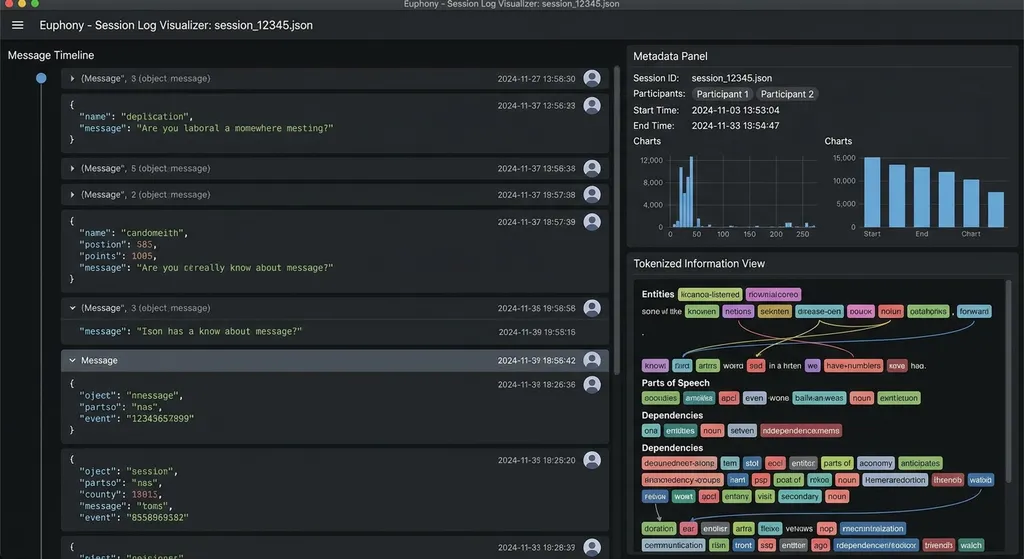
Breaking it down, Euphony offers five core capabilities:
1. Debug AI Chat Logs
You can load JSON log files generated by Codex to fully display metadata, prompt stacks, and tokenized info. This is the foundational and most crucial feature.
For instance, say you tasked a Codex agent with refactoring a module. It ran twenty-something rounds of dialogue, and the resulting code has a subtle bug. Previously, you’d have to open a massive JSON file, digging layer by layer through nested input arrays. Now Euphony lays the entire conversation out as a timeline, categorizing system instructions, user inputs, agent responses, and tool calls. You can click directly into any round to view its full prompt stack—including those AGENTS.md rules you might have forgotten you set.
This feature is especially helpful for understanding Codex’s agent loop. Developers familiar with Codex’s architecture know its core is a Responses API–based cycle: send request → process event stream → execute tool calls → append results to input → send next request. Each round’s input contains the complete history of all previous rounds, making data volume grow quadratically. Euphony visualizes this expansion process so you can quickly see whether your context window overflowed and caused behavioral degradation.
2. Visualize Codex Sessions
This feature takes a more macro view. It doesn’t just show dialogue content—it visualizes the entire development workflow, including codebase structure, file change lists, and agent activity tracks.
Picture this: you have five concurrent Codex tasks handling frontend components, backend APIs, database migration, test cases, and CI configuration. Each task runs as a separate agent session. Euphony can overlay file changes from all five sessions onto a single codebase view so you can instantly spot files being modified by multiple agents at once—often where multi-agent collaboration problems arise.
The official example is a “multi-agent game development session,” tracking sandbox code changes. It’s an apt choice since game development naturally involves parallel tasks (rendering, physics, AI, networking)—a textbook case for multi-agent orchestration.
3. Multilingual Translation and Exploration
This may seem unexpected at first but actually makes perfect sense. Codex users are global, and many teams work with non-English documentation, notes, or requirements. Euphony supports automatic Markdown-based translation of non-English dialogues so team members can review conversations across languages seamlessly.
For example, teams can directly review Chinese research chat logs. For Chinese developers, that means you can interact with Codex in Chinese and share session logs with English-speaking teammates—no manual translation needed. The reverse works too.
4. Dataset Filtering and Editing
This feature broadens Euphony beyond a debugging tool to a data tool. You can browse, edit, and filter specific messages in Codex sessions, then export cleaned data.
The most direct use is preparing training data. If you use Codex logs for fine-tuning datasets, noise is inevitable—like agent self-corrections, repeated tool calls, or meaningless intermediate states. Before, you’d script these cleanups. Now you can do it directly in Euphony’s UI and upload clean data afterward.
5. Collaboration and Sharing
You can generate direct links to conversations or specific messages. This simple feature is extremely practical for team collaboration.
Bug reports used to look like this: “Codex failed during task XX; see lines 847–923 in the attached log.” Now it’s: “Here’s the link to the problematic dialogue—you’ll see the full context right away.”
The efficiency jump speaks for itself.
Within the Codex Ecosystem
To grasp Euphony’s importance, we have to see it in the broader context of Codex’s evolution.
Earlier this year, OpenAI published an engineering blog dissecting Codex’s agent loop. The key insight: data sent from Codex CLI to the Responses API grows quadratically, since each dialogue round must include the full history of all prior rounds. Although the API offers a previous_response_id parameter to alleviate this, Codex opted not to use it to keep requests stateless and support zero-data-retention setups.
That means long-session JSON logs are massive and deeply nested—virtually impossible to review manually without a visualization tool. Euphony essentially fills the observability gap created by that design choice.
Another point from OpenAI’s internal experiments—the million-line project revealed an important lesson: “Codex replicates existing patterns in the repo—including uneven or suboptimal ones. Over time, this inevitably leads to drift.” Their solution was to establish “golden principles” and periodic cleanup cycles with automated background Codex tasks scanning for deviations.
But to detect deviations, you first need to see them. Euphony’s visualization capabilities provide that missing link. You can trace agent decision processes, find the origin of drift, and update AGENTS.md or the golden principles accordingly.
What This Means for Developers
Practically speaking:
- If you use Codex for everyday development, Euphony’s biggest value is cutting debugging costs. With multi-agent tasks, you no longer need to manually parse JSON—just pinpoint issues visually.
- If you run complex agent orchestrations—like Codex auto-reviewing PRs, fixing CI failures, or responding to code-review comments—Euphony’s tracking becomes crucial. These workflows have extended decision chains, more error points, and higher manual intervention costs.
- If you’re doing AI research or dataset work, the filtering and translation tools may be unexpectedly useful.
It’s worth noting Euphony is open source. That means you can customize it—integrate your own logging system, add analytics dimensions, or embed it into your development toolchain. For teams building internal tools atop Codex, this is far more flexible than a closed SaaS product.
Comparing Observability Tools
It’s not just OpenAI—observability has become a focus across the entire AI agent landscape.
LangSmith provides LangChain tracing, Weights & Biases manages experiments, Arize monitors models. But most of these are general-purpose LLM tools; for Codex, which tightly integrates with the development toolchain, generic solutions often fall short.
Codex-specific concepts like shell tool calls, plan updates, and MCP server integrations don’t translate well in general observability dashboards—they get flattened into simple function-call views, losing semantic depth. Euphony, as an official tool, understands these natively and displays them properly.
That said, Euphony still appears early-stage. Community feedback suggests it solves the “existence” problem—finally, there is a tool for this—but “usability” still needs work: performance with very large logs, visualization for complex multi-agent sessions, and IDE integration depth all need refinement.
A Larger Trend
On a broader level, Euphony reflects a major shift: as AI agents evolve from assistants to collaborators, developers need not just stronger models, but better tools to understand and manage them.
OpenAI’s engineers phrased it neatly in that blog: “When software teams’ core work shifts from writing code to designing environments, clarifying intent, and building feedback loops—what changes?”
The foundation of a feedback loop is observability. You must first see what agents are doing to judge whether they’re doing it right, then adjust environments and intents so they improve. Euphony is essentially the “eyes” of that feedback loop.
For teams using or considering Codex, this tool is worth watching. It may not be perfect yet, but it’s on the right path. In a future where multi-agent collaboration is the norm, whoever establishes effective observability first will gain true productivity from AI-assisted development—rather than wasting time debugging black-box agents.
By the way, if you want to run the Codex models (including GPT-5.3-Codex) in your own projects, OpenAI Hub now supports them—you can run them with a single key, and direct access works fine from China too.
References:
- OpenAI officially releases Codex conversation management and visualization features - Linux.do — community discussion including Euphony feature overview and developer feedback


