
GPT-5.5 Appears Early in Codex Console

Several developers discovered that the Codex console’s model list suddenly displayed GPT-5.5 and a group of unknown model options, suggesting that OpenAI may be conducting a gray-scale test. GPT-5.5 is speculated to become a unified supermodel integrating coding, research, and memory.
Codex Console Suddenly Flooded Overnight with a Bunch of “Models That Shouldn’t Be There”
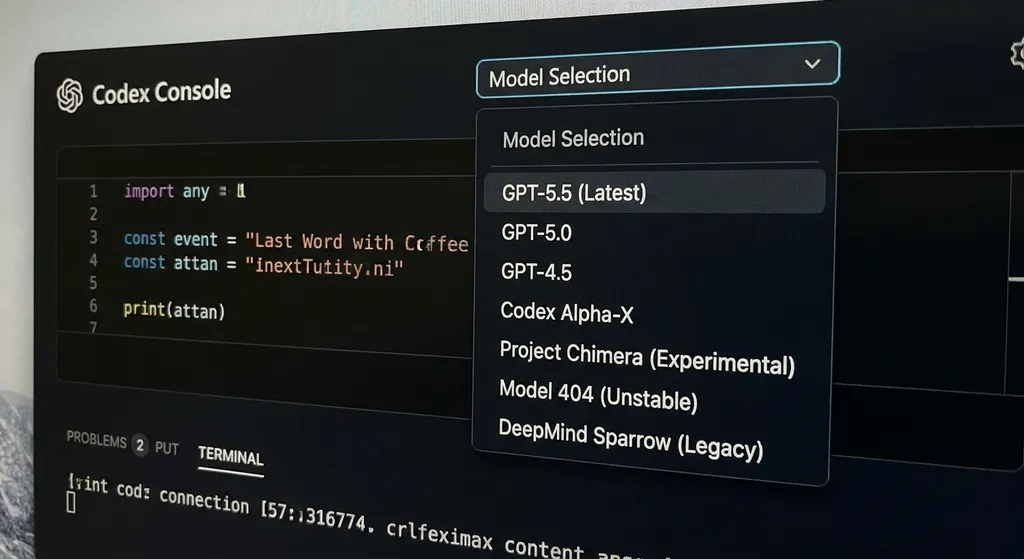
In the early morning of April 22, many developers opened the Codex console and spotted something strange — the model dropdown list suddenly showed GPT-5.5 along with a string of mysterious, never-before-seen model names. The news spread rapidly on the Linux.do forum, spawning half a dozen related threads within hours, with titles ranging from “Is GPT-5.5 out?” to “Bro, am I hallucinating?” Developers’ confusion and excitement were on full display.
No official blog post, no launch event, no teaser tweet from Sam Altman. GPT-5.5 just quietly appeared in a dropdown menu.
What Exactly Happened
Based on feedback from multiple developers, the situation roughly looks like this:
- After switching to “Fast Mode” in the Codex console, an option for GPT-5.5 appeared in the model list
- Other never-before-seen versions like GPT-5.4 Pro also showed up
- A bunch of completely unfamiliar model names were mixed in, with no accompanying documentation
- When users asked those models “Who are you?”, they all replied uniformly: “I am Codex, a code collaboration model based on GPT-5”
- It’s unclear whether this change was global or limited to Team subscription accounts — some free users claimed they saw it too
Interestingly, several developers who actually tested “5.5” said it felt “dumb, not like a new model.” That fits the typical pattern of a grey-release test: the model endpoint might be deployed, but the backend may not be running the final weights — it could just be a routing placeholder.
From 5.2 to 5.5: Codex Is Iterating Faster Than You Think
To grasp the significance of this leak, we need to review Codex’s evolution over the past six months.
When OpenAI launched the desktop version of Codex late last year, its internal codename was GPT-5.2-Codex. That version focused on a standalone macOS app with multi-agent parallel coding — seen as a direct response to Claude Code. At that time, ChatGPT Plus users and above had priority access, so the test rollout was limited.
Later came GPT-5.3 Codex, which marked a major milestone: OpenAI explicitly noted in its technical documentation that the Codex team used early 5.3 builds to debug its own training process, manage deployments, and diagnose results. In other words, it was the first model involved in building itself. That detail didn’t get much attention, but it hinted that OpenAI’s ambitions for Codex went far beyond simple “code generation.”
Now, with 5.4 Pro and 5.5 appearing together in the console, you can see that versions 5.2 through 5.5 were iterated within half a year. This pace means two things:
- Codex has become one of OpenAI’s fastest-evolving product lines.
- The frequent version jumps suggest that differences between releases may not be as drastic as full major-version upgrades — they may focus on continuous fine-tuning and feature expansion.
What GPT-5.5 Might Be
Although OpenAI has made no official statement, based on existing information and industry trends, we can make some reasonable guesses.
From previously leaked product roadmaps, GPT-5.5 seems to center around a “unified super-app” concept — integrating the conversational ability of ChatGPT, the coding power of Codex, the deep research capabilities of Deep Research, and the long-term memory system of Memory into one base model.
This direction makes sense. OpenAI’s current product matrix is fragmented — you use Codex for coding, Deep Research for investigation, and Memory to retain preferences. Each feature may run on a different model variant. For developers, that means switching between multiple API endpoints and model names — a significant cognitive burden.
If GPT-5.5 is indeed this unified foundation, its significance goes beyond being a “smarter GPT.” It represents a substantial architectural consolidation across OpenAI’s product lines: one model, many capabilities, used on demand.
Of course, that’s only speculation — judging from current grey-release performance, 5.5 still seems far from mature.
What About Those “Unknown Models”?
Even more puzzling than GPT-5.5 were the group of completely unfamiliar models appearing alongside it.
Multiple developers noted that these model names had never appeared in any OpenAI documentation, blogs, or API references. When interacted with, they all introduced themselves identically as “Codex models based on GPT-5,” without any distinguishing details.
There are a few possible explanations:
- Internal experimental variants — used for A/B testing different training configurations or inference strategies. Maintaining dozens of branches is common in large-scale model development, though they’re usually not exposed externally.
- Capability-specific modules — e.g., one optimized for code completion, another for review, another for multi-file refactoring. Codex’s multi-agent architecture inherently supports different agents using different sub-models.
- A configuration error — perhaps an internal registry accidentally synced with the production environment. Considering the identical self-introductions, this seems quite plausible.
Whatever the case, the leak gives outsiders a glimpse of the true scale of OpenAI’s investment in the Codex product line — the number of model variants under testing is likely far greater than what’s publicly visible.
Grey Release or Configuration Mishap?
This has become the hottest debate in the community.
Those supporting the “grey release” explanation argue that OpenAI has repeatedly used progressive rollout strategies recently: open to a small cohort first, collect feedback and performance data, then decide on full releases. Codex Desktop’s original rollout worked that way.
Skeptics, however, point out: a legitimate grey release wouldn’t lack model descriptions, wouldn’t expose internal codenames to users, and wouldn’t have all models giving the same self-introduction. That sounds much more like a botched configuration merge, where a staging model registry was mistakenly pushed to production.
Personally, I lean toward calling this a “semi-intentional” incident. The GPT-5.5 grey test was probably planned, but the schedule was unintentionally accelerated by a sync mishap. Those unknown models most likely weren’t supposed to show up publicly.
From OpenAI’s standpoint, the impact is minimal. Even if endpoints are exposed, if the actual model weights aren’t deployed yet, users are only hitting an empty shell. Real capability verification will have to wait until the API is officially opened.
What This Means for Developers
If you’re building products on the Codex API, there are a few key takeaways:
- Model updates are accelerating. Four versions (5.2 → 5.5) in under six months means hardcoding model names is increasingly risky. Abstract model versioning in your architecture — make switching a config change, not a code change.
- Codex capabilities are expanding. If 5.5 truly integrates research and memory abilities, Codex evolves from a code generator into a context-aware, long-term collaborating coding partner — a paradigm shift for AI-assisted development design.
- Multiple models will coexist for some time. Even after 5.5 launches, 5.3 and 5.4 will likely remain available. Their performance differences across tasks will need direct benchmarking.
For those eager to try new models first, watch API aggregation platforms like OpenAI Hub. Once APIs go live, these platforms usually support them quickly, sparing you the hassle of juggling multiple API keys and billing systems.
Competitive Landscape: Codex vs. Claude Code
This early GPT-5.5 exposure becomes more interesting in the broader competitive context.
Just last month, Anthropic’s Claude Code suffered a major embarrassment — its entire source code was found bundled inside npm sourcemap distribution files, leaking 512,000 lines and 44 hidden feature flags. Though the nature of that incident differs, it raised valid doubts about Claude Code’s engineering discipline.
Meanwhile, OpenAI’s Codex Desktop’s key differentiator — multi-agent parallelism — remains a strong selling point. Traditional AI coding assistants operate single-threaded: one task at a time. Codex’s multi-agent model allows concurrent handling — one agent coding a new feature, one testing, one reviewing. In large projects, the efficiency gain is significant.
If GPT-5.5 further enhances this underlying multi-agent collaboration ability, Codex will gain more ground in the AI coding tools race. Still, Claude Code’s strengths in code comprehension and long-context handling are formidable — this battle is far from over.
A Bigger Underlying Trend
Beyond model versions and feature sets, this event reflects a deeper shift: AI model releases are becoming increasingly “soft.”
In the past, new models had clear launch events — press conferences, research papers, benchmark tables, API release dates. Now updates resemble continuous deployment in software engineering — quietly pushed live, tested in small circles, scaled gradually, and rolled back if issues arise. The model you use today might differ from yesterday’s, and you’d never know.
This approach makes sense for OpenAI — it reduces release risk and accelerates iteration. But for developers, it introduces a challenge: the foundational capabilities your product depends on can change at any time, often without notice.
That’s why more developers emphasize building model abstraction layers. Don’t tie your product to one specific model version; design infrastructure that allows quick switching, comparison, and rollback. This isn’t overengineering — it’s table stakes in the AI era.
What to Watch Next
At the moment, this grey test (or leak) is still ongoing, and OpenAI has yet to comment officially. Here are key signals to monitor:
- Whether OpenAI will issue an official GPT-5.5 announcement soon
- Whether the Codex model list will be rolled back and the unknown models removed
- Whether users with 5.5 access can produce meaningful benchmark comparisons
- Whether GPT-5.5 API access will open in sync
If your Codex console already shows these new models, take a screenshot and run some test cases — they might vanish in a few days. In AI, “first come, first served” sometimes refers not to products, but to intel.
References
- Is GPT-5.5 Out? — Linux.do forum discussion; multiple users confirm GPT-5.5 option showing in Codex console
- Codex Added a Bunch of New Models Including 5.5 — What Are Those Unknown Ones? — Discussion on the identity of unknown models; all claim to be Codex based on GPT-5
- Has GPT-5.5 Gone Live? Why Is It in My Codex Console? Grey Test? — User screenshots confirming grey release phenomenon
- Bro, GPT-5.5 in Codex Already? — Developer test feedback with early qualitative impressions
- GPT-5.5 Is Here — One of the earliest posts detecting the anomaly


