
DeepSeek API silently switched models — has V4 really arrived?
Developers recently discovered that the official DeepSeek API is being gradually switched to a new model, whose output style differs noticeably from previous versions. Combined with clues such as the V4 three-mode gray test in early April, a new round of architectural upgrades is clearly imminent.
DeepSeek’s API quietly switched models again.
Over the past few days, many developers have noticed that when calling the official DeepSeek API, the model’s output style has changed noticeably—its tone, structure, and even the wording of self‑introductions no longer match previous results. Some first thought their own prompts were faulty, until running the self‑introduction on the front‑end page confirmed: this isn’t an illusion; DeepSeek really did change something on the backend.
This in itself isn’t new. DeepSeek has long had a “silent upgrade” tradition—no announcements, no version‑number changes, just a gradual online switch of model weights. But this time, combined with signs observed over the past two months, it might signal more than a routine fine‑tuning.
Developers Were the First to Notice
The earliest discussion appeared in the Linux.do community. A user posted screenshots comparing the same self‑introduction prompt at different times; the style difference was obvious. The older DeepSeek output tended to be restrained and structured, while the new version was noticeably more “wordy,” more natural in tone, and with improved role‑playing (RP) ability—echoing rumors that “V4 has specifically optimized RP.”
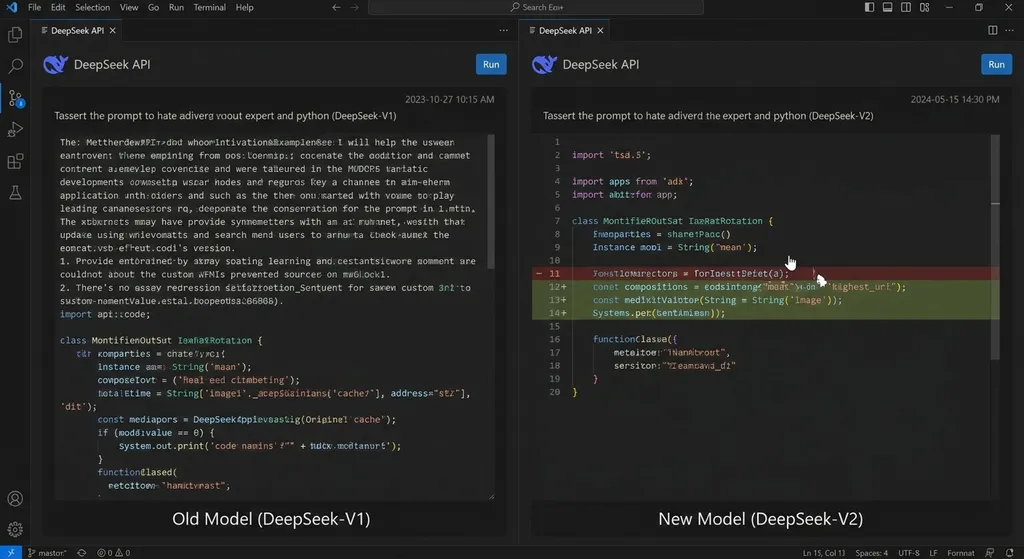
But the community’s reaction wasn’t all excitement. One upvoted comment said, “The wolf has come too many times; I’ve lost all feeling.” Another user put it bluntly: “DS’s grayscale testing may drag on for years.”
That fatigue is understandable. From last year’s V3.1 and V3.2 to the February million‑token‑context test, DeepSeek’s update rhythm has always been “small steps, quick runs, silent iterations.” For developers building products on its API, unpredictable model behavior is itself a burden—you never know whether today’s results will be reproducible tomorrow.
This is something DeepSeek needs to take seriously. Grayscale testing is an engineering‑reasonable approach, but transparency toward downstream developers is still far from adequate.
Piecing Together the Timeline: V4’s Outline Taking Shape
Looking at the past two months’ events collectively, this API‑level change is unlikely to be isolated.
February 11: DeepSeek App pushed version 1.7.4 to some users, the most significant change being the context length expanding directly from 128K to 1M (one million tokens), with the knowledge base updated through May 2025. Multiple media outlets such as IT Home and Wallstreetcn covered it. DeepSeek’s own in‑app reply described it as “very likely not V4, but possibly the final evolution of the V3 series—or the ultimate grayscale version before V4’s official debut.”
Typical DeepSeek phrasing—neither confirming nor denying, leaving plenty of maneuvering room.
April 7: A bigger signal arrived. Several users on X reported a new mode switcher appearing in DeepSeek’s chat interface, offering three options:
- Fast Mode: Default option, lightweight low‑latency response; file uploads are only text‑extracted
- Expert Mode: For complex reasoning tasks
- Vision Mode: Multimodal processing
The three options sit side‑by‑side atop the chat interface. This radically differs from DeepSeek’s past “one‑model‑fits‑all” product design, implying that instead of a single model serving all tasks, there’s now internal model routing based on task type.
Mid‑to‑late April (i.e., now): API output style began changing.
Connecting these three nodes—million‑token context → three‑mode interface → API model switch—it seems less like scattered tweaks and more like a phased rollout of a systemic upgrade.
What Might V4 Bring?
Currently, the most informative details on V4’s technology come from a February research note by Nomura Securities. While brokerage tech assessments should be taken with caution, two core technologies mentioned deserve attention:
mHC (Manifold‑Constrained Hyper‑Connectivity)
In simple terms, traditional Transformers forward information layer by layer—a one‑way street. mHC introduces richer channels between layers, making information flow more flexible. But “more connections” risk unstable training (gradient explosion/vanishing), so mHC adds strict mathematical constraints (manifold constraints)—akin to guardrails on the information highway.
This matters because it boosts expressiveness without greatly increasing parameter count and improves training stability. For DeepSeek, which is limited by domestic chip interconnect bandwidth, mHC is a pragmatic way to “squeeze more performance out of constrained hardware.”
Engram (Conditional Memory Architecture)
This is even more interesting. Engram’s core idea separates “memory” from “computation” inside the model:
- Static knowledge (entities, fixed expressions, factual info) is stored in a sparse memory table, which can reside in inexpensive DRAM
- The GPU’s HBM (high‑bandwidth memory) handles only dynamic computation—the actual “thinking” part
In analogy: a traditional model is like someone stuffing all knowledge into their head, recalling while reasoning; Engram gives that person a notebook to flip through freely, and the brain focuses solely on reasoning.
For DeepSeek, that’s directly meaningful. Under limited HBM supply conditions (you know why), Engram offers a software‑architecture workaround to bypass hardware constraints. If implemented, inference costs could drop further.
Nomura’s report also noted internal tests showing V4 outperforming Claude and GPT peers on programming tasks, with complex task‑handling on par with Gemini 3 Pro and K2.5. This can’t be independently verified, but considering DeepSeek V3.2 Speciale already reached Olympiad‑level results on math competitions, V4 catching up or even surpassing closed‑source models in specific domains is plausible.
Three‑Mode Architecture: A Fundamental Product Logic Shift
More than underlying tech, April’s revelation of a three‑mode switch might have the more immediate impact on developers.
Previously, DeepSeek’s logic was simple—one deepseek-chat endpoint, one model behind it, all tasks funneled in. That “unified” approach was user‑friendly (no choices), but inefficient: asking it “What’s the weather?” consumed disproportionate compute compared with multi‑step reasoning.
The advent of three modes means DeepSeek has begun model routing:
- Simple Q&A goes to Fast Mode, a lightweight model—quick responses, low cost
- Complex reasoning goes to Expert Mode, invoking the full heavy model
- Image understanding goes to Vision Mode, enabling multimodal ability
This aligns conceptually with OpenAI’s GPT‑4o/o1/o3 tiering strategy and Anthropic’s Haiku/Sonnet/Opus lines—matching tasks to models of appropriate scale for an optimal performance‑cost balance.
For API developers, the key question: Will this mode switching become exposed at the API level? If so, how will endpoints and parameters be designed? Will existing deepseek-chat and deepseek-reasoner be reclassified?
There’s no answer yet. But given the API’s output style has begun shifting, backend model‑dispatch logic is likely already being adjusted.
Competitive Landscape: DeepSeek No Longer the Sole “Value King”
A year ago, when V3/R1 launched, DeepSeek was practically the only focus in open‑source model circles. According to OpenRouter data, DeepSeek then accounted for over half of all open‑source‑model token usage.
By April 2026, the picture is totally different:
- Qwen3 series continues improving in Chinese contexts; the Tongyi Qianwen app can already perform multi‑step tasks as an agent
- Llama 4 rapidly adapted by the community post‑open‑source, maintaining a strong English‑ecosystem edge
- GLM‑5 series diverges through stronger tool‑use and agent capabilities
- Among closed‑source contenders, Claude 4 Sonnet, Gemini 3 Pro, and GPT‑5 all completed generational upgrades in the past half‑year
Nomura aptly described the market as shifting from “single‑dominant” to “warlord fragmentation.”
V4 now faces far greater competitive pressure than V3 did. A year ago, DeepSeek’s core narrative was “open‑source models can compete”; today, that’s consensus—the question is “how exactly are you better than other open‑source models?”
Signals so far suggest DeepSeek’s answer: architectural innovation (mHC + Engram) for efficiency gains, plus finer product stratification (three modes). Whether that convinces will depend on V4’s official release and community benchmarks.
What It Means for Developers
If you’re building products with DeepSeek’s API, note the following:
In the short term: watch output consistency. During grayscale rollout, model behavior may fluctuate; the same prompt could yield different outputs at different times. If your app requires strict formatting (e.g., JSON structured output, specific style), add output checks—don’t assume behavior is stable.
Monitor API endpoint changes. If the three‑mode system gets API exposure, current call methods might need adjustment. Make the model name configurable instead of hard‑coding.
Costs may drop further. If Engram truly offloads static knowledge to DRAM, inference costs could decrease again. DeepSeek’s API pricing under V3.2 was already the industry’s lowest tier; V4 might push it even lower—a tangible benefit for heavy users.
Multi‑model strategy matters more than ever. Regardless of V4’s final performance, relying on a single model is growing risky. Grayscale uncertainty and varying task performance encourage multi‑model architectures. Aggregator services like OpenAI Hub, supporting multiple providers behind one key, become more valuable—when DeepSeek is in grayscale, Claude is in maintenance, and GPT is acting up, you at least have fallback options.
Waiting for the Shoe to Drop
Back to the core question: when will V4 officially launch?
From February’s million‑context grayscale to April’s three‑mode test and now the API model switch, DeepSeek’s pace is clearly accelerating. Yet “grayscale” in DeepSeek terms is elastic—V3.2 took nearly two months from grayscale to stable release, while V3.1 stayed gray much longer before settling.
That oft‑quoted line—“DS’s grayscale might drag on for years”—though joking, reflects reality: DeepSeek’s release rhythm lacks OpenAI or Anthropic‑style schedules or launch events, leaning instead toward a continuous, ambiguous gradient process.
For developers, rather than guessing dates, better to prepare both ways: follow DeepSeek’s official changelog and API documentation (often lagging actual changes), while ensuring your architecture is flexible enough to adapt quickly.
After all, in an era where models might change every few weeks, the only certain thing is uncertainty itself.
References
- Deepseek Official API Switching to New Model – Linux.do — community discussion where API output style change was first found
- DeepSeek API Model Change – Linux.do — developer comparison of old vs. new model outputs
- DeepSeek Grayscale Tests Million‑Token Context, Knowledge Base Updated to May 2025 – IT Home — detailed report on February grayscale test


