
Tesla integrates Doubao and DeepSeek — large models have finally hit the road.
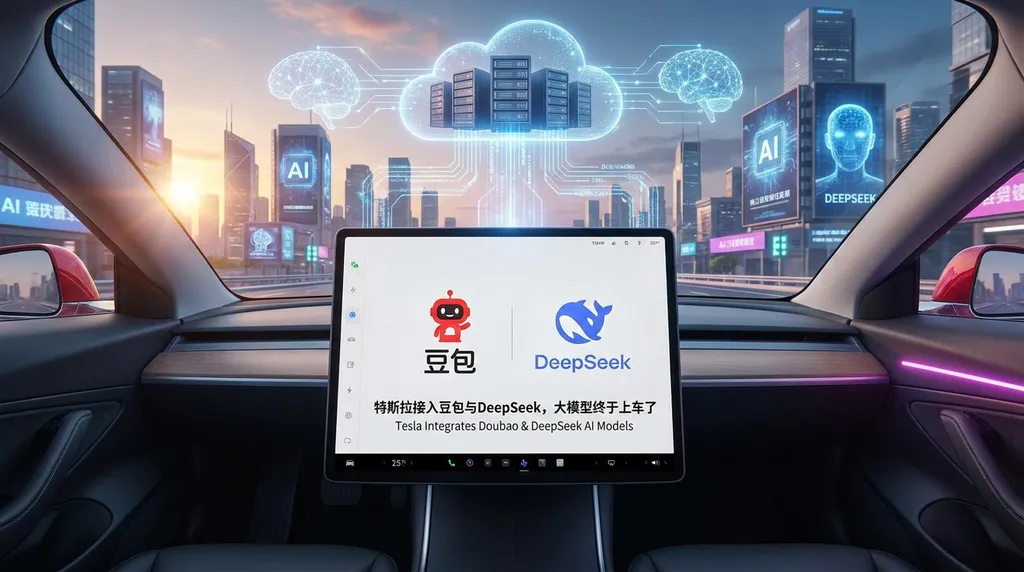
Tesla China’s in-car voice assistant is now officially integrated with ByteDance’s Doubao large model and DeepSeek. Doubao handles voice command control, while DeepSeek is responsible for AI dialogue interaction. The two models are deployed through Volcano Engine, marking a key step in Tesla’s localization of intelligent cockpits for the Chinese market.
Tesla’s Voice Assistant Is Finally No Longer “Half-Deaf”
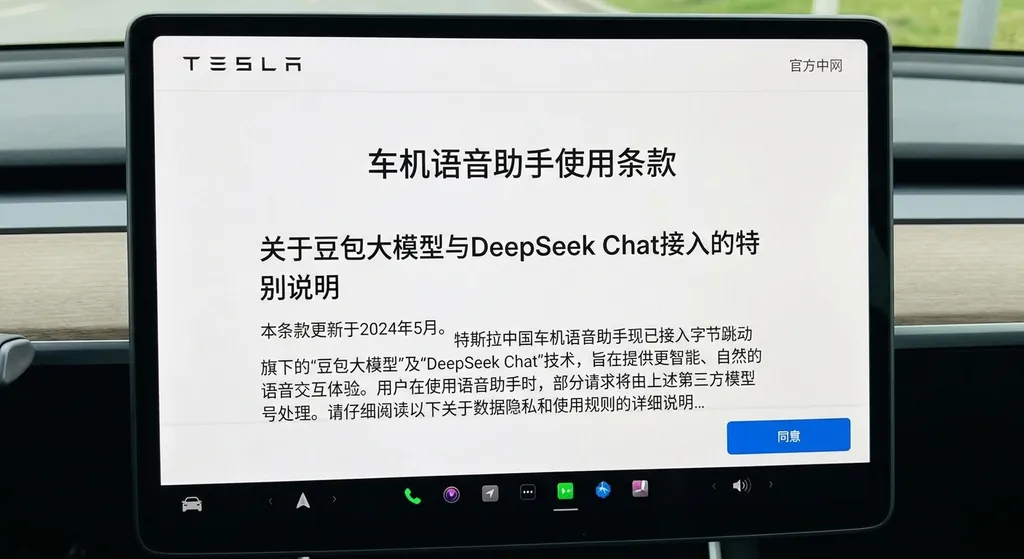
Tesla China’s in-car voice large model service completed its official registration on April 20. According to the updated Tesla In-Car Voice Assistant Terms of Use on Tesla China’s official website, the system will simultaneously connect to ByteDance’s Doubao large model and DeepSeek’s DeepSeek Chat, both hosted on the Volcengine cloud platform.
Put simply: after selling cars in China for so many years, Tesla’s voice assistant is finally evolving from “can understand a few sentences” to “can chat and handle tasks.”
This doesn’t come as a surprise. In the second half of last year, Tesla’s website had already disclosed related clauses, and Doubao and DeepSeek appeared on the Model Y L product page. But completing the regulatory filing means this has moved from “planning” to “ready for launch,” only one step away from actual OTA rollout to users.
Two Models, Separate Roles
Tesla’s approach this time is not just “plugging in a big model,” but making a clear division of labor:
- Doubao Large Model – handles the command layer. Navigation setup, media playback control, air conditioning adjustment, owner’s manual queries—tasks requiring quick and accurate execution go to Doubao.
- DeepSeek Chat – handles the AI interaction layer. Casual chats, information lookup, weather or news inquiries—open-domain dialogue scenes go to DeepSeek.
The logic behind this split is quite clear.
The core pain point of car voice systems has never been “can it chat,” but “can the car execute commands quickly and accurately.” Navigation, adjusting the temperature, playing a specific song—these scenarios demand both speed and precision, with little room for error. When you say “Navigate to the office,” if the assistant pauses for three seconds before replying “Sure, I’m planning your route,” the experience is already ruined.
Doubao has real experience with voice interaction. ByteDance released a full-duplex dialogue model last year, and Doubao’s multimodal, native voice interaction ability ranks among China’s top-tier models. Assigning it to handle car commands makes perfect sense.
DeepSeek, on the other hand, excels at reasoning and knowledge density. Having it handle tasks like “What’s the news today?”, “Explain this traffic law”, or “How long does it take to drive from Beijing to Shanghai?”—which require comprehension, organization, and generation—is the right match.
One handles the “hands and feet,” the other the “brain.” The two models complement each other—far more pragmatic than relying on a single one.
Why Volcengine?
It’s worth noting that both models operate on Volcengine.
Volcengine is ByteDance’s cloud service platform, so Doubao naturally runs on its home cloud. But DeepSeek running on Volcengine indicates Tesla chose a unified cloud provider to host its entire voice AI system rather than integrating separately with two companies.
That simplifies Tesla’s engineering process: network requests, authentication, data handling, and compliance auditing for the in-car system only need to interface with one platform. Volcengine itself provides hosting for DeepSeek, which is common among domestic cloud providers—most major platforms now offer DeepSeek’s APIs.
From another angle, this means Tesla is “outsourcing” its China-market AI capabilities to local vendors. For a company known for vertical integration, this is a pragmatic—but not very “Tesla-like”—choice.
The rationale is simple: Tesla’s own AI (Grok, xAI) still struggles in Chinese-language contexts. Moreover, operating AI services in China requires completing algorithm registration, data compliance, and various local procedures. Instead of building everything from scratch, it’s easier to integrate with already compliant local models.
Compared With Chinese Automakers — Is Tesla Faster or Slower?
Slower. Quite a bit slower.
China’s new automakers are at least one to two years ahead in adopting large models for in-car voice.
NIO’s NOMI GPT connected to its in-house large model as early as 2024, supporting multi-turn dialogue, context understanding, and proactive engagement. XPeng’s system integrates its proprietary AI assistant for voice control, scenario recommendations, and even driving-habit-based personalization. Li Auto’s assistant continues to evolve, deeply embedding large-model capabilities into all cockpit interactions.
BYD, Geely, Great Wall, and other traditional automakers aren’t staying still either—they’ve partnered with Baidu’s Ernie Bot, Alibaba’s Tongyi, and iFlytek’s Spark models, raising the bar for smart voice assistant capabilities across the industry.
Tesla has only now completed the registration and begun integration—it’s definitely a latecomer.
But being “slow” isn’t necessarily bad. Tesla’s strength has never been “doing it first,” but doing it right—achieving integration and consistency. Waiting until Doubao and DeepSeek became mature enough avoided the “early hallucination, slow response, random nonsense” phase of large models. For Tesla drivers, that might actually be a good thing.
Tolerance for errors in cars is much lower than on smartphones. If your phone’s AI misunderstands you, you laugh it off—but in a car, if it mistakes “navigate to the airport” for “navigate to the poultry farm,” or starts philosophizing instead of turning on the air conditioner, that’s no laughing matter.
Tesla’s choice to wait until model stability improves is reasonable from a product strategy perspective.
Will Dual-Model Architecture Become Industry Standard?
Tesla’s “Doubao-for-commands, DeepSeek-for-dialogue” dual-model setup reflects a growing trend: in-car voice AI systems won’t rely on a single model.
The reason is simple—no one model performs best across all use cases.
Voice command processing requires low latency, high accuracy, and strong command understanding—ideally tuned for automotive scenarios. Open-domain conversation needs broad knowledge, deep reasoning, and coherence—that’s where general-purpose models shine.
Combining specialized models and using a routing layer to direct user intent between them is now common in server-side AI services. Tesla just brought that architecture to the car.
We’ll likely see more automakers follow similar patterns:
- A lightweight, low-latency model handling car controls
- A heavier, high-intelligence model handling complex dialogues
- Possibly a third multimodal model for visual inputs (e.g., answering “What’s that building in front?”)
It mirrors the microservices philosophy in the internet world—decompose capabilities, implement each with the most suitable solution, then unify via an interface layer.
What Does This Mean for Developers?
If you develop in-car apps, smart cockpit systems, or voice AI integrations, Tesla’s approach offers several takeaways:
1. Volcengine’s model hosting capability validated by a top-tier client
Tesla’s choice of Volcengine as the unified model platform sets an important benchmark. It shows Volcengine’s deployment, API stability, and SLA guarantees now meet automotive-grade requirements. If you’re evaluating domestic model-hosting platforms, this is a signal to note.
2. Dual-model routing is a viable architectural pattern
Could you apply similar logic in your own apps? Use a fast, lightweight model for intent recognition and command execution, and a more powerful model for complex dialogues and reasoning. This layered approach helps balance cost and experience effectively.
For developers needing to call multiple models like Doubao and DeepSeek, API aggregation tools such as OpenAI Hub can simplify the process—one API key accesses multiple mainstream models, making routing and A/B testing much easier.
3. Car environments demand much stricter model performance
Latency must be lower (drivers won’t wait three seconds), tolerance for mistakes is smaller (wrong execution may affect safety), and context is limited (users expect results after one sentence). If you build voice AI products, the car setting is a great stress test.
Remaining Questions
Registration completion doesn’t mean immediate rollout. There are still key unknowns:
OTA deployment schedule – Filing is a prerequisite, but testing and phased releases must follow. The latest OTA update listed on Tesla China's official WeChat is still an older version. The timeline for rollout remains unspecified.
Supported models – Currently, only Model Y L is mentioned. Will older Model 3, Model Y, Model S/X get the same upgrade? If only newer vehicles qualify, existing owners may be unhappy.
Feature depth – The listed capabilities—navigation, media, climate, manual queries, chat—are fairly basic. Domestic automakers already offer advanced features such as scenario-based recommendations, complex multi-turn commands, and app-level interlinking. Whether Tesla includes such deeper functions is still unknown.
Data privacy – Since voice data will be processed on Volcengine’s servers, user privacy comes into play. Tesla’s terms are expected to detail this, but the specifics of data handling, storage, and deletion merit driver scrutiny.
A Bigger Picture
Zooming out, Tesla’s integration of Doubao and DeepSeek illustrates a pivotal turn in the automotive industry’s AI evolution: large models are shifting from “nice-to-have” to “infrastructure.”
Two years ago, a voice assistant that could understand speech was remarkable. Last year, integration with large models was a selling point. Now, if your in-car voice assistant can’t process complex commands, chat naturally, or proactively provide information, it’s falling behind.
As the global benchmark for electric vehicles, Tesla’s every move draws amplified interpretation. By connecting to domestic large models, it sends two clear signals:
First, Chinese AI models are now good enough that Tesla is willing to use them—an enormous endorsement for Doubao and DeepSeek.
Second, competition in smart cockpits has entered a new phase: a synthesis of model capability × engineering integration × scenario understanding. A strong model alone isn’t enough; great hardware alone isn’t enough—the magic lies in deeply integrating AI into every driving interaction.
Tesla started late, but its engineering integration and OTA iteration speeds remain best-in-class. The next question is whether it can, after adopting local models, rapidly refine the user experience to match—or surpass—domestic automakers.
The AI arms race in smart cockpits has only just entered the second half.
References
- Tesla China’s In-Car Voice Service to Integrate Doubao Model - Linux.do — forum discussion post covering filing completion and dual-model details
- Tesla Finally Adopts Chinese Large Models! Doubao and DeepSeek Hit the Road - Zhihu — detailed analysis of Tesla’s in-car voice assistant terms


