
Trellis v0.5 Beta Field Test: Multi-Agent Orchestration Enters Mainstream Teams

The multi-agent orchestration framework **Trellis** releases **v0.5 Beta**, featuring major improvements in usability. It has already been adopted by multiple medium and large companies in departments with over fifty people. We tested this version and will discuss what problems it solves and which issues remain unresolved.
Trellis v0.5 Beta was officially released last week. This multi-agent orchestration framework—controversial within the developer community—has finally made a major leap in usability.
According to the author’s post on the Linux.do community, Trellis has already been adopted by teams from several large and mid-sized companies, both in China and abroad, with some deployments involving more than fifty people. That number isn’t explosive in the AI framework space, but for a community-driven open-source project, it’s meaningful—it shows that some people are willing to use it in production environments, not just for demos or social posts.
Background: Why Another Framework
Developers building AI applications probably share the same feeling: there are too many frameworks.
LangChain, LlamaIndex, CrewAI, AutoGen, MetaGPT… a new orchestration framework seems to appear every few weeks, each claiming to be the “ultimate solution.” There's even a post on Linux.do titled “There are way too many AI frameworks now,” and the comments underneath are basically a collective developer rant.
Complaints aside, the need is real. Once your application goes beyond a simple “prompt in, text out” flow and involves multiple agents collaborating on complex tasks, you do need an orchestration layer. The problem is that existing frameworks are either too heavy (LangChain’s layers of abstraction are hard to navigate) or too light (some lightweight options rely on wishful thinking for multi-agent coordination).
Trellis aims to strike a middle ground.
What Exactly Changed in v0.5
To understand v0.5’s significance, you first need to know how frustrating previous versions were.
One community user gave a typical bit of feedback: “When I used 4.0, later it seemed to forget what the framework was even for, and the PRD task planning list just stopped working.” That’s quite revealing—the agent lost context during multi-step tasks, and the planned task chain broke halfway through. This memory loss isn’t unique to Trellis—almost all multi-agent frameworks struggle with context retention—but the early versions of Trellis handled it poorly.
Based on publicly available information and community discussions, v0.5 Beta’s improvements mainly focus on several areas:
1. Major Overhaul of Documentation Site
It sounds unglamorous but is perhaps the most practical improvement. The author mentioned in the community that the “beta documentation site was completely revamped” and shared a new link. For any framework, documentation quality directly affects adoption cost. Trellis previously had a painful issue: the docs couldn’t keep up with iteration speed, examples were often broken, and key concepts were left unclear.
The new documentation site has at least been reorganized structurally, which lowers the barrier significantly for teams looking to evaluate or try it out.
2. Major Usability Improvements
The author stated that “usability has been greatly enhanced.” Based on community discussions, this likely includes:
- Simplified task orchestration configuration, reducing boilerplate code
- More transparent communication between agents, with clearer data flow visibility during debugging
- Better out-of-the-box compatibility with mainstream models
These are improvements in the right direction. The biggest enemy of multi-agent orchestration frameworks isn’t lacking features—it’s that developers often can’t figure out what’s actually happening between agents during debugging. If v0.5 truly invested in observability, that’s something worth attention.
3. Faster Update Cycle
The author also mentioned that “updates are frequent lately.” That’s both good and risky. On the plus side, the team is actively iterating; the downside is that teams already using Trellis in production will need to perform compatibility testing more often. But since it’s still in the Beta stage, that pace is understandable.
How Trellis Compares to Competitors
To be honest, the multi-agent orchestration space is extremely crowded. Let’s pull out a few of the main players for comparison:
LangChain / LangGraph: Largest ecosystem, most active community, but too many abstraction layers and poor debugging experience. Many developers feel like “after writing with LangChain, I’m not even sure what I wrote.” LangGraph improves orchestration control but still has a steep learning curve.
CrewAI: Simple to get started, intuitive role definitions, great for quick multi-agent prototypes. But lacks fine-grained control for complex scenarios; few production deployments.
AutoGen (Microsoft): Backed by a major company, with unique multi-agent conversation design. However, the framework leans research-oriented and is less practical for engineering.
MetaGPT: Focused on software development workflows, with an SOP-driven design that’s interesting, but the applicability is limited.
Where does Trellis stand out? From current information, it’s trying to balance “sufficient abstraction” with “adequate control.” It doesn’t try to do everything like LangChain, nor does it stay overly simple like CrewAI. Having fifty-person adoption cases suggests it’s reasonably solid for engineering—it can handle at least medium-scale collaborative development.
That said, Trellis’s main shortcoming right now is its ecosystem. LangChain has tons of third-party integrations and plugins, CrewAI has easy onboarding, and AutoGen has Microsoft’s backing. As a community-driven project, Trellis lags behind in all these dimensions. How far it goes depends largely on whether upcoming versions can keep delivering on the promise of usability.
How Big Is the Real Demand for Multi-Agent Orchestration?
This is worth some sober thought.
Over the past year, the word “Agent” has been seriously overused. Many so-called “multi-agent systems” are essentially a few prompts strung together with some loops, claiming “autonomous decision-making.” In reality, scenarios that truly require complex multi-agent orchestration are rare in business applications.
But some real cases exist where a single agent isn’t enough:
- Complex code generation and review processes: One agent writes the code, another reviews it, another runs tests. They need multiple rounds of interaction—much more reliable than asking a single model to “get it right” in one shot.
- Multi-step data analysis pipelines: Data cleaning, feature engineering, model selection, interpretation—each stage handled by agents with different tools and expertise.
- Enterprise workflow automation: Scenarios with multiple systems, approval stages, and exception handling paths. A single agent’s context window and reasoning ability can’t cover these.
Such scenarios share common traits: long task chains, many intermediate states, and collaboration between agents with different “expertise.” In these cases, a solid orchestration framework can indeed make life easier.
However, most developers’ day-to-day needs aren’t that complex. For things like “call an API, process a response, make a simple decision,” writing a few dozen lines of code is far more efficient than introducing any framework.
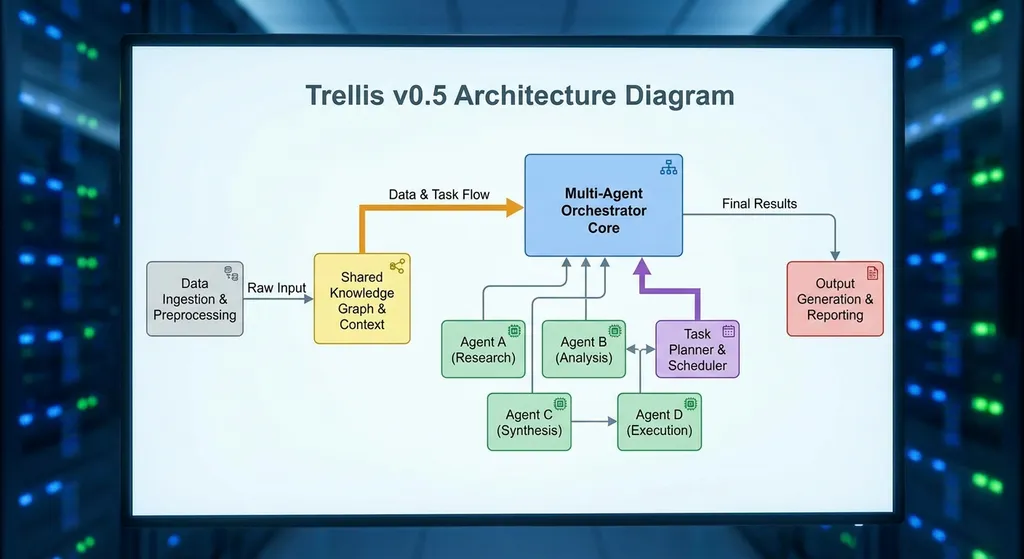
So Trellis’s target users are quite clear: midsize or larger teams building complex AI applications requiring multiple agents to collaborate, who want a unified orchestration layer to manage agents’ lifecycles and communications.
From Vibe Coding to Engineering: The Changing Role of Frameworks
An interesting background note: Trellis discussions often appear in threads related to “vibe coding.”
Vibe coding—using natural language to describe requirements and letting AI generate code directly—has evolved from a meme into a real development approach in the past six months. Many developers have discovered that for prototyping or small projects, vibe coding is insanely efficient.
But as projects scale up and teams grow, vibe coding’s limitations become obvious: inconsistent generated code, poorly coordinated agents, and bugs that are hard to trace. That’s when you need a framework for structure and discipline.
Trellis’s value in this context is that it doesn’t aim to replace vibe coding—it aims to provide an engineering backbone for it. You can still describe tasks in natural language, but task decomposition, assignment, execution, and monitoring are all managed by the framework.
That’s a reasonable positioning. AI-assisted development is evolving from “personal productivity tool” to “team collaboration infrastructure,” and orchestration frameworks will play an increasingly crucial role in that transition.
Practical Recommendations
If you’re considering whether to adopt Trellis v0.5 Beta in your project, here are a few pointers:
Worth trying if:
- Your team already builds multi-agent applications and existing solutions (or lack thereof) frustrate you
- You’re weary of LangChain’s complexity and want a lighter but still controllable alternative
- You can accept Beta-level instability and are willing to provide feedback to the community
Better to wait if:
- Your use case works fine with a single agent—no need to force “multi-agent” complexity
- Your team demands high framework stability and can’t accept Beta risks
- You’ve heavily invested in LangGraph or AutoGen and migration costs are too high
A pragmatic approach: try v0.5 Beta on a non-critical project first, get a full multi-agent workflow running, evaluate performance and learning curve, and then decide whether to scale up adoption.
By the way, regardless of which orchestration framework you use, model calls remain tied at the core. If your agents need to invoke different models (e.g., reasoning with Claude, generation with GPT, lightweight tasks with DeepSeek), check out services like OpenAI Hub—one unified API key saves you from juggling multiple configurations inside the framework.
In Closing
The elimination game in AI frameworks continues. New frameworks emerge every month, while old ones fade away. The release of Trellis v0.5 Beta isn’t exactly a milestone, but it represents a noteworthy trend: multi-agent orchestration is moving from “lab toy” to “production tool.”
Whether it truly finds footing depends on execution in the coming months—keeping documentation up-to-date, energizing the community, and getting enterprise adoption cases shared publicly. These matter more than any technical detail.
The endgame in framework competition has never been about who has the most elegant architecture—it’s about who helps developers get things done fastest. Trellis is betting on usability in v0.5. It’s the right direction. The rest, time will tell.
References
- There are way too many AI frameworks now… — Linux.do community thread featuring the Trellis author and enterprise adoption details
- Q & A about the Trellis Framework — Linux.do community, user feedback on early versions of Trellis
- Feeling burnt out, chatting about advanced vibe coding — Linux.do community, author’s remarks on v0.5 updates and documentation overhaul


