
27B Beats 397B: Qwen3.6, the Most Powerful Open-Source Dense Model, Has Arrived

Ali’s Tongyi Qwen has open-sourced **Qwen3.6-27B** today. This 27‑billion‑parameter dense model comprehensively surpasses the previous MoE flagship—with 15 times more parameters—across all major programming benchmarks, becoming the most deployment‑cost‑effective agent programming model to date.
Today, the Tongyi Qianwen team at Alibaba released the third member of the open-source Qwen3.6 family — Qwen3.6-27B.
A dense, multimodal model with 27 billion parameters, it comprehensively outperforms the previous-generation flagship Qwen3.5-397B-A17B across all major programming benchmarks.
What’s the latter? A Mixture-of-Experts (MoE) model with 39.7 billion total parameters and 1.7 billion active parameters.
In other words, a dense model that’s only a fraction of its size completely beat it down.
This isn’t PR talk — the benchmark scores speak for themselves.
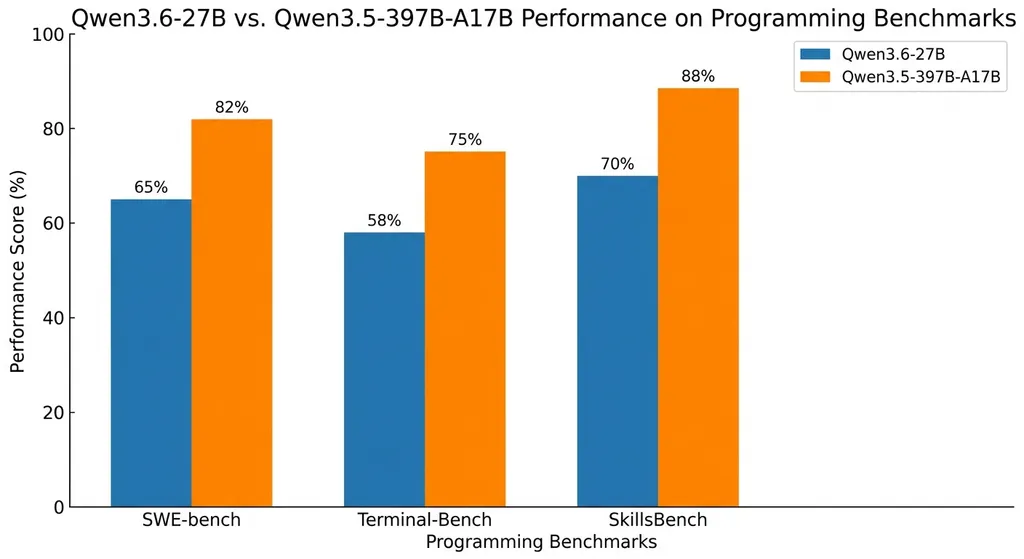
Numbers Don’t Lie: Absolute Dominance in Programming Ability
Let’s start with the hardest metrics.
SWE-bench is one of the most respected benchmarks for real-world software engineering ability — it doesn’t just ask a model to complete a line of code, but gives it a real GitHub issue and expects it to locate the bug, modify code, and submit a patch.
Qwen3.6-27B’s report card:
- SWE-bench Verified: 77.2 (previous 76.2)
- SWE-bench Pro: 53.5 (previous 50.9)
- Terminal-Bench 2.0: 59.3 (previous 52.5)
- SkillsBench: 48.2 (previous 30.0)
All scores improved, but the standout is SkillsBench — jumping from 30.0 to 48.2, an increase of over 60%.
SkillsBench assesses broad, diverse programming skill coverage, which means this improvement signals a fundamental lift in baseline programming ability, not a narrow optimization.
Terminal-Bench 2.0 went from 52.5 to 59.3 — a significant leap.
This benchmark tests interactive programming ability in a terminal environment — reading logs, running commands, debugging errors, iterative fixes — essentially the core tasks of agent-based programming.
A 7-point increase here translates to a nonlinear improvement in real-world usability.
And all of this — achieved with 27B parameters.
The competitor has 397B.
Dense vs. MoE: Why This Matters
Some might argue: an MoE with just 17B active parameters doesn’t require much more compute than a 27B dense model, so comparing total parameter counts isn’t fair.
That’s only half right.
MoE models leverage a larger parameter space with lower compute cost in theory, but the tradeoff is deployment complexity.
A model with 397B total parameters still needs to load all that weight into VRAM — even if only some “experts” activate per inference.
For most developers and smaller teams, that determines how many GPUs and what kind of GPUs you need.
By contrast, a 27B dense model is much simpler:
no expert routing overhead, no MoE-specific load-balancing headaches, just plug-and-play deployment.
A mainstream consumer or professional GPU (like an RTX 4090 or A100 40G) can run it post-quantization.
For teams wanting to deploy agent coding assistants locally or on private servers, it’s a sweet spot.
Alibaba knows this.
The official blog states plainly:
“The ideal choice for developers seeking top-tier programming ability at a practical, widely deployable scale.”
In other words: we know you don’t just want the highest benchmark scores — you want the strongest model you can actually use.
The 27B configuration wasn’t chosen randomly either.
The blog notes it’s the “most requested specification by the community.”
Looking back, from Qwen2.5’s 7B/14B/32B/72B models to the parameter tuning of the Qwen3 series, 27B has always been the model size most discussed — large enough to be powerful, small enough to deploy — precisely the optimal usability range.
Beyond Coding: Reasoning and Multimodal Strength Also Shine
Programming is Qwen3.6-27B’s main highlight, but it’s by no means a code-only model.
On reasoning tasks, it scored 87.8 on GPQA Diamond, one of the most challenging graduate-level benchmarks covering physics, chemistry, and biology.
Officially, its reasoning capability “matches models several times larger.”
For context, Claude 3.5 Sonnet scores around 65, GPT-4o around 53 (based on earlier data) — meaning Qwen3.6-27B ranks among the top tier for reasoning.
In multimodal tasks, Qwen3.6-27B natively supports image, video, and text as combined inputs.
This isn’t a visual adapter bolted on after training — multimodal alignment was part of its training.
Officially, its vision-language performance matches that of Qwen3.6-35B-A3B, which achieved 92.0 on RefCOCO and matches or surpasses Claude Sonnet 4.5 across most multimodal benchmarks.
For developers, this means one model can handle code review, documentation comprehension, UI screenshot analysis, and other mixed scenarios — no need to swap separate models for each modality.
In agent workflows, that kind of unified capability matters more than any single-point metric.
The Qwen3.6 Family Lineup
Putting all released Qwen3.6 models together, Alibaba’s strategy is clear:
- Qwen3.6-Plus: closed-source flagship, available via Bailian API — for those pursuing ultimate performance regardless of deployment cost
- Qwen3.6-35B-A3B: open-source MoE, 35B total / 3B active — ultralight, perfect for resource-constrained edge scenarios
- Qwen3.6-27B: open-source dense model with 27B parameters — the highest-performance open-source option for teams with decent compute
Together, they cover the full spectrum: from cloud API to heavyweight local deployment to efficient edge use.
All share the same multimodal architecture and “thinking / non-thinking” dual-mode design, minimizing migration cost across scales.
Worth noting: The Qwen3.6-35B-A3B, released just a week earlier, already demonstrated MoE’s extreme efficiency — achieving performance close to (or better than) the 27B dense model from the previous generation.
Now, Qwen3.6-27B pushes dense-model performance even higher.
The two architectures are racing neck and neck — a healthy sign for the open-source ecosystem.
Deployment: How to Get Started
Model weights are already available on Hugging Face and ModelScope for direct download.
Key deployment notes:
-
Two operation modes: “thinking” and “non-thinking.”
Thinking mode expands full reasoning chains — ideal for complex coding or reasoning; non-thinking is faster and better for simple Q&A or completion.
This dual-mode design, introduced with Qwen3, is now mature. -
Bailian platform API support is coming soon, including the
preserve_thinkingfeature.
This allows the model to retain prior reasoning chains across multi-turn dialogs — crucial for agentic tasks, where step-three decisions benefit from seeing the full thought process from steps one and two. -
Integration into popular coding assistants:
Officially supported tools include:- OpenClaw (formerly Moltbot / Clawdbot): a self-hostable open-source AI coding agent — connect to Bailian for full terminal-based agent programming
- Claude Code: API-compatible with Anthropic’s protocol via Qwen API
- Qwen Code: open-source terminal AI agent deeply optimized for Qwen models
This means you don’t have to rebuild your toolchain — just swap out the backend model.
Especially thanks to Claude Code compatibility, developers used to its workflow can now seamlessly switch to Qwen3.6-27B, saving on API fees while running locally with full data privacy.
Once online on Bailian, you can call the model directly via API.
For developers managing multiple models under one interface, aggregator platforms like OpenAI Hub will likely support it soon, allowing one key to test and switch easily.
Industry Context: The Arms Race of Open-Source Coding Models
Since mid-2025, coding ability has become the most fiercely contested battleground for large models.
Why? Because it’s the most monetizable capability — and the one developers most readily pay for.
Claude established a strong reputation with its Sonnet series.
AI coding tools like Cursor and Windsurf exploded in popularity, amplifying the need.
OpenAI’s Codex and GPT series continue strengthening coding performance.
On the open-source side, the race is equally intense — DeepSeek-Coder, CodeLlama, StarCoder, and Qwen’s own Coder series all vie for the “strongest open-source coding model” crown.
But Qwen3.6-27B’s strategy is distinct:
it’s not a specialized Coder model, but a general-purpose multimodal model that happens to be the strongest open-source performer in programming.
This “all-rounder who also tops single disciplines” approach is more appealing to developers — no need to deploy separate models for coding and general AI tasks.
More importantly, it focuses on agentic programming rather than just code generation.
The difference?
Coding is filling in a function implementation — agentic programming is taking a vague requirement, planning steps, calling tools, reading/writing files, running tests, and iteratively fixing issues.
That’s the kind of productivity AI coding truly promises — and what benchmarks like SWE-bench aim to measure.
At 77.2% SWE-bench Verified, Qwen3.6-27B reaches a highly usable range.
For reference, human developers average only about 4.8% on this benchmark (yes, it’s that hard — requiring quick debugging in unfamiliar codebases).
77.2% means the model can solve over three-quarters of real GitHub issues — already a genuinely useful assistant in real workflows.
Details Worth Noticing
Several interesting points stand out from Qwen3.6’s release timeline:
- The 6-day gap between April 16th’s Qwen3.6-35B-A3B and today’s 27B release shows that Alibaba had multiple models trained in parallel, not serially.
- The Manus x Tongyi Qianwen strategic partnership matters — announced in March, Manus will base its full domestic functionality on open-source Qwen models and compute platforms.
Qwen3.6-27B, balancing performance and deployability, is likely a cornerstone for that rollout. - The official blog says the Qwen3.6 open family will continue expanding, hinting at upcoming larger-scale releases (possibly 72B-class).
For now, 27B is a strong practical starting point; if you need higher ceilings, stay tuned for the “large” and “XL” tiers.
In Closing
A 27B dense model beating a 397B model, comprehensively surpassing MoE performance in programming tasks — Qwen3.6-27B clearly demonstrates one thing:
as model architectures and training methods evolve, parameter count no longer dictates performance.
For developers, that’s great news.
It means you no longer need the biggest, costliest model to enjoy top-tier agentic programming capability.
One card, one model — programming, reasoning, and multimodal support all included.
The golden age of open-source models is still accelerating.
References:
- ITHome: Tongyi Qianwen Qwen3.6-27B Announces Open Source — launch report with full benchmarks
- ITHome: Alibaba Qwen3.6-35B-A3B Released as Open Source — details of a previous release in the Qwen3.6 series
- Zhihu: Qwen3.6-Plus Major Release — Comprehensive Boost to Programming and Agent Capabilities — overview analysis of the Qwen3.6 lineup


