
Xiaomi MiMo-V2.5 Released: This Time, It's Really Taking on the Top Models

Xiaomi has released the MiMo-V2.5 series of large models and launched public testing, focusing on intelligent agents and code generation scenarios. It claims to be able to compete directly with Claude Opus 4.6 and GPT-5.4, and will soon be open-sourced globally.
Only one month has passed since the last “Late-Night Triple Update,” and Xiaomi’s large-model team has turned in another report card.
On April 22, Xiaomi officially released the MiMo-V2.5 series of large models, including the standard MiMo-V2.5 and the flagship MiMo-V2.5-Pro. The series has now entered public beta testing on the MiMo open platform, with a clear statement that global open-sourcing is imminent.
To be honest, the pace of iteration is quite fast. On March 19, Lei Jun had just announced three models—V2-Pro, V2-Omni, and V2-TTS—and just over a month later, we already have V2.5. Some community members joked, “2-Pro just launched not long ago, and now there’s 2.5-Pro”—not a hallucination, Xiaomi’s model release cadence really is accelerating.
But speed alone doesn’t mean much—the key question is, what exactly did V2.5 bring this time?
Xiaomi chose two of the toughest opponents for itself
Let’s start with the most eye-catching part. In its official introduction, Xiaomi directly named two competitors: Claude Opus 4.6 and GPT-5.4. It claims that MiMo-V2.5-Pro can now “go head-to-head” with these world-class Agent models in general intelligence, complex software engineering, and long-range task capabilities.
That’s a bold statement.
Community reactions are mixed. Some, after seeing benchmarking data, said “It beat Gemini—surprisingly close!” while others dismissed it: “Posting a benchmark doesn’t mean you can ‘go head-to-head’; if it were just a release announcement, I wouldn’t bat an eye.”
Frankly, skepticism like this is completely fair. The gap between benchmark scores and real-world performance is a long-standing issue in the large-model space. But Xiaomi didn’t just give benchmarks this time—it also provided two rather convincing case studies.
4.3 hours to write a compiler, scoring a perfect 100
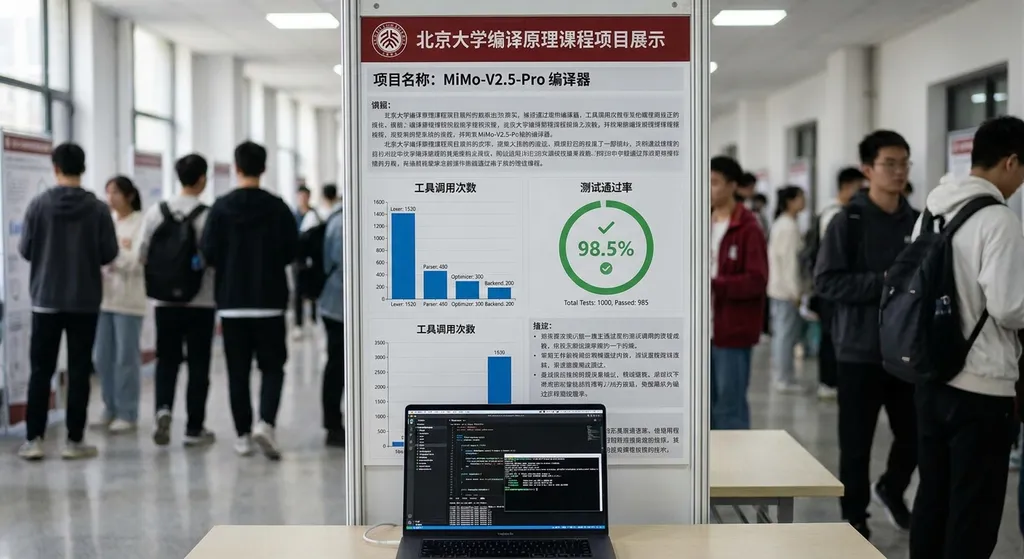
The first case comes from Peking University’s Compiler Principles course project.
The assignment requires implementing a full SysY compiler in Rust from scratch, covering a lexical analyzer, syntax parser, AST construction, Koopa IR generation, a RISC-V assembly backend, and performance optimization. It’s a proper undergraduate course project—PKU students usually take weeks to complete it.
MiMo-V2.5-Pro finished it in 4.3 hours, making 672 tool calls, and achieved a perfect 233/233 score on the hidden test set.
That result deserves a closer look.
First, this isn’t simple code completion or function generation—it’s a system-engineering task requiring deep understanding of compiler theory and long-range planning ability. The model has to grasp dependencies among modules, build the compiler pipeline in the correct order, and handle all edge cases.
Second, 672 tool calls mean the model continually interacted with its environment—writing code, running tests, finding issues, fixing bugs. That’s the hallmark of an Agent workflow. It wasn’t one-shot generation but iterative problem-solving.
And finally, a perfect score—on a hidden test set. That shows the model wasn’t parroting answers but truly understood the requirements and implemented them correctly.
One-line requirement, delivered an 8,000-line video editor
The second case is closer to real-world development.
The input was just one sentence: “Build a web-based video editor.” MiMo-V2.5-Pro autonomously worked for 11.5 hours, made 1,868 tool calls, and finally delivered a runnable web app with multi-track timelines, clip trimming, crossfades, audio mixing, and export workflows. The final codebase totaled 8,192 lines.
To put that in context: a mid-level front-end developer starting from scratch on a similar video editor would conservatively need two to three weeks—and that’s not counting requirement analysis, tech selection, or architecture design.
Of course, we don’t know the quality of those 8,192 lines—whether there’s redundancy or whether it’s production-grade. But as an end-to-end demo from a single-sentence prompt to a functional app, the result is already quite impressive.
Together, these two examples point in the same direction: the MiMo-V2.5 series’ core selling point isn’t chat or writing—it’s acting as an Agent that can autonomously complete complex engineering tasks.
From V2 to V2.5 — what’s upgraded
Let’s recall the foundation of the previous generation. Released in March, MiMo-V2-Pro had over 1T total parameters (42B active), used a hybrid-attention architecture, and supported a 1M-token ultra-long context. It was already positioned as a “flagship base model for high-intensity Agent scenarios.”
From V2 to V2.5, Xiaomi officially calls it a “comprehensive leap.” Based on public info, upgrades focus mainly on several areas:
- Systematic enhancement of Agent capabilities. Not just higher accuracy in single tool calls, but stronger planning, execution, and error correction during long-range tasks. The fact that it successfully handled 672 and 1,868 tool calls shows qualitative improvement in long-sequence stability.
- Major boost in code-generation ability. From the compiler case, the model’s understanding of system-level languages (Rust) and complex architectures is significantly deepened.
- Optimized inference speed. User tests show ~100 tokens/sec for Pro version and ~150 tokens/sec for standard. That’s fast for its class—important because Agent scenarios require frequent calls, and inference speed directly affects total task time.
Speed matters more than you think
Let’s talk about inference speed.
In ordinary chat interactions, the difference between 100 and 50 tokens per second feels slight—users might just notice “it’s a bit faster.” But in Agent settings, that difference is multiplied across hundreds or thousands of tool calls.
A quick calculation: say each call generates ~500 tokens; 672 calls = 336,000 tokens. At 100 tokens/sec, that’s 56 minutes of generation; at 50 tokens/sec, 112 minutes. Add tool-execution and parsing overheads, and speed becomes the difference between finishing a compiler in 4 hours vs. 7–8 hours.
For developers, this isn’t “a bit faster”—it’s “can I finish within a workday” level importance.
Xiaomi is getting good at playing the open-source card
Xiaomi explicitly stated that the V2.5 series is “about to be globally open-sourced.”
Historically, Xiaomi has been proactive with open-source. The V1 series got good community response when released; the V2 series continued that strategy. Now with V2.5, Xiaomi signals that open-sourcing has become a core part of the MiMo roadmap.
The logic is obvious: Xiaomi’s large models ultimately serve its “Human–Car–Home” ecosystem, which needs many developers building MiMo-based applications. Open source is the most efficient way—bar none—to grow a developer ecosystem.
For developers, an open-source model focused on Agents and code generation means local deployment, fine-tuning, or integration into custom workflows—far more flexible than calling closed APIs.
Of course, the details matter—will weights be fully open? Any usage restrictions? Will training code and dataset info be included? Those specifics will determine the real value of the release.
Token Plan update: Xiaomi learns from Sam Altman
Alongside the release, Xiaomi updated the MiMo Platform’s Token Plan:
- Nighttime discount rate: 0.8× consumption (20% off)
- Monthly and yearly subscription deals: annual plan at 12% off
- Surprise benefits: all existing user Credits fully reset
Some users joked, “Learning from Sam the philanthropist—resetting everyone’s quota.” And indeed, resetting Credits is a solid strategy for enticing users back, especially developers who’d already used up quotas and were on the fence—it’s effectively a free chance to deeply try the new model.
Others complained, “Xiaomi’s pricing is expensive.” Pricing is subjective, but given open-source is imminent, price-sensitive users can just wait and self-deploy. The API plan is meant more for teams who want plug-and-play convenience without managing infrastructure.
Industry perspective: where does Xiaomi stand
Zooming out, the competitive landscape of large models in 2026 looks very different from a year ago. OpenAI pushed to GPT‑5.4, Anthropic’s Claude Opus reached 4.6, and Google’s Gemini keeps evolving. Domestically, DeepSeek, Qwen, and GLM each follow their own paths.
Xiaomi’s chosen angle is clear: Agents and code generation.
This choice has several layers of reasoning. First, general conversation capabilities are already saturated—latecomers struggle to differentiate. Second, Agent capabilities are among the most valuable for real-world applications, especially in software development, where models that autonomously complete complex tasks have huge commercial potential. Third, Xiaomi’s own “Human–Car–Home” ecosystem naturally demands strong Agent capability—smart home control, in-car AI, cross-device collaboration—all fundamentally Agent tasks.
Community feedback shows MiMo’s user experience is improving fast. Some said, “It actually feels pretty good, and the conversations sound really Chinese.” That suggests strong work on Chinese language and cultural alignment. For domestic developers, a fast, Agent-focused, open-source, Chinese-proficient model is indeed appealing.
Taking a sober look at a few issues
Of course, not everything is rosy.
First, “head-to-head” doesn’t mean “surpass.” Xiaomi’s phrasing—“can compete head-on with Claude Opus 4.6 and GPT‑5.4”—is vague. Which benchmarks? How close? Full parity or partial? Not transparent yet.
Second, representativeness. The compiler and video editor cases are structured tasks with clear input-output and verification standards. In messier, open-ended real-world dev situations, can the model perform as well? More user testing is needed.
Third, unclear open-source timeline. “Soon” could mean a week or a month—uncertainty affects developer planning.
Fourth, ecosystem maturity. Compared with OpenAI and Anthropic’s developer platforms, MiMo’s ecosystem is still young—docs, SDKs, community support must keep pace with model iterations.
Lei Jun’s 16 billion is starting to make noise
When announcing the V2 series, Lei Jun revealed Xiaomi’s AI R&D and capital investment this year will exceed 16 billion RMB. One month later, V2.5 arrived—this pace suggests Xiaomi’s team has entered an efficient development loop.
On a broader level, Xiaomi’s logic differs from pure AI companies. OpenAI and Anthropic must directly monetize their models; Xiaomi’s models will be embedded across phones, cars, and smart homes. That lets Xiaomi go more aggressive on open-sourcing and pricing—the revenue isn’t from the models themselves, but from the ecosystem they empower.
That’s also why Xiaomi confidently name-dropped Claude Opus 4.6 and GPT‑5.4. Even if absolute performance still trails slightly, being strong in certain niches—Agent and code generation—plus open-source and pricing advantages can carve out a share of the developer market.
For developers, MiMo‑V2.5 is worth attention for simple reasons: it’s a domestic, Agent‑focused, fast‑inference, open‑source model—a distinctive choice among current options. Once the weights are released, testing in real project scenarios will be more informative than any benchmark number.
If you already use API aggregation services like OpenAI Hub, trying MiMo later will be nearly frictionless—just change the model name.
As for whether Xiaomi can truly stand firm in the large‑model race, V2.5 is just one stage answer. But judging from its iteration speed and technical direction, this team looks serious.
References
- Xiaomi MiMo‑V2.5 series public beta and upcoming open‑sourcing – Linux.do discussion — detailed community discussion, including official cases and benchmarks
- Xiaomi quietly released new models V2.5 and V2.5‑Pro – Linux.do — user‑tested inference speed and experience feedback
- Xiaomi MiMo‑V2.5 series enters public beta and will be globally open‑sourced – Linux.do announcement — official MiMo platform announcement and Token Plan details
- Xiaomi released new model and reset plan usage limits – Linux.do discussion — discussion on user Credits reset benefits
- About Xiaomi’s newly released MiMo large model – Zhihu column — analysis of MiMo’s Agent framework capabilities


