
Volcano Coding Plan integrates with GLM-5.1 and MiniMax M2.7
On April 22, Volcano Engine Ark Coding Plan officially launched two domestic models, Zhipu GLM-5.1 and MiniMax M2.7, fully aligned with the original full capabilities and available without purchase restrictions, further expanding its AI coding model ecosystem.
Volcano Engine made some big moves today. On April 22, Ark Coding Plan simultaneously launched Zhipu’s GLM-5.1 and MiniMax’s M2.7 — both models are full-featured, unrestricted versions aligned with their original factory editions. This follows the earlier addition of Doubao-Seed-2.0-Code, DeepSeek-V3.2, and Kimi-K2.5, marking another significant domestic model expansion for Coding Plan.
The developer community reacted quickly — “Hope other vendors follow suit soon.”
Let’s start with the two models themselves
GLM-5.1: Zhipu’s MoE powerhouse
GLM-5.1 is Zhipu AI’s flagship model announced in late March, about a month ago. Architecturally, it adopts an MoE (Mixture of Experts) design, with 744 billion total parameters and 40 billion active parameters, supporting a 200,000-token context window.
What do these numbers mean? Compared to its peers: DeepSeek-V3.2 has about 37 billion active parameters, while Kimi-K2.5 offers a 256k context window. GLM-5.1 holds its own in parameter scale; though its context window is slightly shorter than Kimi-K2.5’s, 200k tokens are more than enough to handle single-file or even mid-sized project code comprehension.
The key, however, is coding capability. According to Zhipu’s technical report, GLM-5.1’s programming ability has improved nearly 10% over GLM-5. Considering that GLM-5 was already a top-tier domestic contender for code generation, this improvement is not trivial.
That said, when GLM-5.1 first went live on Zhipu’s own Coding Plan earlier this year, some issues arose. In February, Zhipu publicly apologized for Coding Plan problems and issued a compensation plan. Thus, its integration into Volcano Engine offers developers another option with potentially better stability.
MiniMax M2.7: A steady step from M2.5 to M2.7
Compared with the fanfare around GLM-5.1, MiniMax M2.7’s launch was much quieter. It’s an incremental update to M2.5, which was already live on Volcano’s Coding Plan, featuring a 200k context window aimed at complex reasoning tasks.
The exact parameter upgrades haven’t been fully disclosed, but the modest version jump (2.5 → 2.7 instead of 3.0) suggests a focused capability optimization rather than a structural overhaul. In March, MiniMax introduced the world’s first all-modality subscription plan, Token Plan, so M2.7 likely brings improvements in multimodal coordination and reasoning efficiency.
For developers, the real question is: how much better is M2.7 than M2.5 in code generation and understanding? As of now, there isn’t sufficient community testing data to answer that.
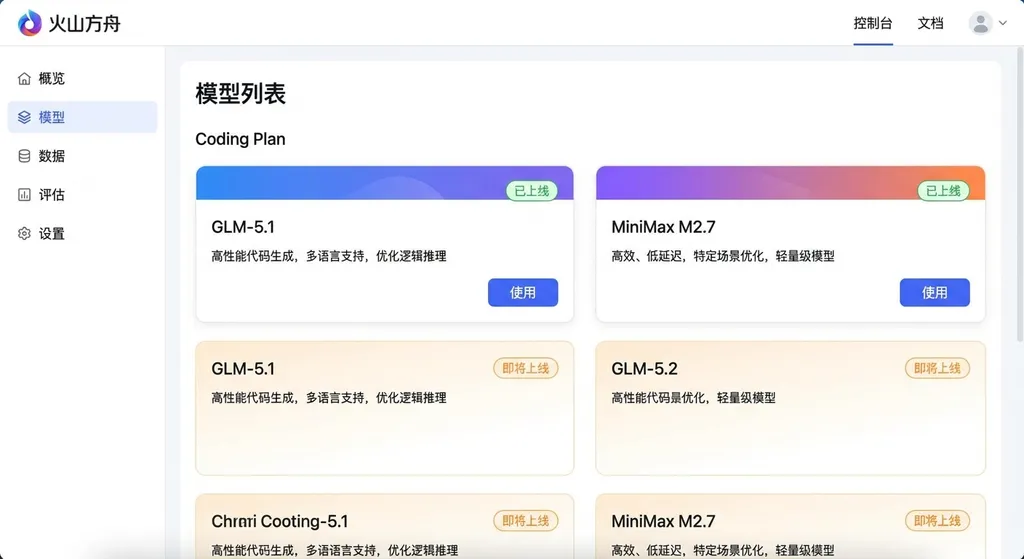
What business is Volcano’s Coding Plan actually in?
To grasp the significance of this update, it’s key to understand what Volcano Ark’s Coding Plan really is.
Simply put, it’s a subscription-based aggregator of AI coding models. For a single subscription fee (Lite or Pro plan), you can access all supported models on the platform, with quotas shared across models and tools. It’s compatible with popular AI coding tools like Claude Code, Cursor, and VSCode—you just configure one Base URL to start switching.
The model’s core selling point: convenience.
Developers no longer need to open separate accounts with Zhipu, MiniMax, and Moonshot, recharge them individually, and manage multiple API keys. Volcano bundles the models under one subscription, claiming costs are roughly one-tenth of standalone API calls. For developers who need to switch frequently between models for testing, this addresses a real pain point.
Currently, Coding Plan supports an impressive lineup:
- Doubao-Seed-2.0-Code (ByteDance’s own model)
- GLM-5.1 (Zhipu)
- GLM-4.7 (Zhipu)
- DeepSeek-V3.2
- Kimi-K2.5 (Moonshot)
- MiniMax M2.7
Together with compatible tools — Claude Code, Cursor, OpenClaw, and VSCode — Volcano is effectively building a “supermarket for models” in the AI coding space.
It’s a clever move. In an era of rapid model iteration — when no one can guarantee which model will dominate which task — betting on a single one is risky. Volcano’s “take them all” strategy lets developers choose freely, even offering an Auto Mode to automatically pick the optimal model based on both performance and speed.
Real community feedback: useful, but with some concerns
Judging from discussions on the linux.do community, developers are “cautiously optimistic.”
The optimism is easy to explain — having more model choices is always welcome, especially since GLM-5.1 is known for strong coding ability.
But concerns are equally concrete. One user asked: “How’s the speed? Will GLM-5.1 also 429?” (“429” refers to the HTTP status code meaning “Too Many Requests,” i.e., rate limiting.) This highlights a long-standing issue for subscription-based model services — performance during peak hours.
Another user was more direct: “Used Volcano Lite for a quarter — decent, but kinda slow in the afternoon.” The likely reason: domestic developer work hours overlap heavily, making afternoons (2–8 PM) peak time for API calls.
Others mentioned that Coding Plan’s usage statistics lack transparency — “Pretty sure it’s just a pie chart; no idea how much I’ve actually used.” For a quota-based service, unclear usage metrics hurt user experience — you can’t plan usage if you don’t know how much remains.
Volcano claims to use a “multi-tenant isolation architecture” ensuring independent resources per user, with the Pro plan offering higher TPM (tokens per minute). Whether this holds true, however, will depend on real-world results after GLM-5.1 and M2.7 go live.
The evolving landscape of domestic AI coding services
Zooming out, this update reflects a larger trend in China’s AI coding space — shifting from “selling models” to “selling services.”
In the past year, the focus was on benchmarks — who scored better, who had more parameters. By 2026, however, developers care less about leaderboard ranks and more about:
- Can I use it directly in my preferred tool?
- Does it slow down during peak hours?
- How much does it cost per month?
- Is there support when problems occur?
All four are service questions, not model questions.
Volcano Engine has a natural advantage — backed by ByteDance’s infrastructure and engineering expertise. With ByteDance itself heavily using AI coding tools internally, Coding Plan has strong foundations in reliability and deployment. Its companion tools, ArkClaw and OpenClaw, further aim to build a closed-loop ecosystem spanning models, tools, and collaboration.
Yet, rivals aren’t standing still. Zhipu has its own GLM Coding Plan, Moonshot offers Kimi coding services, and DeepSeek’s API is already known for cost-effectiveness. Volcano’s differentiator is that “it has everything,” though that breadth may come at the cost of deep optimization for individual models.
For developers, that’s ultimately a good thing — more competition means lower prices and better services.
A noteworthy detail: unrestricted purchase
Volcano was careful to emphasize that GLM-5.1 comes with “unlimited purchase.” There’s a story behind those words.
In earlier phases, some models on Coding Plan had usage or rate limits during launch periods. “Unlimited purchase” means Volcano has secured enough compute resources for GLM-5.1, ensuring supply won’t be a bottleneck.
Of course, “unlimited purchase” ≠ “unlimited speed.” You can buy as much as you want, but your per-minute token cap still depends on your plan tier — something developers should keep in mind.
Practical tips for developers
If you’re already a Coding Plan subscriber, this update is free — GLM-5.1 and M2.7 automatically appear in your available model list with no extra setup.
If you’re considering joining, here are a few points for reference:
- If you mainly use Cursor or Claude Code for daily coding, Coding Plan’s multi-model switching is genuinely attractive. One Base URL handles all models — no API key juggling.
- If you rely heavily on one specific model (say, just DeepSeek), the native API might be more cost-efficient.
- If you need to conduct A/B testing across models to find the best fit for your project, Coding Plan’s subscription-based structure is currently among the most cost-effective options.
It’s worth noting that similar aggregation models have already succeeded in API services. For example, platforms like OpenAI Hub let you call GPT, Claude, Gemini, and DeepSeek with one key, through an OpenAI-compatible interface and domestic connectivity. Volcano’s approach is similar but more focused on coding use cases, plus the added value of subscription pricing.
What to watch next
In the short term, a few things are worth tracking:
- GLM-5.1’s actual inference speed and stability on Volcano’s Coding Plan. Many are already asking about 429s; its first-week performance will be telling.
- Competitor response speed. Will Zhipu’s or Moonshot’s own Coding Plans also integrate other models? If everyone moves toward a “model supermarket” model, the competition will shift to infrastructure and pricing.
- Detailed evaluation of MiniMax M2.7. There’s little public data on it yet; community testing will reveal its true coding performance.
The domestic AI coding ecosystem is maturing fast. A year ago, developers were still asking “Can domestic models even work?” Now the question is, “There are so many options — which one should I use?” That alone is progress.
References:
- Volcano Coding Plan supports GLM-5.1 + MiniMax M2.7 discussion thread — Developer discussions and speed feedback from the linux.do community


