
OpenAI open-sources a privacy-filtering small model with 150 million parameters that runs in the browser.
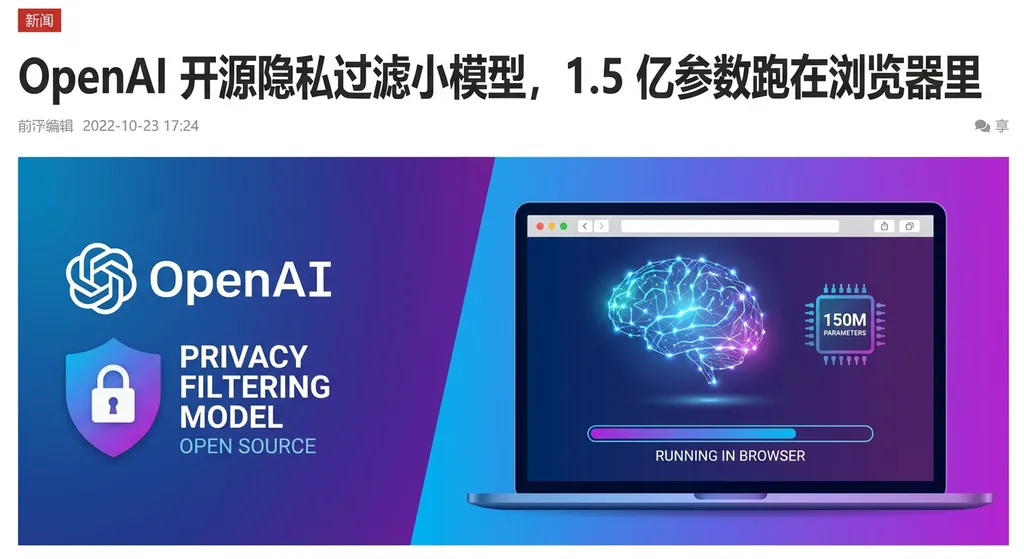
OpenAI releases the open-source privacy filtering model **privacy-filter**, featuring only 150 million parameters and 50 million active parameters, supporting a 128K context. Licensed under Apache 2.0, it can run in browsers and on laptops, providing developers with a lightweight PII detection solution.
OpenAI didn’t release a large model this time—it released a small one.
In April 2026, OpenAI open-sourced a privacy-filter model on Hugging Face. It has a total of 150 million parameters, with only 50 million active ones. Licensed under Apache 2.0, it can run in a browser. This is probably OpenAI’s most "unassuming" model to date—but the problem it solves is anything but small.
An Underrated Necessity
Any developer who’s worked on AI applications involving user data knows that privacy information filtering is a notorious pitfall.
What do you do when your RAG pipeline accidentally includes users’ phone numbers, ID numbers, or email addresses? What if your training data contains clients’ real names and addresses—did you sanitize them? Are your logs storing users’ credit card numbers in plain text, and does your compliance team know?
The traditional approach is to write regular expressions. It’s manageable for fixed formats like phone numbers and emails, but as soon as you encounter natural language descriptions like “I live in Building 3, Room 1502, Chaoyang District,” regex falls apart. And cross-language scenarios are a nightmare—Chinese addresses, Japanese names, Arabic phone numbers—each needs its own rule set, and maintenance costs skyrocket.
Some people use NER (Named Entity Recognition) models, which work a bit better, but generic NER label systems aren’t designed for privacy use cases. There’s still a gap between “person name” and “name that needs anonymization.” Others just call GPT-4 for PII detection—it works great, but are you willing to spend a few cents per log entry on an API call? At scale, your finance department will want a word.
OpenAI’s privacy-filter aims precisely at this gap.
Architecture: Not Generative, a Classifier
The most interesting part of this model is its architectural choice.
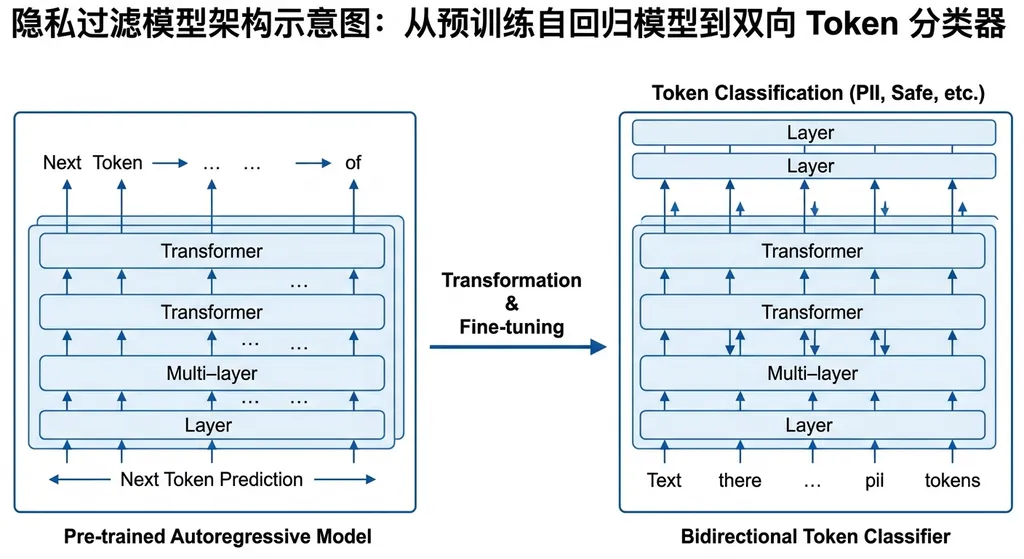
According to the model card, privacy-filter training has two stages:
Step one: Pretrain an autoregressive model based on GPT-OSS architecture, obtaining a smaller checkpoint with a similar structure. This is just like standard language model training, allowing the model to learn “language understanding.”
Step two: Convert that autoregressive model into a bidirectional token classifier and perform supervised fine-tuning with classification loss. The model no longer generates tokens one by one—it labels each token in the input sequence in a single forward pass, then uses a constrained Viterbi algorithm to decode coherent tag sequences.
This design deserves some elaboration.
Autoregressive models (like GPT) generate one token at a time, so their inference speed scales with sequence length. But PII detection is a sequence labeling task—given text, tell me which parts are phone numbers, which are addresses, which are names. It doesn’t require generating anything.
So OpenAI made a pragmatic design: use autoregressive pretraining to gain language understanding, then “bend” the model into a bidirectional classifier for inference. “Bidirectional” means it can consider both previous and following context—critical for entity recognition. Viterbi decoding ensures globally optimal results, avoiding illegal tag transitions like “B-PHONE” followed directly by “B-ADDRESS.”
An analogy: you train someone to have reading comprehension, then make them an exam grader—they don’t need to write essays, just rapidly and accurately mark answers.
8 Output Categories
The label system includes 8 output classes. While the model card doesn’t list them all, typical privacy filters cover these core types of PII:
- Person Name
- Phone Number
- Email Address
- Physical Address
- ID Number
- Financial Account
- Date/DOB
- Other Sensitive Information
Eight categories aren’t many, but they’re sufficient for most compliance cases. The model can also be fine-tuned—if your application needs to identify domain-specific sensitive data (like medical record numbers), you can train further on top.
The Real Killer Feature: Small, Fast, Local
Frankly, if privacy-filter were 7B or even 3B in size, it wouldn’t be nearly as appealing. There are already many open-source models for NER and PII detection—GLiNER, Universal NER, etc.
But 150M total parameters and 50M active parameters—this changes the game.
Comparison:
| Model | Parameter Count | Runs in Browser | Context Length | License | |--------|-----------------|-----------------|----------------|----------| | privacy-filter | 150M (50M active) | Yes | 128K | Apache 2.0 | | GLiNER-large | 400M+ | Barely | 512–1024 | Apache 2.0 | | GPT-4o (API) | Undisclosed | No (cloud-only) | 128K | Commercial | | spaCy NER | ~15M | Yes | Unlimited | MIT |
spaCy is smaller, but as a rule-based/statistical NLP tool, it’s weak at identifying PII in complex contexts. GLiNER performs well but is too large for browser deployment. GPT-4o has the best quality but is expensive and slow for high-throughput cases.
privacy-filter hits a perfect niche: smarter than traditional NLP, cheaper and faster than large models, and small enough to run in-browser.
The 128K context window is also noteworthy. The model card emphasizes “no chunking for long texts,” meaning you can feed in whole documents without splitting or merging sections. For processing contracts, reports, or emails, this saves substantial engineering effort.
Runtime Controls: Balancing Precision and Recall
Anyone experienced in information extraction knows that precision and recall are eternally at odds.
In privacy filtering, this tradeoff is critical:
- High recall = “better safe than sorry”—capture all potential PII, but risk false positives like tagging fictional names as real ones.
- High precision = “only tag the certain ones”—avoid false positives but miss some hidden PII.
Different industries need different balances. Finance compliance needs extremely high recall (missing one ID number is an incident). Content publishing cares more about precision—you can’t redact every public figure’s name.
privacy-filter offers preset operating points to adjust this tradeoff, and it also allows span-length control. Very practical—developers don’t need custom threshold tuning; just pick a preset.
In OpenAI’s Open-Source Strategy
This model wasn’t released in isolation.
Recent OpenAI activity reveals a clear open-source safety toolchain:
- gpt-oss: OpenAI’s open base model family, the foundation for privacy-filter’s architecture
- gpt-oss-safeguard: Open-source content safety classifier with customizable policy and chain-of-thought output
- privacy-filter: Open-source privacy model focused on PII detection
- Youth Safety Policy: prompt-format safety standard developed with Common Sense Media
See the pattern? OpenAI is building a full open-source safety infrastructure.
gpt-oss-safeguard handles content safety (violence, sexual, hate speech).
privacy-filter handles data privacy (personal information in text).
Together they cover the two fundamental axes of AI safety.
The strategy is clear: OpenAI wants to be the infrastructure provider for AI safety—not just selling APIs, but defining safety standards, offering tools, and cultivating an ecosystem. Once your entire safety stack depends on OpenAI’s tools, your “dependency” is no longer just an API key.
Meta did this with Llama. Google did it with Android. Open-sourcing isn’t charity—it’s ecosystem strategy.
Practical Use Cases
Likely real-world applications for privacy-filter:
- RAG pipeline preprocessing. Before documents are chunked or vectorized, run them through privacy-filter to label/remove PII. This is far more reliable than filtering at output—governance at the source is always better.
- Logging and monitoring systems. Logs often leak user data, especially during debugging. Inserting privacy-filter before logs are written can automatically sanitize sensitive fields, reducing leakage risk. It’s lightweight and low-latency enough for inline use.
- Client-side privacy protection. Its browser compatibility enables local privacy checks—before sending input to a server, users can be prompted: “Your message contains a phone number. Proceed?” Data never leaves the device.
- Training data cleaning. Data cleaning before model training is crucial; PII filtering is a major part. With 128K context and high throughput, privacy-filter can efficiently process large corpora.
- Compliance auditing. Regulations (GDPR, CCPA, China’s PIPL) require strict PII handling. privacy-filter can automate scans of databases and documents, producing PII distribution reports.
Limitations and Caveats
Of course, it’s not perfect.
First, 8 categories aren’t comprehensive. Special domains (biometric, genetic, religious data) may need fine-tuning. Thankfully, Apache 2.0 licensing makes this easy.
Second, 150M parameters can’t match large models in nuanced interpretation. For instance: “Xiaoming cited Zhang San’s research.” Is “Zhang San” a real person (thus sensitive) or a public academic reference? Small models can struggle with such semantic nuance.
Third, multilingual ability is uncertain. The model card doesn’t specify supported languages. Given GPT-OSS’s English-heavy training data, performance on Chinese/Japanese, etc., may require evaluation. If your domain is non-English, test before production.
Fourth, Viterbi decoding ensures global optimality but requires dynamic programming across the entire sequence. For 128K-long texts, that can mean noticeable computational overhead. Watch latency during deployment.
How It Stacks Up
Current PII detection tools generally fall into three categories:
- Rule-based: e.g., Microsoft Presidio. High interpretability, fast, but weak for natural-language PII and hard to maintain.
- Traditional NLP: e.g., spaCy + custom NER. Flexible but requires extensive labeled data and tuning.
- Large-model-based: e.g., GPT-4, Claude. Best accuracy, but expensive, slow, and data leaves your system.
privacy-filter opens a fourth path: applying large-model methodology (pretraining + fine-tuning) to produce a compact dedicated model. It inherits language understanding but keeps costs and deployment ease similar to classical NLP.
Simply put: for most production environments needing PII detection, privacy-filter is likely to become the go-to choice—or at least a top contender. It strikes a strong balance between performance, cost, and flexibility.
For high-stakes, accuracy-critical use cases (like finance compliance), treat privacy-filter as layer one filtering—then run flagged spans through a large model for confirmation. Total cost remains far below full large-model inference.
What It Means for Developers
Privacy protection is shifting from “optional” to “mandatory.”
Globally, privacy laws are tightening. GDPR fines reach hundreds of millions of euros; China’s PIPL enforcement is intensifying. For AI developers, “does my model or pipeline leak user data?” is no longer a problem you can fix later.
By open-sourcing privacy-filter, OpenAI effectively lowers the compliance barrier for everyone. Previously, you had to either pay for commercial PII detection, train your own model, or rely on brittle regex. Now there’s a free, open-source, capable option.
Recommendations for AI teams:
- Add a PII detection step to your data pipeline—no matter what tool you use.
- Evaluate privacy-filter on your own data and language.
- If results are lacking, fine-tune privacy-filter rather than training from scratch.
- Consider multi-layer defenses—never rely on a single tool.
Privacy filtering won’t win you praise when it works—but failing to do it will cause serious trouble. OpenAI has given you a low-cost starting point. The rest is up to you.
If you already use API hubs to call model endpoints, inserting a local privacy-filter preprocessor is a near-zero-cost, high-benefit safety upgrade. Run PII detection locally, sanitize, then send upstream—much more peace of mind.
References:
- openai/privacy-filter model card – Hugging Face — official model page with architecture details and usage notes
- Discussion of openai/privacy-filter small privacy model – Linux.do — community discussion and Chinese analysis


