
Vertex AI has been renamed — Google’s ambitions can no longer be hidden.
Google has integrated Vertex AI into the new Gemini Enterprise Agent Platform. This is not just a rebranding, but a key step in shifting Google’s AI platform narrative from “model serving” to an “agent factory.”
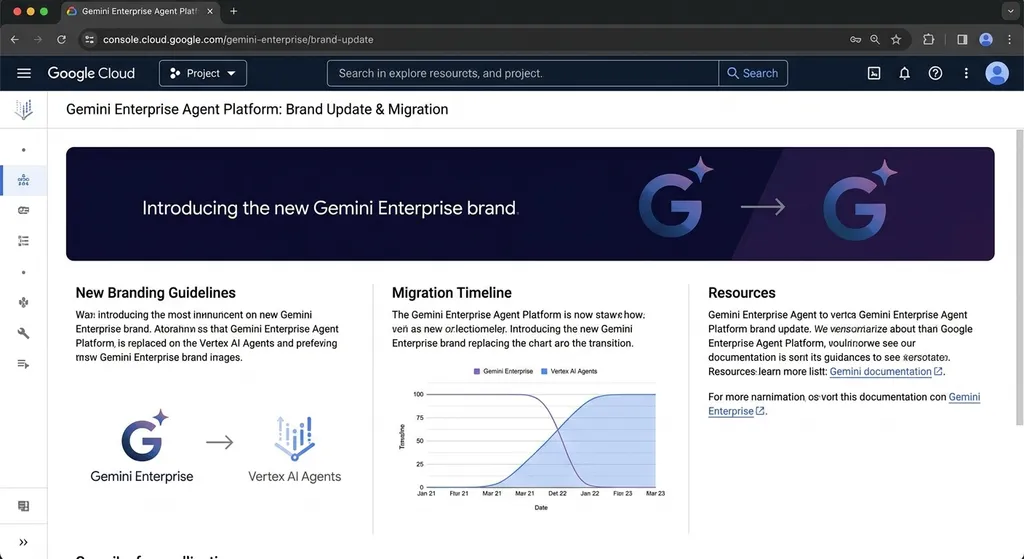
This week, Google did something that looks small but is actually big: it stuffed Vertex AI into a new brand called Gemini Enterprise Agent Platform.
If you open Google Cloud documentation today, you’ll see that all the pages that used to say “Vertex AI” have quietly changed their URLs and breadcrumb trails to gemini-enterprise-agent-platform. The console interface? No change yet. API endpoints? Still the same. Model list? Gemini 3, Gemini 3.1 Pro, Claude Opus — all still there.
So the community’s first reaction was: “Feels no different,” “just a name change, right?”
That’s both true — and not.
Behind the Name Change: From “Platform” to “Factory”
First, the facts. Since its 2021 release, Vertex AI has always been positioned as Google Cloud’s unified ML platform — you could train models, deploy inference, do MLOps, and call Gemini on it. It was a toolbox.
But the new name Gemini Enterprise Agent Platform sends a completely different signal. Break down the three keywords:
- Gemini: Brand unification. It’s no longer a sub-product of Google Cloud, but part of the core Gemini brand line. This is similar to how OpenAI puts everything under the ChatGPT brand.
- Agent: Narrative shift. Instead of giving you a model to piece together yourself, it’s about helping you build “agents that get work done.” This has been the main theme across the industry since 2025, and Google doesn’t want its naming to lag behind.
- Enterprise: Customer anchoring. It tells Wall Street and CIOs explicitly: this is for enterprises — not for folks playing around with a $300 free credit.
In other words, Google wants market perception to move from “Vertex AI is a machine learning platform” to “Gemini Agent Platform is an enterprise-grade agent-building platform.” The former sounds like infrastructure; the latter sounds like a solution.
That difference may not matter to developers, but for Google Cloud’s sales team, it means a completely different pitch deck.
What’s Changed Technically
Honestly, so far — almost nothing.
According to the official docs, all of Vertex AI’s existing capabilities have simply been ported over:
- Model Garden: It’s still the same Model Garden — Gemini series, Claude, Llama, and other third-party models are all there.
- Serverless Training: Custom training jobs, hyperparameter tuning, distributed training — interfaces unchanged.
- Vertex AI Search & Conversation: Now called the search and conversation module under Agent Platform, used for RAG and grounding.
- Vertex AI Agent Builder: This part fits most naturally — Agent Builder was already the Vertex AI tool for agent orchestration, it’s just been elevated from “sub-feature” to “core platform narrative.”
If your current project runs on Vertex AI, you don’t need to change a line of code. API calls, SDK versions, and IAM permission models all remain compatible. Google’s documentation even still uses the vertex_ai namespace extensively.
However, one thing worth noting: the documentation structure is being reorganized. It used to follow the ML lifecycle — “Train → Deploy → Predict → Monitor.” Now it’s shifting toward an agent lifecycle — “Build Agent → Ground → Tool Integration → Deploy.”
That means even though nothing’s changed technically today, Google’s direction for future feature development is clear: everything will revolve around agents.
Why Now
The timing is interesting.
From late 2025 to early 2026, the whole AI industry experienced an “agent narrative explosion”:
- OpenAI doubled down on Operator and Codex Agent, embedding agent capabilities directly into the ChatGPT ecosystem.
- Anthropic’s Claude launched deep integrations for Computer Use and Tool Use, allowing models to operate external systems directly.
- Microsoft upgraded Copilot Studio into an enterprise-grade agent-building platform, deeply tied to Dynamics 365 and Power Platform.
- AWS Bedrock introduced new agent orchestration features at re:Invent.
Technically, Google isn’t lagging behind — Vertex AI Agent Builder was launched last year, and Gemini’s Function Calling has been iterating steadily. But in branding, “Vertex AI” sounds too much like a traditional ML platform. When competitors are all shouting “Agents,” and you’re still saying “Unified ML Platform,” you sound a bit behind.
So this rename is essentially a branding catch-up. The tech didn’t change — the story did.
What It Means for Developers
Short Term: Do Nothing
If you’re currently using the Vertex AI API, you don’t need to migrate. The google-cloud-aiplatform SDK package name hasn’t changed. The REST API base URL is the same. Project configs are unchanged. Google has always been conservative about these things — they won’t suddenly break existing users.
Mid Term: Watch for New Agent Features
Since the brand narrative is now about Agents, you can expect Google to focus heavily on:
- Multi-step agent orchestration: Like LangGraph-style stateful workflows, natively integrated into the platform.
- Improved Grounding: Vertex AI Search’s grounding capabilities will continue to grow, especially connecting with Google Workspace data sources.
- Tool Ecosystem: More prebuilt Tool Connectors so agents can call internal enterprise systems directly.
- Evaluation and Monitoring: Since agent behavior is much more complex than single inference calls, expect Google to launch a dedicated agent evaluation framework.
Long Term: Risk of Platform Lock-in
This is something to think carefully about. When Google puts everything into a big “Gemini Enterprise Agent Platform,” the subtext is clear: you’re expected to handle the full process here — model selection, agent building, data grounding, and deployment monitoring.
For large enterprises, that’s appealing — one-stop solution, simpler integration. But for small teams or indie developers, this “all-in-one” approach means deeper platform lock-in.
And honestly, Vertex AI has never been that friendly to individuals. The frequent complaint — “can’t apply for Opus quota, just stuck with $300 credits” — is a perfect example. Google Cloud’s pricing and quota system are designed for enterprises. A name change won’t fix that.
If you’re an independent developer or small team looking to flexibly call models from multiple vendors without being tied to one platform, using a model aggregator service may be more practical — for example, a unified API (like OpenAI Hub) that lets you switch between Gemini, Claude, and GPT models without juggling multiple accounts, permissions, and billing setups.
Is Google Finally Cleaning Up Its AI Brands?
When it comes to branding, Google is infamous for messy product naming in its AI lineup.
Let’s review the evolution:
| Time | Branding Move | |------|----------------| | 2021 | Vertex AI launched as the unified ML platform | | 2023 | Bard launched, later renamed Gemini | | 2023 | Duet AI launched, later merged into Gemini for Workspace | | 2024 | Gemini brand unified across consumer products | | 2025 | Vertex AI Agent Builder released | | 2026 | Vertex AI → Gemini Enterprise Agent Platform |
You can see the trend: Google is consolidating all AI products under the Gemini umbrella. Consumers have Gemini App, developers have Gemini API, and enterprises now have Gemini Enterprise Agent Platform.
Is that the right move? From a brand consistency perspective — yes. OpenAI has ChatGPT / API / Enterprise; Anthropic has Claude / Claude for Enterprise. The branding lines are clear. Google’s problem was always having too many overlapping product names — users couldn’t tell Vertex AI, Gemini API, AI Studio, and Generative AI Studio apart.
Execution, though, is another question. Google retires products as fast as it launches new ones. Developers carry an inherent distrust of Google’s long-term branding promises. If this renaming is purely cosmetic, without actual product integration, it may deepen that distrust instead of fixing it.
Compared to Competitors, Where Does Google Stand?
Objectively speaking, in the enterprise AI platform race, Google’s position is “technically solid, but behind in experience and ecosystem.”
Versus Azure AI / Microsoft: Microsoft’s biggest advantage is Office 365 penetration. When your enterprise already uses Teams, Outlook, and SharePoint, Copilot Studio agents integrate seamlessly with those workflows. Google has Workspace, but its enterprise market share still trails.
Versus AWS Bedrock: AWS wins on customer base and infrastructure maturity. Many enterprises already have their data on AWS, making Bedrock the path of least resistance for model integration. Google Cloud’s smaller market share limits its ceiling in this space.
Versus OpenAI: OpenAI wins on model capability branding and developer ecosystem. Many developers’ first AI projects use the OpenAI API — that early-mindshare advantage is hard to overcome. Google’s Gemini models are strong, but they don’t yet occupy the same position in developers’ minds as GPT.
So this rename is, in a way, Google’s acknowledgment: “Just having good models isn’t enough.” You need to tell a complete story at the platform level. Agent Platform is that story.
A Deeper Question
Here’s something more fundamental: is the concept of an “Agent Platform” even fully valid yet?
Every cloud vendor is pushing agent platforms, but when you actually try them, most enterprise agent use cases remain fairly basic — RAG Q&A, workflow automation, data queries. Truly autonomous, multi-step, decision-making agents in production are still rare.
Why? Because model reliability isn’t there yet. If your agent needs to make 10 consecutive decisions, each with 95% accuracy, the final success rate is only 60%. That’s unacceptable for enterprise-grade apps.
So by calling it an Agent Platform, Google is really placing a bet on the future — betting that model reliability will improve, that those problems will be solved in a year or two.
Whether that bet pays off is unclear. But directionally, the whole industry is moving this way. Google doesn’t want to fall behind, even if it’s just a name change for now.
Summary
The merger of Vertex AI into Gemini Enterprise Agent Platform has no immediate technical impact for developers. APIs remain the same, functionality unchanged, pricing identical. But it sends a clear signal: Google is shifting its AI platform narrative from “model-as-a-service” to “agent-as-a-platform.”
For teams already on Vertex AI — keep using it, and watch for upcoming agent features. For those evaluating platforms — the rebrand alone isn’t a reason to pick Google Cloud; look at features, pricing, and how it fits your stack.
As for individual developers — Google Cloud still isn’t the friendliest choice. After your $300 credit runs out, you’ll likely go back to more flexible options.
References
- Vertex AI is now part of Gemini Enterprise Agent Platform - Community Discussion — Thread on Linux.do discussing this brand integration, including first-hand developer feedback


