
ByteDance Seed3D 2.0: 3D Generation Scaled to Industrial Level

ByteDance today released the 3D generative large model **Seed3D 2.0**, which adopts a **Coarse-to-Fine** two-stage strategy and an **MoE** architecture. It achieves **SOTA** performance in both geometric and PBR texture generation, and the API is now available on **Volcengine**.
ByteDance Seed3D 2.0: From 3D Generation to Industrial Grade
ByteDance today released Seed3D 2.0, a large 3D generative model designed for industrial-grade applications. The API is simultaneously available on Volcano Engine, and the technical report has been made public.
To put it simply: This may be the best publicly available 3D generative model in terms of geometric precision and material realism.
Why It’s Worth Paying Attention
3D generation has been a hot field over the past two years, but to be honest, most generated results are still far from being truly usable. In gaming, film, and e-commerce scenarios, 3D assets need more than just to “look roughly right”—they require clean geometry, reasonable topology, and materials that respond correctly under varying lighting conditions. These have been exactly the weak points of previous 3D generative models—it's easy to generate a rough cup shape, but its rim turns blurry, thin walls collapse, metal and roughness boundaries blend together, and the meshes are useless in downstream rendering engines.
Seed3D 2.0 directly targets these pain points.
Technical Breakdown
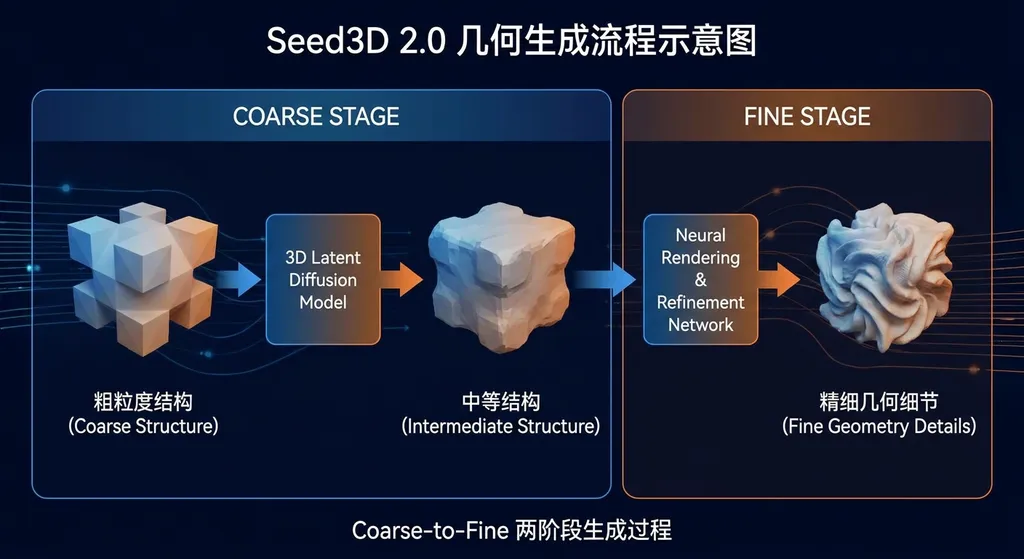
Geometry Generation: Coarse-to-Fine Two-Stage Strategy
Seed3D 2.0’s core architectural innovation lies in splitting geometry generation into two steps: first generating the coarse overall structure, then refining the details.
The idea itself isn’t new—image super-resolution tasks have used similar strategies for years. But in 3D generation, decoupling “coarse” and “fine” isn’t as intuitive as in 2D images. For example, a mechanical part’s overall contour and its surface features like chamfers, threads, or clips are highly coupled in three-dimensional space. Seed3D 2.0 explicitly decouples “global structure” and “geometric details,” optimizing them in separate stages: the first focusing on topological correctness, and the second on sharpness and detail accuracy on the surface.
This produces three clear improvements:
- Sharp edges no longer blur (e.g., knife blades, architectural corners)
- Thin-walled structures remain intact (e.g., eyeglass frames, leaves)
- Complex topology no longer causes self-intersections or broken surfaces (e.g., chains, woven structures)
These three issues have been the most commonly criticized weaknesses of past 3D generative models. Developers who have done 3D printing or game modeling know well—a mesh with poor geometry will cause problems for downstream UV unwrapping, rigging, and physics simulation.
Texture and Material: MoE Architecture + VLM Priors
Material generation is another major highlight of Seed3D 2.0.
Some background: Modern rendering engines (Unreal, Unity, Blender’s Cycles) generally use PBR (Physically Based Rendering) materials. A full PBR material is not just a single "color map" but a set of maps combined—Base Color, Normal, Metallic, Roughness, Ambient Occlusion (AO), etc. There are strict physical relationships between these channels—for instance, areas with high metallic values tend to have darker, less saturated base colors; areas with low roughness produce sharper reflections.
Previous 3D generation models mostly generated just a color map, or generated separate PBR channels independently and then stitched them together. The result looked “fake”—metals didn’t look metallic, plastics didn’t look plastic, and the illusion broke down under realistic lighting.
Seed3D 2.0 uses a unified generative model to jointly model the full set of PBR maps—meaning all channels are generated together, and the model learns the physical constraints among them during training.
Architecturally, it uses a MoE (Mixture of Experts) structure. MoE has already proven effective in large language models (GPT-4 is widely believed to use MoE; DeepSeek-V2/V3 do as well). The key advantage is sparse expert routing, allowing total parameter size to grow while keeping inference cost manageable.
In 3D material generation, MoE’s benefits are concrete: different experts can specialize in different kinds of material details. For instance, some handle transitions between metallic and rough areas, others handle high-frequency texture details (fabric weaves, wood grain), and others process large smooth gradients. This improves resolution and detail richness without linearly increasing compute cost.
Another noteworthy design is the introduction of VLM (Vision-Language Model) priors to enhance material decomposition stability.
This solves a classic challenge—when the input image’s lighting conditions are unknown, models struggle to distinguish between an object’s inherent color and lighting-induced shading. For example, in a photo of a white ceramic cup under warm lighting, the model might bake the color cast into the base color map. The VLM prior gives the model "common sense"—it has seen enough text-image pairs to know ceramics are usually white, metals typically have certain reflective characteristics—allowing more accurate material decomposition even under imperfect lighting.
Evaluation: Blind Test by 60 Professional Reviewers
ByteDance didn’t rely only on automated metrics—it conducted solid human evaluations.
They recruited 60 reviewers with 3D modeling experience to perform blind pairwise comparisons between Seed3D 2.0 and six mainstream 3D generation models. The evaluation covered two dimensions:
- Quality of pure geometry generation
- Quality of full 3D asset generation with textures
Results show Seed3D 2.0 achieved the highest preference rate in both dimensions. In textured 3D asset generation especially, Seed3D 2.0’s preference rate surpassed 69% against current mainstream models.
What does 69% mean? In pairwise comparisons, 50% is random chance, 60% indicates a clear advantage, and 69% means about 7 out of 10 comparisons judged Seed3D 2.0 better. Given that reviewers were professional modelers (not casual crowdworkers), the result is fairly convincing.
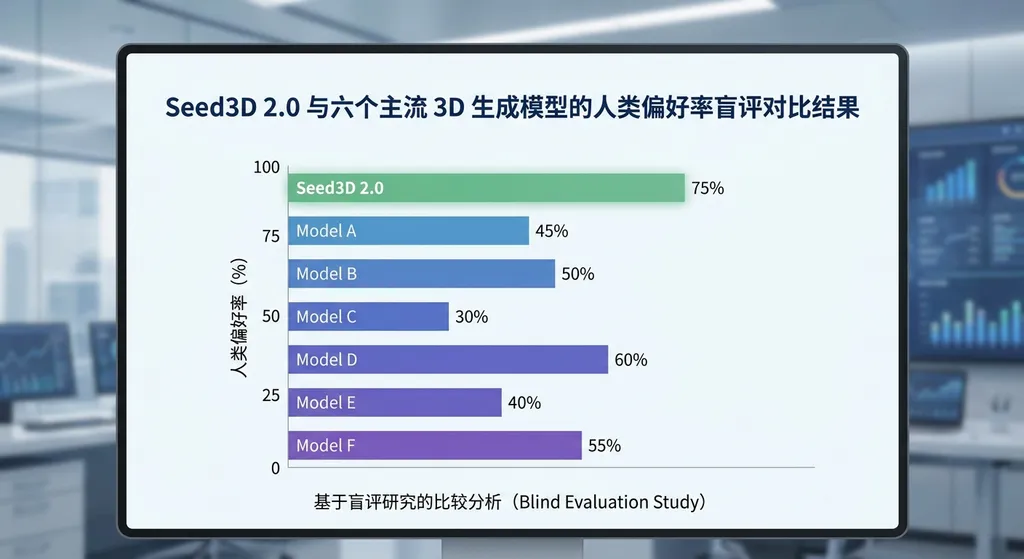
Of course, the limitations of human evaluation should be clear: 60 participants are not a large sample, and the test set’s coverage (object types, complexity) affects generalization. ByteDance has published the full report, where these details are documented.
Beyond Generation: Part Segmentation, Articulated Assets, Scene Composition
Seed3D 2.0 is more than an “input text/image → output 3D model” generator. The technical report showcases several extended capabilities:
- Part-level segmentation and completion: The generated 3D model isn’t a single solid mesh block but can be automatically segmented into semantic parts—for example, a chair broken into seat, back, and legs. Missing parts can be automatically completed.
- Articulated asset generation: It can create movable assets with defined joint constraints—for example, a robotic arm with pre-defined rotation axes and motion ranges ready for physics simulation.
- Scene composition generation: Based on image, video, or text input, it can generate full scenes containing multiple objects, not just single items.
These capabilities elevate Seed3D 2.0 from “generating visually nice 3D models” to “generating usable 3D assets.” For applications like game development, robotics simulation, and digital twins, part segmentation and articulation constraints may be even more valuable than geometric precision—because they are prerequisites for integrating generated assets into real production pipelines.
Comparison with Competitors
The main players in 3D generation currently include:
- OpenAI’s research (e.g., Shap-E)
- Google DeepMind’s related projects
- Stability AI’s former 3D generation models
- Startups focused on 3D generation, such as Tripo and Meshy
- University lab open-source efforts
Seed3D 2.0’s advantages stand out in two areas: first, its geometric precision and material realism are currently top-tier based on public evaluations; second, it goes beyond generation by supporting part segmentation and articulated assets, which are rare among peers.
Its weaknesses or uncertainties: the API is available only on Volcano Engine for now, which limits ecosystem openness; pricing and usage limits are unclear; and its consistency and stability in production environments require more user validation. Also, the 3D generation field evolves quickly—SOTA models rarely stay on top for long.
What It Means for Developers
If you’re working in any of these domains, Seed3D 2.0 deserves attention:
- Mass production of 3D assets in game development
- 3D product visualization in e-commerce
- Scene construction for robotic simulation
- Physical-world modeling in digital twin projects
- Rapid prototyping for AR/VR content
The API is already available on Volcano Engine for direct testing. For teams needing large numbers of 3D assets but limited modeling manpower, the maturity of such tools is approaching the “usable” threshold.
However, don’t expect too much. There remains a gap between “SOTA” and “production-ready.” Generated outputs still lag behind handcrafted models in consistency and controllability. A more realistic workflow might be using such tools for rapid drafts that artists then refine manually, rather than fully replacing the manual modeling pipeline.
A Final Take
ByteDance has consistently invested heavily in AI infrastructure—from the Doubao large model to the Seed series, and now into 3D generation—the layout is becoming increasingly comprehensive. The release of Seed3D 2.0 suggests that ByteDance isn’t just chasing trends in text or image generation—it’s seriously pursuing 3D, a relatively niche but highly promising domain.
3D generation is important because it could be a key step for AI to move from “generating content” to “generating worlds.” Text, images, and videos are all forms of 2D information, whereas 3D assets are the fundamental building blocks for constructing virtual worlds and linking to the physical world. From this perspective, Seed3D 2.0 is not merely a model release—it’s a significant move for ByteDance into spatial computing and embodied intelligence.
Ultimately, how good the model is will depend on developers’ real-world feedback. The API is open—anyone interested can try it out on Volcano Engine.
References
- ByteDance releases Seed3D 2.0, a large 3D generative model achieving SOTA in geometry and material generation - IT Home: Detailed technical report interpretation and evaluation data


