
Tencent Open-Sources Hunyuan Hy3: A 295B-Parameter Fast-and-Slow Thinking MoE
Today, Tencent released and open-sourced **Mixtral Hy3 preview**, a **Mixture-of-Experts (MoE)** model with **295B total parameters** and **21B active parameters**. It supports a **256K context window**, integrates both fast and slow thinking capabilities, delivers comprehensive upgrades across reasoning, coding, and agent-related tasks, and offers **aggressive API pricing**.
Today, Tencent has laid down the biggest card yet in its Hunyuan series.
On April 23, Tencent officially released and open-sourced the Hunyuan Hy3 preview language model — a Mixture of Experts (MoE) architecture with 295B total parameters and 21B active parameters, supporting up to 256K context length, and natively integrating two reasoning modes: fast thinking and slow thinking.
This is not a routine version update. According to Tencent’s official statement, in February this year, the Hunyuan team “rebuilt” its pretraining and reinforcement learning infrastructure. Hy3 preview is the first model trained after this rebuild. In other words, this marks Tencent’s fresh start in the large-model race.
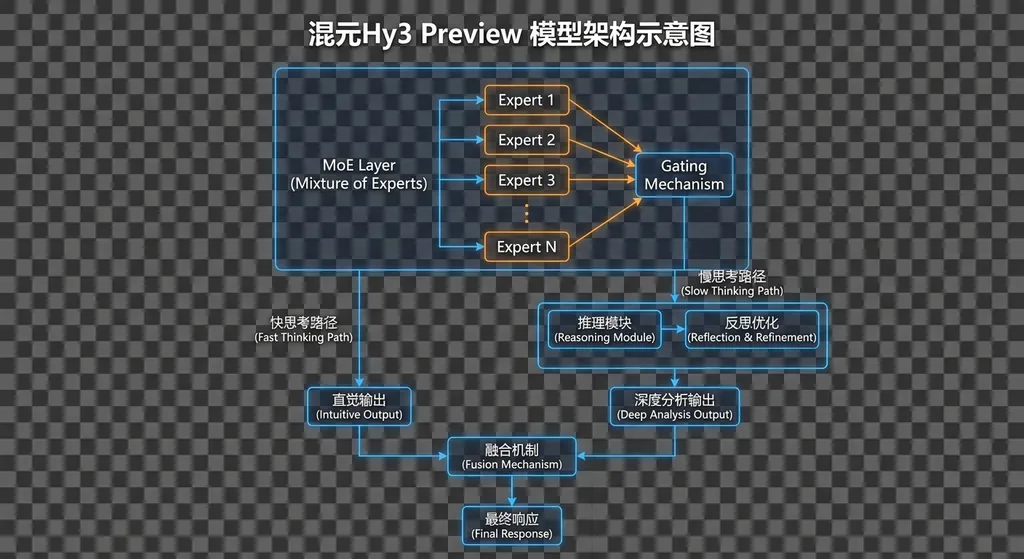
295B Total, 21B Active: Another Milestone on the MoE Path
Let’s look at the hard numbers.
With 295B total parameters and 21B active, Hy3 preview exhibits about 93% sparsity. During each inference, only about 7% of parameters are activated, while the rest of the expert modules remain on standby.
This design idea isn’t new. From Mixtral to DeepSeek-V3 to Qwen3, MoE has already become the mainstream approach for parameter expansion in large models. The logic is simple: you want a model that “knows a lot,” but you don’t want to run through all parameters every time — MoE is the compromise.
Total parameters define the upper limit of a model’s knowledge capacity, while active parameters determine the computational cost per inference.
A quick comparison with contemporaries:
| Model | Total Params | Active Params | Max Context | Architecture | |--------|---------------|----------------|--------------|--------------| | Hunyuan Hy3 preview | 295B | 21B | 256K | MoE | | DeepSeek-V3 | 671B | 37B | 128K | MoE | | Qwen3-235B | 235B | 22B | 128K | MoE | | Llama 4 Maverick | 400B | 17B | 1M | MoE |
Hy3 preview’s total parameter count sits between Qwen3-235B and Llama 4 Maverick, with an active parameter size close to Qwen3 — but its context length reaches 256K, double that of DeepSeek-V3 and Qwen3 base.
What does 256K context mean? Roughly a 200,000-character Chinese novel or the core module of a medium-sized codebase. For long-document analysis, large-scale code comprehension, or multi-turn complex dialogue, this window is sufficient.
Of course, while Llama 4 Maverick claims 1M context, there’s often a large gap between the theoretical and effective usable context — a fact well-known in the industry.
It’s worth noting that Hy3 preview remains a preview version. This typically means ongoing optimization, and the official release may show improvements in parameter efficiency and long-context performance. By open-sourcing now, Tencent is both seizing the time window and leveraging community feedback for faster iteration — a common tactic in the current open model competition.
Fast–Slow Thinking Fusion: Not Every Problem Deserves “Deep Thought”
If the MoE architecture is Hy3 preview’s skeleton, then the fusion of fast and slow thinking is its central idea.
The terms “fast thinking” and “slow thinking” borrow from Daniel Kahneman’s Thinking, Fast and Slow. For large models:
- Fast thinking (System 1): Directly provides an answer without a reasoning chain. Suitable for simple Q&A, routine conversation, or structured output. Fast and token-efficient.
- Slow thinking (System 2): Expands a full chain-of-thought inference, step by step. Suitable for math proofs, complex code debugging, multi-step reasoning. Higher quality, higher token cost.
Over the past year, “thinking models” have become an industry buzzword. OpenAI’s o series, DeepSeek-R1, and Qwen3’s thinking mode all move in this direction. But the downside is obvious: if every query triggers slow thinking, inference costs skyrocket — and many simple queries don’t need it.
If you ask the model “What day is today?” and it spends 500 tokens thinking aloud, that isn’t intelligence — that’s waste.
The goal of fast–slow thinking fusion is to let the model decide for itself when to “think” and when to “speak.”
Earlier this year, Qwen3 attempted something similar via the enable_thinking parameter, which allowed users to toggle modes manually. But that still left the decision to the caller.
Hy3 preview goes further — according to Tencent, the model can adaptively determine reasoning depth based on question complexity.
If this works well, it’s very meaningful for deployment. Imagine a customer service scenario:
- A user asks “How to request a refund?” — fast thinking answers immediately.
- Another asks “I bought product A but received B, which is defective; I want a refund and compensation.” — slow thinking steps in, analyzes conditions, and provides a structured response.
Same model, same API — automatically adapting to query complexity. That’s what production-grade intelligence needs.
Of course, “adaptive” is easier said than done. How does the model assess problem complexity? What if it misjudges? Triggering slow thinking on simple queries only wastes tokens, but misusing fast thinking on complex queries risks wrong answers. Balancing that tradeoff will require real-world testing. In the preview stage, observation matters more than conclusion.
Infrastructure Rebuild: What Lessons Is Tencent Catching Up On?
One line in Tencent’s press release deserves a closer look:
“In February this year, Tencent Hunyuan rebuilt its pretraining and reinforcement learning infrastructure.”
“Rebuilt” isn’t a light word — it implies existing systems had deep enough issues that patching wasn’t enough; a full reset was needed.
Tencent also outlined three pragmatic principles for model development:
- Systematic capabilities — focus on balanced all-around competence, not leaderboard glory.
- Evaluation realism — avoid overfitting to benchmarks; prioritize real-world task performance.
- Cost–performance optimization — find the best tradeoff between quality and cost.
These principles read like a self-correction.
Over the past two years, many domestic models boasted excellent benchmark scores but delivered subpar user experience. Optimization for test sets, narrow evaluation metrics, and neglect of long-tail scenarios all contributed. Earlier Hunyuan versions also weren’t immune.
By explicitly emphasizing “evaluation realism,” Tencent is tacitly acknowledging past missteps — and signaling to the developer community: we’re serious this time; no more benchmark games.
Whether that claim holds up depends on Hy3 preview’s real-world performance. Fortunately, since the model is open-source, the community will soon provide independent evaluations.
Pricing: An Open and Fierce Price War
Now for API pricing — perhaps the most “competitive” part of the release.
Base API prices are tiered by input length:
| Input Tier | Input (¥/M Tokens) | Output (¥/M Tokens) | Cache Hit (¥/M Tokens) | |-------------|-------------------|---------------------|------------------------| | 0–16K | 1.2 | 4 | 0.4 | | 16–32K | 1.6 | 6.4 | 0.6 | | 32–256K | 2 | 8 | 0.8 |
Tiered pricing is pragmatic. Most API calls fall within 16K input, which gets the lowest rate. Longer-context requests cost more, avoiding “paying for unused capacity.”
The cache-hit price deserves special attention — ¥0.4 per million input tokens, one-third of base price. For production tasks with heavy prefix reuse (system prompts, fixed few-shot examples, etc.), this can significantly reduce cost.
Even more aggressive is the Token Plan package:
| Plan | Monthly Fee | Unit Price (¥/M Tokens) | Token Quota (M) | |-------|--------------|-------------------------|-----------------| | Lite | ¥28 | 0.80 | 35 | | Standard | ¥78 | 0.78 | 100 | | Pro | ¥238 | 0.74 | 320 | | Max | ¥468 | 0.72 | 650 |
The Max plan achieves ¥0.72 per million tokens, cheaper than DeepSeek-V3’s official input pricing (¥1 per million input, ¥2 per million output).
The ¥28 Lite plan clearly targets individual developers. For the price of a coffee, you get 35 million tokens — plenty for learning and side projects. Tencent’s intent is clear: attract developers, get them using the model, build habit first; monetization can come later.
This mirrors the broader domestic API market — a full-blown price war approaching the floor. Great for developers; for providers, the challenge will be achieving sustainable business models at these near-zero margins.
Ecosystem Expansion: From Tencent’s Product Suite to Open-Source Agents
Hy3 preview is quickly rolling out across Tencent’s ecosystem. On launch day, it was already integrated into or being deployed within multiple products:
- Already live: Yuanbao, CodeBuddy, WorkBuddy, QQ, iMa, QQ Browser, Tencent Docs, Tencent Lexiang
- In rollout: WeChat Official Accounts, Tencent News, Tencent Stock, Peacekeeper Elite, Tencent Customer Service
This list covers nearly every one of Tencent’s main business lines — social, office, search, gaming, finance, and support.
From “lab product” to “company-wide integration,” the internal rollout is progressing fast.
More interesting is support for open-source agent ecosystems. Tencent states that Hy3 preview already works with OpenClaw, OpenCode, and KiloCode agent frameworks.
That means Tencent isn’t just open-sourcing the model but is also adapting it to community-used agent infrastructures.
For AI agent developers, this brings real benefit:
a 295B-parameter, 256K-context, fast–slow reasoning-capable open model makes an ideal agent brain — combining richer tool descriptions and history within context, while flexibly switching between simple tool calls and complex planning.
The Meaning of Open Source: More Than Just Releasing Weights
In today’s AI landscape, “open source” itself has become a market strategy.
Meta stirred the industry with Llama. DeepSeek built developer reputation rapidly through openness. Qwen occupies an important spot among Chinese open models.
Tencent’s decision to open-source Hy3 preview serves several strategic purposes:
- Win developer mindshare. In the MoE open model track, DeepSeek-V3 and Qwen3 were early movers. To secure a foothold, Hy3 needs developers using, evaluating, and discussing it ASAP.
- Leverage community for faster iteration. A preview model still has optimization headroom; real-world community feedback is more valuable than internal QA.
- Drive traffic to Tencent Cloud’s API services. The model alone doesn’t earn revenue, but cloud APIs, customized deployments, and enterprise support do — the Token Plan pricing clearly aligns with this strategy.
For developers, one more high-quality open option is always good news.
If you’re evaluating models, Hy3 preview deserves a slot — especially if your use cases need long context and advanced reasoning. Once released, tools like OpenAI Hub will make cross-model benchmarking and evaluation even easier.
Cool-Headed Look: Open Questions in the Preview Stage
Lastly, a few cautionary notes — not skepticism, but realistic points for developers making tech decisions:
- Accuracy of adaptive fast–slow thinking. It’s Hy3’s headline feature and the one needing most validation. Wait for independent benchmarks, especially on edge cases.
- Practicality of 256K context. Does attention remain uniform near the upper limit? Is there “middle forgetting”? This affects all long-context models, and Hy3 likely as well.
- MoE deployment challenges. With 295B total parameters, GPU memory demand stays high even for inference. Active params may be 21B, but all expert weights must be loaded. Full local deployment isn’t realistic for individuals; watch for quantized-version tradeoffs.
- Gap from preview to release. Preview models may have stability and consistency issues. For production use, better wait for the official release.
Final Thoughts
The release of Tencent Hunyuan Hy3 preview marks another key milestone in the 2025 Chinese open-model race.
A 295B MoE architecture, 256K context, integrated fast–slow reasoning, and aggressive API pricing — none groundbreaking alone, but together forming a competitive package.
More importantly, they reflect Tencent’s shift in attitude:
From chasing leaderboard scores to pursuing practical utility;
from building behind closed doors to embracing open ecosystems;
from isolated breakthroughs to full-spectrum product integration.
These transformations matter more than the raw parameter count.
As for whether Hy3 preview fulfills its promise — time and the community will tell.
The model is open, the code is out there; now it’s up to every developer willing to try it.
References:
- Hunyuan’s Most Advanced Model Yet: Tencent Releases and Open-Sources Hy3 Preview — IT Home
- Qwen3-Next Technical Analysis: Long Context + High-Sparsity MoE + Hybrid Attention — Zhihu
- Explaining Qwen3’s Mixed and Fast–Slow Thinking Mechanisms — Zhihu
- How Qwen3 Implements Hybrid Reasoning (Fast and Slow Thinking) — Zhihu


