
Alibaba Cloud JVS Crew goes live: Turn Agents into APIs
Alibaba Cloud has officially launched the enterprise-level intelligent agent development platform **JVS Crew**, centered around the concept of *“being integrated.”* Through atomic APIs and SDKs, it enables businesses to quickly embed AI Agent capabilities into their existing products, while taking care of all the platform-level heavy lifting such as multi-tenant isolation and security compliance.
This time, Alibaba Cloud didn’t release a new model. Instead, it turned its focus to a more practical question: how can enterprises actually use AI agents?
On April 23, Alibaba Cloud officially launched an enterprise-level intelligent agent development platform called JVS Crew. In one sentence: it’s not an Agent for you to use, but rather the infrastructure for you to build Agents for others.
This positioning is critical—and it’s also what fundamentally differentiates JVS Crew from most other Agent platforms on the market.
First, clarify one thing: What stops enterprises from building Agents?
The Agent track has been on fire over the past year. From Coze to Dify, from Baidu Qianfan to ByteDance Coze, everyone has been working on “helping you quickly set up an Agent.” Drag some blocks, configure a prompt, connect a few tools, and—boom—you’ve got a conversational Agent.
But then what?
For individual developers, playing around with an Agent is enough. For enterprises, the real pain points have never been at the “building” stage, but rather in everything that comes after:
- Your SaaS product has 5,000 enterprise customers, and each needs a separate Agent configuration and data isolation—how do you do that?
- Agents calling large models incur token costs. How do you measure and allocate these costs precisely per tenant?
- One of your clients’ Agents hallucinates or produces inappropriate content—how do you audit or trace that?
- Your app has been running for three years with a stable architecture. Now you want to add Agent capabilities—do you rebuild everything or integrate progressively?
Each of these problems is enough to keep your tech team working overtime for months. And these are exactly the issues JVS Crew aims to solve.
The core logic of JVS Crew: You build products, I lay the foundation
Alibaba Cloud has defined a clear design philosophy for JVS Crew — “To be integrated.”
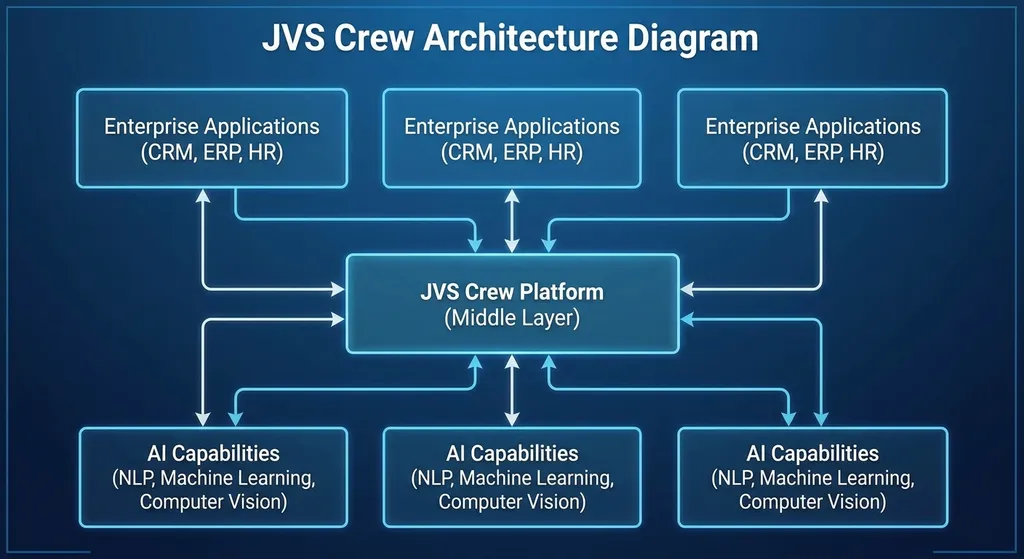
These three words sound simple, but in an environment where Agent platforms all want to be “big and comprehensive,” this approach is remarkably restrained. JVS Crew doesn’t want to be an independent Agent app or steal your user entry point—it wants to serve as the AI infrastructure layer hidden behind your product.
Concretely, JVS Crew takes on roughly 80% of the “heavy lifting” involved in building enterprise-grade Agents:
Multi-tenant isolation: The lifeline of any enterprise product. JVS Crew natively supports multi-tenant architecture—each tenant’s Agent setup, conversation data, and usage logs are fully isolated. If you’re a SaaS provider, each enterprise customer can have an independent Agent instance without interference. Building this yourself would mean significant design work just for databases and permissions.
Security compliance and auditing: Full observability across the system—every Agent request and response is logged and traceable by session, user, and timestamp. For regulated industries such as finance, healthcare, and government, this isn’t just nice to have—it’s a prerequisite.
Cost accounting: JVS Crew has a built-in Credit system that tracks token consumption for every request. Enterprises can set consumption limits per tenant or monitor total resource usage. This means you can offer AI services as a value-added product and keep clear financial records.
Channel integration: Through standardized APIs and SDKs, Agent capabilities can be embedded into apps, websites, mini-programs, or smart devices. You don’t need to build a separate Agent system for each channel.
On the technical side: Atomic APIs are the key
According to Alibaba Cloud’s documentation, JVS Crew’s API design follows an “atomic” approach, divided into four major categories that cover the Agent lifecycle.
This idea is worth unpacking.
Many Agent platforms on the market offer “monolithic” architecture—you configure an Agent on the platform, it gives you a dialogue API, and you just use it. This simplicity comes at the cost of flexibility. If your business logic is even slightly complex—say you need to insert custom business checks mid-conversation or dynamically adjust Agent behavior based on user profile—these black-box interfaces become limiting.
JVS Crew’s atomic API lets you control Agent behavior with finer granularity. Intelligent template creation and management, session lifecycle handling, Skill and MCP tool mounting and scheduling—all can be done through separate API calls.
Think of it this way: a monolithic platform gives you a pre-assembled PC—turn it on and use it, but if you want to swap out a GPU, you’re stuck. Atomic APIs are like standardized spare parts and interface specs—assemble however you want, or just use the pieces you need.
You can see from the documentation that JVS Crew’s feature matrix includes:
| Module | Function | Description | |---------|-----------|-------------| | Agent Template Management | Role settings, model selection, Skill & MCP configuration | Define the core behavioral parameters of an Agent | | Global Monitoring Dashboard | Active users, total sessions, Credit consumption | Operations-level data visualization | | Session Details | Session logs, credit usage, full trace monitoring | Per-request observability | | Billing Management | Credit balance, usage limits, postpaid management | Enterprise-level cost control | | Skill/MCP Centralized Management | Tool registration, permissions control, version management | Unified management of all callable capabilities |
Among these, the Skill/MCP Centralized Management feature deserves special attention.
MCP (Model Context Protocol), proposed by Anthropic last year, is becoming a de facto standard for Agents to call external tools. JVS Crew natively supports MCP, meaning enterprises can plug existing MCP servers directly into the platform so Agents can use those tools—saving a ton of effort compared to building the integration from scratch.
Moreover, centralized management allows unified governance: which tools are available to which tenants, which tools require approval, how invocation frequency and cost are distributed—these are all vital for enterprise environments.
Relationship to JVS Claw: One for consumers, one for businesses
If you follow Alibaba Cloud’s AI updates, you may have heard of JVS Claw, an AI Agent product for mobile launched by Alibaba Cloud’s Wuying team. It emphasizes “create an Agent on your phone in three minutes” with zero code and minimal setup, targeting individual users.
JVS Crew and JVS Claw are part of the JVS Agent Suite, but their roles are entirely different:
- JVS Claw: Targeted at individuals and lightweight use cases. It emphasizes usability and self-learning abilities—users can create, train, and use Agents directly from the mobile app. The core strength is convenience and personalization.
- JVS Crew: Targeted at enterprises and ISVs (independent software vendors). It emphasizes integration, governance, and scalable delivery. Its core strength is embedding Agent capability into enterprise products.
Alibaba Cloud’s strategy is clear: use Claw for user education and ecosystem building—get more people playing with Agents; use Crew for commercialization—help enterprises turn Agent capabilities into actual revenue.
You might say, “Claw breeds the shrimp, Crew mass-produces the lobsters.” It’s a goofy analogy—but accurate: individuals validate the feasibility and value of Agents on Claw, then enterprises are motivated to scale those capabilities through Crew.
Industry context: Who is JVS Crew competing with?
There are already plenty of players in the enterprise-grade Agent platform space.
Dify is the hottest open-source Agent/LLM app development platform—self-deployable, highly flexible, and with a very active community. However, Dify focuses more on helping you build an Agent; features like multi-tenant management, enterprise auditing, and cost sharing often require additional development on top of it.
Coze (by ByteDance) offers a rich ecosystem and solid plugin marketplace. But Coze acts more like an Agent app marketplace: it wants users to create and publish Agents on its platform, rather than integrating them into existing products—fundamentally different from JVS Crew’s “to be integrated” philosophy.
Baidu Qianfan AppBuilder follows a similar path—Agent building and deployment—but it’s tightly coupled with Baidu’s own Ernie models, limiting model flexibility.
Microsoft Azure AI Agent Service is the corresponding overseas solution, also focusing on enterprise-level integration, but has natural limitations around availability and compliance within China.
JVS Crew differentiates itself in three ways:
- “To be integrated” philosophy – It doesn’t compete for your user interface or force migration to a new platform; it embeds directly into your existing tech stack, minimizing adoption cost for mature products.
- Alibaba Cloud’s infrastructure advantage – Elastic computing, security compliance, and multi-region deployment are Alibaba Cloud’s long-established strengths. Built on this foundation, JVS Crew has a natural edge in stability and compliance.
- Synergy with Alibaba’s model ecosystem – The Tongyi Qianwen models and those on the Bailian platform can all serve as Crew’s underlying engines. Enterprises can choose models based on use case rather than being locked to one.
Of course, JVS Crew also has obvious limitations. As a newly launched product, its ecosystem maturity, community activity, and documentation completeness still lag behind open-source veterans like Dify. And its “to be integrated” positioning means a slower adoption funnel—you need to persuade enterprise decision-makers, not just let individual developers explore freely.
The bigger trend: Agent infrastructure is being layered
Looking beyond JVS Crew itself, this product reflects an important structural evolution within the Agent industry.
From 2023 to 2024, the dominant theme was “let everyone build an Agent.” Numerous low-code and no-code platforms emerged, competing on usability and feature richness.
Starting in 2025, the focus is shifting toward “how to actually run Agents in enterprise environments.” That’s a completely different problem. A consumer Agent only needs to chat and retrieve info; an enterprise Agent must meet strict demands for permissions, auditing, costs, stability, and compliance.
This shift is creating clear infrastructure layers within the Agent ecosystem:
- Model layer: Provides foundational language understanding and generation (e.g., Tongyi Qianwen, GPT, Claude).
- Orchestration layer: Handles reasoning flows and tool-calling logic (e.g., LangChain, LlamaIndex).
- Platform layer: Enables Agent building, deployment, management, and operations (e.g., JVS Crew, Dify).
- Application layer: End-user Agent products (e.g., AI assistants, Copilots).
JVS Crew occupies the platform layer, specifically the “infrastructure” end of that layer. It doesn’t want to make apps or models—it sits in the middle, ensuring Agents can run securely, controllably, and at scale within enterprises.
Is that a good position? Depends how you see it.
The upside: this is a real, unsolved need. Any enterprise looking to commercialize Agent capabilities will eventually face issues like multi-tenancy, auditing, and billing. Whoever solves these cleanly will benefit first.
The downside: the commercialization path is long and susceptible to upstream and downstream encroachment. Model providers can move up the stack (as OpenAI already does), and application vendors can move down (many SaaS companies are building their own frameworks). JVS Crew must prove it’s irreplaceable in this middle space.
What it means for developers
If you’re considering adding Agent capabilities to your product, JVS Crew is worth a look—but it’s not for everyone.
Best suited for:
- Products with an existing base of enterprise customers who each need isolated Agent services
- Scenarios requiring precise cost accounting and billing to sell AI as a value-added service
- Industries with strong compliance demands needing end-to-end audit trails
- Tech stacks already integrated with Alibaba Cloud to minimize setup complexity
Less suited for:
- Prototyping or experimentation—Dify or Coze might be faster
- Early-stage products with low user scale, where multi-tenancy and enterprise governance aren’t priorities
- Teams that prefer full control and self-hosting over using a cloud-based service
As for model flexibility, which developers increasingly care about: enterprises often need to switch models based on task type—Tongyi Qianwen for cost efficiency, Claude for superior reasoning, DeepSeek for coding tasks. JVS Crew supports multiple models natively, but if you require an even more flexible, unified approach, pairing it with an API aggregation service such as OpenAI Hub lets you manage all model APIs under one key and gain greater freedom at the model layer.
Final thoughts
Alibaba Cloud’s launch of JVS Crew essentially bets on one idea: the next phase of the Agent race isn’t about who builds the smartest Agent, but who can make Agents run best within enterprises.
Whether that bet pays off remains to be seen. But from a product perspective, JVS Crew does address real pain points—multi-tenant isolation, auditing, cost accounting, channel integration—things that may not sound glamorous but are essential to turning an Agent from demo to production.
Whether JVS Crew becomes the standard for enterprise Agent infrastructure will depend on future ecosystem growth and real customer validation. After all, in the cloud business, great infrastructure doesn’t win through flashy launches—it earns its place one deployment at a time.
Sources:
(Note: References include Alibaba Cloud’s official documentation and industry media reports. Due to domain restrictions, links are omitted—readers can search “JVS Crew” on Alibaba Cloud’s Help Center for full technical documentation.)


