
Claw Cloud shuts down: the wild era of relay reverse proxies has come to an end

ClawCloud Run (爪云) announced its shutdown on April 23 and will be completely offline on May 11. This container platform, widely used by developers for AI model reverse proxying and relaying, is exiting the stage—reflecting the accelerating contraction of the entire gray relay ecosystem.
ClawCloud Run is gone.
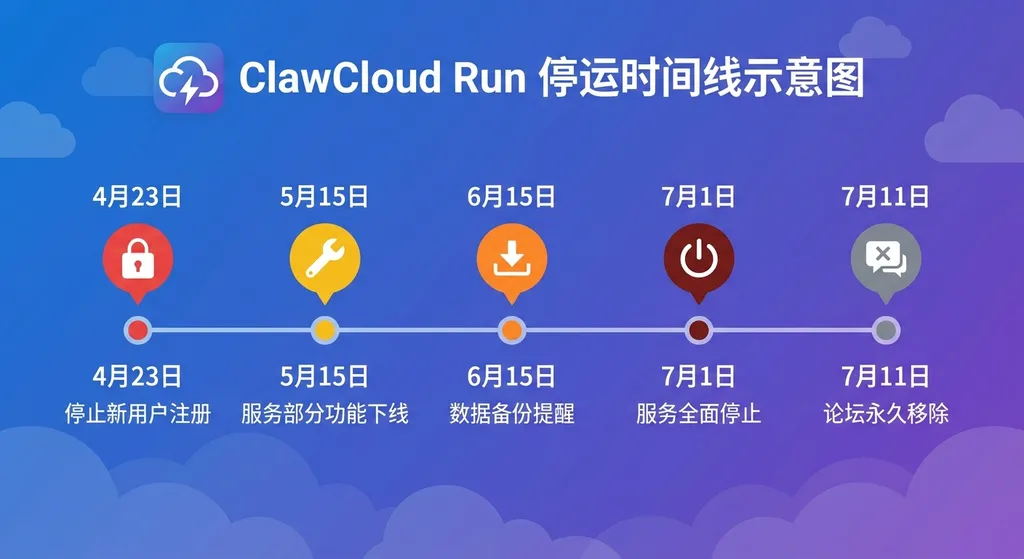
On April 23, the container runtime platform known among developers as “爪云” (“ClawCloud”) sent an email to all users announcing its shutdown. The wording was restrained — “After careful consideration, we have made the difficult decision to terminate the product and related services” — but the result was decisive: new user registration stops today, free users will be removed by May 11, paid users can request prorated refunds by May 20, and by July 11 the forum will be permanently deleted.
No fallback plan, no “maintenance mode,” just pulling the plug.
What is ClawCloud, and why do people care?
If you don’t hang around Linux.do or haven’t experimented with AI model reverse proxies, you’ve probably never heard of it.
ClawCloud Run was essentially a lightweight container hosting platform, similar in positioning to Railway or Render. Users could run Docker containers on it and deploy various web services. It offered generous free usage, affordable paid plans, and was friendly to individual developers.
But what truly made it go viral in the Chinese developer community wasn’t running ordinary web apps — it was running reverse proxies for AI models.
For the past two years, Chinese developers have faced network obstacles when accessing overseas AI APIs from OpenAI, Google Gemini, and Anthropic Claude. A sophisticated gray-market chain emerged: deploy a reverse proxy service on an overseas container platform (using open-source projects like one-api or new-api), forward requests to the official APIs, and access via the relay from within China.
ClawCloud became one of the most popular “hosting boards” in this chain.
The reasons were simple: the free tier was sufficient, deployment was easy, containers started quickly, and the network routes were relatively favorable for domestic access. In the Linux.do community, there were countless step-by-step tutorials on how to deploy a Gemini reverse proxy or how to relay Claude’s APIs on ClawCloud Run. Some users lamented under the shutdown news: “My Gemini proxy has always been running on it — pretty reliable.”
This isn’t the fall of a big platform, but it is a signal.
Shutdown schedule: clean and decisive
ClawCloud’s timeline left no room for ambiguity:
- April 23 (today): Stop new user registration and purchases; entry closed
- May 11: Official website, documentation, and blog go offline; all free user services terminated
- May 20: Deadline for paid user refund requests; refunds prorated by remaining service term
- July 11: Q&A forum retained for two months, then permanently removed
From announcement to free user removal — less than three weeks. From announcement to complete disappearance — under three months.
No talk of “seeking acquisition,” no promise of “core features migrating to a new platform,” no hint of continuation. It feels more like a company that’s done the math, realized operations were no longer worth it, and chose an orderly exit.
The refund process at least deserves credit — prorated, formally documented, with nearly a month’s application window. Compared to smaller platforms that vanish without notice, ClawCloud at least made a proper exit.
Why it shut down
The official announcement gave no specific reason beyond “careful consideration.” But given the industry context, several hypotheses are reasonable.
1. Compliance pressure.
When your platform hosts numerous AI API reverse proxy services — whose core purpose is to help domestic users circumvent restrictions to call overseas models — you inevitably step into a gray zone. Over the past year, both tighter domestic regulation of AI services and stricter enforcement by overseas model providers have increased operational risks for such platforms.
OpenAI started blocking API calls from unsupported regions in 2024; Google and Anthropic followed suit. If a container platform shows an abnormal traffic profile — e.g., a large number of requests targeting specific AI API endpoints — the upstream cloud providers may flag or suspend it.
2. An unsustainable business model.
ClawCloud’s free tier was key to attracting users, but reverse proxy workloads often consume heavy traffic (AI requests and responses are large, especially with streaming). The bandwidth and compute costs were real. If conversion to paid plans remained low, the platform was simply burning money to host “freeloaders” — users with near-zero loyalty who’ll jump to whichever service offers more free credits. ClawCloud shuts down today; tomorrow they’ll just migrate to another Railway-like alternative.
Such a user base can’t sustain a PaaS business.
3. Upstream squeeze.
Bigger players like Railway, Render, and Fly.io have also tightened their free usage policies. The entire lightweight container hosting sector is changing — everyone’s realized that unlimited free quotas attract freeloaders, not paying customers. As a smaller player, ClawCloud’s early exit in this reshuffling isn’t surprising.
The real question: how long can reverse proxying last?
The shutdown of ClawCloud itself has limited impact. For those depending on it to host reverse proxies, migrating to other platforms — Hugging Face Spaces, Vercel Serverless Functions, or directly to a personal overseas VPS — isn’t technically difficult and can be done in an afternoon.
But zoom out, and you’ll see this isn’t an isolated event.
Over the past six months, the reverse proxy ecosystem has been shrinking:
- Several community-run relay nodes have quietly shut down or reduced quotas
- OpenAI and Anthropic have strengthened detection and blocking of unauthorized regional calls
- Domestic models (DeepSeek, Qwen, GLM, etc.) have rapidly caught up, making overseas models less crucial in many cases
- Legitimate API aggregation services are maturing, providing compliant, stable, direct access from within China
Reverse proxying was essentially a temporary workaround during a “missing infrastructure” period. When Chinese developers wanted to use GPT-4 but had no official access, self-hosted proxies were the only choice. Now it’s different — domestic models are strong enough for many tasks, and legitimate aggregator platforms (like OpenAI Hub) offer compliant multi-model connections. With one API key, you can call GPT, Claude, Gemini, or DeepSeek — no need to manage your own proxy, worry about key bans, or fix broken containers at 3 a.m.
The “cost-effectiveness” of self-hosted reverse proxies is dropping fast. The tiny margin you save on API markups is paid for with operational time, stability issues, and constant anxiety about bans. For hobbyists, it’s still fine; for production workloads, it’s becoming untenable.
What developers should do
If you still have services running on ClawCloud Run, here’s what you need to do immediately:
1. Export data and configurations
Before May 11, export all container configurations, environment variables, and persistent data. Don’t assume you’ll be able to log in after shutdown — even the site will be gone.
2. Paid users: request your refund promptly
Deadline: May 20, 00:00 UTC. Submit through the official form provided. After that, likely no further opportunity.
3. Assess whether you still need a proxy
Ask yourself seriously: do you really need a reverse proxy, or is it just habit? If you mainly use APIs like GPT or Claude for development/testing, there are now easier, cleaner options. Legit API aggregators already price transparently, with stability leagues beyond self-hosted setups.
If you truly have special needs (e.g., full request control, custom rewriting), consider these migration options:
- Hugging Face Spaces: still generous free tier, but subject to policy shifts
- Fly.io: offers free tier and good deployment UX, but also tightening
- Own VPS: most controllable, but highest maintenance cost
That said, these alternatives share ClawCloud’s risks — policy changes and quota cuts can happen overnight. You migrate today, then face another move tomorrow.
The end of an era
From 2023 to 2025, Chinese developers experienced a “grassroots era” of accessing overseas AI models indirectly. ChatGPT had just exploded, domestic models were catching up, and developers improvised — registering foreign phone numbers, using virtual credit cards, building proxies, relay stations, and running one-api on various free container platforms. Threads on Linux.do could go on for pages.
It was a fascinating and valuable experience. It proved the ingenuity and hunger of China’s developer community for new tech.
But by 2026, that era is fading.
Domestic foundation models are no longer where they were two years ago. DeepSeek-R1’s reasoning performance has made many reconsider the assumption that “nothing beats GPT.” The Qwen series continues to improve on Chinese-language tasks. Crucially, their APIs are natively accessible within China — and getting cheaper.
At the same time, use cases that still require overseas models — such as Claude’s long context window or Gemini’s multimodal understanding — now have legitimate access channels. Aggregator platforms have drastically simplified multi-model integration: compatible with OpenAI format, just change the base_url and API key — almost no code changes needed.
ClawCloud’s shutdown won’t be the last. More small platforms, community relays, and free intermediaries will follow. Not because they failed, but because the problem they were solving is being replaced with better solutions.
For developers still relying on self-hosted proxies, my advice is simple: migrate proactively while your services are still up. Don’t wait for the next shutdown email to scramble.
The grassroots era had its charm, but production environments need certainty.
References:
- ClawCloud Run service to be discontinued - Linux.do — user-shared translation of shutdown email and timeline
- ClawCloud Run (爪云) to cease operations - Linux.do — community discussion thread with feedback on proxy service disruption


