
GPT-5.5 release window opens, next generation imminent

OpenAI hints at the imminent release of GPT-5.5 through updates to the Codex model list and a Base64 Easter egg. GPT-5.4 has been stripped of its “cutting-edge” label, and the community has spotted multiple signs of an early rollout—suggesting that the new generation of frontier models is just around the corner.
OpenAI didn’t hold a press conference or publish a blog post, but all the signals point to one thing — GPT‑5.5 is coming.
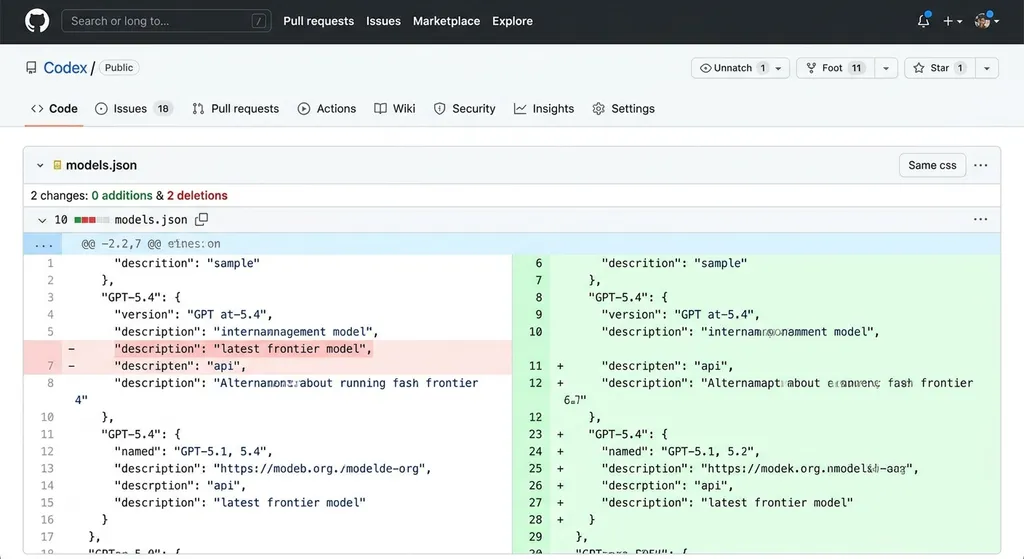
On April 23, OpenAI quietly updated Codex’s models.json file on GitHub, removing the “latest frontier” title from GPT‑5.4. The change itself was just 5 lines added and 5 deleted, but carried massive implications: when the current flagship is no longer called “the latest frontier,” the only reasonable explanation is that something new is about to replace it.
A Carefully Orchestrated “Leak”
The timeline of events is worth tracing.
On April 22, some users spotted GPT‑5.5 appearing in the Codex CLI terminal. The interface clearly labeled it “the cutting‑edge intelligent programming model.” According to a Reddit post by user DavidAGMM, Codex CLI even leaked an entire batch of unreleased model names, including a mysterious glacier-alpha-block-cy3. It was most likely an internal test configuration accidentally pushed into production—something that has happened more than once at OpenAI.
By the 23rd, things started to feel more “official.” X user @JasonBotterill noticed the models.json change and posted that GPT‑5.4 was no longer marked as “latest frontier.” Codex lead Tibo (@thsottiaux) directly confirmed this. Shortly after, the official OpenAI Developers account @OpenAIDevs posted a seemingly cryptic message:
NS41
Someone quickly realized — it was Base64‑encoded. The decoded result: 5.5.
That wasn’t a hint anymore — it was a direct confirmation.
From 5.4 to 5.5: OpenAI’s Model Release Cycle Is Accelerating
Looking back at the GPT‑5 series release cadence, it’s clear OpenAI has significantly sped up its iteration this past year:
- GPT‑5.1: an early version of the 5‑series, focused on response style and quality improvements
- GPT‑5.2 Instant: a lightweight version targeted at speed‑sensitive use cases
- GPT‑5.3 Instant mini: further compacted model
- GPT‑5.4: released March 2026, featuring both mini and Thinking variants; currently the flagship
- GPT‑5.5: coming soon
From 5.1 to 5.4, the interval between updates has been roughly 4–8 weeks. Since 5.4 rolled out mid‑March, a late‑April 5.5 release window fits perfectly.
But 5.5 may represent more than just a “minor update.” From Codex’s description — “the latest intelligent programming model” — this update likely focuses on Agent capabilities. In other words, GPT‑5.5 is not just “smarter,” but “more capable of action.”
Why Codex First?
That’s a question worth pondering.
OpenAI chose to hint at 5.5 through the Codex product line rather than ChatGPT itself — which says a lot about its core emphasis. Codex is OpenAI’s programming assistant product for developers, directly competing with GitHub Copilot (which also uses OpenAI models under the hood). In this setting, the model needs more than language understanding; it needs:
- Long‑context comprehension (reading entire codebases)
- Tool‑use ability (executing commands, manipulating files)
- Multi‑step reasoning (breaking a task down into executable actions)
- Autonomous decision‑making (handling uncertainty effectively)
These are precisely the core traits of an “Agent.” Some users during the leak period reported that GPT‑5.5 supports a 1M‑token context window — if true, that means it can process an entire mid‑sized project’s full codebase in one go.
Interestingly, the community has already started debating a practical question: can GPT‑5.5 make up for the front‑end capability gap? That has long been GPT’s weaker area compared to Gemini. Developers joked, “Why not distill Gemini directly?” — a joke, but one rooted in a real issue: GPT models have lagged behind in front‑end code generation and UI understanding. Whether 5.5 can improve there is something many developers are watching closely.
Competitive Landscape: 5.5 Faces a Different Field
The 2026 AI model market looks nothing like it did a year ago.
Google’s Gemini 3 Pro is reportedly nearing GA, with rumors claiming it “far outperforms prior versions,” even rivaling Gemini 3.5. Anthropic’s Claude has established a strong reputation in code generation, especially in contextual understanding of complex projects. DeepSeek continues to push in the Chinese market with a compelling price‑performance advantage.
OpenAI needs 5.5 to re‑assert its leadership in frontier models. Judging from its positioning as “the latest intelligent programming model,” their chosen breakthrough direction is Agent capability — the hottest topic in the field.
But a great model alone isn’t enough. Codex’s user experience, API pricing, and rate limits will all affect developer adoption. Currently, users with Codex Pro 20x accounts have already reported being routed to the new model, suggesting OpenAI is prioritizing high‑tier subscribers in early gray testing — just like when GPT‑4.5 was Pro‑exclusive at launch.
What This Means for Developers
If you use OpenAI’s API for development, here are a few things worth preparing ahead of time.
First, model switching. Following OpenAI’s past pattern, new models coexist for a short transition period, but older ones do get retired. When legacy models such as GPT‑4o were discontinued earlier in 2026, the phase‑out came faster than many expected. If your app still hard‑codes model names, now’s a good time to make them configurable.
Second, context window. If the 1M‑token context is confirmed, it will unlock entirely new scenarios — e.g., feeding an entire project in one go for a complete code review or having the model suggest refactors with full business‑logic awareness. But longer context also means higher token costs, so budget planning will need revisiting.
Finally, Agent capabilities. If 5.5 indeed brings major improvements in tool use and autonomous decision‑making, automation workflows built on LLMs (e.g., CI/CD integration, automatic bug fixing, code migration) could see a significant leap in effectiveness.
Early Access: Preparing Your API Calls
For developers wanting to be first to integrate GPT‑5.5, you can get your code ready now. Based on OpenAI’s naming convention, the new model will likely use the identifier gpt-5.5. Here’s a basic example:
from openai import OpenAI

client = OpenAI(
    api_key="your-api-key",
    base_url="https://api.openai-hub.net/v1"  # OpenAI Hub aggregation endpoint, direct access within China
)

response = client.chat.completions.create(
    model="gpt-5.5",  # Will be available after official release; final name subject to confirmation
    messages=[
        {"role": "system", "content": "You are a senior software engineer."},
        {"role": "user", "content": "Review this code and suggest improvements..."}
    ],
    max_tokens=4096
)

print(response.choices[0].message.content)
If you want to flexibly switch between GPT‑5.5, Claude, Gemini, and other models in one project for comparative testing, OpenAI Hub (openai-hub.com) supports invoking multiple mainstream models with a single key. The API format is compatible with OpenAI’s SDK, and switching models only requires changing one string — no more juggling multiple API keys.
# Same code; just change the model name to call Claude or Gemini
response = client.chat.completions.create(
    model="claude-sonnet-4-20250514",  # or gemini-2.5-pro, etc.
    messages=[
        {"role": "user", "content": "Same prompt, different model."}
    ]
)
What to Watch Next
Given the density of current signals, GPT‑5.5’s official launch is likely just days away. OpenAI’s usual rollout pattern is: pre‑release leak or “accidental” exposure → official social media teaser → formal blog post + API availability. We’re now at step two.
Key aspects worth watching:
- Pricing — Will 5.5, as the new flagship, cost more than 5.4? Will Agent features be billed separately?
- Rate limits — How different will Pro versus standard limits be?
- Thinking variant — 5.4 had one; 5.5 likely will too. The leap in reasoning capability will be crucial.
- Front‑end performance — The community is vocal on this; will OpenAI shore up weak spots?
- Benchmarks — Early leak data is anecdotal; robust testing post‑launch will tell the real story.
One thing’s certain: the 2026 model race is only accelerating. GPT‑5.5’s arrival isn’t the finish line — it’s the starting gun for the next arms race.
For developers, the good news is: more choice, more power. The bad news: you’ll spend even more time figuring out which model fits best.
That’s the sweet dilemma of being a developer in this era.
References:
- GPT‑5.5 Enters Release Window; Official Warm‑Up Complete — Linux.do community post summarizing official signals and analysis
- Possible Codex 5.5 Launch; GPT‑5.4 Being Rerouted — Codex Pro users report rerouting to new model
- New GPT Model Confirmed for Upcoming Release — models.json change and Base64 Easter‑egg decoding
- Thread: Let’s Witness the GPT‑5.5 Release Together — Live community discussion
- Will GPT‑5.5 Fix the Front‑End Gap? — Developer expectations for new capabilities
- OpenAI Codex models.json Update — GitHub model‑config commit history
- GPT‑5.5 Tomorrow? — Release speculation thread on Reddit Codex community


