
DeepSeek-V4-Flash Day-0 adaptation for domestic GPUs
Moore Threads, in collaboration with BAAI FlagOS, has completed Day-0 adaptation of the DeepSeek-V4-Flash model on its flagship GPU, the MTT S5000. Leveraging its native FP8 capability, the team achieved deep optimization of core operators, reducing TTFT latency by 16.5% and increasing throughput by 65.7%, marking another milestone for China’s domestic computing ecosystem.
DeepSeek-V4-Flash Achieves Domestic GPU Day-0 Adaptation: A Joint Breakthrough by Moore Threads and BAAI
On April 24, Moore Threads and BAAI’s FlagOS community jointly announced the completion of Day-0 ultra-speed adaptation of the DeepSeek-V4-Flash large model on the flagship AI training–inference integrated GPU MTT S5000, together with comprehensive optimization and deployment support for all core operators.
“Day-0 adaptation” means that on the very day a model is released, it has already been run successfully and optimized on domestic hardware—not just a demo, but deeply adapted at the operator level and ready for real deployment. This marks the third consecutive domestic Day-0 adaptation achieved by Moore Threads for major model releases, following MiniMax M2.7 and Zhipu GLM-5.
While not unexpected, in the current context its symbolic significance outweighs the technical one.
Why This Adaptation Matters
DeepSeek-V4-Flash isn’t a routine model update. It employs a Mixture of Experts (MoE) architecture with 284B total parameters, 13B active parameters, supports million-token context lengths, and uses over 32T tokens of pretraining data. In Flash-Max mode, inference performance already approaches the Pro version.
But the real technical milestone lies in DeepSeek-V4’s first-ever use of an FP4+FP8 mixed-precision strategy.
Why is that important? Most mainstream domestic AI chips—including Huawei’s Ascend—primarily use BF16 (Brain Float 16) precision. BF16 is a 16-bit float (2 bytes per parameter), while FP8 is an 8-bit float (1 byte per parameter).
In simple terms: if BF16 is a two-lane highway for cargo, FP8 compresses that cargo by half—letting twice as much data flow through the same path. On a GPU, this means:
- 50% lower memory bandwidth pressure
- 2× theoretical compute throughput
- Lower VRAM consumption, allowing bigger models on the same cards
The catch: your chip needs native FP8 support. If not, it must emulate FP8 in software—performance drops sharply.
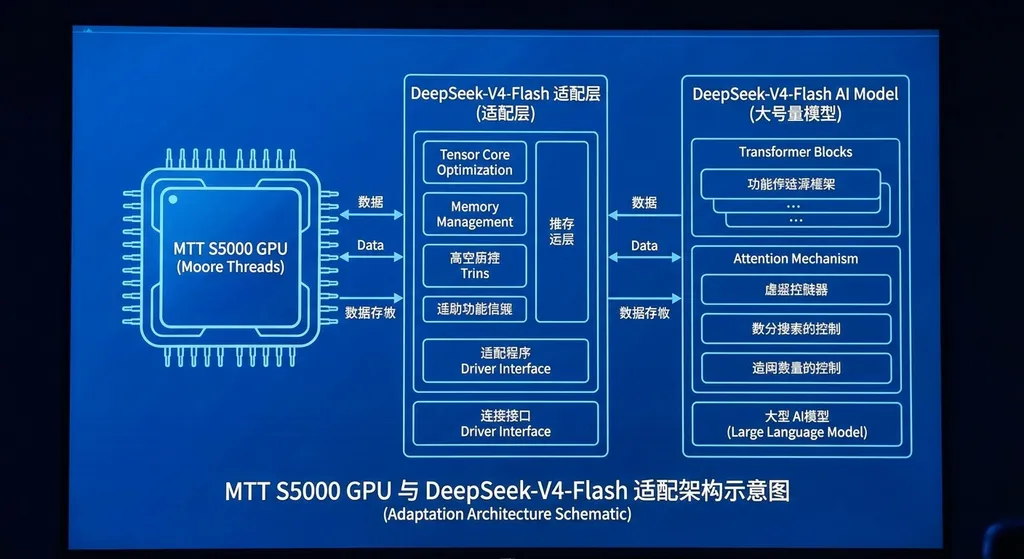
MTT S5000: The FP8 Pioneer among Domestic GPUs
Moore Threads’ MTT S5000 happens to be one of the first domestic training GPUs with native FP8 precision support. That’s no coincidence—it was a forward-looking design choice.
Here are the MTT S5000’s key specs:
| Metric | MTT S5000 | |---------|------------| | VRAM Capacity | 80GB | | VRAM Bandwidth | 1.6TB/s | | FP8 AI Compute | 1000 TFLOPS (1 PFLOPS) | | Multi-GPU Interconnect | 784GB/s | | Precision Support | FP8 ~ FP64 full precision | | Architecture | 4th-gen MUSA “Pinghu” |
Single-card FP8 compute hits 1 PFLOPS—one quadrillion operations per second. Compared to the previous MTT S4000, memory capacity grew 67% and bandwidth 113%. It features hardware-level FP8 Tensor Cores, not software emulation.
In real-world tests, MTT S5000 already competes with NVIDIA’s H100; in multimodal fine-tuning tasks it sometimes even outperforms the H100, and its inference is about 2.5× faster than H20.
In other words, when DeepSeek-V4 chose the FP4+FP8 hybrid precision path, MTT S5000 was one of the few domestic GPUs that didn’t have to compromise.
Adaptation Challenges: FP8 Operators and Sparse Attention
Of course, hardware FP8 support is only the first step. Getting DeepSeek-V4-Flash running well on the MTT S5000 required extensive software work.
Through system-level analysis, Moore Threads and FlagOS tech teams focused their efforts on two fronts:
1. FP8 Operator Optimization
FlagOS engineers performed FP8 quantization for the DeepSeek-V4 model. This isn’t just converting weights from BF16 to FP8—doing so naively degrades model accuracy. It requires a carefully designed quantization strategy to keep precision losses within acceptable limits.
For an MoE architecture, this is complex: with 284B total parameters and only 13B active at once, different “Experts” activate for different inputs. The quantization must preserve precision across all Experts, not just average performance.
2. Sparse Attention Operator Optimization
A million-token context creates enormous attention matrices. DeepSeek-V4 uses Sparse Attention to reduce computation, but this irregular memory access pattern demands more from the GPU’s memory subsystem.
Across these two focus areas, breakthroughs were achieved in compiler optimization and auto-tuning:
- Compiler optimization: Deeply optimized operator graphs for FP8 and Sparse Attention under the MUSA architecture, cutting redundant computation and data movement.
- Auto-tuning (FlagOS-Tune): Automatically searches for optimal kernel configs, replacing traditional hand-tuning. This is crucial—manual tuning is slow and narrow; auto-tuning finds better results faster across larger search spaces.
The test results were impressive:
| Metric | Optimization Effect | |---------|---------------------| | TTFT (Time-To-First-Token) | ↓ 16.5% | | ITL (Inter-Token Latency) | ↓ 39.7% | | Throughput | ↑ 65.7% |
A 16.5% lower TTFT means users see the first output almost 20% faster. A 39.7% lower ITL means subsequent tokens generate nearly 40% faster. 65.7% higher throughput means the same hardware serves more concurrent users.
Together, these numbers translate directly into deployment cost savings.
The Bigger Picture: Accelerating Maturity of the Domestic Compute Ecosystem
Zooming out, this adaptation illustrates how domestic compute is rapidly converging and maturing.
In early April, DeepSeek-V4 had already fully migrated to Huawei Ascend chips and been open-sourced—marking trillion-parameter scale realized entirely on domestic compute. Now Moore Threads has achieved Day-0 adaptation on its MTT S5000. DeepSeek-V4 now officially runs on at least two domestic hardware platforms.
Multiple hardware options are good news for model developers.
A quick timeline:
- Dec 2025: Moore Threads + SiliconFlow complete DeepSeek-V3 671B full adaptation on MTT S5000; single-card Prefill throughput > 4000 tokens/s, Decode throughput > 1000 tokens/s
- Jan 2026: BAAI trains RoboBrain 2.5 end-to-end on a thousand-card MTT S5000 cluster; training loss difference vs H100 cluster only 0.62%
- Mar 2026: DeepSeek open-sources TileLang language; Huawei and Cambricon finish Day-0 adaptation the same day; Moore Threads’ MUSA supports “zero-cost PyTorch migration”
- Apr 2026: DeepSeek-V4 fully shifts to Ascend; Moore Threads completes V4-Flash Day-0 adaptation
A clear trend emerges: domestic GPUs are evolving from “can run” to “run well,” and from post-release adaptation to synchronous Day-0 compatibility—with visibly accelerating iteration speed.
Moore Threads is now pushing for migration of the larger DeepSeek-V4-Pro (1.6T parameters) onto MTT S5000—an even greater test of cluster communication, memory management, and compute efficiency.
Key Questions to Consider
Will FP8 become the watershed for domestic GPUs?
When leading models like DeepSeek adopt FP4+FP8 precision instead of BF16, FP8 support shifts from “nice to have” to “must-have.” Currently, MTT S5000 is one of the few domestic GPUs with native FP8 support. Vendors that don’t follow will struggle to host next-gen models.
It mirrors the industry’s historic shift from FP32 to FP16—once models converge around it, hardware must keep up or fall behind.
What’s the real meaning of Day-0 adaptation?
It may look like marketing—“supported on release day”—but it actually reflects deep collaboration between GPU vendors and model developers.
To achieve Day-0, both sides must co-develop and test before the model’s release. Such synchronization is standard in NVIDIA’s ecosystem (they provide early builds to partners), but still new in China’s.
If this collaboration model persists, domestic compute maturity could advance faster than most expect.
Software stack is the true moat
FlagOS-Tune’s 65.7% throughput boost shows that software maturity now drives user experience more than hardware performance itself.
Moore Threads’ MUSA ecosystem, BAAI’s FlagOS platform, and DeepSeek’s TileLang language are pushing domestic stacks from “usable” to “excellent.” But the gap with CUDA remains vast—closing it will take sustained ecosystem building, not just one-time adaptations.
Final Thoughts
The story of domestic GPUs is shifting—from “we can make it too” to “we’re just as good.” MTT S5000’s foresight in FP8 precision gave it an edge in DeepSeek-V4’s precision revolution. And the normalization of Day-0 adaptation is reshaping cooperation and efficiency across the local compute ecosystem.
That said, a sober view is essential: a single successful adaptation doesn’t equal ecosystem maturity; competing with H100 doesn’t mean catching up with NVIDIA’s new Blackwell generation; and FP8’s early lead must be reinforced through long-term software investment.
But the direction is right—and the pace is quickening. That’s enough.
For developers evaluating domestic compute options, the MTT S5000 + FlagOS combination deserves a place on your shortlist—especially for DeepSeek-V4 model inference and deployment scenarios.
References
- ITHome: Moore Threads and BAAI’s FlagOS complete DeepSeek-V4 Day-0 adaptation for MTT S5000 GPU — Original report on the joint success of the Day-0 adaptation


