
Meituan’s trillion-parameter large model goes online, trained entirely with domestic computing power

Meituan releases LongCat-2.0-Preview, with total parameters exceeding one trillion, supporting a 1M context window. Training and inference were fully completed using a domestic computing cluster, targeting GPT-4-level capabilities.
Meituan’s Trillion-Parameter Model Goes Live, Fully Trained on Domestic Compute Power
Meituan today opened the invitation test for its new generation foundation model, LongCat-2.0-Preview. The model has surpassed a trillion parameters, adopts a Mixture of Experts (MoE) architecture, and claims performance on par with GPT-4.
More notably, this is the first trillion-parameter model in China fully trained using domestic compute clusters. According to reports, Meituan used 50,000–60,000 domestically produced compute cards during training, relying entirely on Chinese chips for both training and inference.
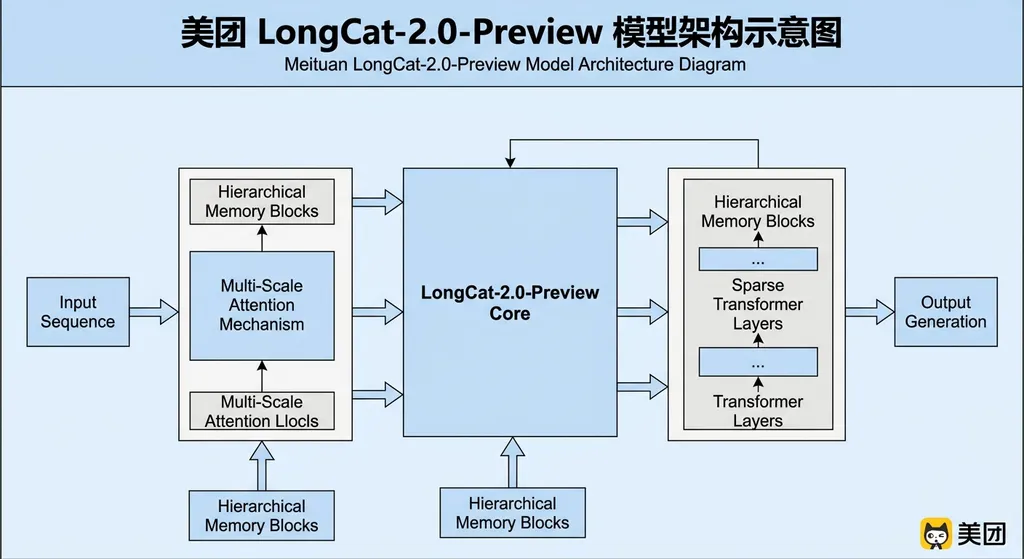
Parameter Scale and Technical Architecture
LongCat-2.0-Preview has over 1 trillion total parameters, but due to its Mixture of Experts design, only a small portion of parameters are active during inference. This approach significantly reduces inference cost and latency while maintaining model capability.
Technically, Meituan follows a similar MoE architecture to GPT-4 and Grok-2. The key idea is to split the model into multiple expert networks and only activate some of them for each inference, instead of all parameters. This retains the knowledge capacity of large models while keeping cost and speed comparable to smaller ones.
For LongCat-2.0, although the total parameter count exceeds a trillion, the number of parameters activated per inference may only be in the tens to hundreds of billions range. This design makes its response speed and deployment cost significantly better than dense models.
The Real Meaning of a 1M Context Window
LongCat-2.0-Preview supports a 1M token context window, putting it in the same range as the recently announced GPT-5.5.
What does 1M context mean? In Chinese characters, that’s roughly 1.5–2 million characters, enough to read 3–4 medium novels or process hundreds of pages of technical documents, reports, or contracts in a single input.
For developers, the benefit is clear—much more contextual information can fit into a single request. For instance, when reviewing code, entire core repositories can be loaded, or entire product manuals can be uploaded for document Q&A, without splitting.
However, a large context window isn’t a silver bullet. The larger the window, the more severe the “Lost in the Middle” phenomenon—attention decay in the middle of the input. Meituan hasn’t released LongCat-2.0’s performance data for long-context scenarios, so this capability still requires testing.
Breakthrough in Domestic Compute Clusters
The main highlight isn’t the parameter count—it’s that training and inference were completed fully using domestic compute hardware.
In recent years, China’s large models have mostly relied on NVIDIA A100 or H100 GPUs. After US export restrictions tightened last year, chips like H100, H200, and B100 became inaccessible. Domestic companies had to rely on stock A100/H800s or turn to local alternatives.
By training a trillion-parameter model using 50,000–60,000 domestic compute cards, Meituan has demonstrated that Chinese chips can handle full large-scale training pipelines. Although the company didn’t specify the manufacturer (likely Huawei Ascend, Hygon DCU, or Biren BR100), supporting this scale proves at least three things:
- Sufficient single-card performance – Trillion-parameter models demand high computation and memory capacity per card; domestic chips now approach A100-level specs.
- Stable cluster interconnects – Running a 50,000-card cluster stresses network topology, communication, and fault recovery; successful training implies mature infrastructure.
- Complete software stack – Frameworks, compilers, and drivers require huge adaptation effort; successful end-to-end operation proves Chinese chip ecosystems are now viable.
This is an important signal for the industry: if domestic compute can train trillion-parameter models, others can follow suit without fear of hardware restrictions.
Deep Optimization for Agent Scenarios
Meituan emphasized that LongCat-2.0 is deeply optimized for Agent applications, a highly practical direction.
Agents are one of this year’s main application focuses for large models—designed not just to answer questions, but to plan tasks, call tools, and execute actions. For example, to book a flight, the model must understand demand, search flights, compare prices, and complete payment—dozens of steps involving multiple APIs.
Meituan highlighted several realistic optimization points:
Code generation ability – Agents often need to write code for API calls or data processing. LongCat-2.0 strengthens this via large code datasets and fine-tuning for function calling and parameter parsing.
Complex task planning – The core Agent ability. The model must decompose goals into executable subtasks and manage dependencies—demanding strong reasoning and contextual understanding.
Enterprise automation – Meituan’s operations involve large-scale automation—food delivery logistics, merchant operations, customer service, etc. LongCat-2.0 likely received specialized training on such data, making it more domain-aware.
Given Meituan’s rich operational ecosystem, Agent-focused optimization plays to its strengths—it can train and validate models on real business data, far more effective than open datasets.
Matching GPT-4-Level Capabilities
Meituan claims that LongCat-2.0’s overall capability matches GPT-4—a statement that needs data verification.
Since GPT-4 was released nearly three years ago, it’s no longer the top model. If they mean the March 2023 GPT-4, then LongCat-2.0 likely sits between leading open-source models (Llama 3.1 405B, Qwen2.5 72B) and top closed models (GPT-4o, Claude 3.5 Sonnet).
But “matching” can mean many things—is it across all tasks, or only in specific domains? Meituan hasn’t released detailed benchmarks, so conclusions are premature.
Judging by architecture and scale, LongCat-2.0 should reach 70–80% of GPT-4’s general capability, but possibly exceed GPT-4 in Meituan-specific business tasks. That’s often the main motivation for tech giants to build proprietary models: not to win every benchmark, but to dominate their own core domains.
A New Stage for Chinese Large Models
LongCat-2.0’s release marks a new stage for China’s LLM development.
Over the past year, Chinese model development has split into two approaches:
- Open-source models – by companies like Alibaba (Qwen), Zhipu (GLM), Baichuan, and MiniMax.
- Vertical applications – targeted sectors like education (iFlytek) or healthcare (SenseTime).
Meituan is taking a third path: building a proprietary foundation model, not open-sourced, tailored for internal and ecosystem use.
This differs from Meta or Google’s strategies. Meta open-sourced Llama to build ecosystem adoption; Google built Gemini to rival OpenAI. Meituan treats LongCat as an infrastructure layer—to improve its own efficiency and user experience.
From this angle, LongCat-2.0’s success won’t be judged by benchmarks, but by how much value it brings to Meituan’s operations—for example, making delivery logistics more efficient, merchant management smarter, or customer experience smoother.
That’s why the company emphasizes Agent capability and enterprise automation. They’re not building a general chatbot—they’re building an intelligent system deeply integrated with their business flows.
Can Developers Access It?
Currently, LongCat-2.0-Preview is invite-only with no public API. Based on Meituan’s history, they’re unlikely to release it as a general API service like OpenAI. The likely rollout plan:
- Internal use first – large-scale deployment in Meituan’s own business lines to validate performance.
- Ecosystem partners – potential API access for Meituan’s merchants and partners.
- Limited enterprise access – if effective, a business version may be released, but not as a fully open public API.
In the short term, independent developers probably won’t get direct access. However, LongCat-2.0’s technical route and domestic compute training completion are of demonstrative value for the entire industry—proof that large-scale training is feasible entirely with Chinese hardware.
If you need LLM APIs now, OpenAI Hub supports GPT, Claude, Gemini, DeepSeek, and others—accessible with a single key, fully OpenAI-compatible, and with domestic connectivity.
Open Technical Questions
Details are scarce, but several technical questions remain:
Training data scale – Trillion-parameter models typically need tens to hundreds of terabytes of data. How much did Meituan use, and how much came from internal datasets?
Training duration – How long did training take with 50–60k cards? Roughly, training such a model on A100s could take months. How efficient are domestic chips?
Inference cost – While MoE lowers inference cost, deployment remains expensive. How will Meituan manage run-time costs?
Model distillation – Will smaller distilled versions of LongCat-2.0 be released for cost- or latency-sensitive applications?
Answers to these will determine LongCat-2.0’s real-world application range and commercial viability. Hopefully, Meituan will share more technical details later.
Final Thoughts
The biggest takeaway from LongCat-2.0-Preview isn’t its parameter count or performance level—it’s the proof that domestic compute power can train trillion-scale models end-to-end.
This is a landmark for China’s AI industry. Many had worried that export restrictions would cripple model development. Now it’s clear that while domestic chips may still trail in raw performance, they are sufficient for full-scale training.
The next challenge is cost and efficiency—Is training on domestic chips much more expensive? Does it take significantly longer? Those factors will decide large-scale adoption.
But at least, the path is proven. What remains is optimization and iteration.


