
DeepSeek OCR Sample Project Revealed: Image Recognition May Offer Independent API Access
The DeepSeek OCR demo project is now available on Hugging Face. Technical details show that it uses a task queue architecture to handle OCR inference and supports output in both Markdown and JSON formats. Several platforms have begun deploying related services, with standalone APIs either already available or coming soon.
DeepSeek OCR Demo Project Revealed: Image Recognition May Soon Offer a Standalone API
A demo project named khang119966-deepseek-ocr-demo has recently launched on Hugging Face Spaces, exposing the full invocation process of the DeepSeek OCR model. Judging from its interface design, the system already has the foundation for production-level deployment—releasing an independent API service seems only a matter of time.
Task Queue Architecture: Designed for High-Concurrency Scenarios
The most noteworthy part of this demo project is its task-handling mechanism. When a user uploads an image, the system generates a unique upload_id, and the front end submits it via multipart/form-data format to the /gradio_api/upload endpoint. At the same time, a WebSocket connection monitors upload progress—this design greatly improves the experience when handling large files.
The actual OCR inference takes place through the /gradio_api/queue/join interface. The naming directly reveals the underlying architecture: DeepSeek uses a task queue to process long-running inference tasks. After submitting a request, the front end receives an event_id, then listens for status updates via WebSocket or polling. This workflow closely mirrors the asynchronous generation logic of Midjourney and Stable Diffusion—both designed to handle lengthy inference and heavy concurrency.
The project documentation notes that “failures may occur during peak times,” which feels realistic. It indicates that the deployed computational resources are limited, indirectly confirming the high resource demand of OCR inference. If a commercial API is opened in the future, pricing will be a key factor—charging per image or per processing time will directly affect developer costs.
Output Format: Parallel Support for Markdown and JSON
The demo project supports two output formats: Markdown and JSON. Markdown is suitable for direct user display, while JSON facilitates programmatic processing. This practical design covers the major use cases of document digitalization and structured data extraction.
What’s more interesting are the special markers in the output: <|ref|>sub_title<|/ref|><|det|>[[48, 66, 580, 202]]<|/det|>. These markers contain semantic tags (ref) and position coordinates (det), suggesting that DeepSeek OCR not only performs text recognition but also understands document structure and element positioning. This capability is highly valuable for table extraction and layout analysis tasks.
Compared to existing OCR services that typically return only raw text or simple coordinates, DeepSeek’s tagging system—if preserved in its API—could enable developers to perform refined post-processing, such as automatically identifying title hierarchies or extracting specific regions.
Deployment Ecosystem: Multi-Platform Integration Underway
Beyond the Hugging Face demo, multiple platforms are now deploying DeepSeek OCR services. Alibaba Cloud Function Compute released a deployment solution based on FunModel, and the China Science Cloud Large Model API Platform has launched an OCR service for PDF files.
The China Science Cloud implementation deserves mention. It offers a /deepseek-ocr/convert endpoint dedicated to PDF OCR tasks. The interface is simple: send a POST request with a file, and the system returns the extracted text. This encapsulation is enterprise-friendly, requiring no concern over underlying model details.
Alibaba’s approach is more technical, providing full deployment code. It uses ThreadPoolExecutor for concurrent processing and supports batch handling of images and PDFs. One notable detail: PDFs are first converted to images and processed page by page, meaning large PDFs may experience noticeable latency. If DeepSeek later introduces native PDF processing capabilities, performance could improve substantially.
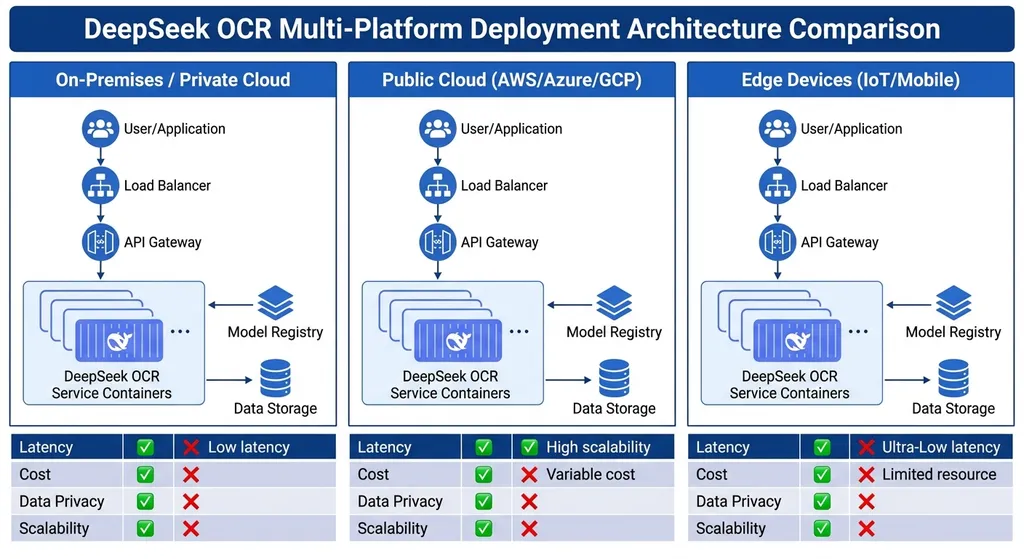
Local Deployment: Challenging but Feasible
The open-source community already has detailed local deployment guides. The basic process involves cloning the GitHub repository, creating a Conda environment (Python 3.12), installing PyTorch 2.6 and vLLM 0.8.5, and finally adding Flash Attention 2.7.3.
vLLM is the recommended inference engine. Compared to the native Transformers implementation, throughput improves severalfold. However, vLLM requires compatible CUDA versions and GPU models—if hardware mismatches occur, Transformers can still run, albeit slower.
On first execution, the model automatically downloads from Hugging Face, which may take time. If network conditions are poor, it’s best to pre-download the model files using mirror sites. In the config.py file, you can specify a local model path to avoid repeated online downloading.
Invocation methods are flexible, supporting various Prompt templates:
<image><|grounding|>Convert the document to markdown.– Convert to Markdown<image><|grounding|>OCR this image.– Plain text recognition<image>Parse the figure.– Chart parsing<image>Describe this image in detail.– Detailed image description<image>Locate <|ref|>target text<|/ref|> in the image.– Text localization
These Prompts cover multiple levels—from basic OCR to advanced visual understanding. The text-localization feature is particularly useful for precise content positioning, which can be applied in automated testing or UI verification scenarios.
Technical Highlights: Visual Compression and Multimodal Fusion
The core of DeepSeek OCR is DeepEncoder—a visual encoder designed specifically for document understanding. It compresses high-resolution images into compact feature representations, reducing computational load for subsequent language models. This design shines when processing multipage documents, preventing inference slowdown due to excessive input length.
From the API design of the demo, it’s clear DeepSeek has invested in engineering. Mechanisms such as task queues, progress monitoring, and asynchronous processing are standard in production environments. In contrast to academic projects that only provide model weights and simple scripts, DeepSeek is evidently aiming for commercial viability.
Market Positioning: Open-Source Model Moving Toward API Commercialization
DeepSeek OCR is an open-source model, but several platforms already offer hosted services. This pattern is common in the large-model ecosystem: open-source weights with paid API access from official or third-party providers—lowering usage barriers.
For developers, this is welcome news. Self-hosting requires GPU servers, dependency management, and inference optimization—all costly and time-consuming. With stable API services, developers can pay per use and instantly access the latest models, greatly enhancing development efficiency.
Currently, these third-party services are self-deployed based on open-source code—DeepSeek itself hasn’t launched a commercial API. Judging by the demo’s maturity, technical barriers are minimal; remaining decisions are likely strategic. If DeepSeek enters the OCR API market, pricing and service stability will be the key differentiators.
Application Scenarios: Beyond Text Recognition
DeepSeek OCR’s capabilities go well beyond traditional OCR. In addition to basic text extraction, it can:
- Understand document structure—identify titles, paragraphs, lists
- Parse tables—preserve row and column relationships
- Extract chart data—interpret visualized information
- Locate specific text or elements
- Generate detailed image descriptions
Together, these features enable numerous business applications:
Document Digitalization: Convert scanned files or PDFs to editable Markdown while retaining original formatting—more practical than plain-text output.
Knowledge Base Construction: Batch process archival documents to extract structured information for indexing. Combined with vector databases, this allows semantic search.
Automated Testing: Locate specific text or buttons in UI screenshots to verify correct display.
Data Extraction: Pull key details from invoices, contracts, or reports for automated entry—table parsing is especially valuable here.
Content Moderation: Detect text in images to check for violations. Compared to pure vision models, OCR enables more accurate text matching.
Performance and Cost: Key Metrics Awaiting Validation
No performance data has been published for the demo, but its task-queue design suggests inference may take seconds per request—acceptable for batch processing, though real-time OCR (e.g., barcode scanning) may need optimization.
On cost, local deployment requires at least one mid-to-high-end GPU (recommended 24GB memory or above). Cloud servers billed hourly aren’t cheap either. This is why hosted API services are attractive—billing per call is more affordable for teams than maintaining their own GPUs.
Current providers like China Science Cloud haven’t announced pricing yet. When DeepSeek releases an official API, cost strategy will directly affect adoption. Based on typical OCR service rates (a few to several dozen RMB per thousand calls), DeepSeek could gain strong competitiveness if it offers high quality at lower cost.
Competitive Comparison: Multimodal Capabilities as Differentiation
Existing OCR services fall into two main types:
Traditional OCR (e.g., Tesseract, Baidu OCR, Tencent OCR): Focused on text accuracy and speed, but limited in understanding document structure.
Multimodal Large Models (e.g., GPT-4V, Claude 3, Gemini): Understand image content but aren’t optimized for OCR, yielding inconsistent results on complex documents.
DeepSeek OCR sits between these approaches—combining dedicated OCR optimization with visual understanding. This makes it ideal for intelligent document workflows, such as processing academic papers that demand precise recognition of formulas, tables, and figures—tasks beyond traditional OCR and general multimodal models.
Another major distinction is open source. Most commercial OCR services are closed-source; developers can only call APIs without customization. DeepSeek’s openness allows fine-tuning with proprietary data to suit domain-specific document formats (e.g., medical records or legal contracts).
Potential Issues: Stability During Peak Hours
The documentation’s warning about “possible failures at peak times” is worth noting. If similar instability occurs once the official API is live, user experience could suffer. OCR workloads tend to spike during business hours and drop off off-hours—designing effective auto-scaling to maintain quality under traffic surges will be a key engineering challenge.
Error handling is another concern. From the current API design, if OCR fails (e.g., blurred image, unsupported format), will error messages be sufficiently informative? Can developers quickly diagnose via error codes? Such details must be thoroughly documented for production use.
Outlook: A New Variable in the OCR Market
The emergence of DeepSeek OCR introduces a new variable into the market. If an official API launches, its combination of open-source cost advantages and multimodal capabilities could carve a strong position in intelligent document processing.
For developers, having another option is always beneficial. Particularly for Chinese-language documents, domestic models often outperform in linguistic understanding. DeepSeek’s proven technical strengths in coding and reasoning tasks suggest promising potential in OCR as well.
However, competition is fierce—major providers like Baidu, Tencent, and Alibaba already have mature OCR solutions with strong enterprise presence. To stand out, DeepSeek must go beyond technology and pricing—focusing also on reliability, documentation, and ecosystem development. Open-sourcing is a great start, but turning that into commercial success remains a lengthy journey ahead.
References
- DeepSeek OCR Research – Linux.do Community Discussion – Detailed API process and technical breakdown
- Get Started with DeepSeek’s Latest OCR Model in 10 Minutes – Zhihu – Model overview and quick guide
- Building and Deploying DeepSeek-OCR Model Service with FunModel – Alibaba Cloud – Production-grade deployment and code sample
- DeepSeek-OCR Tutorial – Apifox – Complete installation, configuration, and usage guide
- China Science Cloud Launches DeepSeek-OCR Model API Service – Official hosted service introduction


