
GPT-5.5 integrated with GitHub Copilot, significantly enhancing multi-step code generation capabilities.
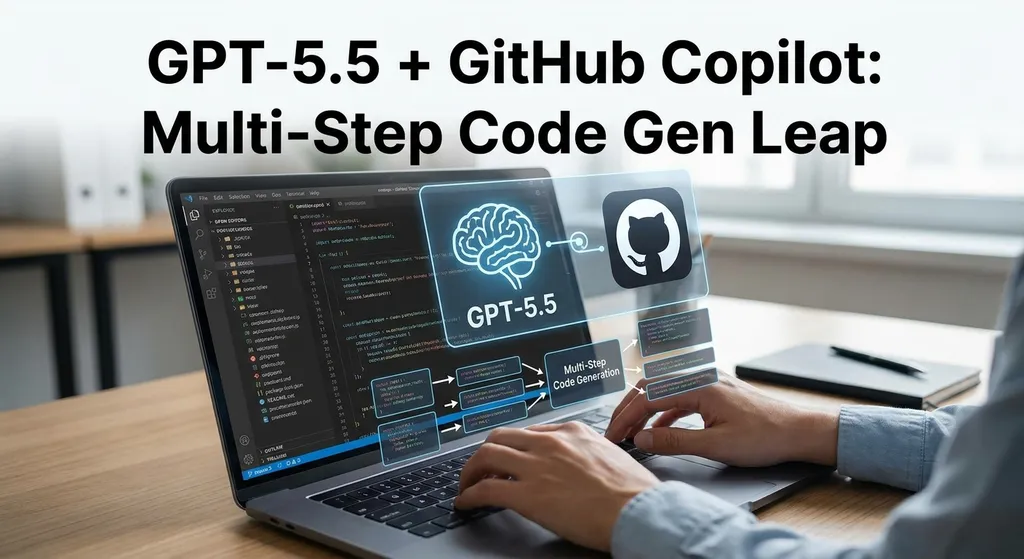
OpenAI’s latest model, **GPT-5.5**, has officially been integrated into **GitHub Copilot**, showing significant improvements in complex, multi-step code generation tasks. However, it is only available to **Pro+ users**, with token consumption up to **7.5 times higher**.
GPT-5.5 Integrated into GitHub Copilot, Dramatic Improvement in Multi-Step Code Generation
GitHub Copilot officially launched support for the GPT-5.5 model yesterday. According to early test data disclosed in GitHub’s official blog, OpenAI’s latest model performs best when handling complex, multi-step agent coding tasks, solving more real-world development problems.
But there’s a practical issue: GPT-5.5 is currently available only to Copilot Pro+ and higher-tier subscribers, and consumes points at 7.5× (promotional rate), significantly higher than other models. This means that if you’re still on a regular Pro subscription, you won’t be able to access this new capability yet.
Performance Leap in Complex Task Scenarios
The core advantage of GPT-5.5 lies in “multi-step agent tasks.” What does that mean? Simply put, these are complex coding scenarios that require the AI to plan, break down, and execute multiple sub-tasks by itself — for example, refactoring a module that involves editing multiple files, adjusting interface definitions, updating test cases, or locating the root cause of a bug and generating a fix in an unfamiliar codebase.
Traditional code completion tools (including earlier versions of Copilot) specialize in “single-step generation”: given context, they predict the next line or function. But real-world development often requires “seeing the big picture, breaking down the steps, and iterating verification.” GPT-5.5’s improvement in these tasks means it can better understand project structures, dependencies, and business logic — not just produce textual continuations.
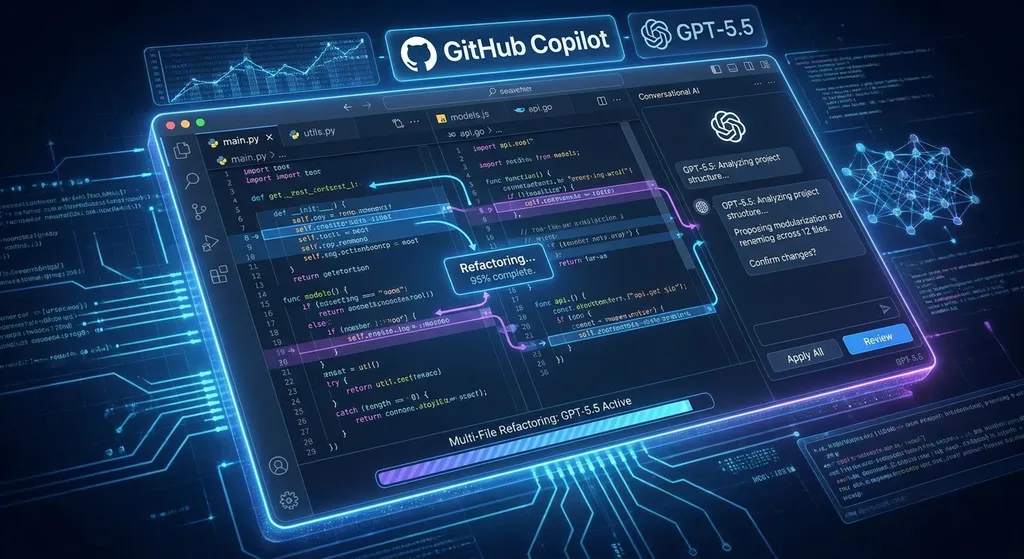
GitHub hasn’t published specific benchmark data, but their phrase “resolves real-world problems” suggests that the tests were based on real tasks in actual projects, rather than academic datasets like HumanEval. This is the right direction — developers don’t need high scores on algorithm tests; they need help in scenarios like “I know how to do this but don’t feel like writing it” or “I’m unsure of the best practice.”
Pricing Strategy Signals
A 7.5× point consumption is no small number. For comparison, GPT-4 Turbo in Copilot consumes around 1–2× the baseline, while Claude Opus 4.7 consumes about 7×. GPT-5.5’s pricing hits the top end.
This reflects two things:
First, OpenAI’s inference cost control for GPT-5.5 may not yet be optimal. Although the model is more capable, if inference efficiency hasn’t improved proportionally, the high compute cost is ultimately passed on to users. The 7.5× pricing reflects a trade-off between cost and performance.
Second, GitHub is implementing user segmentation through pricing. The Pro+ subscription is targeted at power users and enterprise teams. Positioning the newest and most capable model at this tier meets the needs of users willing to pay for productivity while controlling overall compute demand. After all, if every user defaulted to GPT-5.5, GitHub’s cost pressure would be enormous.
It’s worth noting that Reddit users have already predicted that GPT-5.4 may soon be deprecated. If true, it means OpenAI and GitHub are accelerating their model iteration cycle — older versions will have increasingly short lifespans. Developers should take this as a reminder: if your workflow heavily depends on a specific model version, prepare for migration in advance.
Copilot’s Model Strategy Adjustments
Aside from GPT-5.5’s rollout, GitHub also made several notable adjustments this week:
- Introduced a 5-hour weekly limit — likely to control usage of high-consumption models
- Stopped new user registration — temporarily closed certain subscription channels, reasons unknown
- Pro users can no longer use Claude Opus — previously available for Pro subscribers, now restricted
These signals suggest that GitHub is rebalancing model supply and cost management. The AI coding assistant market has moved from “territory expansion” to “precision operations.” Merely stacking model capabilities is not enough; commercial sustainability now matters.
The restriction on Claude Opus is particularly intriguing. Opus 4.7 is seen by many developers as the “model with the best code quality,” especially in tasks requiring deep understanding, such as code review or architecture design. But its inference cost is also very high (7× consumption). GitHub may be substituting GPT-5.5 for some Opus use cases while limiting access to reduce overhead.
Comparison with Competitors
GitHub Copilot is not the only AI coding assistant. Tools like Cursor, Windsurf, and Codeium are iterating rapidly — some even outperform Copilot in specific scenarios.
Cursor’s strength lies in deep editor integration and context management. It allows you to select whole project files as context, resulting in AI-generated code more aligned with your coding style and project structure. Windsurf’s recently introduced Cascade mode is also interesting — it automatically navigates and modifies across multiple files, similar to GPT-5.5’s emphasized “multi-step agent” capabilities.
Codeium takes a different approach: fully free, compatible with nearly all mainstream IDEs. While its model is less powerful than GPT-5.5 or Opus, it’s sufficient for daily completion and simple refactoring. For individual developers or small teams, Codeium offers excellent value.
GitHub Copilot’s core competitive edge lies in “official endorsement” and “ecosystem integration.” It’s built directly into VS Code, JetBrains suite, Neovim, and other mainstream editors with no extra configuration needed. As GitHub’s official product, it can deeply leverage repository metadata — such as issues, PRs, and commit history — to provide more precise suggestions.
However, GPT-5.5’s high price may push some users toward competitors. If you only need basic code completion or simple function generation, the 7.5× consumption clearly isn’t cost-effective. GitHub must balance between “offering the strongest model” and “maintaining its user base.”
Technical Challenges of Multi-Step Agents
“Multi-step agent coding” sounds appealing, but it’s technically challenging to implement.
First is context management. For the AI to complete a refactoring spanning multiple files, it must understand the entire project’s structure, dependencies, and naming conventions. But most LLMs have limited context windows (even GPT-5.5 can’t fit a large project entirely). Selecting the most relevant context and maintaining consistent state across multiple turns remain key issues.
Second is error recovery. Single-step generation errors are minor — you can fix a single line manually. But in multi-step tasks, an error midway could invalidate all subsequent steps. The AI must be able to detect mistakes, roll back actions, and replan — demanding high “self-reflection” capabilities.
Third is tool invocation. Real-world coding tasks often require external tools — running tests, querying documentation, using linters. For GPT-5.5 to truly act as an “agent,” it must actively call such tools and adjust strategy based on results. OpenAI’s function-calling ability is relatively mature, but in a constrained Copilot environment, how many tool interfaces can be exposed remains uncertain.
GitHub’s blog mentions GPT-5.5’s excellence in “agentic coding tasks” but doesn’t clarify the specific agent capabilities. Can it only do multi-file editing, or also autonomously run tests, query APIs, even submit PRs? These details directly impact developer experience.
Practical Implications for Developers
If you’re a Copilot Pro+ user, GPT-5.5 is worth trying — especially for these scenarios:
- Large-scale refactoring — editing multiple files, adjusting interfaces, updating callers
- Unfamiliar codebases — understanding and modifying inherited projects
- Complex bug tracing — tracking cross-module call chains
- Architecture design discussions — requiring AI to propose multiple solutions and analyze pros/cons
But if your daily work mostly involves new feature development or simple code completion, GPT-4 Turbo or Claude Sonnet may be sufficient — no need to pay 7.5× the cost.
Regular Pro users may not feel much change in the short term. GitHub’s current strategy clearly targets premium users. If you don’t want to upgrade to Pro+, consider complementing with other tools — e.g., use Cursor for refactoring and Copilot for daily completion.
Also, if your team is evaluating the ROI of AI coding tools, GPT-5.5’s pricing is an important factor. The 7.5× consumption translates to a significant cost increase, which should be weighed against productivity gains. Large teams might need detailed cost accounting and usage planning.
Industry Trend: From Completion to Agentic Coding
The launch of GPT-5.5 marks a key milestone in the evolution of AI coding tools — from “code completion” to “agentic programming.”
Early AI assistants (including the initial GitHub Copilot) mainly performed “next-line prediction.” That was helpful, but essentially an advanced form of autocomplete. Developers still had to plan tasks, break them down, and handle edge cases.
Now the trend is for AI to take on more “planning and execution” duties. You tell it “refactor this module into a microservice architecture,” and it analyzes dependencies, splits code, defines interfaces, and updates tests. Once truly mature, this will transform software development workflows.
But the evolution won’t be smooth. Agent reliability, controllability, and interpretability remain challenges. If AI performs actions you can’t understand or fix when they fail, the tool could become a cognitive burden instead of a help.
GitHub and OpenAI clearly recognize these challenges. Limiting GPT-5.5 to Pro+ users serves as a controlled rollout to gather feedback and optimize gradually. When both model capability and user experience mature, broader deployment will follow.
In the long run, the ultimate form of AI coding tools might not be “a single super-intelligent assistant,” but “a system of collaborative agents.” Some focus on code generation, others on testing, documentation, or review — sharing context and working together on complex tasks. GPT-5.5’s enhancement in multi-step tasks is a step toward that future.
Final Thoughts
The integration of GPT-5.5 into GitHub Copilot is an important development, but not one to overhype. Its improved performance on complex tasks is real — and so is the 7.5× cost. For most developers, the pragmatic strategy is “use the right model for the right job”: cheaper models for everyday completion, GPT-5.5 only for complex tasks.
Competition among AI coding assistants is intensifying. GitHub Copilot benefits from ecosystem advantages, but tools like Cursor and Windsurf are rapidly improving user experience. The eventual winner will be whichever achieves the best balance among model capability, product experience, and cost control.
For developers in China looking to try GPT-5.5 or other latest models, API aggregator platforms like OpenAI Hub offer convenient access — one key for all major models, direct domestic connectivity, and OpenAI-format compatibility. In an era of fast-evolving toolchains, staying alert to new technology while evaluating real value rationally is the wiser approach.
References
- GitHub Changelog - GPT-5.5 is generally available for GitHub Copilot — Official GitHub announcement of GPT-5.5 launch
- Linux.do Community Discussion - GitHub Copilot Launches GPT-5.5 — Developer community discussion on GPT-5.5 pricing and functionality


