
Momenta R7 mass production launch — Physical AI is no longer just a concept
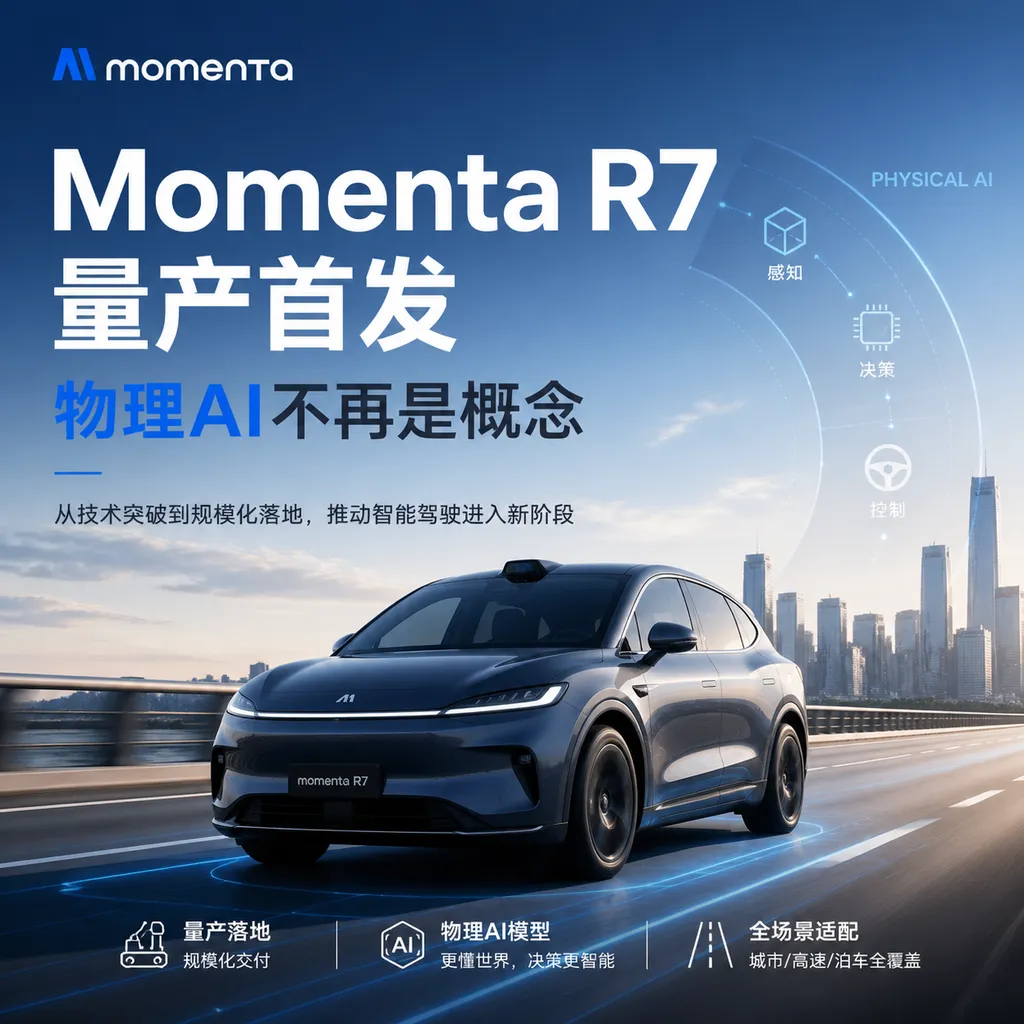
At the Beijing Auto Show, Momenta officially launched the R7 Reinforcement Learning World Model and announced its mass-production debut. This is the world’s first large-scale application of a world model in intelligent driving, marking the transition of Physical AI from research papers to real-world vehicles.
Momenta R7 Production Launch: Physical AI Is No Longer Just a Concept on a Slide
Yesterday (April 25), at the Beijing International Auto Show, Momenta officially announced the production launch of the R7 Reinforcement Learning World Model.
To sum up the significance in one sentence: this is the first time—globally—that a company has taken the “world model,” a concept that has been discussed for over two years in both academia and industry, and actually put it into a production vehicle. Not a demo, not a tech validation for a limited scenario, but a large-scale rollout that has already been delivered in more than 70 vehicle models and designated in over 200 models.
This milestone deserves a closer look.
What Problem Is the World Model Really Solving?
Let’s start with some background. Over the past few years, the mainstream paradigm in intelligent driving essentially follows a perception–planning–control pipeline: cameras and radars are responsible for “seeing,” the perception module transforms raw data into structured information (where the lane lines are, how far the car ahead is), and the planning module then makes decisions based on rules or learned strategies.
This approach works, but its ceiling is clear.
For example: a truck ahead suddenly brakes hard, and a car in the adjacent lane is accelerating to overtake. A traditional system can recognize the locations and speeds of both vehicles but struggles to simulate how the world will evolve in the next 2–3 seconds—will that overtaking car cut into the lane? Could a pedestrian suddenly appear from behind the truck? Answering these requires a deep understanding of physical causality, not just object detection in the current frame.
That’s what the world model aims to solve.
If we say the core ability of a large language model (LLM) is Next Token Prediction—compressing human linguistic reasoning and knowledge by predicting the next word—then the world model’s task is World Model Prediction—predicting the next state of the physical world. The former makes AI “speak human language”; the latter teaches AI to “understand how the physical world works.”
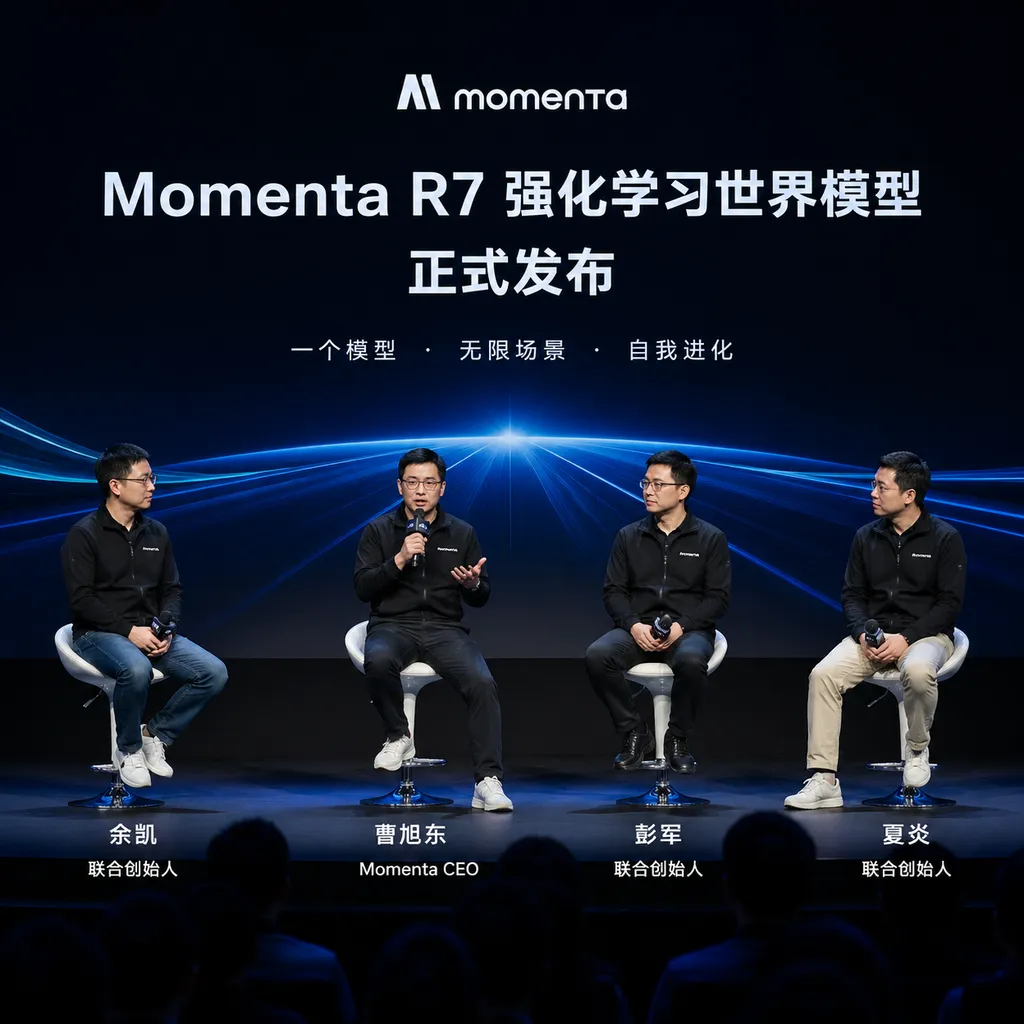
This analogy was introduced by Momenta CEO Cao Xudong at the press conference, and frankly, it’s one of the most intuitive explanations of what a world model really is.
The Three-Layer Architecture of R7: From Pretraining to Reinforcement Learning
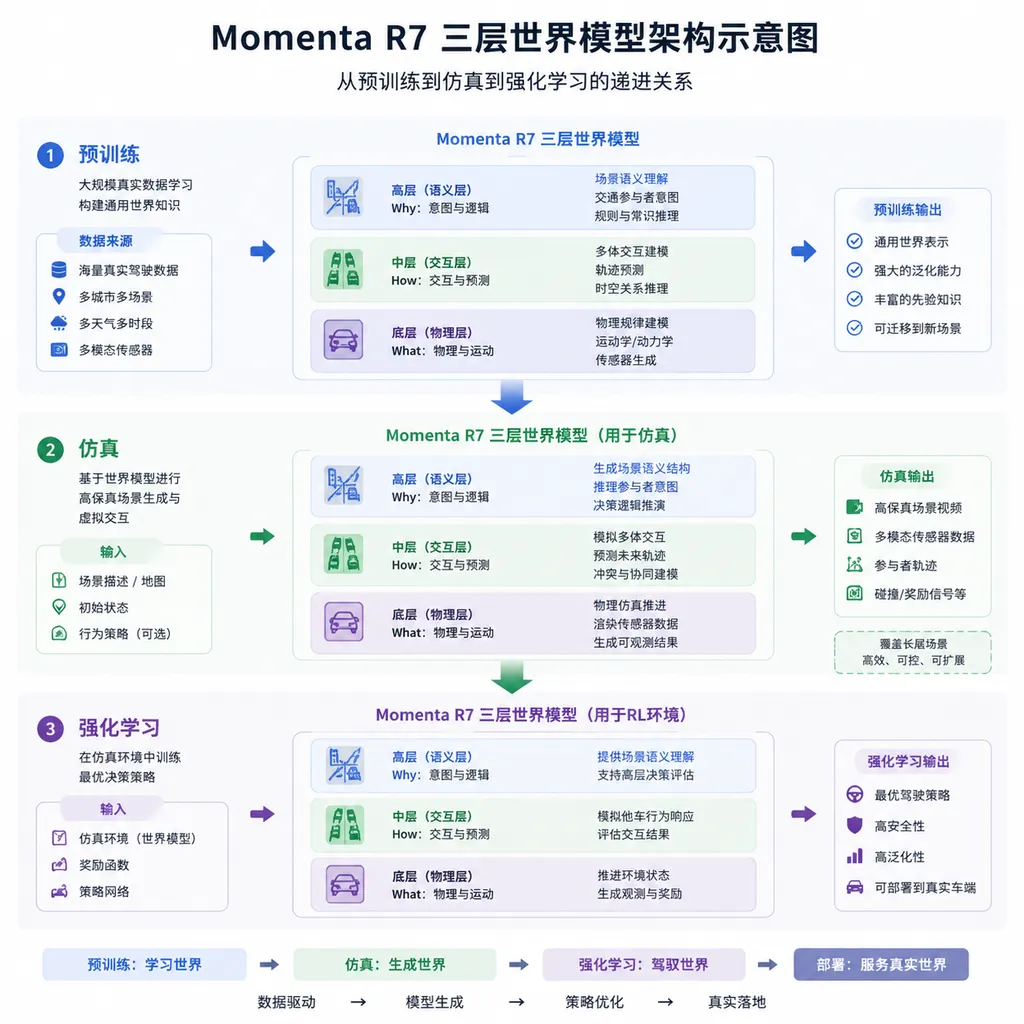
At the launch event, Momenta Partner and VP of R&D Xia Yan broke down the technical architecture of R7. The entire world model consists of three progressive layers:
Layer 1: World Model Pretraining
Massive real driving data is used for pretraining, encoding physical laws, driving common sense, and causal relationships into model parameters.
This step mirrors the logic of LLM pretraining—just as the GPT series learns linguistic structures from vast internet texts, Momenta’s world model learns physical patterns from massive driving scenes. The difference is that text is one-dimensional, whereas driving scenes are four-dimensional (3D space + time), several orders of magnitude more complex.
This layer solves the problem of basic cognition: knowing that braking distance increases on slippery roads, that a pedestrian approaching the curb may cross the street, that large trucks have blind spots… all the kinds of “common sense” human drivers learn from experience, but here, the model must infer them from data.
Layer 2: World Model Simulation
Use the trained world model for closed-loop simulation—allowing the system to forecast “how the world changes if I make different decisions.”
The key here is handling long-tail scenarios. The hardest part of self-driving isn’t the 99% of routine cases, but the 1% of rare and extreme ones: a bike going the wrong way, a suddenly fallen cargo box, a construction site with temporary diversions. These are rare on real roads but can cause accidents if mishandled.
Traditionally, you’d rely on road testing mileage to eventually encounter these scenarios—extremely inefficient. With world model simulation, such long-tail situations can be generated and iterated rapidly in a virtual environment, assessing system performance under edge conditions. It’s similar to AlphaGo self-playing in a virtual board: no need for a real opponent, just fast self-iteration.
Layer 3: Reinforcement Learning Within the World Model
This is the core innovation of R7—the reason for the term “Reinforcement Learning” in its name.
Once the first two layers establish a highly realistic virtual environment, the third layer lets the AI explore, experiment, and optimize within it. The basic idea is familiar: given a reward function, the agent learns the optimal strategy through trial and error. But reinforcement learning demands high environmental fidelity—if the virtual environment is unrealistic, the learned strategy won’t transfer well to the real world.
That’s why the first two layers are foundational: pretraining gives deep physical understanding, while simulation ensures realistic feedback. Only on this base can reinforcement learning yield strategies that generalize to real-world driving.
A simple analogy: the first layer lets the AI “read all the driver’s manuals,” the second gives it an “infinitely realistic driving simulator,” and the third trains it for “millions of hours” inside that simulator.
Production Deployment Speaks for Itself
No matter how elegant the architecture sounds, real-world deployment is what counts.
Momenta reports: over 70 production vehicle models have already been delivered, with more than 200 confirmed production designations. At this Beijing Auto Show, more than 20 brands and over 60 models adopted Momenta’s intelligent assisted driving solutions—spanning domestic and joint venture brands.
The key value lies in the word production. The intelligent driving industry doesn’t lack demos, but it does lack solutions that meet vehicle-grade standards, fit production lines, and run stably across dozens of brands and hundreds of models. Delivering 70 models and securing 200 designations suggests Momenta’s tech has passed the most rigorous OEM validation processes.
For comparison: globally, few suppliers have reached a similar production scale. Tesla’s FSD serves only its own models; Huawei’s ADS mainly supports Aito and a few partners; Mobileye ships at scale but follows a more traditional stack. Momenta, as a “Tier 1-style” supplier pursuing the cutting-edge world model route, is indeed taking a rarer path in this industry.
Why Now?
The concept of a world model isn’t new. As early as 2022, Yann LeCun had emphasized that world models are key to AGI, and academia has published countless related papers. But why did it take until the spring of 2026 for someone to actually put it into production?
Several prerequisites have just matured in the last year or two:
-
Compute power. Training and inference for world models demand vastly higher compute than conventional perception models. Over the past two years, in-vehicle chips like NVIDIA’s Orin/Thor and Horizon’s Journey 6 have made complex on-car models feasible.
-
Data. World models need massive, diverse, high-quality driving data. Through production vehicles and data feedback loops, Momenta has built a large-scale data engine—the more cars sold, the more data gathered, the better the model, leading to more design wins in return.
-
Scaling Laws validated for Physical AI. Over the past year, experiments have shown that the same scaling law seen in LLMs—more data, larger models, more compute leading to predictable gains—also applies to world models, giving industry players the confidence for large-scale investment.
-
Engineering breakthroughs in Reinforcement Learning. From DeepSeek-R1 to OpenAI’s “o” series models, 2025 saw a wave of engineering advances in reinforcement learning. Those experiences and methods now apply to Physical AI, lowering the barrier for deployment.
What “From Seeing to Understanding” Means
Momenta described this as the shift from “seeing the world” to “understanding the world.”
That’s not just marketing. Traditional perception systems essentially perform pattern matching—this cluster of pixels is a car, that one’s a pedestrian. A world model performs causal reasoning—this car is accelerating, there’s a red light ahead, so it will likely slow down within 50 meters; if it doesn’t, maybe the brakes failed or the driver’s distracted, so better prepare to react.
The difference may be subtle in simple cases but becomes crucial in complex interactive scenarios—like unregulated intersections where multiple drivers negotiate right-of-way, or narrow urban alleys where pedestrians, bikes, and tricycles “negotiate” space. These call not for better object detection, but for the ability to anticipate intent and understand deeper physical dynamics.
That’s why Momenta calls this release the “Prologue of Physical AI.” R7 is just the first step, but far from the last. Once validated, the world model approach could go beyond self-driving—to robotics, industrial automation, gaming, and simulation—any scenario where AI must understand and predict the physical world.
A Few Questions to Stay Grounded
Of course, it’s not all rosy. A few points to watch:
Compute constraints on the vehicle. World model inference requires far more computation than traditional approaches. Within the car’s limited compute budget, how large and how fast can the model run? Momenta hasn’t disclosed R7’s exact latency and compute usage—something to monitor.
The sim-to-real gap. Reinforcement learning within a world model assumes the simulation is realistic enough. But the sim-to-real gap has long plagued robotics and self-driving. Whether the world model can shrink it effectively remains to be proven with large-scale road data.
Safety fallback mechanisms. End-to-end architectures like world models tend to be less interpretable than modular pipelines. In safety-critical situations, how to design fallback layers and meet regulatory requirements remains an open challenge for all companies pursuing end-to-end autonomy.
Shifting Industry Landscape
Zooming out, Momenta R7’s launch marks a key signal for autonomous driving in 2026: world models are shifting from academic consensus to industry consensus.
Tesla’s FSD V13 already uses a similar end-to-end philosophy; Huawei revealed its world model R&D progress late last year; emerging players like XPeng and NIO are ramping up their investment in this direction. But Momenta is the first to explicitly claim “world model in production,” supported by data from 70+ delivered models.
The broader effect may be this: the question is no longer whether to build a world model, but how and how fast to do it. OEMs and suppliers still on the fence may accelerate their follow-up.
For developers, Physical AI is becoming a more compelling field. Training a world model requires scalable data systems, distributed training, and simulation infrastructure—all technically challenging engineering problems. If you’re working in these domains, Momenta R7’s production launch proves one thing: this path works, and someone has already brought it into real-world production.
The story of Physical AI is just beginning. R7 is the prologue—but the prologue alone is enough to make the world take this direction seriously.
References
- Momenta R7 Reinforcement Learning World Model Production Launch at the Beijing Auto Show – IT Home: IT Home’s detailed report on the Momenta R7 launch, including technical architecture and production data.


