
Codex free period countdown — OpenAI has marked it as temporarily open

The official OpenAI documentation clearly states that Codex is currently “free for a limited time,” which means that the ability for Free and Go users to write code with Codex is only a temporary benefit. Behind this adjustment is OpenAI’s repricing of its programming assistant product line.
Codex Free Period Countdown, OpenAI Marks as Limited-Time Access
OpenAI has added four new words to its official help documentation: “For a limited time.” This means that the Codex currently available to ChatGPT Free and Go users could become a paid feature at any moment.
This isn’t the first time an AI company has used a “limited-time free” offer to test users’ willingness to pay, but the timing of OpenAI’s move is notable—Codex was only made fully available to free users in April this year. Now, by explicitly labeling it as a temporary benefit, OpenAI is signaling that it already has a clear roadmap for the product’s commercialization.
How Long Will the Free Honeymoon Last?
According to OpenAI’s official help documentation, Codex is currently included in the ChatGPT Free, Go, and Plus plans. However, the words "limited time" are especially prominent on the pages seen by Free and Go users. Such a label is rare in OpenAI’s product language—they usually use terms like “beta”, “experimental”, or simply leave it unmentioned.
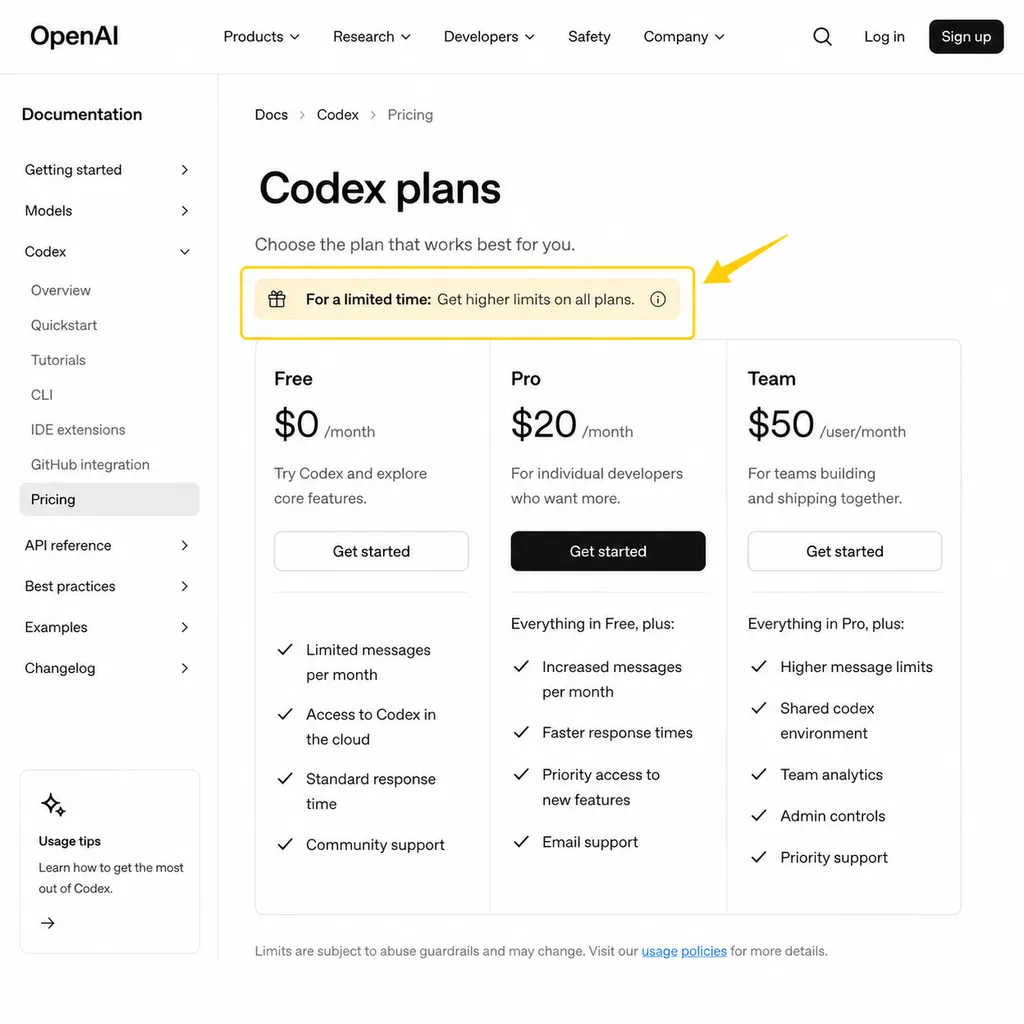
This explicit time limitation sends a straightforward message: you can use it for free now because OpenAI needs to collect more usage data, optimize the product experience, and test server load. Once those goals are met, the free access could be closed at any time.
By comparison, Anthropic’s Claude went through a similar phase when it launched its Artifacts feature, but it never used the word “limited time” in official documentation. OpenAI’s move shows a degree of transparency—almost like a preemptive warning to users.
Why Codex?
Codex is not the first OpenAI feature to transition from free to paid, but it could be the one with the widest impact.
In the coding assistant space, GitHub Copilot has already proven that developers are willing to pay for productivity. Newcomers like Cursor and Windsurf are using even more aggressive pricing strategies to compete. If OpenAI keeps Codex free, it would essentially be handing over a lucrative market.
More importantly, Codex is much more computationally expensive than regular chat. It must understand coding context, execute code, and handle multi-file dependencies—tasks that consume far more model inference power and system resources than simple text generation. Once free user volume grows, OpenAI’s cost pressure will spike sharply.
From a product positioning standpoint, Codex also naturally fits as a paid feature. Its target users are developers—a group already comfortable paying for productivity tools and able to quantify Codex’s benefits. A tool that saves you two hours of debugging time per week seems well worth a $20/month subscription.
The Subtle Balance of Pricing Strategy
OpenAI’s current subscription tiers are: Free, Go ($20/month), Plus ($20/month but with more features), and Pro ($100/month). If Codex becomes paid, there are likely two possible routes:
- Give full Codex access only to Plus and Pro users, removing it entirely from Free and Go
- Keep a minimal quota for Free and Go users (for example, five uses per day), requiring an upgrade for more
The first approach is straightforward but risks angering many free users. The second is more gradual but could make the experience fragmented—users might hit their quota in the middle of a task.
Based on OpenAI’s previous approach with GPT-4, it tends to favor limiting usage rather than outright blocking access. This maintains product accessibility while introducing friction that nudges users toward upgrading.
The Pro plan also gives OpenAI more pricing flexibility. At $100/month, it targets heavy coding users and enterprise developers. Under this tier, Codex usage could be “nearly unlimited,” with faster response times and longer context windows.
How Competitors Handle It
GitHub Copilot charges $10/month or $100/year for individual users and $19/month for its enterprise version. Its strategy is clear: low price for volume among individuals, higher price for enterprise profit. The model works—GitHub revealed in 2024 that Copilot’s annual revenue has exceeded $1 billion.
Cursor takes a bolder route—it bundles the editor and AI capabilities into one package. Its Pro plan costs $20/month and includes unlimited code completions and chat. Though twice as expensive as Copilot, its smoother experience continues to attract many paying users.
Windsurf adopts a “freemium” approach: basic code completion is free, but advanced features like multi-file editing and code review require a subscription. This layered strategy lets it target students, individual developers, and enterprises all at once.
OpenAI’s strength is that Codex isn’t a standalone product—it’s woven into the ChatGPT ecosystem. Since users are already accustomed to doing many tasks within ChatGPT, if Codex becomes paid, they’re more likely to upgrade their ChatGPT subscription than switch to Copilot or Cursor. This ecosystem stickiness is something competitors struggle to replicate.
The Real Purpose of the “Limited-Time Free” Label
Why did OpenAI explicitly write “limited-time free” in the docs instead of changing things quietly? There are several reasons behind this move:
Setting user expectations. Announcing abruptly that “Codex will be paid starting next month” could cause a backlash. But labeling it “limited-time” months in advance eases the eventual transition psychologically.
Gathering feedback data. The free period is a perfect stress test. OpenAI can observe user patterns, peak server loads, and common use cases—data that will directly influence future pricing and product decisions.
Measuring conversion rates. By tracking how many users upgrade to Plus or Pro after seeing the “limited-time” label, OpenAI can gauge Codex’s real commercial potential. A high conversion rate would justify monetization; a low one might prompt adjustments.
Putting pressure on competitors. A clear signal that OpenAI is moving to monetize Codex forces Copilot, Cursor, and others to rethink their pricing or speed up innovation. Either way, competition intensifies—and users benefit.
What Developers Should Do
If you’re a heavy Codex user on the free plan, you have a few options:
Get familiar with alternatives. Tools like GitHub Copilot, Cursor, Windsurf, and Codeium all offer free tiers or trials. Try them out while Codex is still free to find what best fits your workflow.
Evaluate whether paying is worth it. If you code daily, the time Codex saves could easily exceed the $20/month cost. Do the math before deciding whether to upgrade.
Stay updated on OpenAI’s announcements. OpenAI will surely give advance notice before the free period ends. Subscribe to their mailing list or blog so you’re not caught off guard when the feature suddenly locks behind a paywall.
Consider the API route. If your use case is consistent, you can call OpenAI’s API directly and pay as you go. This might offer more flexibility and lower costs. For developers in China, platforms like OpenAI Hub provide aggregated access to many models including GPT—usable with a single key and direct domestic connectivity.
Long-Term Implications of This Transition
Codex moving from free to paid isn’t just an internal business decision—it will reshape the entire AI coding assistant market.
Pricing anchors will shift upward. If OpenAI prices Codex at $20/month, competitors will struggle to justify $10/month offerings. The market will gradually accept that “AI coding assistants aren’t free.”
Free options will shrink. Once Codex becomes paid, others will likely follow. Existing free coding assistants may soon face feature or usage limits. Fully free and unlimited AI coding tools will be increasingly rare.
Enterprise demand will grow faster. Individual users might hesitate due to cost, but companies won’t. For them, paying $20 per developer per month is trivial if it boosts team efficiency. OpenAI, GitHub, and Cursor will all likely shift focus toward enterprise clients.
Open-source projects will gain momentum. Some developers will refuse to pay for AI tools and instead migrate to open-source alternatives like Continue.dev, Tabby, or CodeGPT. These communities may see a surge in activity and contributors in the coming months.
Final Thoughts
OpenAI adding the phrase “limited-time free” might look like a small change, but it signals that the AI coding assistant market has entered a new phase.
Over the past two years, companies have raced to attract users, data, and market share through free access. Now comes the time to test their business models. Codex monetization is just the beginning. Soon, more AI features will move from “free trials” to “paid subscriptions.”
For developers, that’s not necessarily bad news. Paying often means more stable performance, faster iteration, and better support—but only if the tools are truly worth the cost.
Is Codex worth $20/month? That depends on the user. What’s certain is this: the era of free AI lunches is coming to an end.
References
- OpenAI Official Help – Using Codex – Official explanation from OpenAI about Codex availability across subscription plans
- Linux.do Community Discussion – Codex Free Access May End Anytime – Developer community discussion and analysis of Codex’s limited-time free policy


