
DeepSeek cache 90% off, permanently effective — the price war has hit rock bottom

DeepSeek announced that the input cache hit price for its entire series of model APIs has been permanently reduced to one-tenth of the original launch price, changing from a limited-time offer to a permanent rate, once again setting a new record low for domestic large model API pricing.
DeepSeek Cache Hit Permanently 90% Off: Liang Wenfeng Slashes Prices to the Floor Again
Just when everyone thought the API price hike wave for large models was the new normal, DeepSeek went the opposite way.
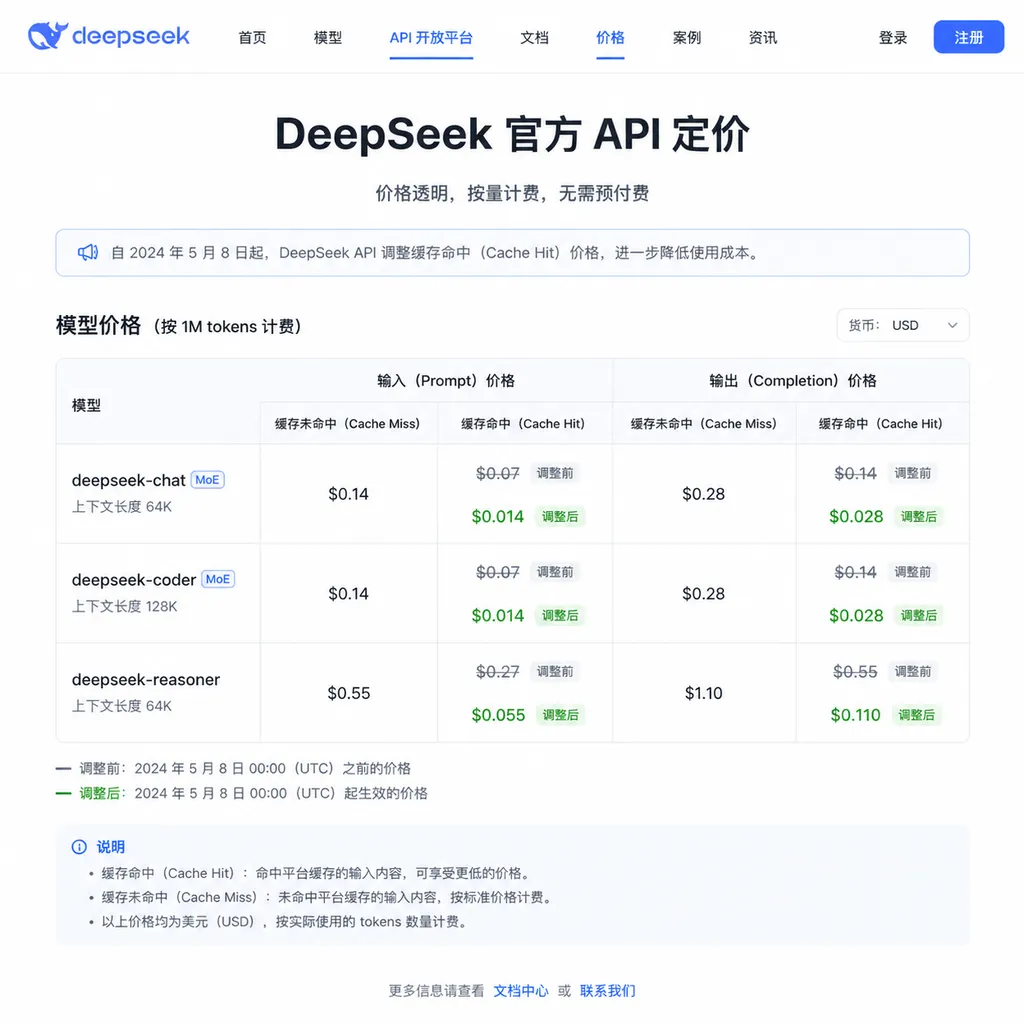
On April 25, DeepSeek quietly updated its official API pricing page: For all model series (including the latest V4 Pro), the input cache hit price has been reduced to one-tenth of the launch price — permanently, not a limited-time offer.
The news immediately blew up the developer community. Within hours, nearly a dozen related posts appeared on the Linux.do forum, with titles ranging from “What’s Saint Liang doing?” to “Too rich to care about profit,” reflecting an absurd sense of being subsidized by the vendor instead of the customer.
How much cheaper is it really? Let’s do the math
Let’s lay out the numbers clearly.
Take DeepSeek V4 Pro as an example. The previous pricing system looked roughly like this:
| Billing Item | Price Before (CNY / Million Tokens) | Price After (CNY / Million Tokens) | |---|---|---| | Input (Cache Miss) | Unchanged | Unchanged | | Input (Cache Hit) | Launch Price × 1 | Launch Price × 0.1 | | Output | Unchanged | Unchanged |
The key phrase here is “cache hit.” DeepSeek has implemented disk-based KV Cache since the V2 generation — when your request has the same prefix content as previous ones (like a system prompt or previous conversation context in multi-turn chats), the repeated part is read directly from cache, skipping recomputation. The cached portion was already much cheaper than uncached input — now it’s cut by another 90%.
What does that mean? If your application achieves a cache hit rate of 80% (common in multi-turn conversations, agent calls, RAG scenarios, etc.), your actual input cost becomes extremely low. For apps with long system prompts and high context reuse, the input cost practically disappears.
Even more notable is the timeline: Yesterday (April 24), DeepSeek announced a limited-time 75% discount; today it made cache hits permanently 90% off. Two drops in just one day — and the second one is both deeper and permanent. Forum users joked “Used it yesterday, already lost money” — though just humor, it shows the speed of this price cut caught everyone off guard.
Why can DeepSeek afford this pricing?
To understand the confidence behind this move, we need to look at DeepSeek’s technical architecture.
MLA architecture’s cost advantage
The MLA (Multi-head Latent Attention) architecture introduced from DeepSeek V2 is the core reason it can optimize cache so effectively. Ordinary Transformers have massive KV Caches, which are expensive to store and transmit. MLA compresses these by applying latent-space compression to attention heads, shrinking the KV Cache size by several times, even an order of magnitude.
What does that mean? The same disk space can hold much more context. The same bandwidth can transmit more cached data. When cache’s marginal cost is low enough, pushing the price down isn’t “burning money”—it’s trading technical advantage for market share.
Scale effects of disk caching
DeepSeek is one of the world’s first API providers to adopt large-scale disk-based KV Cache. Disk space is several orders of magnitude cheaper than GPU memory or system RAM. And DeepSeek’s cache system is particularly aggressive—the cached data persists far longer than competitors’.
Developers have compared it on forums: Some competitors’ cache validity is so short that you have to act like a “cyber foreman,” constantly monitoring to prevent expiry-induced cost spikes. DeepSeek’s cache retention is far more generous, so developers don’t need to engineer request timings just to preserve cache hits.
That’s crucial in real development. If the cache window is too short, you either send frequent “keep-alive” requests (wasting money) or endure unpredictable cost swings from cache expiry. DeepSeek’s long cache retention plus 90% discount allows developers to design their systems calmly—instead of revolving around cache strategy.
Industry background: others raising prices, DeepSeek cutting them
Viewed in the broader context of the large-model API market, the contrast is striking.
Starting from late 2025, the domestic large-model API market saw an obvious price hike trend. DeepSeek itself raised prices once when launching V3.1 last year—canceling its nighttime half-price discount and increasing output from 8 CNY to 12 CNY per million tokens. At the time, 36Kr and IT Times covered it, asking whether the price war had ended.
Zhipu’s GLM-4.5-X hit 16 CNY per million tokens after ending promotions, and Moonshot’s Kimi K2 High-Speed version returned to 64 CNY per million tokens for output pricing. The whole industry’s pricing direction was upward.
The logic is simple: compute is expensive, talent is expensive, data is expensive. Early price wars were about burning money for market share—it can’t last. OpenAI passed US$1 billion in monthly revenue this year, yet Sam Altman said he’ll spend trillions building data centers. If even the market leader worries about cost, how can anyone else keep offering ultralow pricing?
And yet DeepSeek chose to go the other way.
This isn’t just “losing money for growth.” Technically, cache hits consume little GPU compute—the data is read from disk, skipping costly inference. So cache-hit marginal cost is naturally far lower. Setting this tier extremely cheap may barely touch DeepSeek’s profit margin, but it shocks developers’ expectations.
What does this mean for developers?
The impact varies depending on your cache hit rates.
High-benefit scenarios
- Multi-turn conversations: Each turn must resend conversation history; prefixes naturally repeat. Cache hit rates reach 70–90%.
- Agent / Function Calling: Agents have long system prompts and tool definitions that rarely change, yielding very high cache reuse.
- RAG applications: If retrieval results are relatively stable (same knowledge base queried repeatedly by different users), prefix reuse is considerable.
- Batch processing: Reusing the same prompt template across large data batches ensures template portions consistently hit the cache.
Low-benefit scenarios
- Single-turn, short requests: No context reuse, so low cache hit rates; the discount helps little.
- Totally unique requests each time: For one-off tasks like translation or summarization, prefixes differ and cache is unused.
Practical optimization tips
If you want to maximize the benefit:
-
Place fixed content at the very beginning. DeepSeek caching matches prefix tokens—only consecutive matches from token 0 count. So system prompts, tool definitions, and static instructions must come first.
-
Avoid injecting dynamic elements in the prefix. Some developers include timestamps or session IDs in the system prompt, making every prefix unique—turning off caching entirely. Move dynamic data to the user message.
-
Remember the minimum cache unit is 64 tokens. DeepSeek caches in chunks of 64 tokens; anything shorter won’t be stored. Ensure your fixed prefix is at least 64 tokens to get discounted caching.
-
Leverage long cache windows. Unlike some competitors, you don’t need to send frequent “keep-alive” calls. DeepSeek caches persist long enough that normal request rates won’t expire them.
Where does the price war go from here?
The broader question: Is this pricing strategy sustainable?
My judgment: For the cache-hit segment specifically, sustainability is stronger than it looks.
Simple reason—the cost structure for cache hits differs fundamentally from inference. Inference burns GPU cycles on huge matrix multiplications: the largest API cost driver. Cache hits involve only reading precomputed KV Cache from disk, consuming storage and bandwidth but not valuable GPU time.
With MLA architecture’s compression gains, DeepSeek cut KV Cache storage cost even further. Therefore, a permanent 90%-off cache price may be near or even at marginal cost. This isn’t “selling at a loss”—it’s direct monetization of technical advantage.
But it presents a dilemma to competitors: If your model architecture lacks MLA-like KV Cache compression, your caching cost is higher. Follow this price cut and risk losing money; hold prices and lose clients.
From a longer-term view, large-model API pricing is becoming more refined. Early on, it was simplistic—“input X yuan, output Y yuan.” Now we see splits by cache hit/miss, context length, and performance tiers. This shows industry maturity—vendors now base price design on true cost structures, not flat-rate formulas.
Essentially, DeepSeek is saying: We have a structural cost edge in the caching layer, so we’re passing that advantage directly to developers. That’s far smarter than a blanket “50% off,” because it targets competitors’ weak spots while keeping profits controlled.
Closing thoughts
In the 2024 price war, everyone competed on how much they could afford to lose. In 2025’s price hikes, the industry faced reality. And moving into 2026, DeepSeek seems to prove a simple truth: True low prices come from technology, not subsidies.
When your architecture drives a specific cost down by an order of magnitude, you can set prices where competitors can’t follow—while still making profit. That’s a healthy, sustainable “price war.”
For developers, now is the time to reexamine your app architecture. If you haven’t optimized for caching yet, this price cut is a clear signal: Pre-position fixed content and maximize cache hits—this is no longer optional optimization, but a core cost strategy.
As for whether Liang Wenfeng is truly a “saint,” let the forums debate that. But one thing’s clear: DeepSeek currently leads the pack in tech-driven cost reduction. If you’re using aggregation platforms like OpenAI Hub, you can already experience DeepSeek’s new pricing—one key accesses all major models, direct China connection, no tedious setup.
Now that prices are down to this level, the next competition is: who can create more value from cheaper tokens.
References
- DeepSeek API Price Cut Again: Cache Hits Down to 10% — Linux.do community thread summarizing the official announcement
- What’s Saint Liang Doing? Cache Permanently 90% Off! — Developer community discussion on the permanent discount
- DeepSeek Official Promotion Update: Cache 10% (Updated: Permanent 10%) — Earliest post confirming permanent discount
- DeepSeek V4 Series Input Cache Price Reduced to One-Tenth of Launch Price — Price confirmation citing official documentation
- DeepSeek’s Cache 10% Discount—Apparently Not Limited-Time? — Community debate on the “permanent” nature of the discount
- Discussion of DeepSeek Restoring V3 Model API Pricing — Historical pricing discussion on Zhihu


