
AWS integrated the latest Claude into Bedrock.
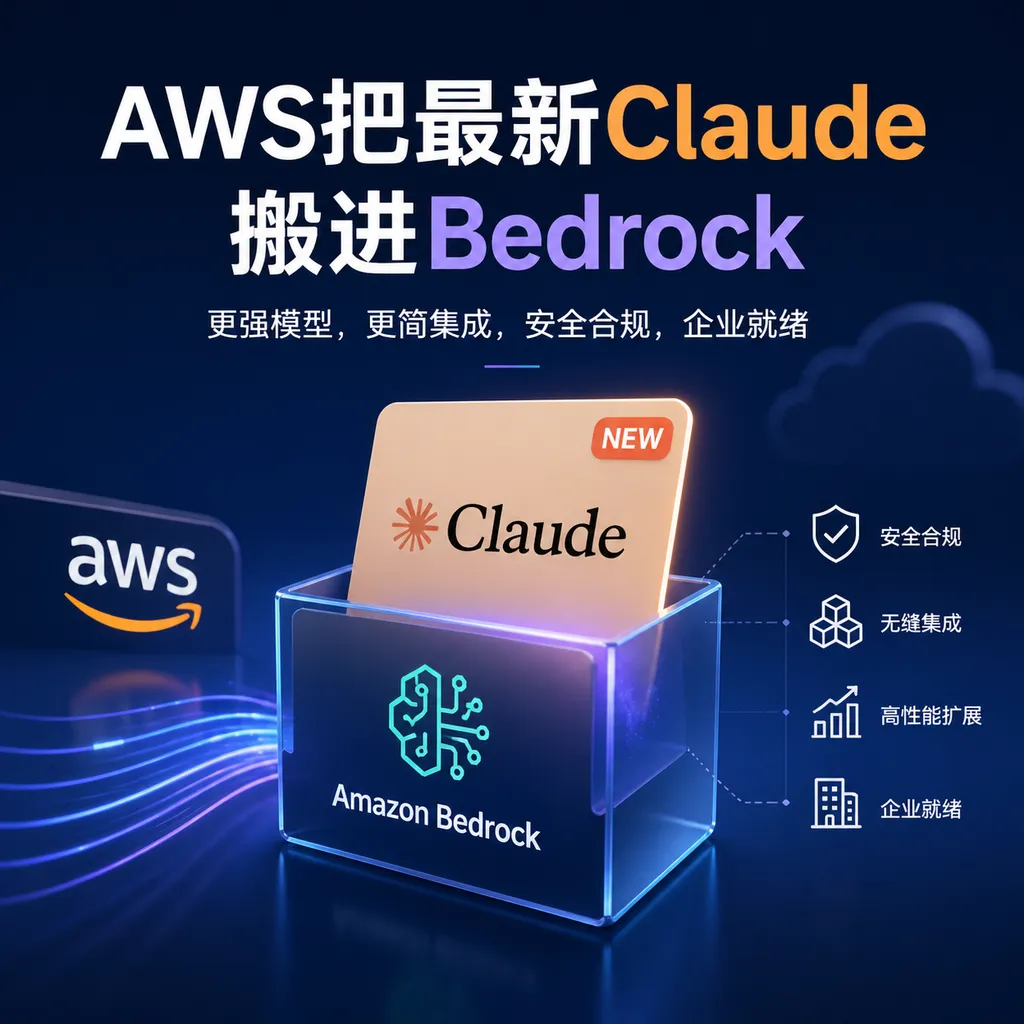
AWS announced integration with Anthropic’s native Claude Platform, allowing enterprises to invoke the latest Claude models more directly within Bedrock. This means that AWS is no longer just “hosting Claude,” but is embedding Anthropic’s cutting-edge capabilities more deeply into existing enterprise cloud stacks.
AWS Connects Anthropic’s Native Claude Platform to Bedrock—Making Enterprise Access to the Latest Models Much Smoother
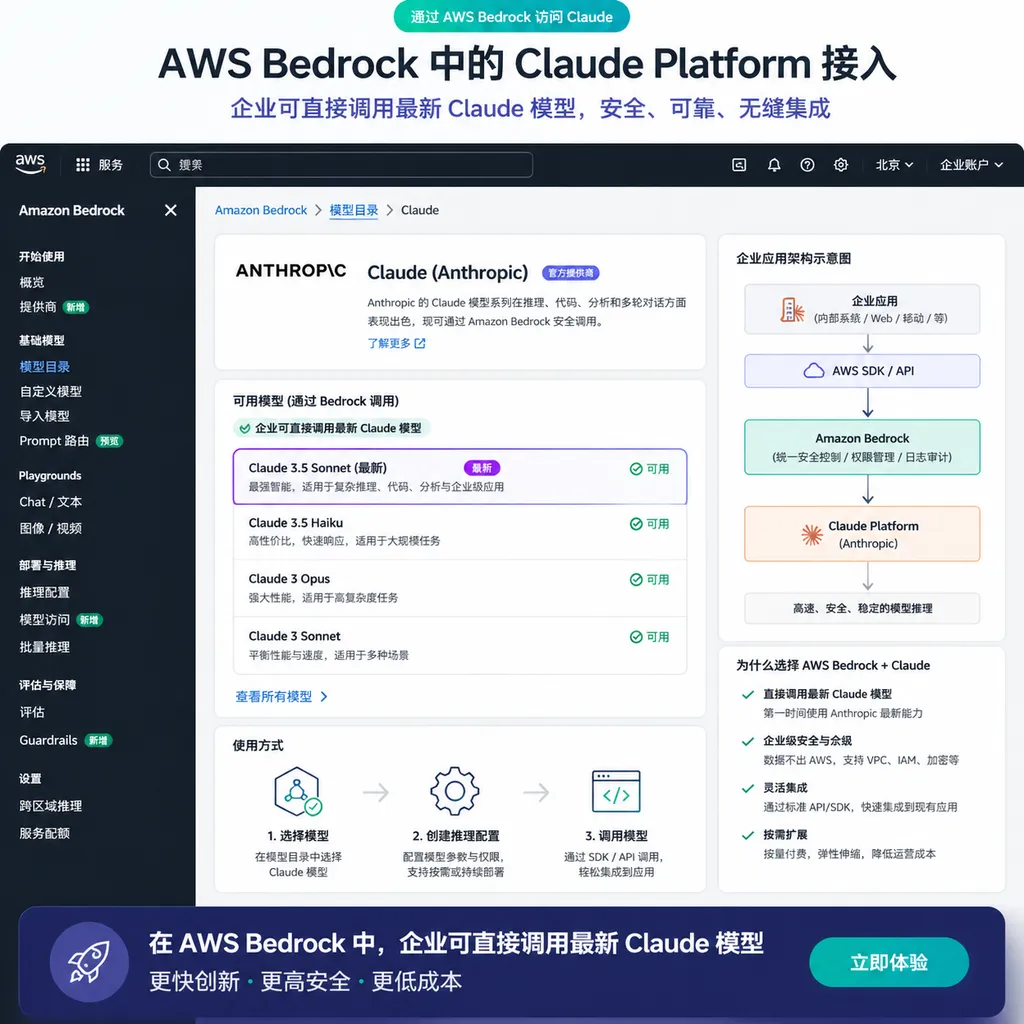
This time, what AWS did is more than just “adding another model.” It directly connected Anthropic’s Claude Platform to Amazon Bedrock, effectively tying together Anthropic’s native developer experience, its latest capabilities, and AWS’s enterprise cloud infrastructure. For companies already running business on AWS, the meaning is straightforward: faster access to the newest Claude models, less hassle with the integration layer, and seamless embedding of models into existing permissions, network, auditing, and data governance systems.
From a product logic perspective, this step goes beyond simply listing more model names in Bedrock. In the past, enterprises often faced a two‑layer divide when adopting large models on the cloud: one layer being the model provider’s native capability evolution, the other the cloud platform’s enterprise packaging. The former moves fast, the latter is stable, but the two rarely move in sync. AWS’s deep integration of the Claude Platform into Bedrock essentially shortens this bridge: Once Anthropic releases the latest model capabilities, AWS users can naturally access them within Bedrock.
What This Update Actually Is
According to AWS, Claude Platform on AWS gives enterprises direct access to Anthropic’s newest capabilities and native development experience, with the entry point still through Amazon Bedrock. In other words, enterprises don’t need to rebuild their AWS architecture from scratch—they can continue along the Bedrock path to integrate Claude into their applications, agents, workflows, and internal tools.
This is not on the same level as “adding another model to a cloud marketplace.” What truly matters is:
- Shorter integration path – developers no longer need to maintain a separate integration parallel to Anthropic’s native platform.
- Faster updates – the newest Claude capabilities are more likely to sync on Bedrock right away, without enterprises chasing API versions.
- Unified governance – AWS enterprise customers can continue using familiar tools for access control, network boundaries, audit logs, and org‑level billing.
- Lower migration cost – teams already running other models on Bedrock don’t have to rebuild inference infrastructure to switch to or add Claude.
For most enterprises, that’s the key. Model capability matters, but what really determines deployment speed is integration cost, compliance paths, and operational complexity. AWS understands this perfectly.
Why This Matters
On the surface, this looks like an upgraded platform partnership; but viewed in the context of over a year of enterprise AI competition, it carries deeper implications.
1. AWS Is Turning “Model Choice” into Its Moat
AWS has long sought to sell not a fixed model, but the idea of “come here—choose any model you want, and I’ll handle the infrastructure.” Bedrock’s whole positioning is as an aggregator: giving enterprises access to multiple mainstream models from a single entry, avoiding vendor lock‑in.
But model competition today isn’t about “who lists more names.” It’s about:
- Who can access new models faster;
- Who provides richer context, tool‑calling, and long‑task execution;
- Who best integrates model capabilities with enterprise governance, identity systems, and data boundaries.
By integrating the native Claude Platform, AWS is essentially telling enterprises: if you want the newest Claude, you can stay within our ecosystem. That’s crucial for a cloud platform because it reduces reasons for customers to go straight to the model vendor’s native API.
2. Anthropic’s Enterprise Strategy Is Becoming Clearer
Anthropic’s enterprise play has long been deliberate: emphasizing reliability, long context, reasoning, and agent scenarios—not chasing consumer‑facing buzz but embedding itself into enterprise workflows.
Developers already know Claude’s strengths:
- Long‑form document understanding and summarization;
- Code generation, refactoring, and review;
- Multi‑step reasoning and tool use;
- Acting as a “high‑quality sub‑agent” in workflows.
Now that AWS is natively connecting the Claude Platform into Bedrock, Anthropic’s enterprise story becomes more complete: model capability delivered by Anthropic, enterprise‑level deployment, compliance, networking, and orchestration managed by AWS. For enterprise sales, that’s far more compelling than selling an isolated model API.
3. Developers Will Face Less “Meaningless Friction”
For those building real products, the biggest pain isn’t an underpowered model—but one that can do the job yet is hard to connect.
Common enterprise friction includes:
- IAM, VPC, CloudTrail, and KMS already unified on AWS;
- Security teams disallowing direct external API calls;
- Procurement and compliance requiring all inference calls to flow through unified billing and auditing;
- Business teams wanting to test multiple models in one platform without switching SDKs each time.
Bedrock already addresses these issues. With the Claude Platform integrated deeply, those benefits grow. For developers, updates like this may not “wow” in demos but will steadily save hours after launch.
What’s Different from the Previous Claude on Bedrock
A common question: “Didn’t Bedrock already support Claude? What’s new here?”
The difference is that before, it was more like “Bedrock supports the Claude model,” whereas now it’s “Bedrock directly integrates with Anthropic’s native Claude Platform.”
That’s not just wording—it’s a deeper integration level:
- Old model: the cloud platform offered model access, and users connected from the cloud side;
- New model: the cloud platform provides access and stays aligned with the model vendor’s native capabilities and update cadence.
What does that mean?
For Enterprises: Fewer Version Guesses, Less Duct Tape
Enterprises dread “version lag” in their model supply chain. If the vendor releases a new feature but the cloud platform takes weeks to catch up, teams feel stuck—wait or build a direct integration? That direct route later means re‑migration pain.
Native platform integration minimizes this uncertainty.
For the Platform: More of a “Model OS” Than a “Model Shelf”
If Bedrock were just displaying models, AWS would be little more than a procurement portal. But if it can couple Anthropic and other major models deeply with enterprise governance, it starts looking more like the operating system layer for enterprise AI. Once that position solidifies, platform stickiness skyrockets.
How Enterprises Will Use It—and Why Chatbots Aren’t the Biggest Beneficiaries
Such updates are often misunderstood as “another chatbot entry for enterprises.” In reality, the more valuable use cases are workflow automation and agent orchestration.
1. Code Assistants and R&D Efficiency
Claude’s coding capabilities have long drawn enterprise interest. With Bedrock integration, R&D teams can more easily plug Claude into:
- Code review processes;
- Automated test generation;
- Legacy system refactoring;
- Internal scaffolding and template synthesis;
- Ops scripting and troubleshooting suggestions.
The focus here isn’t “faster answers,” but “stable, controllable, and toolchain‑friendly results.” Bedrock’s enterprise environment fits this perfectly.
2. Knowledge Workflows and Document Processing
Industries like law, insurance, consulting, finance, and procurement deal heavily with documents. Claude’s long‑context and summarization strengths, once within Bedrock, can connect naturally to internal document repositories, approval systems, and knowledge bases.
Examples include:
- Contract review and clause comparison;
- Bid summary and risk detection;
- Meeting‑minutes to work‑item conversion;
- Automated filing and synthesis of emails, reports, and spreadsheets.
These tasks are messy but monetizable—streamlining them saves real money.
3. Agent and Multi‑Tool Execution
Both Anthropic and AWS understand that enterprises ultimately won’t pay for “a chatty model,” but for agents able to call tools and execute tasks across systems.
Bedrock’s edge is that it naturally sits in the middle of enterprise systems:
- It can connect to internal APIs;
- It can integrate with access control systems;
- It can turn model output into structured actions;
- It can centralize audit, rate‑limiting, and monitoring.
With Claude Platform onboard, the barrier to building agents drops further—especially for teams already cloud‑native on AWS.
What It Means for the Competitive Landscape
In current market terms, this isn’t a single headline‑grabbing move—but another shift that drags enterprise AI battles further onto AWS’s home turf.
AWS Is Defending the “Default Enterprise Entry”
For many large enterprises, AWS isn’t “one of several options”; it’s the default infrastructure. If model selection happens within AWS, procurement, compliance, networking, and billing all become simpler.
Now that Anthropic’s latest capabilities are also directly available in Bedrock, enterprises are less likely to leave AWS just to access a native API. In other words, AWS isn’t defending a specific model—it’s defending AI’s default enterprise workstation.
Anthropic Is Avoiding Becoming “Just a Model Maker”
Model vendors that only compete on cutting‑edge capabilities eventually get commoditized by platforms. By partnering deeply with AWS, Anthropic embeds itself into real enterprise contexts. For a company focused on “reliable AI,” this route is more sustainable than consumer expansion.
The Battle Will Shift from “Who Launches Faster” to “Who Integrates Better”
Over the past year, model launches felt like an arms race—bigger parameters, higher scores, quicker tool use. But in enterprise procurement, the real questions are:
- Can it run inside my VPC?
- Can it pass audit?
- Who’s accountable if issues arise?
- Can data stay in designated regions?
- Can it directly connect to my IAM and KMS?
AWS’s native Claude Platform integration answers those. It may not be the flashiest move—but it could be the one that most enterprises are willing to pay for.
How Developers Should Judge Whether to Jump In
If you’re a developer, whether to adopt this update depends on where you are right now.
Teams That Should Prioritize It
- Enterprise application teams already heavily using AWS;
- Teams needing multi‑model switching without maintaining multiple integrations;
- Teams building internal agents, knowledge assistants, or R&D‑productivity tools;
- Industry teams with strict compliance, auditing, and data‑boundary demands.
Teams That Can Wait and Observe
- Small teams running on single machines or lightweight services;
- Early‑stage products still validating PMF;
- Teams sensitive to vendor lock‑in seeking maximum flexibility.
In short, if you’re already in AWS, this update makes life smoother; if you’re not, it may not immediately change your choices. But it reinforces a trend: cloud platforms are eating deeper into the enterprise entry point for large models.
Conclusion: Not Just Another Model Launch, but a Tightening of the Enterprise AI Entry Point
AWS’s integration of Anthropic’s native Claude Platform isn’t just another stronger model on Bedrock—it further intertwines the relationship among cloud platforms, model vendors, and enterprise applications.
For enterprises, the immediate payoff is this: the newest Claude capabilities are easier to invoke, govern, and deploy at scale within AWS. For AWS, it strengthens Bedrock’s role as a platform. For Anthropic, it places its cutting‑edge models more securely within paying, real‑world enterprise contexts.
Updates like this may not explode on social media—but in the coming months, they’ll quietly reshape many companies’ model‑selection paths. For developers, the key question isn’t “what was released,” but “will the default way to call models increasingly mean doing it inside AWS?”
References
- linux.do discussion — Source of information on AWS integrating Anthropic’s native Claude Platform.
- juejin.cn article — Discusses workflow changes after integrating Claude with AWS Bedrock.
- juejin.cn article — A developer’s perspective on Claude’s new models integrated with Bedrock.


