
After real-device training of the Xiaomi open-source VLA model, sub-millimeter-level operation was achieved in 20 hours.
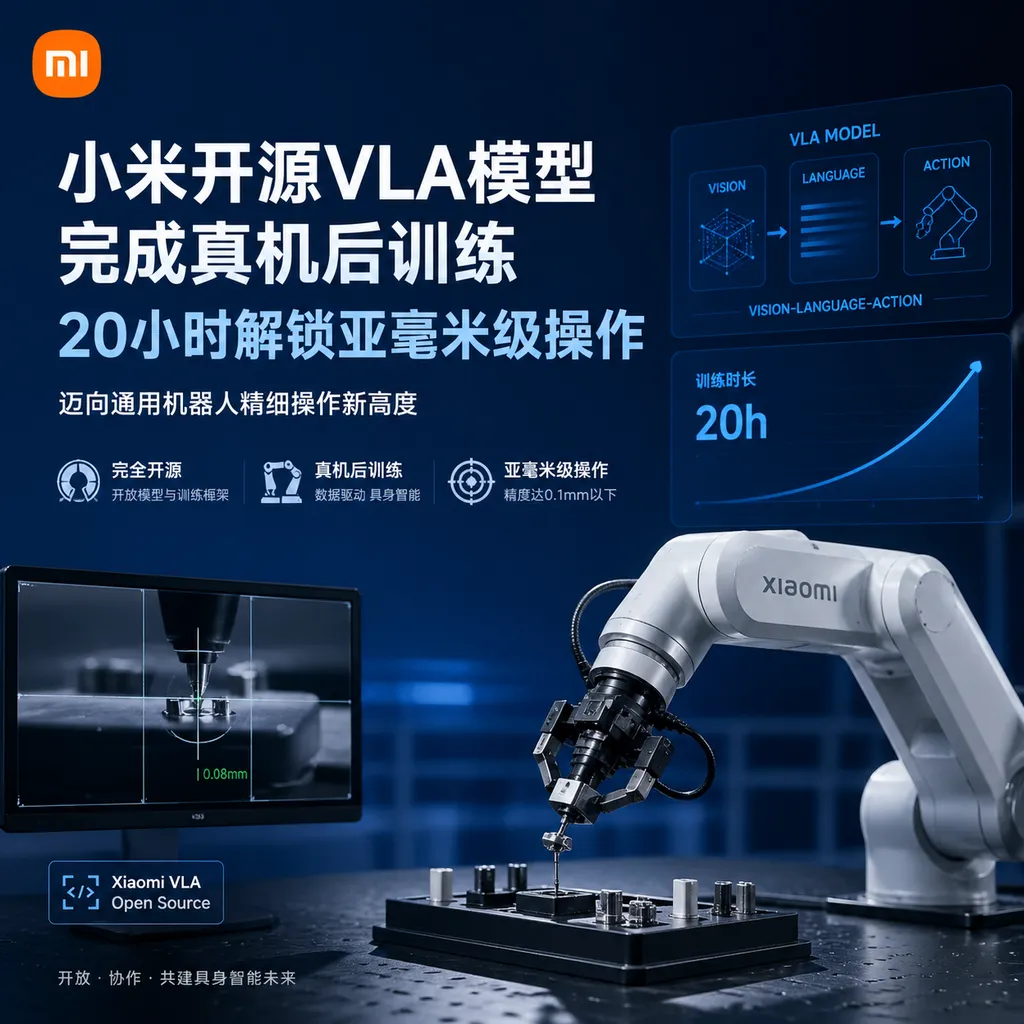
Today, Xiaomi officially unveiled the full post-training process for the Xiaomi-Robotics-0 real machine. With just 20 hours of task data, the model mastered the complex action of earphone storage, achieving sub-millimeter spatial perception accuracy — marking a key step toward a “ready-to-use” robotic productivity tool.
Xiaomi Open-Source VLA Model Completes Real-Machine Post-Training: 20 Hours of Data Unlocks Sub-Millimeter Precision Operation
From open source to real-world deployment, Xiaomi-Robotics-0 uses a complete post-training pipeline to prove a feasible path for VLA large models toward real-machine deployment.
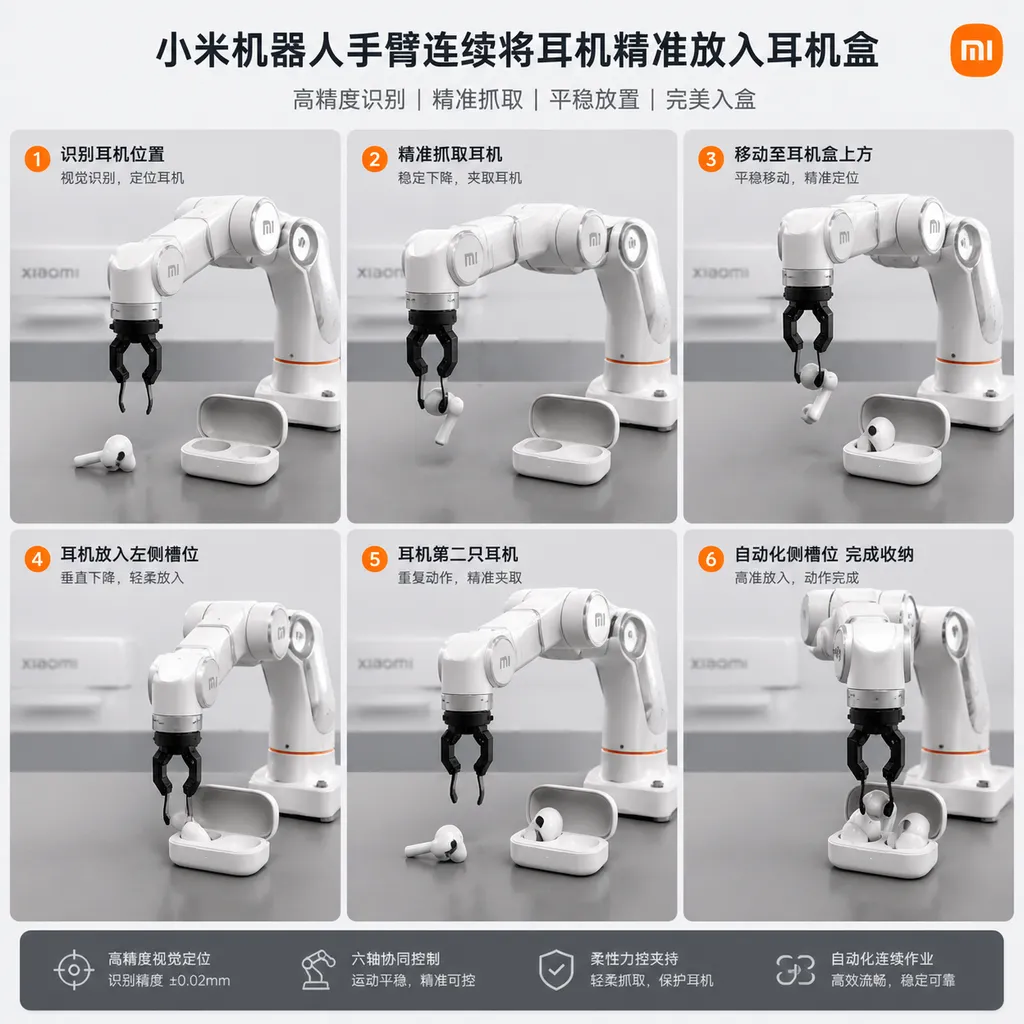
On April 27, 2026, the Xiaomi Robotics Team officially released the complete post-training pipeline for Xiaomi-Robotics-0, accompanied by an impressive demonstration of new capabilities—robots continuously and seamlessly storing multiple earbuds into their cases with high precision. This marks another key stride in Xiaomi’s pursuit of physical intelligence, following the model's initial open-sourcing in February.
I. Background Review: From Open Source to Sixth on the Download Chart
On February 12, 2026, Xiaomi officially released and open-sourced its first-generation robotic VLA (Vision-Language-Action) model, Xiaomi-Robotics-0. With 4.7 billion parameters, the model combines strong visual-language understanding and high-performance real-time action execution. Within the same month, it ranked sixth globally on HuggingFace’s VLA model download chart, generating widespread industry attention.
However, between a pretrained model and one that can “get work done” in the real world lies a crucial gap—post-training. Just as large language models require alignment steps such as RLHF to become truly “useful,” VLA models need targeted post-training in real-world scenarios to evolve from a “capability foundation” into an “out-of-the-box productivity tool.”
Today, Xiaomi completes that missing piece.
II. Core Release: The Complete Real-Machine Post-Training Pipeline
2.1 What Is “Real-Machine Post-Training”?
In the VLA technical roadmap, training typically consists of two stages:
- Cross-Modal Pre-training: Trained on large-scale, multimodal datasets (images, language, actions) to gain comprehensive visual understanding, linguistic reasoning, and basic motion generation ability.
- Real-Machine Post-Training: Fine-tuning the model using a small amount of task-specific data from a real robot platform and environment, aligning it precisely to that hardware’s kinematic traits and task requirements.
Xiaomi’s newly released complete pipeline covers the entire end-to-end process—from data collection and training strategy to deployment validation. This means developers and researchers can take the open-source pretrained base and, following Xiaomi’s workflow, reproduce and extend post-training on their own robot platforms.
2.2 A Stunning Demonstration: Continuous Earbud Storage
To demonstrate post-training performance, Xiaomi selected a highly challenging task—storing earbuds into their case.
This is far from a simple “pick-and-place” scenario. According to official details, two key technological hurdles are at play:
- Sub-Millimeter Spatial Precision: The tolerance between earbuds and their case slots is extremely small. The model must achieve sub-millimeter spatial perception accuracy to align objects precisely; even minute deviations prevent proper insertion.
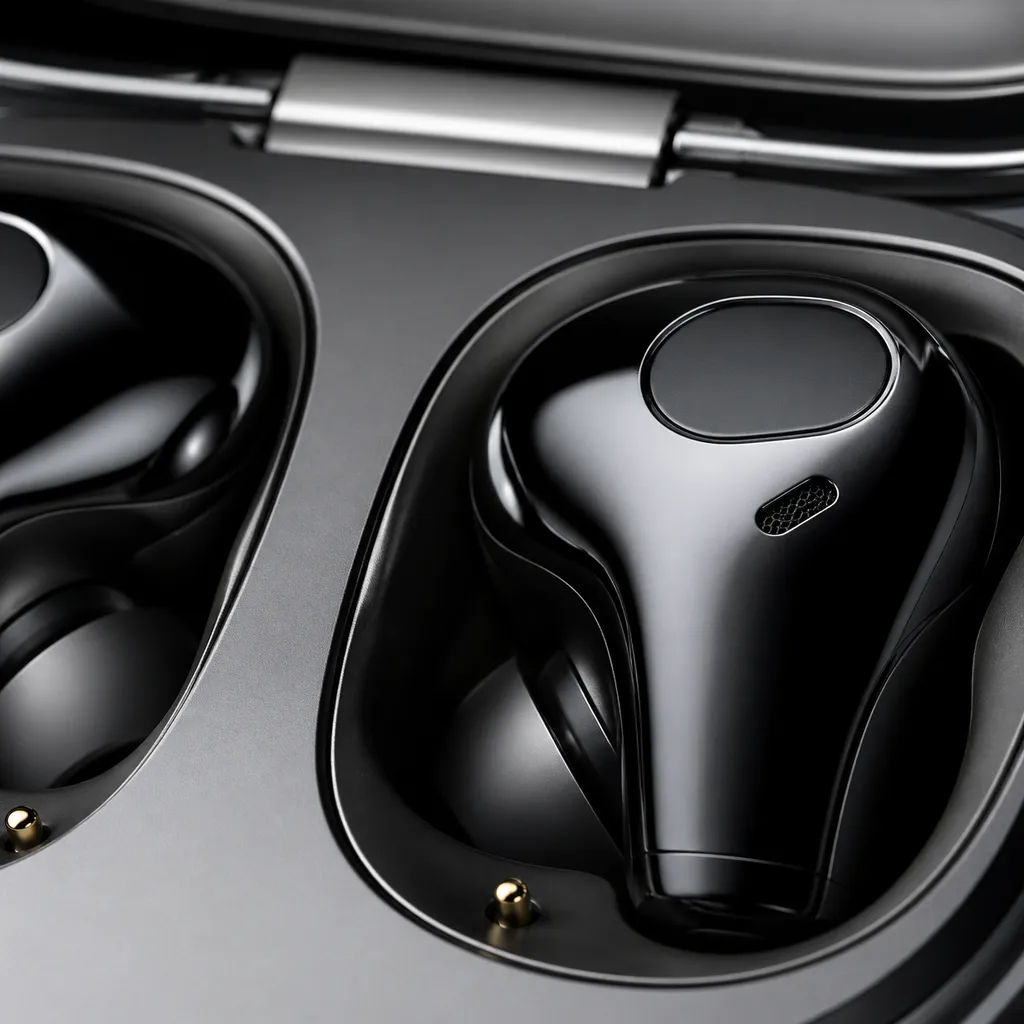
- Contact Control on Ultra-Low-Roughness Surfaces: With surface roughness as low as Ra 0.03μm (mirror-smooth level), earbuds easily shift upon contact. The model must rapidly detect and correct deviations in real time to avoid assembly failure.
Amazingly, using only 20 hours of task data for real-machine post-training, the Xiaomi team enabled Xiaomi-Robotics-0 to master this complex motion—executing continuous, fluid movements to neatly store multiple earbuds, smooth as flowing water, with no hesitation.
III. Technical Deep Dive
3.1 Architectural Foundation: Mixture-of-Transformers (MoT)
Xiaomi-Robotics-0 adopts the mainstream Mixture-of-Transformers (MoT) architecture, whose chief advantage lies in processing vision, language, and action information within a unified framework—achieving end-to-end perception, decision-making, and execution.
The model’s 4.7 billion parameters are not simply stacked; they are dynamically allocated across tasks through a carefully designed multimodal mixing mechanism, preserving strong general reasoning while enabling efficient action generation.
3.2 Training Strategy: Two-Stage Method to Preserve Foundational Abilities
Most VLA models face a classic issue during action learning: catastrophic forgetting. As they acquire new action skills, they often lose prior capabilities such as visual understanding, object detection, and logical reasoning.
To overcome this, Xiaomi designed a two-stage training strategy of cross-modal pre-training + post-training:
- Pre-Training Stage: Mixes multimodal and action data so the model learns basic operations while retaining strong object detection, visual Q&A, and reasoning abilities—“wise and capable.”
- Post-Training Stage: Applies specialized fine-tuning techniques such as Implicit World Modeling, allowing refined motion control for specific tasks.
Notably, post-training does not overwrite prior learning—it precisely injects new capabilities. The reason 20 hours of data suffice is that pre-training already established robust physical commonsense and visual understanding; post-training merely fine-tunes for task-level precision.
3.3 Asynchronous Inference: Solving “Action Discontinuity” in Real Deployment
Inference latency has long plagued real-world robotics. When model inference lags behind control frequency, robots exhibit “motion discontinuity”—manifesting as jerky, stalled actions.
Xiaomi addresses this via asynchronous inference, whose core idea is decoupled model computation and robotic control:
- The model continuously infers in the background, generating action chunks.
- The robot reads and executes actions from a buffer at the set control frequency.
- Carefully designed alignment ensures smooth transitions between consecutive motion chunks.
This mechanism guarantees coherence and fluidity in robot movements—crucial for achieving the seamless continuous actions seen in Xiaomi’s demo.
3.4 Real-Time Inference: Runs on Consumer-Grade GPUs
Another highlight is that Xiaomi-Robotics-0 enables real-time inference on consumer GPUs, dramatically lowering the hardware threshold. Developers can deploy and verify the model on their own robots at minimal cost—no need for expensive data-center infrastructure.
This democratizes VLA model adoption—a regular gaming GPU can make the robot move.
IV. Open-Source Ecosystem and Community Resources
Beyond unveiling technical details, Xiaomi continues its open-source commitment: releasing full code, model weights, and documentation. Key resources include:
| Resource Type | Link | |---------------|------| | Open-Source Code | GitHub - Xiaomi-Robotics-0 | | Model Weights | HuggingFace - XiaomiRobotics | | Official Website | robotics.xiaomi.com | | Project Page | robotics.xiaomi.com/xiaomi-robotics-0.html |
Developers can download weights via HuggingFace and reproduce both pre-training and post-training using code and documentation from GitHub.
Quick Start
For those wishing to try the model:
# Clone project code
git clone https://github.com/XiaomiRobotics/Xiaomi-Robotics-0.git
cd Xiaomi-Robotics-0

# Install dependencies
pip install -r requirements.txt

# Download model weights from HuggingFace
# Refer to project README for detailed loading and inference instructions
Detailed specs for post-training configuration, data formatting, and script usage are provided in the repository documentation.
V. Industry Significance and Forward Outlook
5.1 VLA Models Move from “Paper” to “Production Line”
The significance of this release goes beyond a technical showcase—it marks VLA large models’ transition from academic research to real-world industrial deployment.
Previously, most VLA evaluations remained within simulation; real-machine cases were rare and simple. Xiaomi’s demonstration of “earbud storage,” with tight tolerances and complex environment constraints, sets a new benchmark—showing VLA potential in precision assembly and other industrial scenarios.
5.2 The “20 Hours” Insight: Data Efficiency Is Key
Completing post-training with only 20 hours of task data is profoundly meaningful. In industrial deployment, data collection is time-consuming and costly. If each new task required hundreds or thousands of demonstration hours, VLA models would be impractical.
Xiaomi’s results prove that a powerful pretrained foundation drastically reduces post-training data needs—enabling rapid deployment across diverse tasks.
5.3 The Power of Open Source: Accelerating Industry Iteration
By open-sourcing the entire post-training pipeline, not just pretrained weights, Xiaomi bridges the critical gap between “generic foundation” and “specific tasks”—a previously opaque area in robotics research.
This effectively offers the community a replicable zero-to-one solution:
- Researchers can explore new post-training algorithms.
- Developers can rapidly adapt models to various platforms and use cases.
- Businesses can assess VLA model feasibility with minimal barriers.
5.4 Outlook: The Dawn of General Robotic Intelligence
From a broader perspective, Xiaomi-Robotics-0’s post-training release marks a milestone in Physical Intelligence. It validates a clear route:
Large-Scale Pre-Training → Small-Data Post-Training → Real-Machine Precision Operation
This mirrors the evolution of large language models—where pre-training provides broad knowledge, and post-training (e.g., RLHF) delivers alignment and utility. VLA models are following a similar trajectory—and Xiaomi stands at the forefront.
As more researchers and developers join this open ecosystem, new tasks will be unlocked, expanding the boundaries of VLA capabilities. The vision of general robotic intelligence may be closer than imagined.
VI. Summary
Today’s launch of the complete Xiaomi-Robotics-0 real-machine post-training pipeline is the most significant capability upgrade since its February open-source release. Key highlights:
- 20 hours of task data achieve full post-training—high data efficiency
- Sub-millimeter precision spatial perception and control meet fine-operation demands
- Asynchronous inference ensures smooth, continuous real-machine motion
- Fully open-source pipeline, from code to weights, available to the community
- Runs on consumer GPUs, lowering hardware barriers dramatically
More than a technical update, it marks a turning point: VLA models entering real-world application. Xiaomi demonstrates through action that open source means sharing complete knowledge chains—from pre-training to deployment. For researchers and developers in robotics or physical intelligence, this is an essential reference worth deep exploration.
References
- ITHome: Robot Continuously Stores Earbuds—Xiaomi Releases Full Post-Training Pipeline of Its Open-Source VLA Model Xiaomi-Robotics-0 — Core report with demonstration details and technical challenges
- Zhihu: How to Evaluate Xiaomi’s First Open-Source Robotic VLA Model Xiaomi-Robotics-0? — Technical discussions on architecture and post-training mechanisms
- GitHub: Xiaomi-Robotics-0 Open-Source Repository — Full source code with post-training scripts and documentation
- HuggingFace: XiaomiRobotics Model Weights — Downloads for both pretrained and post-trained model weights


