
QClaw v0.2.14: Tencent’s ambition for its Agent can no longer be hidden
Tencent QClaw releases its largest update to date, integrating the Hermes framework to enable dual-agent kernel parallelism. The underlying models have been switched to DeepSeek-V4-Pro and MixYuan Hy3 preview, alongside the simultaneous launch of multiple new features such as Expert Plaza and Team Collaboration.
Tencent pushed QClaw to v0.2.14 today, officially calling it “the most significant update so far.” That phrase has become something of a cliché in the tech world, but after reading through the changelog, I’d say Tencent isn’t exaggerating much this time.
In one sentence: QClaw is evolving from a desktop tool capable of running Agents toward becoming an Agent operating system.
Hermes framework integration: Two Agent types running in one shell
The most noteworthy change in this release is QClaw’s official integration with the Hermes framework.
If you haven’t been following Hermes—it’s an Agent framework focused on multi-step reasoning and tool calls, using a different technical approach than QClaw’s native Agent kernel. The native QClaw kernel focuses more on conversational interactions and skill orchestration, while Hermes excels at complex task decomposition and autonomous decision-making.
Now, QClaw has placed both into the same application. When creating an Agent, users can choose the kernel type—either QClaw’s native one or Hermes. A report from Sohu used a colorful analogy: “raising both shrimp and horses.” It’s a bit rustic, but quite accurate.
What does this mean?
For developers, you no longer have to struggle with “which framework fits my scenario.” Use the native kernel for simple dialog tasks; switch to Hermes for complex multi-step reasoning and tool coordination—all within the same workspace. That’s far more elegant than juggling two tools and workflows.
For Tencent, this is a smart move. Instead of competing with Hermes, they’ve integrated it. The Agent framework arena is crowded—LangChain, CrewAI, AutoGen all have their fans. Tencent is positioning itself as a “framework of frameworks,” elevating QClaw from an Agent runtime to an Agent platform.
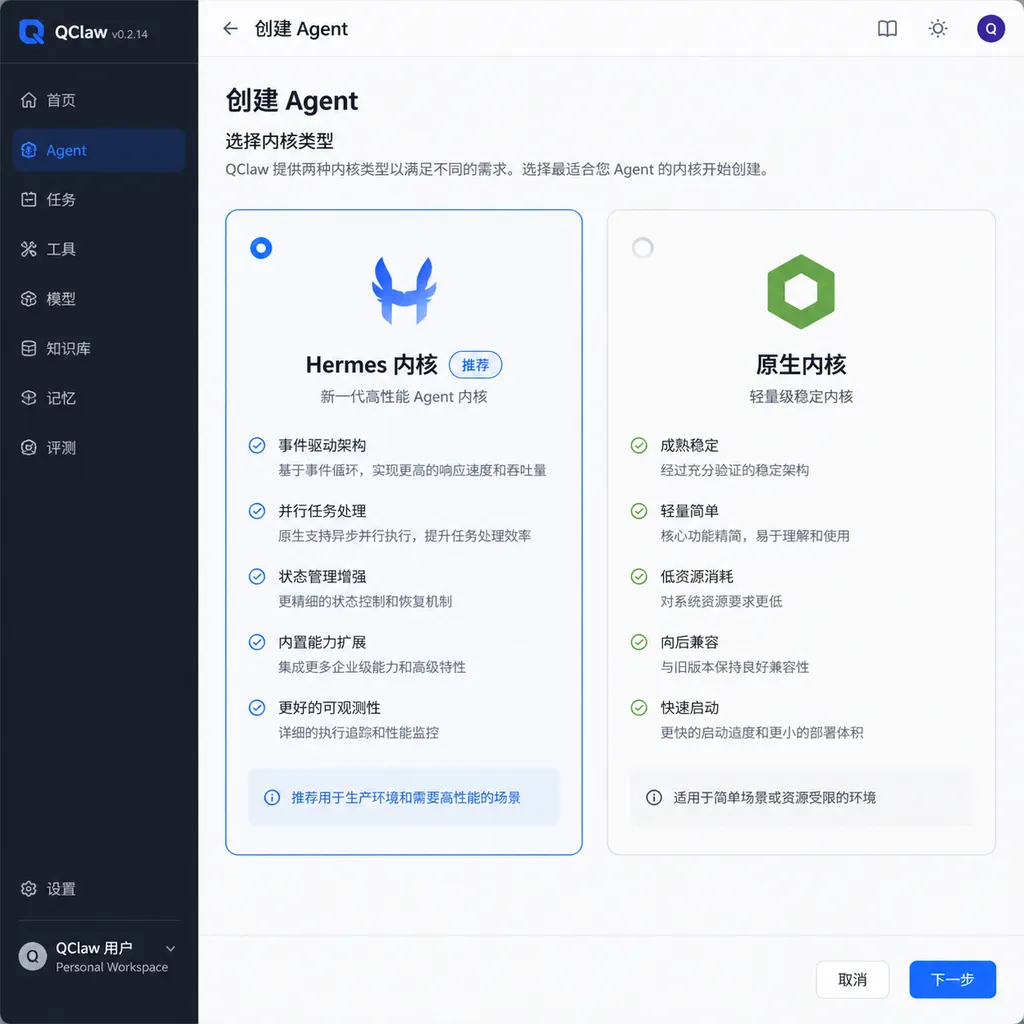
One thing to watch: the stability and resource consumption of dual kernels operating in parallel. The two kernels differ in scheduling logic, context management, and tool calling protocols. How thick QClaw’s adaptation layer is, and how much performance overhead it introduces—these will only become clear once the community starts running it extensively.
Major shift in underlying models: from “we choose for you” to “you choose yourself”
Previously, QClaw had a fixed underlying model—whatever the platform assigned, you used.
Version 0.2.14 completely removes that limitation—users can freely switch models or let the system auto-match them.
Currently supported models:
- HunYuan Hy3 preview: the first model after Tencent’s HunYuan architecture rebuild, a Mixture of Experts (MoE) model with 295B total parameters, 21B active parameters, and up to 256K context.
- DeepSeek-V4-Pro: released April 24, open-source model with 1.6T total parameters, 49B active, and 1M context length.
- KIMI-K2.6: latest version from Moonshot.
- GLM-5.1: newest generation from Zhipu AI.
An interesting lineup.
Starting with Hy3 preview — the 295B/21B ratio suggests Tencent is chasing efficiency after rebuilding HunYuan: balancing performance and inference cost with a large expert pool but fewer activated parameters. A 256K context window is sufficient for most Agent workflows, since they rarely consume that much context in a single dialog turn.
Next, DeepSeek-V4-Pro — 1.6T parameters, 49B active, 1M context. Considering it was released only days ago, QClaw’s integration pace is impressive. The 1M context holds far greater value for Agents than for chatbots—Agents must process tool outputs, operational logs, and file content, and longer contexts reduce information loss.
Worth noting: the points system change. QClaw has replaced token counting with a task-type-and-model-based point system. For users, this simplifies billing—no need to calculate tokens per call, you’re charged “per completed task.” But transparency decreases, making costs harder to estimate.
For developers, model flexibility means dynamic optimization: lightweight models for simple text tasks to save points, larger ones like DeepSeek-V4-Pro or Hy3 for complex code or data analysis. This flexibility is especially valuable because a full Agent workflow often contains subtasks of varying complexity.
By the way, both DeepSeek-V4-Pro and HunYuan Hy3 preview are already supported through OpenAI Hub, so they can be called via a single API key—no need to apply separately for each vendor.
“Expert Plaza”: making Prompt Engineering effortless
The former “Inspiration Plaza” has evolved into Expert Plaza, now featuring over 100 AI experts sorted by industry and scenario.
The intended users are clear: those who don’t know how to write prompts, configure skills, or even understand what an Agent is. Interaction boils down to three steps—select an expert, state your need, get a result.
Admittedly, the concept isn’t new. ChatGPT’s GPTs, Coze’s Bot Store, Baidu’s Lingjing Matrix—everyone’s doing similar things. But QClaw’s distinction is that its “experts” are tied to Agent capabilities. These experts aren’t mere prompt templates—they run full Agent workflows, can invoke connectors, access external data, and perform multi-step operations.
Example: you choose a “Data Analysis Expert” and say “analyze the Q1 sales Excel sheet in my Baidu Drive.” It uses the Baidu Drive connector, fetches the file, analyzes data, and produces a report. Far more practical than a simple chat-based AI assistant.
Each expert has an independent persona and isolated conversation space—a thoughtful design. Isolation means dialogue with the “Coding Expert” won’t contaminate the context of the “Content Creation Expert.” For users handling multiple projects, this separation matters.
Initial coverage includes content creation, data analysis, and coding. To be fair, 100 experts sounds plenty, but quality matters more than quantity. If they’re just generic prompts with different names and greetings, they offer little real value—the community’s feedback will tell.
WeChat Mini Program upgrade: your phone becomes an Agent remote
Remote control has always been a key differentiator for QClaw, and this round brings major upgrades:
- Voice interaction: issue remote commands verbally, no typing needed.
- File sharing: share Agent-generated files directly with WeChat contacts.
- One-click cloud binding: link Agent instances running on Tencent Lighthouse cloud servers for unified local-cloud management.
Voice interaction seems simple but is practical—say you’re commuting and remember a data task; just speak to the Mini Program, no need to type on your phone.
File-sharing within WeChat’s ecosystem fits naturally. Generated a report? Forward it to colleagues directly in chat—no more download-send juggling.
The cloud binding feature unlocks serious potential. It means your Agents aren’t confined to your local PC—they can run 24/7 in the cloud while you monitor and command them via mobile. For long-duration tasks (e.g., continuous data monitoring, scheduled reporting), this is essential.
Tencent’s advantage here is clear: WeChat + Tencent Cloud + QClaw forms a self-contained loop. Other Agent tools need separate apps or third-party comms for remote control—Tencent doesn’t.
Connector expansion: giving Agents longer reach
Four new connectors added:
| Connector | Capability | |------------|-------------| | Baidu Drive | Access and manage cloud files | | Trip.com (Ctrip) | Query itineraries, flights, hotels | | Fliggy | Query itineraries and travel products | | Tencent News | Retrieve news content summaries |
Connector variety and quality directly determine real Agent usability. Without external service access, an Agent is just a glorified chat interface.
These additions cover key use cases—file storage and travel. Baidu Drive integration is especially notable—many Chinese users store personal files there, so direct agent access saves tedious uploads/downloads.
Ctrip and Fliggy both joining is interesting: overlapping OTA platforms, but supporting both likely caters to user habits—some prefer one, some the other. From an Agent perspective, dual integration enables price comparison: check both platforms for flight/hotel deals and pick the optimal one—makes practical sense.
Team collaboration: Agent sharing via Tencent Docs
QClaw also introduced team collaboration features based on Tencent Docs.
Details are scarce, but from the “based on Tencent Docs” description, it’s likely that Agent configurations, skills, and workflows are stored as editable documents—team members can co-edit and use Agents collaboratively.
The direction is right. Most Agent tools remain single-user, with collaboration via primitive “export config and send to colleague” methods. If QClaw achieves Docs-level collaboration quality, it’ll be attractive for enterprise use.
Still, Agent collaboration is trickier than document editing—it involves configuration, permissions, runtime states, and histories. Maturity will take time.
Overall assessment: What game is QClaw playing?
Putting all v0.2.14 updates together, Tencent’s agenda is clear:
QClaw doesn’t just want to be an Agent tool—it wants to be the operating system for the Agent era.
Hermes integration = multi-kernel support (akin to OS supporting multiple app architectures)
Model switching = pluggable compute layer (like drivers)
Connectors = external service I/O capability
Expert Plaza = app store
Team collaboration = multi-user permissions
WeChat remote = mobile interface
That’s a big ambition. Many Chinese players (Coze by ByteDance, Wenxin Agents by Baidu, Tongyi Stardust by Alibaba) are in the field, but most are still at the “help you build an Agent” stage. QClaw now aims higher—to become the platform that manages and runs all Agents.
Of course, it’s still v0.x—much depends on maturity and stability. How deeply Hermes integrates, how efficiently both kernels cooperate, and how reliable the connectors are—all need real-world testing.
But the direction is right. The Agent race is shifting from “whose model is stronger” to “whose ecosystem is more complete,” and Tencent’s cards—WeChat, Tencent Cloud, Tencent Docs—give it a natural edge in platformization.
Next to watch: will QClaw open protocols for third-party kernel integration?
If it truly wants to be an Agent OS, supporting only its own and Hermes won’t suffice—it needs to run LangChain, CrewAI, etc. That’s what will make it a true platform.
References
- Tencent QClaw v0.2.14 update: first to support Hermes, integrates DeepSeek-V4-Pro and HunYuan Hy3 preview models - IT Home (Detailed feature update and model parameter comparison)


