
Youdao Cloud Notes bets on AI knowledge management — can LLM-Wiki really work?
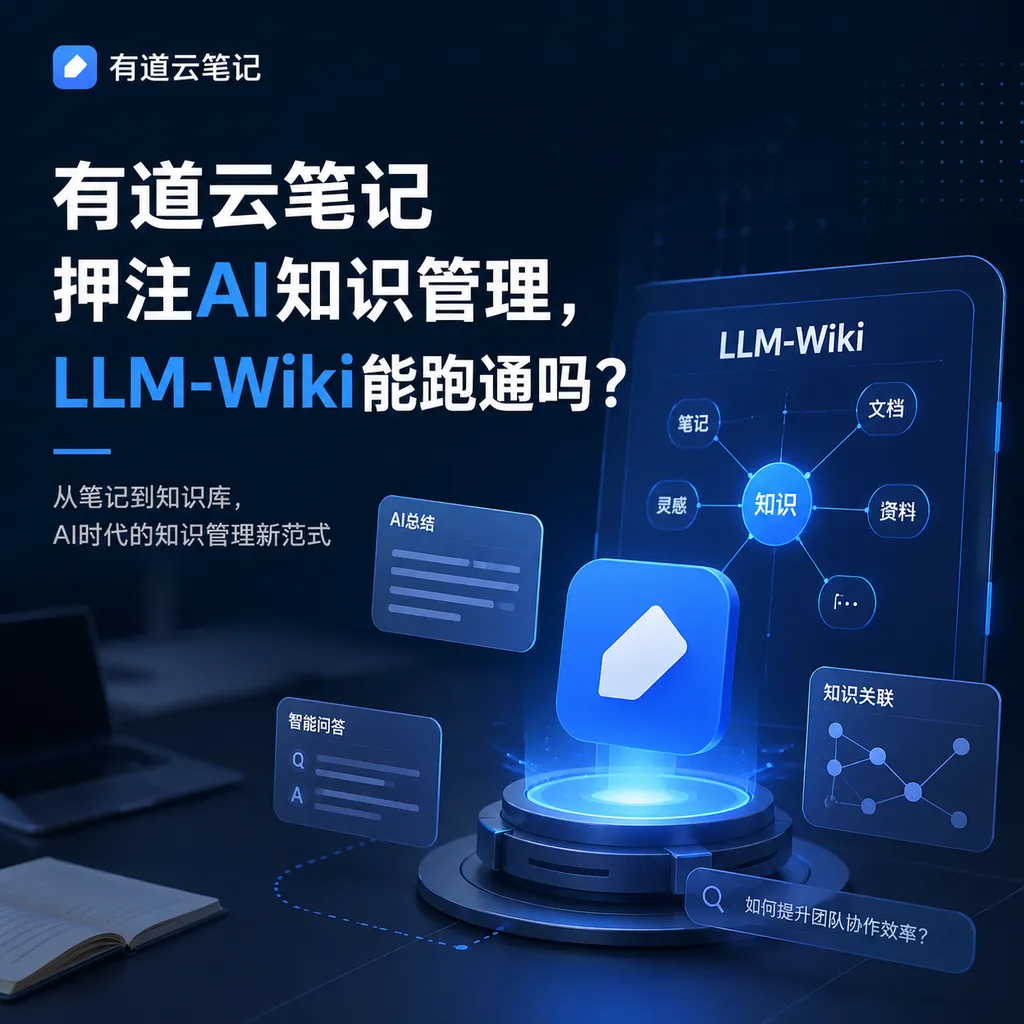
NetEase Youdao Cloud Notes has released the LLM-Wiki skill suite, featuring zero-barrier conversion of fragmented notes into a structured knowledge base, simultaneously launched on the OpenClaw and LobsterAI skill markets. This marks another attempt by note-taking tools to transition toward AI-driven knowledge management.
Youdao Note Bets on AI Knowledge Management — Can LLM-Wiki Really Work?
On April 27, NetEase Youdao Note officially launched its LLM-Wiki skill suite, which simultaneously debuted on the OpenClaw and NetEase Youdao LobsterAI skill markets. The official core selling point is straightforward: with zero technical background, turn your years of scattered notes into a structured knowledge base in just 5 minutes.
Sounds tempting, but is this a genuine need or just a gimmick? Let’s take a closer look.
First, what problem is it actually solving?
Anyone who does development probably knows this feeling: your note-taking app contains hundreds or thousands of entries — web clippings of technical articles, quick debug notes, meeting minutes, annotations from papers, and more. They’re scattered across folders, tags, or even different notebooks.
Over time, this content becomes "digital junk" — you know you recorded it, but you can’t find it; and even if you do, it’s hard to connect related pieces.
The traditional solution? Manual organization. Create directories, add tags, write indexes. Diligent users can keep this up for a while, but most give up within three months.
Then came bidirectional link note apps (Obsidian, Logseq, Roam Research), which try to automatically build a knowledge graph through linking relationships. The idea is correct, but the barrier is high — you must change your note-taking habits and actively create links, and the quality of the resulting knowledge graph depends entirely on how much effort you invest.
Youdao Note’s LLM-Wiki essentially wants to use a large language model to replace this manual organization process. No need for manual categorization, tagging, or linking — the AI reads all your notes, extracts themes, summarizes structure, and automatically generates a Wiki-like knowledge base.
This direction isn’t new. Notion AI, Mem, Reflect are all doing similar things. But Youdao’s angle is a bit different — instead of embedding the AI into the note-taking tool itself, it has packaged the capability as a standalone “skill suite” released on a skill marketplace.
What does a "skill suite" actually mean?
Some context is needed here.
Youdao Note has launched LLM-Wiki on two platforms: the OpenClaw and LobsterAI (Lobster) skill markets. These platforms are positioned similarly to the GPTs Store or Coze plugin markets — developers or product teams encapsulate LLM-based capabilities into “skills” that users can directly invoke.
Choosing this form instead of embedding it directly into Youdao Note may involve several considerations:
First, lower trial-and-error cost. As an independent skill, it’s easy to adjust or take down if feedback is poor, without affecting the stability of the main product.
Second, broader reach. Not everyone uses Youdao Note. Theoretically, users of other note-taking tools could still invoke LLM-Wiki through the skill marketplace to process exported content. This offers more flexibility than locking it to a single product.
Third, testing a skill ecosystem. NetEase Youdao is clearly betting on the AI Agent ecosystem, and the LobsterAI skill market is part of this strategy. LLM-Wiki serves both as a product and as a “showroom” — demonstrating to other developers, “Look, our own team is using this platform to publish skills.”
That said, skill marketplaces are still in an early phase. Even after more than a year, OpenAI’s GPTs Store has few blockbusters, and most domestic plugin/skill markets remain lukewarm. How much organic traffic LLM-Wiki can get via this channel is uncertain.
Is “building a knowledge base in 5 minutes” realistic?
The official pitch goes like this: you give the AI a prompt or question, and it automatically organizes hundreds of scattered notes into structured Wiki pages.
That “5 minutes” likely refers to the user’s operation time — you just select which notes to process, input a command, and wait. The actual processing time depends on the number of notes and the model’s inference speed.
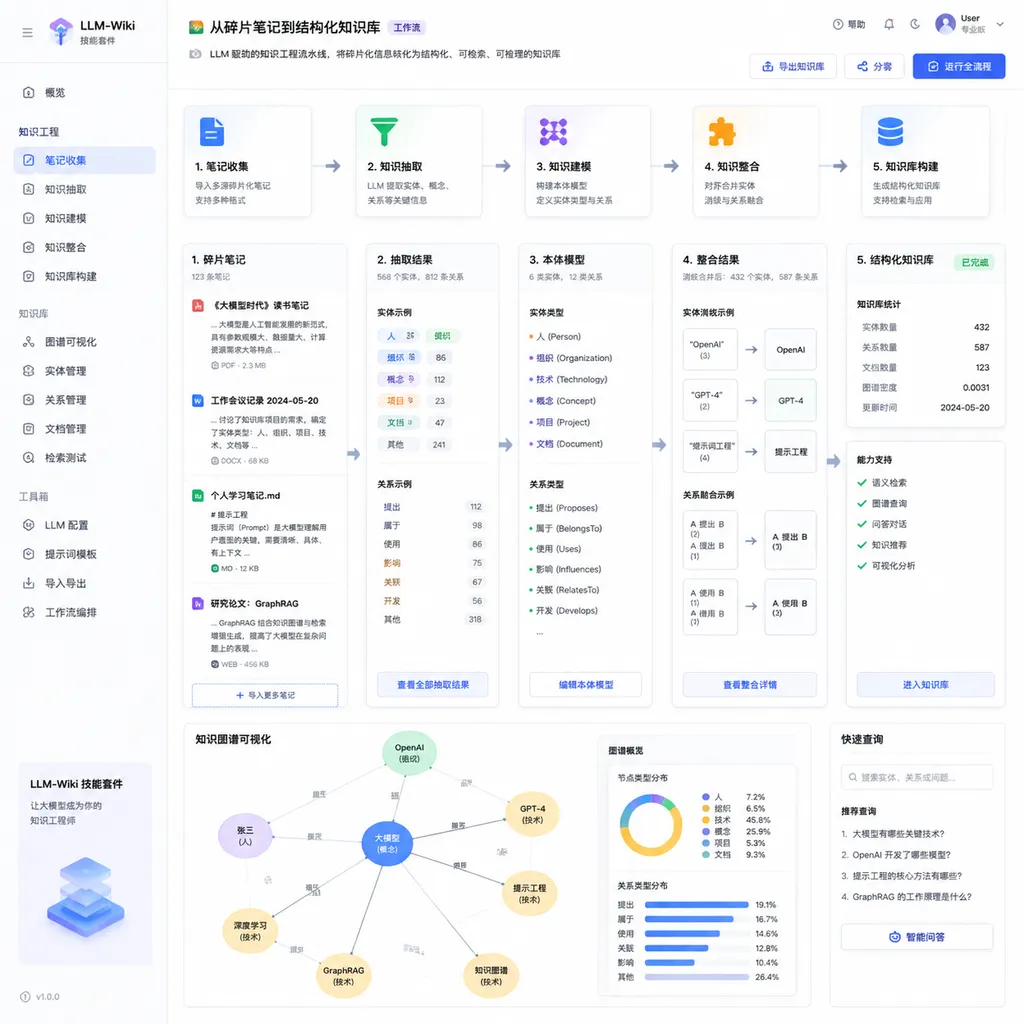
From a technical point of view, nothing mysterious here. The pipeline looks roughly like this:
- Content extraction and cleaning: unify different note formats (rich text, Markdown, web clips, image OCR, etc.) into plain text
- Topic clustering: use an embedding model to vectorize all notes and cluster them (e.g., K-Means or hierarchical clustering)
- Structure generation: use an LLM to generate summaries, titles, and hierarchy for each cluster, forming a Wiki outline
- Content filling: for each Wiki entry, extract key info from the original notes and have the LLM rewrite it into coherent content
- Cross-referencing: identify relationships between entries and automatically create internal links
Each step is technically mature with ready-made solutions. The challenge lies in consistency and reliability —
How do you control clustering granularity? Too coarse, and unrelated content gets lumped together; too fine, and a trivial idea becomes its own page, worsening fragmentation.
How do you ensure the rewritten LLM content is accurate? Your notes may contain errors, outdated info, even contradictions. Does the model keep them as-is or “fix” them on its own? If it edits, how can users tell what’s original and what’s AI-generated?
Another practical issue: how is the knowledge base maintained afterward? You’re always adding new notes — is it auto-updated incrementally or must you regenerate it manually? If the latter, users will likely stop using it, turning it into another “generated once then abandoned” feature.
These details haven’t been disclosed.
The bigger picture: AI transformation anxiety in the note-taking industry
Youdao Note’s move isn’t impulsive — the entire note-taking tool sector faces the same existential question: in the age of large language models, where does a note app’s value lie?
For the past decade, note apps were valued for "storing" and "organizing" information. You put information in, manage it through folders, tags, and search. But now, when you can ask AI any question anytime and get an instant answer, the value of “information storage” itself diminishes.
Why bother saving a technical article in your notes when you can just ask ChatGPT next time?
Note app vendors are well aware of this threat. Hence the collective pivot:
- Notion launched Notion AI, integrating LLMs across document editing, database querying, and content generation
- The Obsidian community produced many AI plugins for local knowledge Q&A, auto-tagging, and smart link suggestions
- Evernote (Yinxiang Note in China) was acquired by Bending Spoons and is also adding AI features, albeit slowly
- Domestic products such as Feishu Docs and Yuque are integrating AI as well
Youdao Note’s LLM-Wiki is part of this wave — trying to answer: your stored notes aren’t trash; AI can turn them into valuable knowledge assets.
That logic holds. Whether it works well, however, depends on execution.
What developers should care about
If you’re a developer, LLM-Wiki may not be particularly appealing — most developers already have their own knowledge systems: Obsidian + Git, Logseq, or plain Markdown files.
But the trends behind it are worth noting:
1. The AI skill market ecosystem is taking shape
Platforms like OpenClaw and LobsterAI are early but headed clearly toward modular, composable, and distributable AI capabilities. If you’re building AI products or tools, these could become meaningful distribution channels.
2. “Unstructured data → structured knowledge” is a universal need
LLM-Wiki applies this to note-taking, but the same technique can be used for many things: company document organization, support knowledge base building, automated technical documentation, even codebase documentation. A good direction for anyone building B2B products.
3. Local knowledge management vs cloud-based management
Youdao Note is a cloud service; your data sits on NetEase servers, and LLM-Wiki likely processes notes in the cloud. That raises privacy concerns for sensitive users.
By contrast, a local setup (e.g. Obsidian + a small model via Ollama) keeps data entirely local — a more attractive option for developers.
Of course, local models are weaker. A 7B or 13B model can’t match GPT-4-level reasoning. It’s a trade-off.
Questions still unanswered
As a product debut, LLM-Wiki’s details remain sparse. Several key unknowns will determine if it’s actually usable:
Which base model is used? Is it Youdao’s own Ziyue LLM or a third-party API? Model choice sets the ceiling for quality.
What’s the scale limit? “5 minutes for hundreds of notes” — what about thousands, tens of thousands? How are token limits and costs managed?
What output format? Is the knowledge base viewable only in Youdao Note, or exportable to Markdown, HTML, etc.? If locked in, users face another data silo.
Pricing model? Free or paid? Per-use or subscription? For a “skill suite,” pricing directly affects willingness to try.
How about privacy and data safety? Notes can include private data — work logs, personal diaries, even credentials. Are these used for model training? What privacy promises exist?
Without answers, developers will hesitate.
A candid assessment
Youdao Note’s direction is sound, and the timing is right. In this industry, refusing to adopt AI is basically waiting to die — that’s a consensus now.
However, the tagline “Build a knowledge base in 5 minutes” is more marketing than product promise. Knowledge management has never been a “one-click” matter — it requires ongoing maintenance and iteration. If LLM-Wiki only does one-time generation without incremental updates, human reviews, or version control, its real value will be limited.
Also, the choice to debut via the skill market suggests caution — it looks more like an experimental probe than a full strategic commitment.
For ordinary users, if you’re already a heavy Youdao Note user, give it a try. The 5-minute time cost is low, and seeing how AI organizes your notes might help you re-evaluate your own knowledge collection.
For developers, it’s more productive to focus on the underlying idea than the product itself. “Automatic structuring of unstructured content” has broad applications. Whether via a prebuilt skill suite or your own RAG pipeline, this is a field worth exploring.
The AI-ification of note-taking tools is just beginning. LLM-Wiki won’t be the last attempt. Whoever truly solves “the last mile” of knowledge management will win this race — and no one has done it yet.
This article does not constitute any product endorsement or investment advice.


