
Baidu GenFlow 4.0: An AI with 100 million monthly active users aims to become your AI workstation
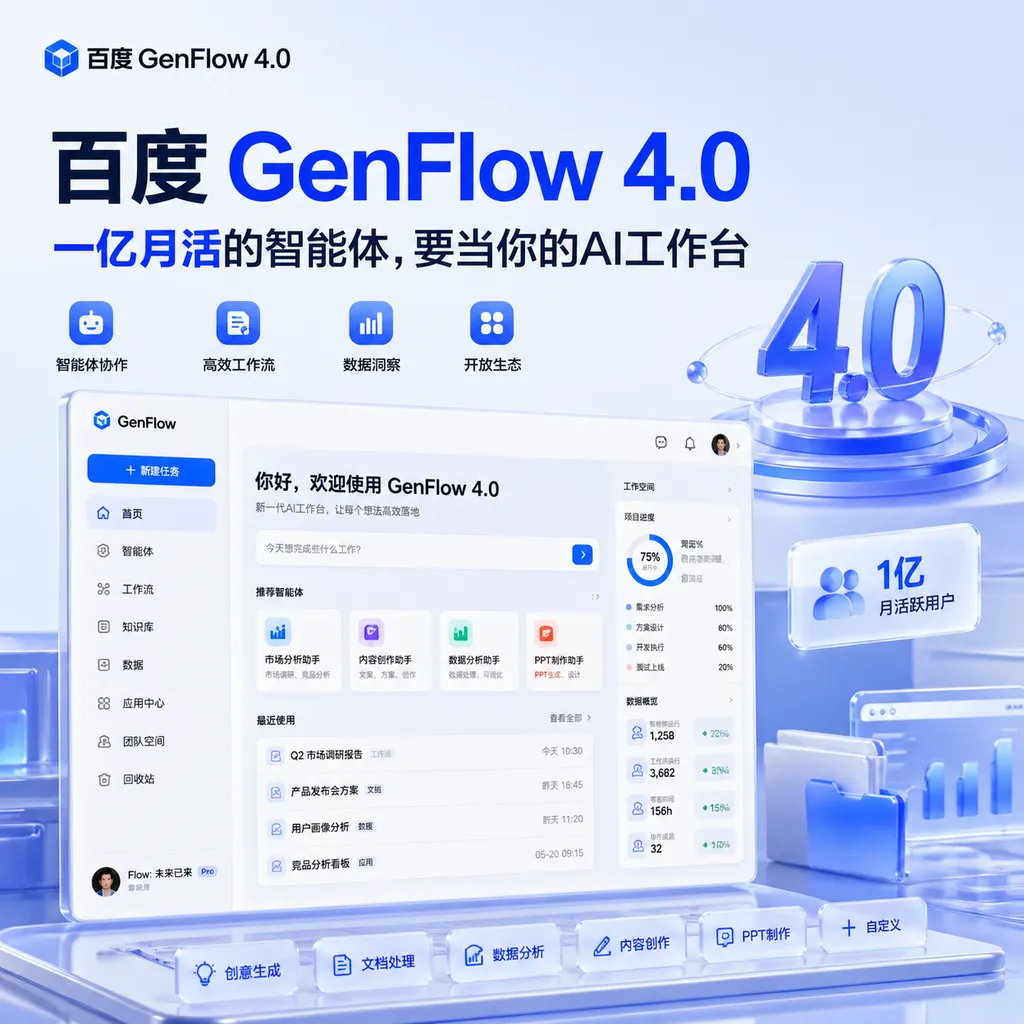
At AI Day, Baidu Wenku Cloud jointly released the general-purpose intelligent agent GenFlow 4.0, fully upgraded the Office Agent, and added one-click deployment support for OpenClaw. Monthly active users have surpassed 100 million, with 200 million tasks delivered per month.
At Baidu’s AI Day Open Event today, the company played a major card: Baidu Wenku (Document Library) and Baidu Netdisk jointly launched the general-purpose agent GenFlow 4.0.
This is not a minor version update. From a product positioning perspective, Baidu is transforming Netdisk from a “place to store files” into a “place that helps you get work done” — the core narrative of GenFlow 4.0 is an AI Workbench, not just another chatbot.
Let’s Start with Some Numbers
100 million monthly active users with 200 million monthly task executions.
These two numbers only make sense together: on average, each active user lets GenFlow execute two tasks per month. Frankly, that’s not a high frequency, suggesting that most users are still in a “try it out” phase rather than relying on it in their workflow. But looking at it another way, the 100 million MAUs come mainly from Baidu Netdisk’s existing user base — even if users only experiment lightly with the agent, it already shows Baidu’s channel advantage.
The real test lies ahead: of those 200 million executed tasks, how many were high-value tasks proactively initiated by users, and how many were “guided demos” prompted by the system? Baidu hasn’t disclosed retention or reuse-rate data — metrics that are even more telling than MAU.
OpenClaw One-Click Deployment: The Core Selling Point of GenFlow 4.0
The most noteworthy aspect of this release is GenFlow 4.0’s deep compatibility with the OpenClaw framework.
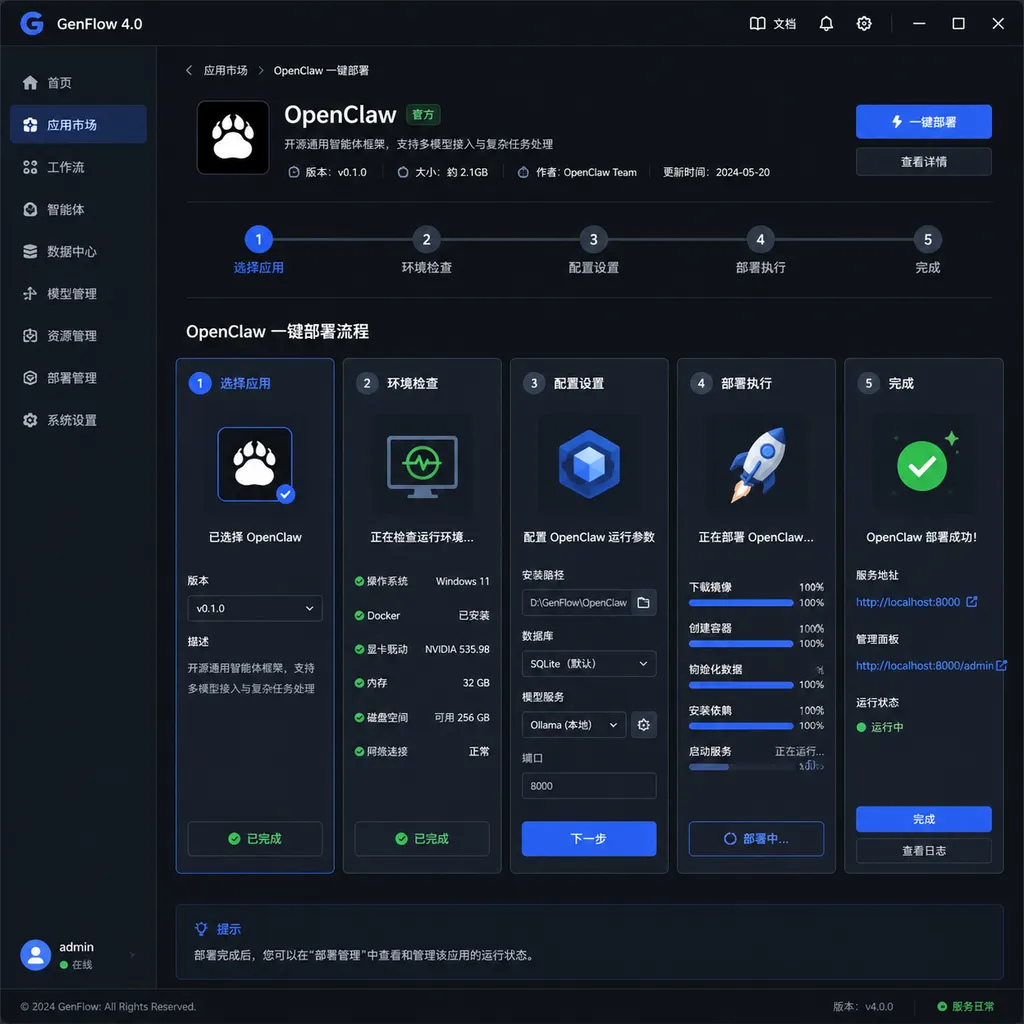
First, what is OpenClaw? If you’ve been following developments in the agent field this year, OpenClaw can be understood as a general-purpose agent orchestration framework — it defines how agents break down tasks, call tools, and manage context. It’s somewhat like an “OS kernel” for agents. Previously, to run OpenClaw, you had to set up your own environment, manage dependencies, and secure compute resources — a high barrier to entry.
What GenFlow 4.0 does is reduce the deployment cost of OpenClaw to zero.
Specifically:
- Zero-barrier deployment: Start the agent on the PC or mobile Baidu Netdisk app with a single click — no local installation of dependencies required
- No local resource usage: Computation runs in the cloud; your computer doesn’t become a server
- Cross-device collaboration: Initiate a task on your phone, let the AI execute it on your computer, or vice versa
- Scheduled tasks: Set timed triggers with one click so the agent automatically runs on schedule
This idea is easy to understand. Think of it like this: before, if you wanted to run a service with Docker, you had to install Docker, pull an image, and set up ports. Now someone has given you a one-click start button that handles everything behind the scenes. That’s essentially what GenFlow 4.0 does for OpenClaw.
For developers, this means you can treat Baidu Netdisk as a free agent runtime environment. Write your OpenClaw configuration, upload it to Netdisk, and run it with one click. No compute management, no operations burden, no need to keep your PC on — start a job from your phone, and it runs in the cloud.
Office Agent Upgrade: The PPT, Excel, and Writing Suite
Another product line update in GenFlow 4.0 is the upgraded Office Agent.
To be honest, AI-generated PPTs and AI-written Excel formulas are already a red-ocean market. From Microsoft Copilot to WPS AI, Kingsoft Docs, and countless indie tools, everyone is chasing the same opportunity. So where does Baidu differentiate itself?
I see two key points:
1. The files are already in Netdisk. That’s Baidu’s biggest structural advantage. Your documents, spreadsheets, and presentations already live in Netdisk, so the AI processes them in place — no uploading, downloading, or switching tools. This is far smoother than the “open an AI tool → upload file → process → download result” flow.
2. Agents can chain multiple file operations. Traditional AI office tools usually handle one file at a time — you give it an Excel sheet, it analyzes it; you give it a topic, it generates a PPT. As a general-purpose agent, GenFlow 4.0 can theoretically do things like: find last week’s sales data Excel file in Netdisk → analyze trends → generate a charted PPT → draft a summary email. This kind of multi-step, cross-file orchestration is the true value of agents compared to single-function AI tools.
Of course, “theoretically possible” and “practically effective” are worlds apart. What Baidu demonstrated on stage looked smooth, but real office workflows are far messier — broken formatting, dirty data, unclear requirements. How GenFlow 4.0 performs under such real-world conditions still needs to be proven by user feedback.
Team Collaboration: From Personal Tool to Team Infrastructure
Another easily overlooked signal from this release is that GenFlow 4.0 explicitly supports team use cases.
Baidu Netdisk previously had a team edition, but it mostly focused on “shared storage space.” With agent capabilities injected into the team space, the positioning changes — it now aims to become AI collaboration infrastructure for teams.
Baidu used quite an aggressive slogan: “Get a week’s work done in 10 minutes.” It’s obviously marketing hyperbole, but the underlying product direction is clear:
- Team members can share deployed OpenClaw agents
- An automation workflow set up by one person can be reused by the entire team
- Task results sync automatically to the team space
It’s reminiscent of Slack’s bots and workflows — one teammate sets up automation, others just use it. GenFlow 4.0 aims to do something similar, but the platform is Netdisk rather than a messaging tool.
That’s the right direction. For agents to create real value, they have to evolve from “personal toys” to “team tools.” One person using AI for a PPT is productivity improvement; an entire team automating reports, data summaries, and documentation — that’s transformation.
Competitive Landscape: Baidu Is Fighting an Asymmetric War
In the broader strategic context, Baidu’s GenFlow 4.0 move is quite interesting.
Current players in the agent race fall roughly into three categories:
| Type | Representative Products | Strengths | Weaknesses | |------|--------------------------|------------|-------------| | Large model providers | Doubao, Kimi, Tongyi | Strong model capabilities | Lack of file ecosystems | | Office suites | WPS AI, Feishu Smart Partner | Deep office use cases | Don’t own file storage | | Baidu Netdisk | GenFlow 4.0 | File ecosystem + massive user base | Model capabilities not top-tier |
Baidu Netdisk’s strategy is simple: don’t compete on model intelligence, compete on proximity to the user’s files.
It’s an asymmetric war. For Doubao or Kimi to process a user’s file, the user must first upload it. WPS AI can handle documents, but not photos, videos, or archives. Baidu Netdisk naturally holds users’ entire file collections — that’s its biggest moat for agent development.
But this advantage has a ceiling. Netdisk is inherently geared toward “storage” and “personal productivity”; for heavier enterprise use cases like collaboration and project management, Feishu and DingTalk have deeper ecosystems. How far GenFlow 4.0’s team features can go depends on how well Baidu’s team edition penetrates the enterprise market.
Technical Perspective: What OpenClaw Compatibility Means
From a technical viewpoint, GenFlow 4.0’s compatibility with OpenClaw matters because it ensures developers are not locked into Baidu’s ecosystem.
Agents built with OpenClaw standards can theoretically run on any platform that supports OpenClaw. You can run it on Baidu Netdisk today, then easily migrate elsewhere tomorrow if a better option arises. That openness is a plus for developers — no one likes vendor lock‑in.
Conversely, Baidu’s choice to support OpenClaw instead of creating its own closed framework reflects a broader trend: the orchestration layer of agents is moving toward standardization. Just as container ecosystems converged on Docker + Kubernetes, agent ecosystems are undergoing a similar process. Whether OpenClaw becomes the ultimate “standard” remains to be seen, but the direction is clear.
For developers who want to try it, the current deployment flow is roughly:
- Write an OpenClaw configuration file locally or in any environment
- Upload it to Baidu Netdisk
- Select the configuration in GenFlow 4.0 and deploy with one click
- The agent runs in the cloud and interacts through the Netdisk interface
The whole process requires no API keys, no server setup, no runtime management. For developers wanting to quickly validate an agent concept, the entry barrier is indeed very low.
A Cold Look: The “Monthly Active Trap” of Agents
Finally, a dose of realism.
A 100 million MAU figure looks impressive, but for an agent product, it doesn’t mean the same thing as it does for traditional internet services.
For conventional apps, MAU reflects habit — you open WeChat or TikTok daily by muscle memory. But for agents, much of the MAU may come from one‑off, curiosity‑driven interactions. A user hears about the feature, clicks once to try it, and counts as an MAU. Next month, will they return? Not necessarily.
Baidu’s cited “200 million monthly tasks” already hints at this — 100 million users, averaging two tasks each per month. In contrast, a tool that’s truly woven into workflows would see multiple daily uses per user.
For GenFlow 4.0 to prove it’s more than a passing fad, it needs to show two key metrics over the coming quarters: DAU/MAU ratio and average monthly tasks per user. If both rise steadily, that means agents are genuinely changing work behavior. If they stagnate, that 100 million MAU may just reflect fleeting curiosity from existing Netdisk users.
Summary
GenFlow 4.0 is a strategically clear move for Baidu in the agent race: not competing on models or conversations, but on who can make AI actually get work done.
One‑click OpenClaw deployment, cross‑device collaboration, team sharing — none of these features alone is revolutionary, but combined inside Baidu Netdisk, with its massive user base and file ecosystem, they form a distinctive edge.
The key question ahead: can it evolve from “100 million people tried it once” to “100 million people use it every day”? That’s the challenge GenFlow 4.0 must now answer.
References:
(Note: This article is based on information from Baidu’s AI Day event and coverage by multiple tech media outlets. Since the domains of those sources are not on the citation whitelist, specific links are omitted. For more details, search for “Baidu GenFlow 4.0” to find relevant reports.)


