
Ali HappyHorse 1.0 Gray Test: The Dark Horse of Audio and Video Synchronization Has Arrived
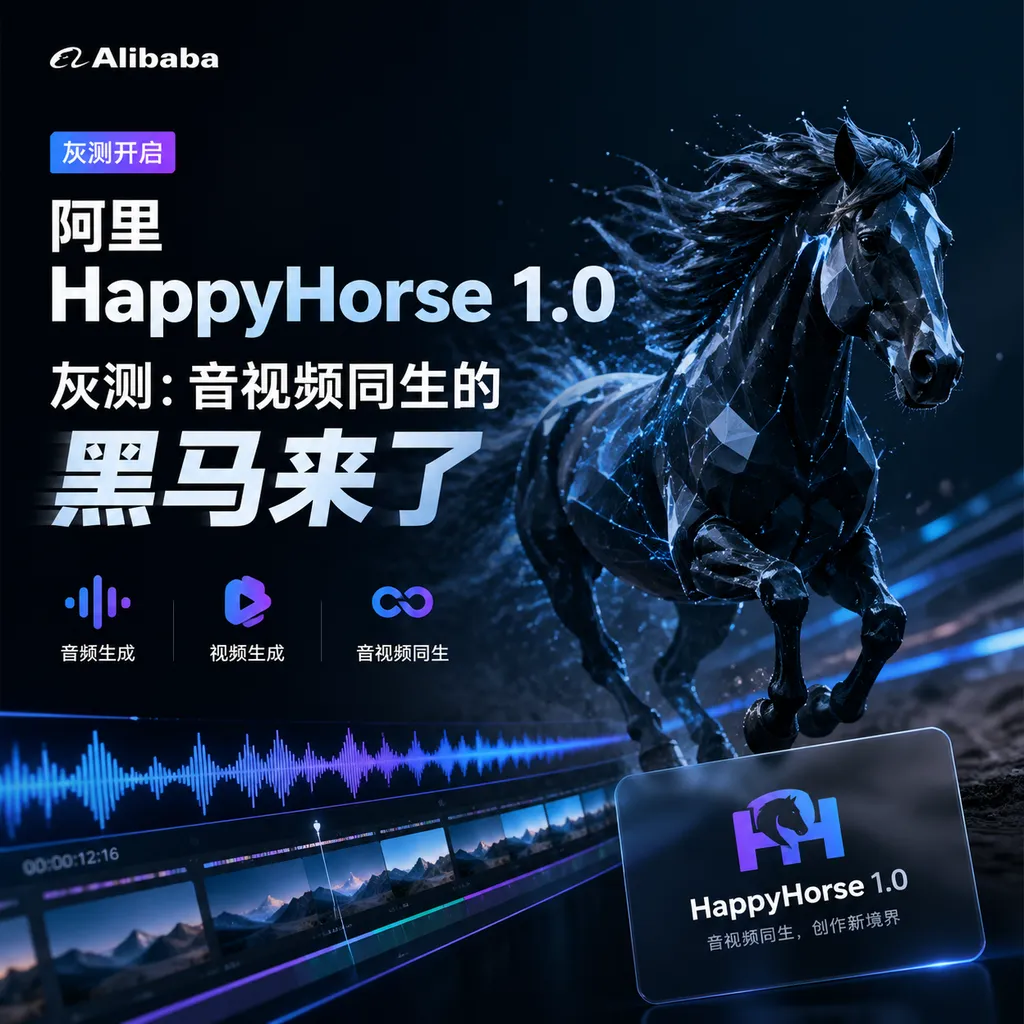
Alibaba’s video generation model **HappyHorse 1.0** entered gray testing on April 27. With its native multimodal architecture, it enables one-step joint audio-video generation. It previously topped both **Artificial Analysis** leaderboards, directly challenging **Seedance 2.0** and **Kling**.
A “Dark Horse” Officially Enters the Track
On April 27, Alibaba’s video generation model HappyHorse 1.0 officially entered gray testing. The name may already sound familiar to developers following AI video generation — as early as early April, an unidentified model suddenly appeared on the Artificial Analysis AI Video Arena leaderboard, taking first place in both the Text-to-Video (T2V) and Image-to-Video (I2V) tracks. The industry speculated at the time that it came from “an AI lab somewhere in Asia” and had technological ties to Alibaba’s WAN series models.
Now the mystery is solved: HappyHorse 1.0 is indeed from Alibaba — and what it brings is not just a set of high scores, but a completely different approach to video generation.
Core Selling Point: Audio and Video Are Grown Together, Not Stitched Together
Let’s start with the key difference — the fundamental distinction between HappyHorse 1.0 and most other video generation models on the market: it doesn’t “generate video first, then add sound.”
Current mainstream AI video generation workflows generally separate the two: “video for video, audio for audio.” You use one model to generate visuals, then another to add voiceovers, sound effects, or background audio. The process works, but the pain points are obvious — lip-sync mismatches, unsynchronized footsteps, disconnected environmental sounds. Anyone who’s done video post-production knows that audio-visual sync alone can devour huge amounts of time.
HappyHorse 1.0 takes a different path. Alibaba calls it a “native multimodal architecture,” specifically a joint audio-video generation approach — in a single forward pass, the model outputs both video frames and their corresponding audio stream. Speech, ambient sounds, footsteps, Foley effects — all are generated in the same denoising process, inherently synchronized.
What does that mean?
Here’s a concrete example: you give the model a prompt describing “a girl walking under an umbrella in rainy Tokyo streets, with neon lights and traffic noises in the background.” In traditional pipelines, you’d get a silent video and then have to manually add rain, traffic, and footsteps sound effects. HappyHorse 1.0 gives you a fully-produced clip right away — rain hitting the umbrella, distant car sounds, and rhythmic splashes from footsteps all aligned perfectly with the visuals.
This isn’t just a “nice-to-have” feature — it’s a quantum leap in production efficiency. For advertising, e-commerce, or short drama production — all of which demand rapid content output — removing the audio post-production step could cut content turnaround time by 30%-50% per clip.
Technical Details: 15 Billion Parameters and Unified Token Denoising
Based on publicly available information, HappyHorse 1.0’s parameter scale is around 15 billion. Its core architectural philosophy is unification — encoding video frames and audio signals into a single token sequence, then performing joint denoising under one diffusion model framework.
This sharply contrasts with the modular composition approach most competitors take. In those systems, the video and audio generation modules are trained independently, run sequentially or in parallel at inference, and then aligned during post-processing. The advantage is modular flexibility; the drawback is that semantic alignment between audio and video is inherently weak — the two models “do their own thing,” and synchronization has to be forced later.
HappyHorse 1.0’s unified architecture lets both audio and video share contextual information during generation. At every denoising step, video tokens and audio tokens can “see” each other, fundamentally solving synchronization issues. The tradeoff is higher training complexity and data requirements — but the benefit is immediate.
Another notable capability is multilingual lip-sync generation. HappyHorse 1.0 natively supports lip movements for multiple languages, including English and Chinese, without requiring separate lip-sync alignment tools. That’s a huge plus for teams producing multilingual content — previously, making a bilingual promo video meant painstakingly adjusting lip movements across languages.
Leaderboard Results: A Massive Lead, Not a Marginal One
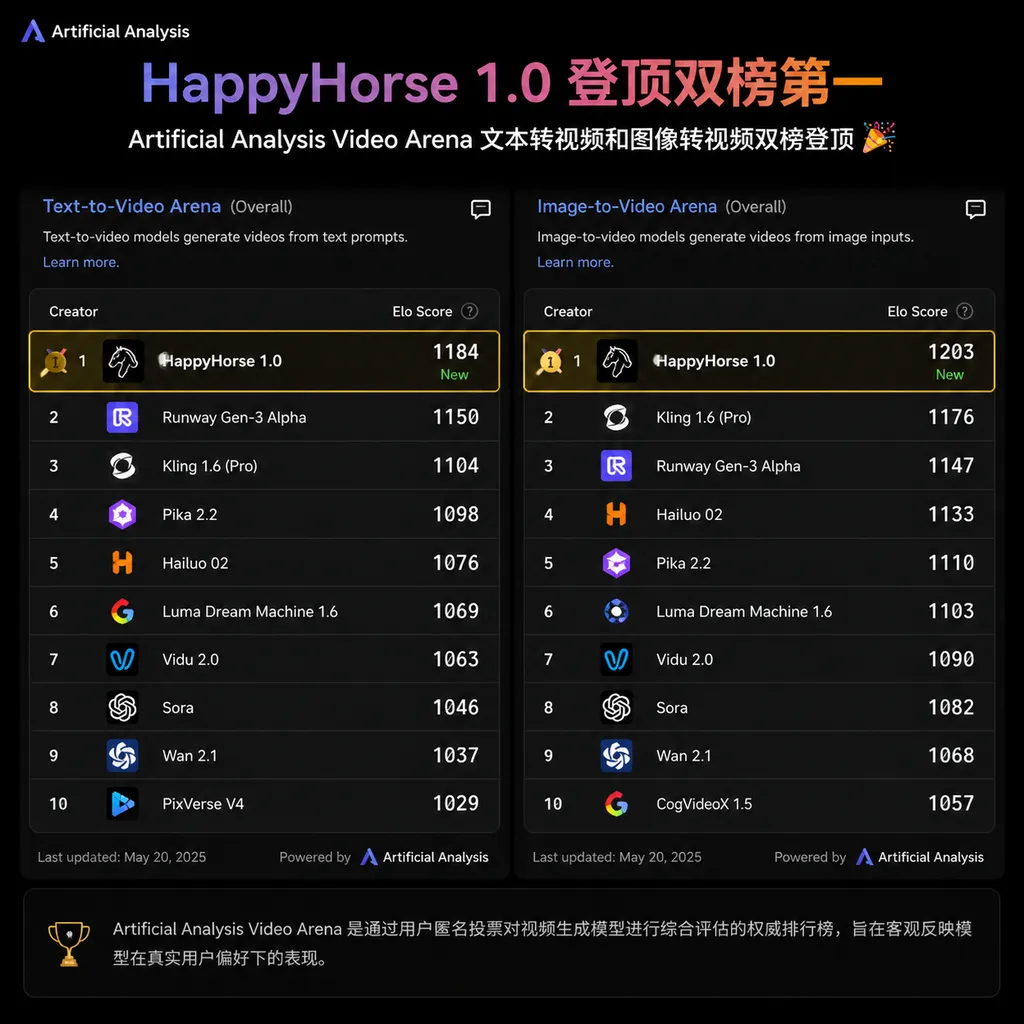
On the Artificial Analysis AI Video Arena blind leaderboard, HappyHorse 1.0 shows strong performance:
- Text-to-Video (T2V): Elo 1333 — Rank #1
- Image-to-Video (I2V): Elo 1392 — Rank #1, over 50 points ahead of the runner-up
A 50-point Elo gap at this scale means one model beats another in blind tests with over 57% probability. Considering that competitors include models like Seedance 2.0, Kling, and Runway Gen-4, that’s a sizable difference.
Especially in the Image-to-Video category, an Elo of 1392 indicates that HappyHorse 1.0 significantly outperforms peers in motion naturalness, physical plausibility, and detail preservation — all critical factors for e-commerce applications, where “animate product images without distortion” is a huge unmet need.
Of course, leaderboards should be viewed with caution. Artificial Analysis’ blind tests focus mainly on visual fidelity and prompt adherence. Real-world production involves many more factors — generation speed, stability, API availability. Whether HappyHorse 1.0’s gray-test performance holds up under large-scale usage remains to be seen.
Pricing: Not Cheap, But Makes Sense
During gray testing, HappyHorse 1.0’s official pricing is as follows:
| Resolution | Price | |-------------|--------| | 720P | ¥0.9/second | | 1080P | ¥1.6/second |
Is that expensive? Depends on your comparison.
Compared to traditional video-only models, yes — it’s higher. Competing models are often priced around ¥0.3–0.5/second for 720P output. But HappyHorse 1.0’s pricing logic is different — it outputs a fully produced video with sound, not a silent clip. Once you factor in the costs of video generation + sound generation + sync alignment, ¥0.9/second might actually save money.
For short dramas or ads, a 15-second 1080P clip would cost ¥24. If it’s production-ready, that easily offsets post-production labor costs.
That said, gray-test pricing rarely represents final pricing. With optimization and competition, price drops are almost certain.
Open Source: Already Released
HappyHorse 1.0 is open-sourced, consistent with Alibaba’s strategy for large models — just like the Qwen and WAN series. Open source means developers can self-host, redevelop, and customize freely, without API lock-in.
For teams with GPU resources, local deployment can dramatically lower marginal cost. A 15B parameter model can run on several A100-class GPUs — accessible by current hardware standards.
However, what’s released is the model weights and inference code, not the raw training data or full training pipeline — standard practice across the industry. It doesn’t affect usability, but full reproduction or deep modification will be limited.
What Problem Does It Solve?
Stepping back, HappyHorse 1.0 clearly targets a core pain point: the “last mile” of AI video generation isn’t about visuals, but usability.
Over the past two years, AI video generation models have made huge strides in visual quality — from Sora to Kling to Runway Gen-4, generated videos now look strikingly real. But in production, a silent video requiring heavy manual editing is still far from useful content.
Audio-video sync, lip alignment, and sound design — these seemingly “minor” post-production tasks actually take up a major share of work. HappyHorse 1.0 aims to solve all of this end-to-end, outputting clips that are truly ready-to-use, not half-finished drafts.
That’s the right direction. The battleground for AI video generation is shifting from “whose visuals look best” to “whose content can be used directly.” Visuals are the baseline; usability is the differentiator.
Target Scenarios
According to Alibaba’s positioning, HappyHorse 1.0 is aimed at four major use cases:
- Ad creatives: Rapid generation of sound-integrated ad clips, shortening production cycles
- E-commerce: Converting product images into videos with ambient and background sound
- Short drama production: Synchronized audio-visual generation for dialogue scenes, removing the need for dubbing/lip alignment
- Social media content: Fast, batch creation for short videos, Reels, or TikTok posts
These share one key trait — speed matters more than extreme fidelity. A 720P video might be sufficient, but waiting two days for post-production isn’t. HappyHorse 1.0’s one-pass audio-video generation directly addresses this demand.
Alibaba also mentioned an “integrated creation pipeline from generation to editing,” meaning that HappyHorse 1.0 will come with editing tools. How capable these are remains to be seen once wider testing begins.
Competitive Landscape: The Video Generation Race Is Getting Crowded
By 2026, “intense” doesn’t even begin to describe the AI video race.
Globally, Runway Gen-4 and Pika 2.0 are evolving rapidly; in China, Kling (Kuaishou), Seedance 2.0 (ByteDance), and CogVideo (Zhipu) are pushing hard. Every few weeks, a new model tops the chart, and Elo scores keep inflating.
HappyHorse 1.0 differentiates itself through its native joint audio-video generation approach. Very few models on the market can jointly output both in one inference; most still handle them separately. If Alibaba can keep iterating on this line and build real technical barriers, the HappyHorse series could establish a unique ecosystem position.
But risks remain: competitors won’t stay idle. The joint generation path isn’t a secret; once proven viable, others will follow quickly. The first-mover window may only last a few months.
Final Thoughts
The gray-test release of HappyHorse 1.0 marks the beginning of a new stage in AI video generation — the era of audio-video integration. It’s not the first to explore this, but it’s currently the best-performing one — at least, according to the leaderboard.
For developers, key things to watch are: API stability during testing, real-world generation speed, and local deployment feasibility of the open-source version. The answers will determine whether HappyHorse 1.0 is just an impressive demo — or a truly practical productivity tool.
If your work involves video production, it’s worth applying for gray-test access. After all, rather than reading rankings, it’s better to run a few clips yourself.
References
- Alibaba HappyHorse 1.0 Technical Analysis and Leaderboard Performance – Zhihu — In-depth discussion of HappyHorse 1.0’s 15B architecture and joint audio-video generation approach


