
Microsoft and OpenAI Renew Agreement: The Era of Exclusivity Comes to an End

On April 27, Microsoft and OpenAI announced an adjustment to their cooperation agreement. Microsoft will no longer have exclusive licensing rights to OpenAI’s technology and will also cancel the revenue-sharing payments to OpenAI. The partnership between the two companies will shift from a deeply integrated relationship to a more flexible collaboration model.
Exclusivity Ends, Revenue Sharing Cancelled: Microsoft and OpenAI Enter a New Phase
On April 27, Microsoft and OpenAI officially announced major adjustments to their cooperation agreement. The two core changes are these: Microsoft’s exclusive license for OpenAI technology becomes a non-exclusive license, effective until 2032; and Microsoft will no longer pay OpenAI a revenue share.
This is not a minor tweak. It is the first systemic loosening between two companies that have been deeply bound together in the AI era.
What Exactly Changed
Breaking down the revised terms:
- License shifted from exclusive to non-exclusive: Microsoft still retains the rights to use OpenAI’s models and products, but is no longer the sole authorized party. The license is valid until 2032.
- Microsoft stops paying OpenAI a revenue share: Previously, Microsoft shared with OpenAI part of the income earned via Azure sales of OpenAI models; this payment will now cease.
- OpenAI continues paying Microsoft a share: OpenAI must keep paying Microsoft a revenue share at the same rate until 2030, but with a cap on the total amount.
- Cloud service priority remains but becomes flexible: OpenAI products will continue to launch first on Azure. However, if Microsoft cannot or chooses not to support certain features, OpenAI may use other cloud providers. More importantly—OpenAI can now deliver all its products through any cloud provider.
- Microsoft remains a major shareholder: It continues to participate in OpenAI’s development as a shareholder.
In short, Microsoft traded “exclusivity” and “reverse payment” for a clearer, more predictable long-term cooperation framework. Meanwhile, OpenAI gained what it wanted most—freedom.
Why Now
This adjustment didn’t come suddenly. Looking back over the past year, both sides have been laying the groundwork for this moment.
In early 2025, Microsoft announced a cooperation adjustment, but key terms stayed intact—exclusive usage rights, Azure-only APIs, and the revenue-sharing model remained. That was more a statement of intent than real change.
In September 2025, reports from Cailian Press revealed OpenAI was significantly cutting business revenue sharing to Microsoft, potentially retaining over $50 billion more in the coming years. The two companies then issued a vague joint statement, saying they were finalizing terms for the “next stage of collaboration.”
In February 2026, Sina Finance reported that both sides reached a new framework agreement: Microsoft would receive 20% of OpenAI’s total revenue through 2032, and OpenAI gained flexibility to work with other computing service providers.
Today, the deal is finally official.
The fundamental driver for this change is simple: OpenAI is going public. A company valued at over $100 billion preparing for an IPO cannot allow its core technology to remain exclusively bound to a single partner. Investors would not accept such structural risk.
As for Microsoft, its rationale is clear as well: rather than cling to an increasingly untenable exclusivity clause (OpenAI’s AGI clause already stipulates that once AGI is achieved, Microsoft loses exclusive access), it’s better to proactively concede and secure predictable financial returns and long-term shareholder value.
Who Won
On the surface, OpenAI is the biggest winner. It broke free from Azure exclusivity, gained freedom to choose any cloud provider, and no longer has its technology locked to Microsoft alone. For a company sprinting toward its IPO, these are structural issues that must be resolved.
But Microsoft didn’t really lose.
First, Microsoft no longer has to pay revenue sharing. The portion of Azure income from OpenAI model usage that previously went to OpenAI now stays in its pocket—no small sum, considering usage continues to rise rapidly.
Second, OpenAI’s payments to Microsoft continue at the same rate until 2030. Based on prior reports of a 20% share and OpenAI’s projected revenue growth, this still represents tens of billions of dollars.
Third, Microsoft keeps its equity stake. Once OpenAI goes public, those shares could be worth far more than any revenue share payments.
Fourth, non-exclusive licensing still means licensed use. Microsoft can continue integrating OpenAI models into its own products—Copilot, Azure AI, Office suite—unaffected, except that others can use them too.
So this is more a redistribution of interests acceptable to both sides, not a zero-sum game.
What It Means for the Industry
This adjustment sends several important signals.
First, the “exclusive era” of AI models is officially over.
When even OpenAI—the company most likely to be held exclusively—moves toward open licensing, no other model developer has reason to tie itself to a single platform. Future AI infrastructure competition will hinge more on service quality, cost, and ecosystem richness, not on “who can keep whom exclusive.”
Second, the cloud landscape will change.
OpenAI can now deliver its services through any cloud provider. That means AWS, Google Cloud, and even Chinese cloud companies could theoretically serve as OpenAI distribution channels. Azure remains ahead but is no longer the only choice.
For developers, that’s great news. More distribution channels mean more integration options, flexible pricing, and better regional coverage. Platforms like OpenAI Hub—API aggregators—thrive precisely under multi-model, multi-channel trends. As exclusivity barriers fall, the value of aggregation grows.
Third, OpenAI’s IPO path is now clearer.
Removing exclusivity clauses, reorganizing revenue sharing, and clarifying equity relationships are all governance preconditions for going public. With these barriers cleared, OpenAI’s IPO may arrive sooner than markets expected.
Microsoft’s Shifting AI Strategy
It’s worth noting: dropping exclusivity doesn’t mean Microsoft is retreating from AI. On the contrary, it likely reflects growing confidence in its own AI capabilities.
Over the past two years, Microsoft’s AI footprint has expanded far beyond OpenAI:
- Its self-developed Phi series of small models continues iterative improvement
- The Copilot product line now permeates Office, GitHub, Windows, and Azure
- It has developed its own Maia accelerators at the chip level
- And Microsoft collaborates with other model companies such as Mistral and Meta
Microsoft’s strategy is evolving from “bet on one company” to “platform-oriented.” It doesn’t need exclusive access to OpenAI tech—it needs Azure to become the best platform for all AI models. From that perspective, abandoning exclusivity actually makes its positioning purer.
The Money Issue
Finally, let’s talk about money.
According to earlier reports, under the old agreement Microsoft could have earned up to $35 billion in revenue share from OpenAI by 2030. OpenAI, however, had been pushing to reduce that figure—last September’s reports suggested OpenAI wanted to cut the rate from 20% to around 8%, effectively retaining $50 billion more.
The current outcome: the share rate remains unchanged, but there’s now a total cap and an end date in 2030. And Microsoft now pays nothing back in return.
The elegance of this arrangement lies in its certainty: OpenAI knows its maximum payment liability and can plan accordingly; Microsoft knows its expected income and needn’t worry about unilateral adjustments. For a company preparing to go public and another that must justify AI investments to Wall Street, predictability itself is the highest value.
In Closing
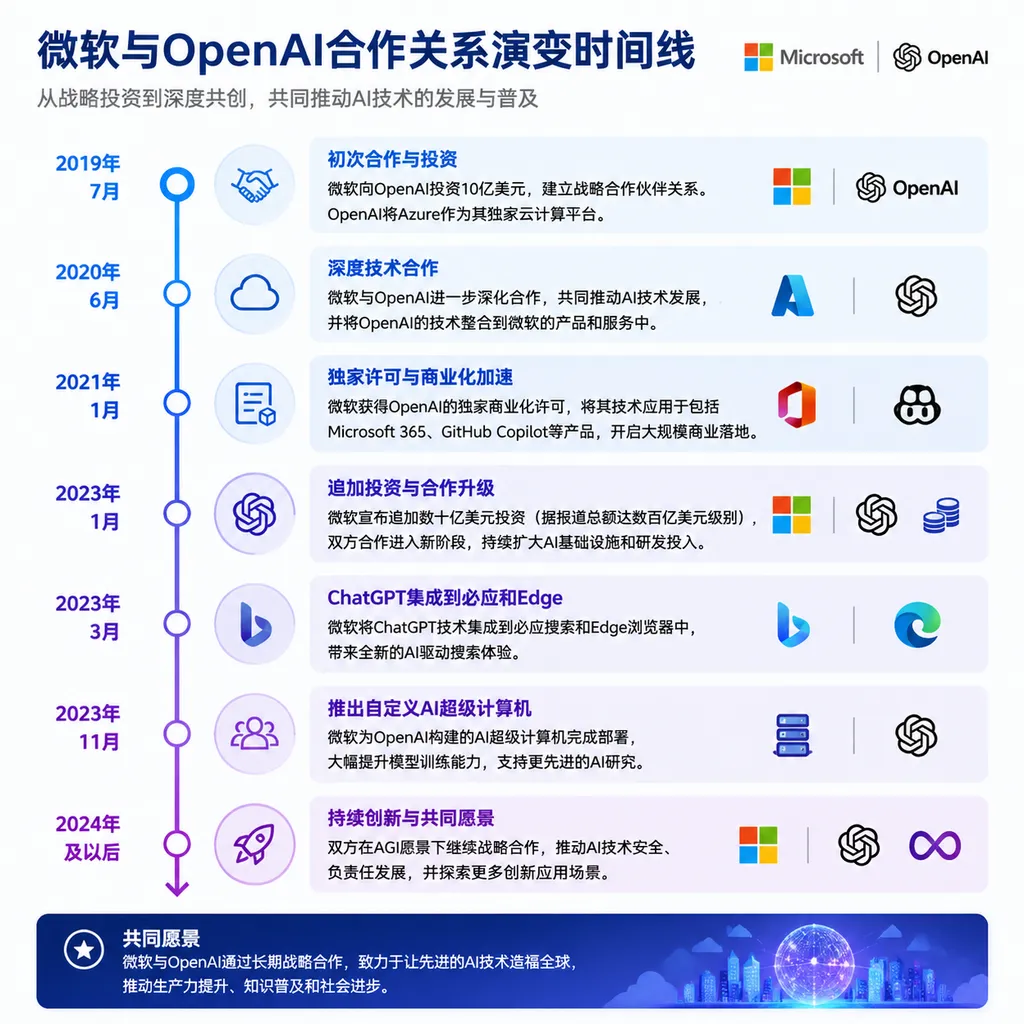
Since Microsoft’s first investment in OpenAI in 2019, their relationship has spanned seven years—from an initial $1 billion investment, to a cumulative $13 billion, to today’s contract revision. It has evolved fully from “investor–investee” to “exclusive partners,” and now to “open partners.”
The era of exclusivity has ended—but cooperation has not.
For the broader AI industry, this may be a turning point: when even the tightest partnership begins to loosen, it signals that the industry has moved from the “land-grab” phase to the “ecosystem competition” phase. The next challenge is no longer about who can lock down whom, but who can create more value for developers and users.
References
- ITHome: Microsoft Will No Longer Pay OpenAI Revenue Share, Loses Exclusive License for Its Technology — Chinese report on the core revised terms of the agreement


