
Cerebras integrates major domestic models: GLM5/Kimi K2.6 onboard
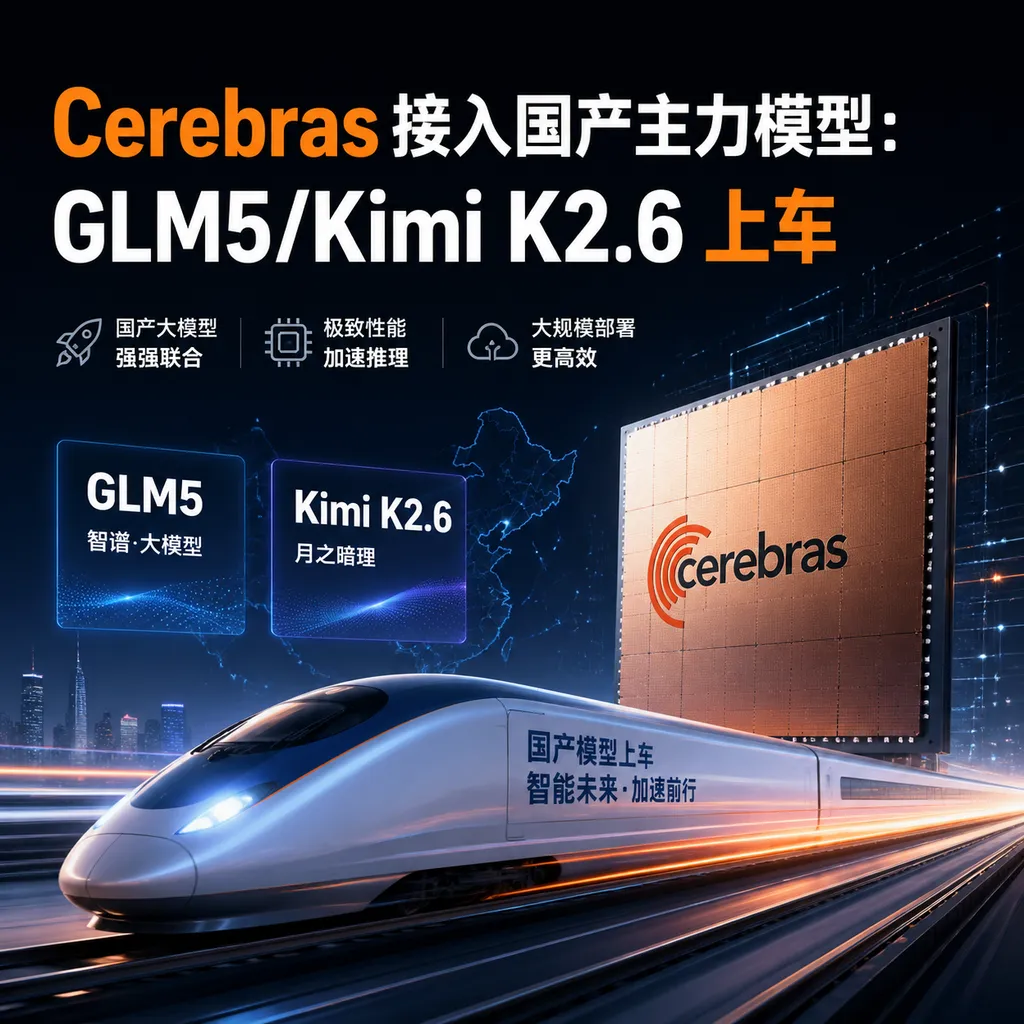
AI inference chip manufacturer **Cerebras** announced that its enterprise edition now supports **Zhipu GLM5/5.1** and **Moonshot Kimi K2.6**, marking its first large-scale integration with the domestic model ecosystem and signaling that Chinese large models are beginning to gain recognition on high-performance overseas inference platforms.
Cerebras Integrates Mainstream Chinese Models: GLM5/Kimi K2.6 Onboard
AI inference chip manufacturer Cerebras has just announced enterprise support for Zhipu’s GLM5/5.1 and Moonshot’s Kimi K2.6. This marks Cerebras’ first large-scale integration into the Chinese model ecosystem and represents a major step for Chinese large models entering high-performance inference platforms abroad.
For developers, this means Chinese models can now run on Cerebras’ wafer-scale chips — theoretically much faster than GPUs, though the real-world performance depends on how deeply Cerebras optimizes for these models.
Why these three models?
Cerebras didn’t pick these models randomly:
GLM5/5.1 is Zhipu’s current flagship commercial model. When GLM5 launched late last year, it was benchmarked against GPT-4o, with multimodal capability and long-text processing as highlights. GLM5.1, released in March, improves code generation and reasoning, showing substantial gains on programming benchmarks like HumanEval.
Zhipu has been aggressive in the enterprise market — especially in finance and government, where data security is key. GLM’s privatization deployment solutions are mature, which likely attracted Cerebras: enterprise clients want high-performance inference without sending data to the public cloud.
Kimi K2.6 is Moonshot’s latest version, focusing on ultra-long context (2 million tokens) and multimodal understanding. The K2 series established a strong presence in long-text applications last year; developers use it for contract review and academic paper analysis — tasks requiring “reading the whole book.”
Compared with previous versions, K2.6 improves inference speed and cost efficiency. Moonshot mentioned in its tech blog that it uses sparse activation and dynamic routing to reduce computation, which is promising for dedicated hardware like Cerebras — offering further optimization potential.
From the model-selection perspective, Cerebras is clearly focusing on commercially mature and technically distinctive leading models, rather than trying to cover every Chinese model. GLM and Kimi have substantial penetration in domestic enterprise markets, meaning Cerebras instantly connects to a large existing customer base.
Where does Cerebras’ hardware shine?
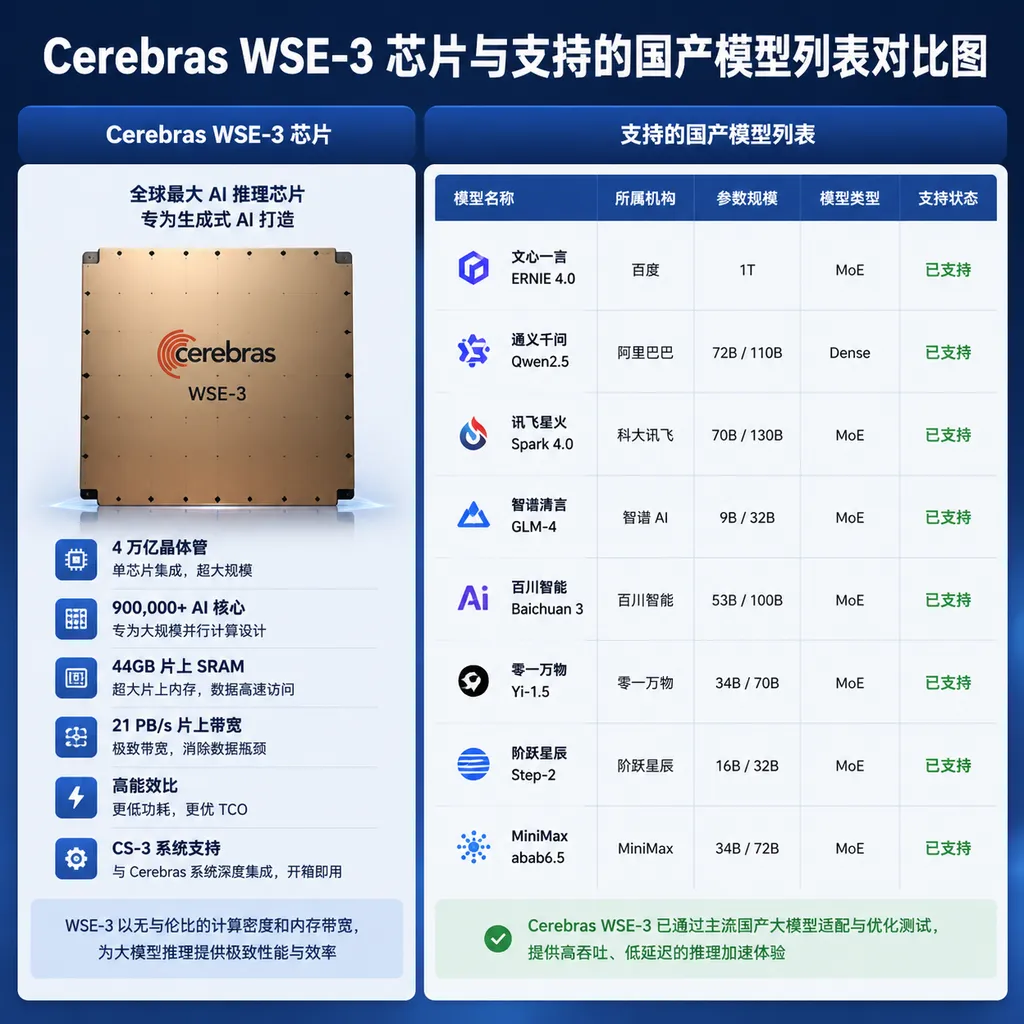
Cerebras is best known for its Wafer Scale Engine (WSE) chips. Traditional GPUs cut silicon wafers into smaller chips; Cerebras uses a full wafer to make one enormous chip. The WSE-3 holds 4 trillion transistors — 56× larger than NVIDIA’s H100.
This design delivers two key advantages:
-
Massive on-chip memory: WSE-3 has 44GB of on-chip SRAM with 21 PB/s bandwidth. Compared to the H100’s 80GB HBM (3.35 TB/s bandwidth), Cerebras’ memory bandwidth is three orders of magnitude higher. Large-model inference is usually limited by memory bandwidth, not raw compute — this is why Cerebras dares to claim “20× faster than GPU.”
-
No model parallelism required: The chip is big enough that small and medium-sized models can fit entirely on one chip, eliminating GPU-style tensor or pipeline parallelism. This greatly reduces communication overhead and improves latency stability.
However, Cerebras also has weaknesses: high cost and weak ecosystem. A full CS-3 system costs over a million dollars, affordable only for large enterprises or cloud providers. Its software stack is relatively closed, with far fewer optimization contributions than CUDA’s vast GPU ecosystem.
By integrating Chinese models, Cerebras is partially addressing its ecosystem gap. Chinese model developers usually provide detailed documentation and optimization guidance — which helps Cerebras adapt faster. In reverse, Chinese models gain access to high-end international inference platforms.
How does performance actually compare?
Cerebras reports that when running Llama 3.1 70B on WSE-3, inference is 16× faster and 30% cheaper than on an H100 — but that’s under ideal conditions and may vary in real workloads.
For GLM5 and Kimi K2.6, the key metrics are:
First token latency (TTFT) — the time between request and first token response. The large on-chip memory theoretically allows extremely low TTFT, if the model weights fit entirely in SRAM. GLM5 is around 100B parameters; Kimi K2.6’s parameter size is undisclosed — if it exceeds WSE-3 capacity, HBM or model sharding will be required, reducing the advantage.
Throughput — how many requests can be processed per unit time. Cerebras’ architecture isn’t ideal for batch processing — its giant chip limits scaling via large batch sizes. In high-concurrency scenarios (like API services), GPU clusters may still offer better economics.
Long-text processing — Kimi K2.6’s specialty. A 2M-token context means KV cache sizes are huge. Traditional GPUs rely on techniques like PagedAttention or multi-GPU setups to handle this. Cerebras’ large on-chip memory could give clear advantages here, but real data is needed to confirm.
Currently, Cerebras hasn’t released benchmarks for GLM5 or Kimi K2.6. Both models reportedly use MoE (Mixture of Experts) or similar sparse designs — theoretically a good fit for Cerebras’ architecture — but real performance will depend on implementation and tuning.
Significance for Chinese models going global
This partnership is symbolically more important than commercially meaningful.
Cerebras has recognition in sectors like finance and healthcare that demand fast inference. Having GLM and Kimi listed as supported models gives them a technical endorsement — proof that architecture, APIs, and documentation reach world-class standards.
Commercial impact, however, will be modest. Cerebras’ primary clients are in North America and Europe, where adoption of Chinese AI is limited by data compliance and trust issues.
A more practical benefit is reverse integration: Chinese enterprises using Cerebras hardware through cloud intermediaries can now run GLM or Kimi directly — without migration or retraining. For teams already committed to these models but needing higher inference performance, that’s a real advantage.
Another highlight is technical collaboration. Adapting these models will require deep engineering cooperation between Cerebras and Chinese teams, exchanging optimization know-how. Chinese model developers can learn hardware-specific tuning, while Cerebras gains understanding of Chinese architectures and use cases.
Long term, this could encourage hardware-friendly model design. Most current Chinese models are GPU-oriented; future diversification across NPUs, FPGAs, and photonic chips will demand architecture-level flexibility.
How can developers use it?
Cerebras’ enterprise solutions are mainly cloud-based; public API docs and pricing haven’t been released yet. Historically, Cerebras charges by inference token count — usually 20–50% more expensive than GPU services, but faster throughput may offset that cost for comparable ROI.
For Chinese developers, the bigger issue is network access. Cerebras servers are overseas; connecting from China may cause latency or instability. For real-time apps (e.g., chatbots), domestic inference providers remain preferable.
However, if you use aggregator platforms like OpenAI Hub, keep an eye out — they may soon integrate Cerebras services. Aggregation makes switching between inference backends easy, enabling cost-performance testing.
Cerebras previously launched Cerebras Inference, supporting Llama, Mistral, and other open-source models — at lower prices than OpenAI’s. If GLM and Kimi join that platform, it could impact China’s model API market, since overseas inference providers often have stronger compliance guarantees and SLAs.
Shifts in competition
This collaboration highlights several evolving trends in the AI inference market:
Specialized hardware is eating into GPU share. NVIDIA still dominates training, but inference is fragmenting. Cerebras, Groq, and SambaNova promote “X× faster than GPU” messages — exaggerated but occasionally true for specific tasks.
Model vendors now value hardware optimization. Before, large model companies focused on algorithms while cloud providers handled hardware tuning. Increasingly, model developers cooperate directly with hardware vendors or even build their own inference engines (e.g., DeepSeek’s DeepSeek-Infer). This shows inference cost has become a vital commercialization bottleneck.
Chinese models’ overseas strategy is shifting. Previously, they competed mainly on price — often 50% cheaper than OpenAI at equal performance. Now emphasis lies on technical differentiation (like Kimi’s long-text capability, GLM’s multimodality) and ecosystem compatibility (support for OpenAI format and mainstream platforms). This is a healthier form of competition.
For Cerebras, partnering with Chinese models also mitigates geopolitical risk. If future U.S.–China decoupling worsens, Cerebras might lose Chinese access but remain technically connected. Conversely, if Chinese models gain traction abroad, Cerebras benefits too.
Remaining Challenges
Despite the promising outlook, several issues remain unresolved:
Model version sync: GLM and Kimi iterate rapidly, with quarterly releases. Can Cerebras keep pace? Lagging adaptation means developers will stay with GPU setups.
Feature completeness: Many Chinese models have custom functions — like Zhipu’s GLM-4-AllTools (with function calling) or Kimi’s web search. Are these supported on Cerebras? If only basic inference runs, appeal may drop.
Data compliance: When enterprises use Cerebras to run Chinese models, where does data flow? Through Cerebras servers, or in isolated environments? This affects sovereignty and legal compliance.
Cost transparency: Cerebras’ pricing is highly customized. If significantly higher than Zhipu or Moonshot’s native APIs, enterprises won’t switch.
Technical support: Who handles issues — Cerebras or the model vendor? Poor coordination will degrade developer experience.
None of these are clarified in the announcement, suggesting ongoing negotiation. Early users should expect some trial and error.
Final Thoughts
Cerebras integrating GLM and Kimi represents a supply-chain convergence in AI: hardware vendors seeking validation, and model vendors seeking performance and cost optimization.
For developers, this broadens choices — those needing ultra-fast inference and having budget can try Cerebras; for cost and ecosystem maturity, GPUs remain mainstream.
Chinese models have made fast progress, but sustained global success requires more than performance and price — engineering quality, documentation depth, and ecosystem compatibility matter just as much. This partnership with Cerebras is a small but meaningful step in that direction.
Whether Cerebras can use Chinese models to enter the Chinese market, or vice versa, whether Chinese models can leverage Cerebras for global expansion, depends on future commercialization. Technical cooperation is easy; real adoption is hard. The story continues.
References
-
Cerebras Now Supports GLM 5, GLM 5.1, Kimi K2.6 for Enterprise - Discussion on Linux.do
Community users sharing news on Cerebras’ support for Chinese models -
note4yaoo/lib-ai-app-pm-products.md - GitHub
Open-source notes on AI applications and product management


