
Ubuntu is going to weld AI into the system’s core.
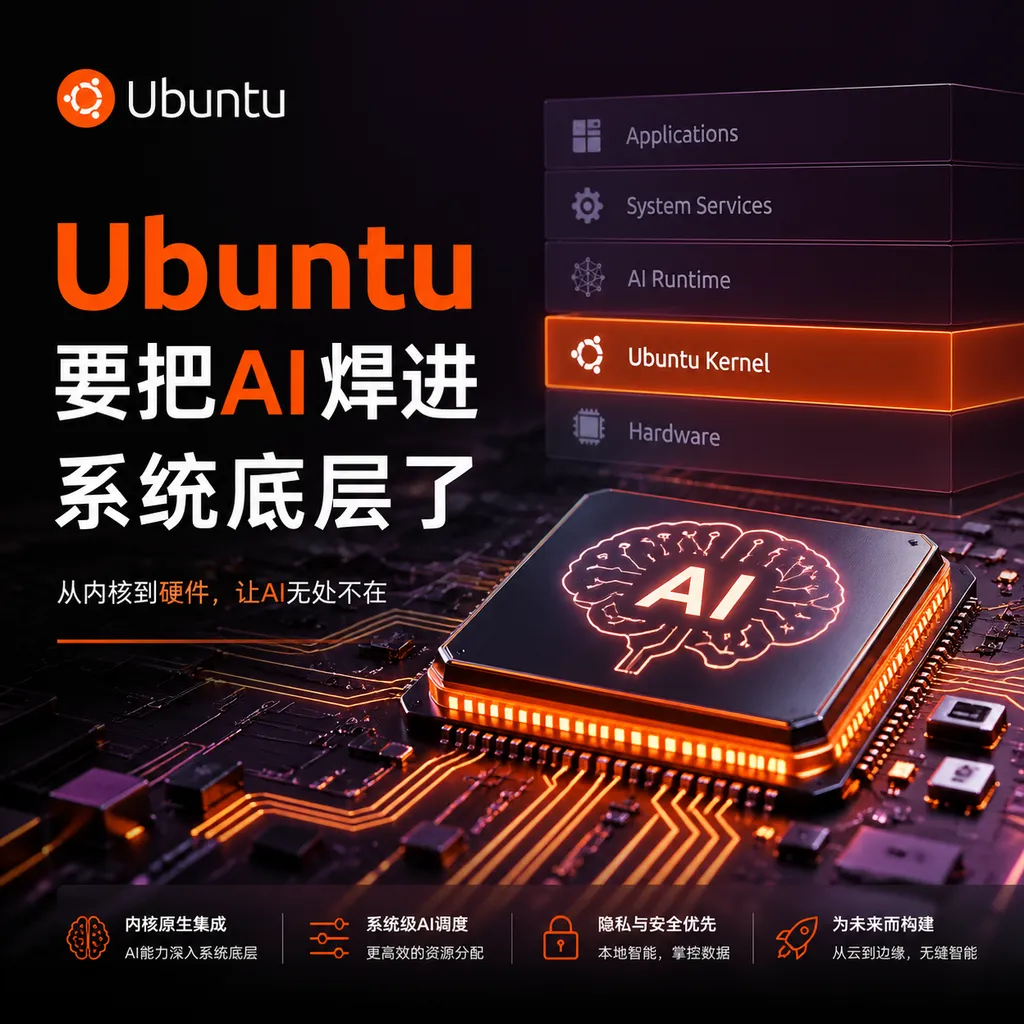
Canonical announced the Ubuntu AI roadmap, planning to integrate local inference engines, AI-assisted accessibility features, and agentic workflows as core system components within the next year — marking the first time a mainstream Linux distribution has elevated AI to the native operating system level.
Canonical is getting serious. This Monday, Jon Seager, VP of Engineering at Ubuntu’s parent company Canonical, published a blog post laying out Ubuntu’s AI roadmap for the next year: local model inference, AI-powered accessibility tools, and agentic automation workflows — all no longer treated as mere third-party add-ons, but built as native OS components written into Ubuntu’s core architecture.
This isn’t a minor patch. For the millions of servers, developer machines, and edge devices running on Ubuntu worldwide, it means that “AI capability” is about to go from “DIY” to “out of the box.”
Two-Legged Approach: Background Enhancement + AI-Native
In his blog, Seager divided the roadmap into two carefully worded phases:
The first phase is to “use AI models to enhance existing OS functions in the background.” In plain English — you won’t necessarily notice AI at work, but speech recognition will be more accurate, text-to-speech more natural, and the input methods smarter. These capabilities run locally as system services, requiring no network connection or user configuration.
The second phase is the truly radical one: providing AI-native functions and workflows for users who want AI. The keyword here is Agentic — it’s not just about giving you a chat box, but letting AI agents directly perform system-level tasks. Imagine saying to your terminal: “Upgrade all dependencies in this project to the latest stable versions, run the tests, and roll back anything that breaks,” and the system actually executes that workflow for you.
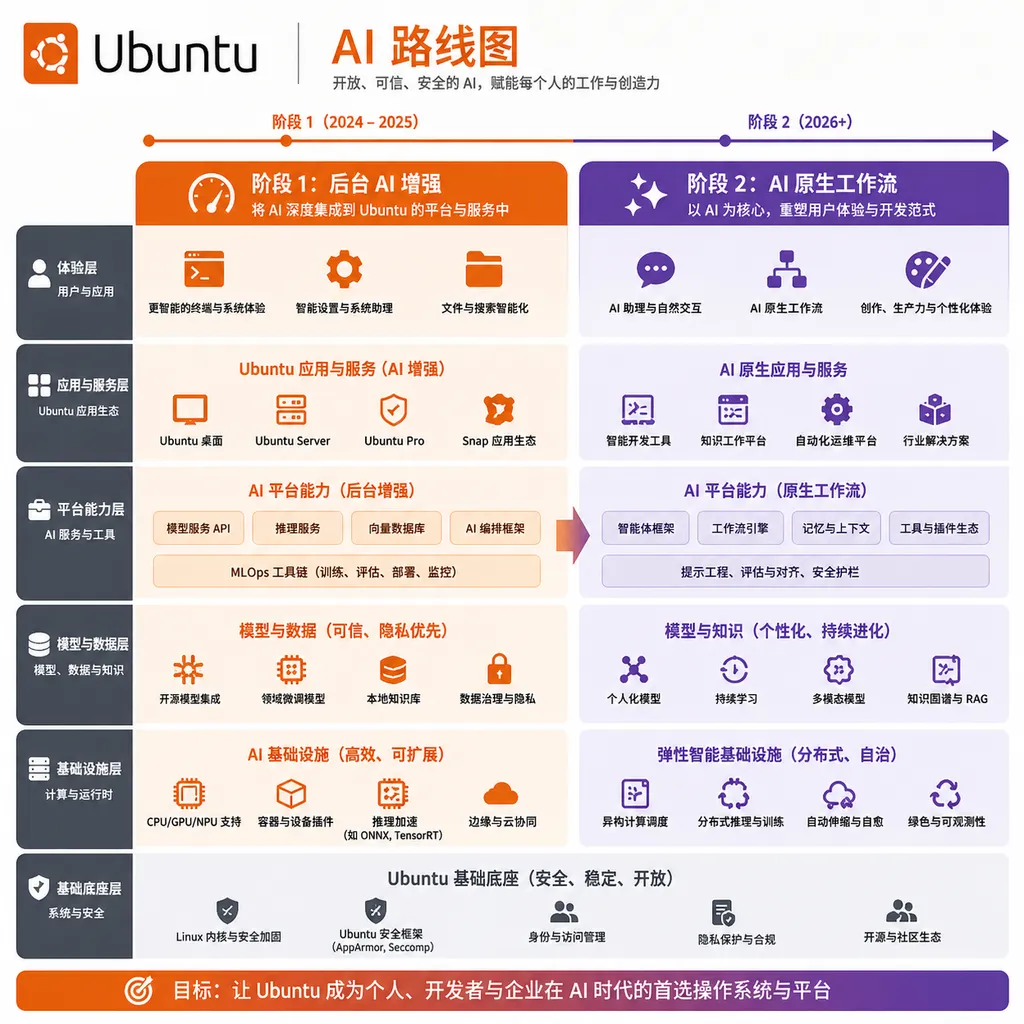
This division is clever. Users who don’t want AI interference simply get a system that improves quietly; those who want deep integration have native agentic capabilities ready to call on. No force-feeding, but no absence either.
Why Now?
You might ask, “Running local AI on Linux isn’t new — tools like ollama, llama.cpp, and vLLM already run great on Ubuntu. Why is Canonical jumping in now?”
The answer lies at the intersection of three trends.
First, the hardware barrier for on-device inference is plummeting. AMD’s Ryzen AI Max+ processors can now run models at the level of Qwen 3.5 locally with near-cloud performance. Intel and Qualcomm are pushing hard on NPUs. Hardware vendors have already packed AI compute into every new PC — but there’s no unified management stack at the OS level. That’s a massive gap.
Second, Ubuntu is the primary OS for AI developers. This isn’t opinion but ecosystem reality — NVIDIA’s CUDA toolchain has the best support on Ubuntu; PyTorch and TensorFlow test officially on Ubuntu; and cloud GPU instances default to Ubuntu images. As one Zhihu article put it bluntly: Ubuntu LTS is “currently the best — even the only uncompromised — choice for AI development and local LLM deployment.” Since the users are already here, building AI capabilities into the system base is a natural next step.
Third, and perhaps most business-driven — Canonical needs a new story. Traditional revenue streams like Ubuntu Pro subscriptions and enterprise support have limited growth. If Ubuntu becomes the de facto “AI-native operating system,” Canonical’s enterprise leverage changes completely.
How Will It Be Implemented Technically?
The blog didn’t provide a complete technical architecture, but existing clues allow us to sketch a rough outline.
First comes local inference services. Ubuntu will likely bake in a system-level inference runtime, similar to what ollama does but more deeply integrated with systemd. This means model loading, unloading, and resource allocation are orchestrated at the OS level, rather than siloed per app. For developers, it might mean a standardized D-Bus interface or socket API so any app can invoke system-provided inference without bundling a model itself.
# Possible future interaction style (speculative)
# System-level inference service management
systemctl status ubuntu-inference
systemctl enable ubuntu-inference

# Call local model through system API
curl --unix-socket /run/ubuntu-ai/inference.sock \
  -X POST -H "Content-Type: application/json" \
  -d '{"prompt": "Summarize this log file", "context_file": "/var/log/syslog"}' \
  http://localhost/v1/completions
Next is accessibility — long a weak spot for Linux desktops. Windows integrates Narrator and Copilot, macOS has VoiceOver and Apple Intelligence, but Linux accessibility often lags at the “usable but crude” stage. Canonical plans to use AI models to improve speech-to-text and text-to-speech quality — a substantial improvement for visually impaired users or voice interaction scenarios. If done well, this could be the Ubuntu desktop’s most socially impactful upgrade.
Finally, the agentic workflow — the fuzziest yet most imaginative piece. Broadly, Agentic AI means models that not only answer questions but plan tasks, call tools, and execute actions. Putting that at the OS level means AI agents could directly manipulate the file system, invoke CLI tools, and manage system services. That’s both a massive productivity leap and a huge security challenge — more on that soon.
Ubuntu’s Place Among Competitors
Stepping back, OS-level AI integration is already a global arms race.
Microsoft stuffed Copilot into Windows 11 and introduced Recall (though it stumbled over privacy). Apple’s Apple Intelligence is permeating every layer of iOS 18. Google’s ChromeOS is embedding Gemini Nano for edge inference.
But those are closed systems. In the open-source world, Ubuntu is the first mainstream distribution to plan AI at the architectural level.
There’s a subtle but crucial distinction: Windows and macOS dictate which models you can use, while Ubuntu’s open nature means users can theoretically swap models, customize inference pipelines, or turn AI off entirely. For developers and enterprises, that flexibility is gold.
However, Ubuntu also faces stiff competition inside open source. Fedora has Red Hat (IBM) backing; SUSE has its own enterprise Linux play; Arch and NixOS communities are exploring declarative AI environments. If Canonical moves too slowly or locks things down too tightly, others may leap ahead.
Why Developers Should Care
Let’s get practical. If you’re a developer using Ubuntu daily, what does this roadmap mean for you?
Short term (next 6 months): likely no big differences. Canonical tends to plan first, then deliver in the next LTS cycle. Given Ubuntu 24.04 LTS has already launched, these AI features will probably first appear experimentally in 25.04 and stabilize in 26.04 LTS.
Mid term: watch for standardization of the system-level inference API. If Ubuntu truly offers a unified local inference interface, then desktop apps, CLI tools, and scripts can call system AI directly without managing model deployment. That drastically lowers the bar for “adding AI features.”
Long term: the most exciting change could be agentic workflows transforming development itself. Imagine:
ubuntu-agent "review my nginx config for security issues"analyzes and suggests improvementsubuntu-agent "set up a Python 3.12 dev environment with PostgreSQL"installs dependencies, configures venvs, and launches databases automaticallyubuntu-agent "why is my disk usage at 95%"investigates disk usage and suggests cleanup
Sure, ChatGPT or Claude can do this today — but you have to copy-paste context and outputs. If an agent runs inside the OS with full local context, efficiency jumps by an order of magnitude.
The Big Issues: Security and Privacy
Embedding AI agents in the OS core brings unavoidable risks.
The most direct worry is permission control. An AI agent that can manipulate files and execute shell commands could be exploited via prompt injection. You tell it to “clean temporary files,” and it’s hijacked into running rm -rf / — not sci-fi anymore.
Canonical must design a strict sandboxed permission model: each AI operation should have explicit boundaries, sensitive actions require user consent, and all activity must be auditable. Android’s permission system and macOS’s TCC (Transparency, Consent, and Control) framework are good reference points, but AI agents will need their own adaptations.
Another issue is data privacy. Local inference is inherently privacy-friendly — data stays on the device. But if Canonical offers “optional cloud enhancement” (which almost certainly it will), then data flow transparency becomes paramount. Linux users are far more privacy-conscious than Windows or macOS users; mishandle this, and backlash will be intense.
Remember Ubuntu’s 2012 fiasco — Amazon shopping results in desktop search? The community outrage forced Canonical to roll it back. In the AI era, privacy battles will be even fiercer. Canonical must bake in “offline by default, optional online, fully transparent” as a core design principle from day one.
What It Means for the Industry
Broadly speaking, this move could accelerate AI integration across the entire Linux ecosystem.
Once Ubuntu defines a standard “OS-level AI interface,” other distros must either adopt or propose alternatives. Either way, the open-source world will debate at which layer and in what form AI should exist within the OS — a healthy and necessary discussion.
For hardware vendors, Ubuntu’s native inference support means their NPUs and AI accelerators can target a consistent software stack. Currently, every vendor builds its own drivers and SDKs — a nightmare for developers. A unified Ubuntu abstraction layer would streamline both hardware adaptation and developer access across the board.
For cloud platforms and AI service providers, this signals another shift. When the OS itself runs models, hybrid architectures — local + cloud inference — become more natural. Simple tasks run locally, complex ones call cloud APIs. For multi-model developers, this design is ideal. Aggregators like OpenAI Hub are well-positioned to serve as unified cloud endpoints for such hybrid systems.
A Reality Check
That said, a roadmap is still just a roadmap.
Canonical’s execution record has been mixed — Unity desktop, Ubuntu Phone, Ubuntu Touch, Mir display server — many ambitious starts, few lasting impacts. Whether the AI roadmap ships on time and on quality remains to be seen.
Moreover, “building AI into the OS” is far easier said than done. Model selection, inference optimization, hardware adaptation, security auditing, community governance — every step is a hard problem.
Still, the direction is right. As the foundational software layer, the OS should natively support AI — just as it natively supports networking, graphics, and audio. Ubuntu is taking the first step; now we’ll see how far it can go.
For developers, there’s nothing special to do just yet. Keep using your usual toolchains, watch the Ubuntu 25.04 and 26.04 release notes, and evaluate migration when the features actually land. Until then, ollama + your favorite model remains the best solution for local AI on Ubuntu.
References:
- 2026: AI Development and Local Model Deployment — Why Choose Ubuntu? - Zhihu Column (Analysis of Ubuntu’s advantages in the AI development ecosystem)


