
Xiaomi MiMo-V2.5 fully open-sourced, MIT license allows direct commercial use
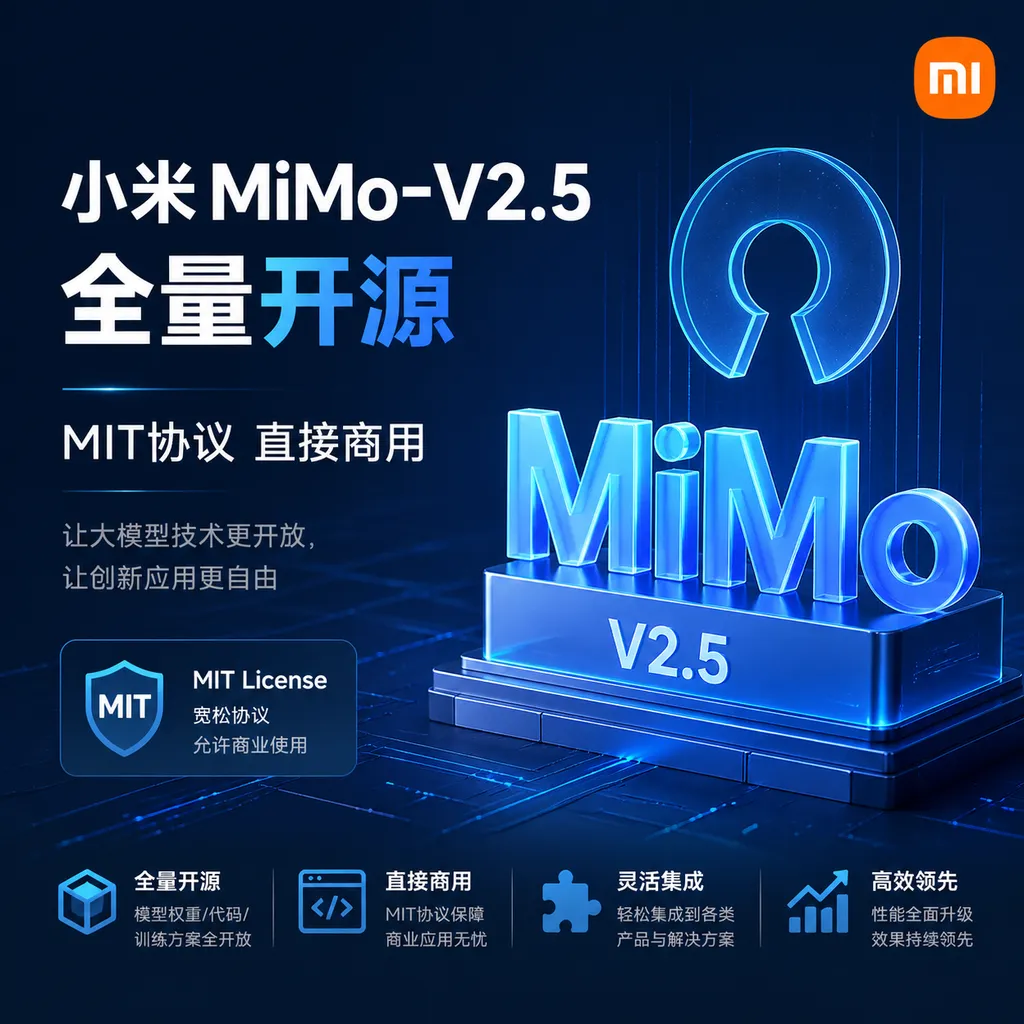
Xiaomi has officially open-sourced two large models globally — **MiMo-V2.5** and **MiMo-V2.5-Pro**. Under the MIT license, all weights and inference code are fully released, supporting commercial deployment and secondary training. At the same time, the **MiMo Orbit** ecosystem program, featuring a quadrillion-token incentive, has been launched.
Xiaomi isn’t holding back this time.
At the end of April, the Xiaomi MiMo-V2.5 model series was officially open-sourced worldwide. Xiaomi released the full weights and inference code for two models—MiMo-V2.5 and MiMo-V2.5-Pro—under the MIT License, the most permissive license in the open-source world. In plain terms: you can use them commercially, modify them, distill them, or even repackage them—no need to inform Xiaomi.
Among domestic large-model vendors, this is considered quite an aggressive move.
Two models, different positioning
The MiMo-V2.5 series includes four models in total, but only the two core versions are open-sourced:
- MiMo-V2.5: positioned as a general base model covering mainstream scenarios such as daily conversation, content generation, and code assistance. Ideal for small and medium-sized teams to fine-tune and build vertical applications.
- MiMo-V2.5-Pro: Xiaomi’s most powerful publicly available model so far. Officially, it claims comparable performance to models at the level of Claude Opus 4.6 and GPT-5.4 in areas like general agent capability, complex software engineering, and long-term task planning.
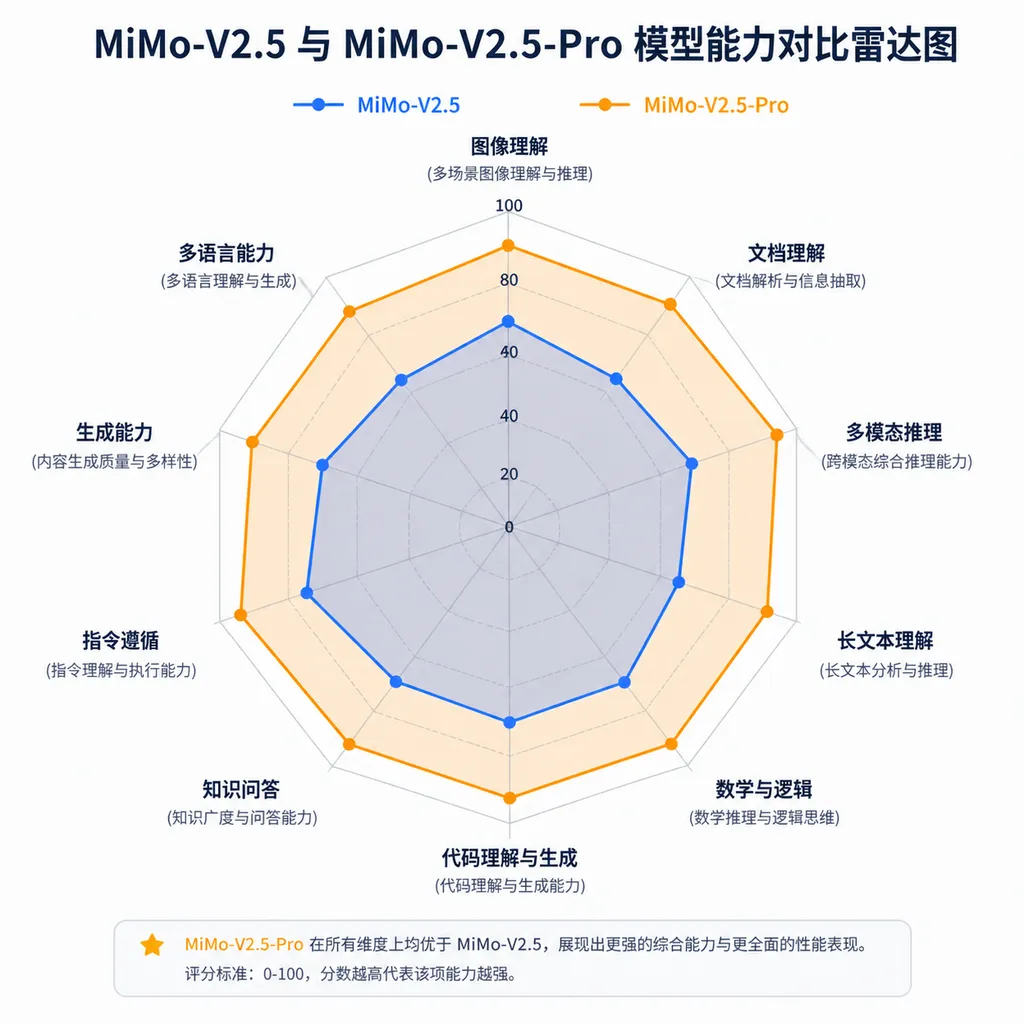
Of course, “head-on competition” is partly marketing talk, but if you’ve followed the MiMo series’ evolution, Xiaomi’s progress in large models hasn’t been slow. From MiMo-V1’s low-key debut in late 2024, to V2-Flash’s trial open-sourcing under MIT, and now the full release of V2.5—in less than two years, three major versions have launched, faster than many pure AI companies.
This is backed by real financial investment. Public data shows that Xiaomi’s cumulative investment in AI over the last three years exceeds 60 billion RMB, ranking just behind a few top Chinese internet companies.
What the MIT license means
Licensing is always a key topic when discussing open-source models.
Over the past two years, open-sourcing in China’s AI industry has evolved from chaotic to more structured. Early on, many vendors claimed to be open-source but actually used custom licenses—with restrictions on commercial scale, bans on competitive use, or mandatory attribution. Developers often had to spend half an hour reading the fine print to check compliance before using such models.
This time, Xiaomi’s choice of MIT makes its stance clear: no barriers.
The MIT license boils down to one line—you can use the code for any purpose, as long as you keep the copyright notice. No restrictions on commercial use, usage scenarios, or output ownership. For developers and companies integrating models into their products, this is the lowest-risk option legally.
As a comparison:
| License | Commercial use | Fine-tuning | Distillation | Modification & redistribution | Typical representative | |----------|----------------|-------------|--------------|------------------------------|------------------------| | MIT | ✅ | ✅ | ✅ | ✅ | MiMo-V2.5 | | Apache 2.0 | ✅ | ✅ | ✅ | ✅ (must note modifications) | LLaMA 3 | | Custom license | Conditional | Conditional | Usually prohibited | Conditional | Some domestic models |
Of course, MIT also means Xiaomi gives up the possibility of building a moat through restrictive licensing. Competitors could directly base their products on MiMo-V2.5’s weights and even train stronger models to compete. Xiaomi clearly understands this—it isn’t focusing on model monetization, but on ecosystem building.
How strong is the Pro version?
Back to the model’s performance itself.
MiMo-V2.5-Pro is described by Xiaomi as its “most powerful model to date.” The official comparison targets are Claude Opus 4.6 and GPT-5.4—both top-tier closed models, particularly strong in Agent scenarios and complex reasoning tasks.
Xiaomi highlights three main domains of capability:
General agent capability (Agent): The toughest battlefield in today’s model competition. A good agent model must not only chat but also understand multi-step instructions, call external tools, and complete tasks in real environments. For instance, “Find the GitHub commit that introduced a bug in the last three months and generate a fix plan.” A model capable of planning, executing, feedback, and self-adjustment during such chained tasks truly demonstrates agent strength.
Complex software engineering: Writing simple code is easy, but understanding a hundred-thousand-line codebase, locating cross-module bugs, and generating project-standard PRs requires long-context comprehension and engineering thinking. MiMo-V2.5-Pro’s performance in this area is one of Xiaomi’s key promotion points.
Long-term task planning: Not just answering a question, but completing a project. The model must break down a big goal into actionable subtasks, progress sequentially, and adjust when encountering obstacles—essentially testing working memory and planning ability.
Benchmark data will gradually be released on Xiaomi’s open-source page, but truth be told, anyone who’s deployed models knows the gap between benchmarks and real-world use. Developers are better off downloading the model and testing it in their own use cases than looking at any leaderboard.
Domestic chip adaptation: a noteworthy signal
A detail that might be overlooked—Xiaomi explicitly states that MiMo-V2.5 will support domestic AI chips.
This is not just talk. In today’s global environment, supply of high-end AI chips is a constant concern for China’s AI industry. NVIDIA’s H100/H200 are affected by export controls, making acquisition difficult. If open-source models only run on NVIDIA GPUs, then their practical value is effectively reduced.
Xiaomi’s active adaptation to domestic chips serves both as policy alignment and ecosystem expansion—if you want more domestic developers and companies using your model, you can’t only cater to those with top-tier compute.
The official list of supported domestic chips hasn’t been published yet, but it’s highly likely to include major players like Huawei Ascend and Cambricon.
MiMo Orbit: not just open-sourcing, but building an ecosystem
Model open-sourcing is only the first step. Xiaomi simultaneously launched the MiMo Orbit Program, which is the strategic core of this release.
Orbit has two sub-projects:
Creator Trillion-Token Incentive Program
Targeting all AI builders, simply put: use MiMo models to build applications, and Xiaomi gives you free inference credits. One trillion Tokens—enough to sustain substantial app development and testing workloads.
For independent developers and small teams, inference cost is a real challenge. An AI app with tens of thousands of daily users can easily rack up API charges in the tens of thousands of RMB monthly. Xiaomi’s free tokens are meant to draw developers into its MiMo ecosystem, much like how cloud providers used to offer startup credits—bring people in first, focus on monetization later.
Agent Ecosystem Co‑Development Plan
This one targets Agent framework teams. Currently, there are numerous open-source Agent frameworks—LangChain, CrewAI, AutoGen, MetaGPT, etc.—but these frameworks mostly rely on GPT or Claude as backend models. Xiaomi aims to make MiMo-V2.5-Pro a “first-class citizen” within these frameworks.
If MiMo-V2.5-Pro’s agent capability truly rivals Claude Opus 4.6 and it’s fully open-source and locally deployable, it will appeal strongly to enterprises with data-security requirements. Not every company wants to send business data to overseas closed APIs.
The competitive landscape of open-source large models
Looking at the broader picture, where does MiMo-V2.5’s open-sourcing position Xiaomi in the industry?
By 2025–2026, open-source large-model competition has entered deep waters. Meta’s LLaMA series continues to evolve; Alibaba’s Qwen dominates China’s open-source ecosystem; DeepSeek has forged its path through extreme cost performance; and Mistral stands firm in the European market.
As a company rooted in hardware and consumer electronics, Xiaomi’s large-model narrative differs from these players. Its core advantages lie not in algorithm depth, but in:
- Scale of terminal devices: Phones, tablets, TVs, IoT devices—all natural carriers for AI model deployment. A model that runs efficiently on-device combined with Xiaomi’s hardware ecosystem offers huge potential.
- Engineering capability: Years of phone manufacturing have proven Xiaomi’s supply-chain management and engineering execution. Translating that to AI training and deployment ensures high efficiency.
- User base: With hundreds of millions of active global device users, once the model is integrated into MIUI/HyperOS, there are massive usage scenarios and feedback loops.
Of course, drawbacks exist. Compared to research-focused AI teams, Xiaomi’s academic accumulation is thinner; compared to internet giants, its data and compute reserves are smaller. Whether MiMo-V2.5-Pro can truly go toe-to-toe with Claude Opus 4.6 in Agent scenarios remains to be validated by the community.
For developers: how to use it
If you’d like to try MiMo-V2.5, here are a few suggestions:
Local deployment: Both weights and inference code are available from Xiaomi’s official channels or Hugging Face. Under MIT, no license application is needed—just clone and run.
Fine-tuning scenarios: If you have domain-specific datasets, MIT allows full SFT (supervised fine-tuning) or even full retraining. For specialized domains like medical, legal, or finance, it’s a low-cost starting point.
Agent development: If your project involves Agent frameworks, focus on MiMo-V2.5-Pro. An open-source, locally deployable strong Agent model offers clear data-compliance and cost advantages.
Apply for token incentives: Independent developers and small teams should consider joining the MiMo Orbit trillion-token program. Free inference credits—save money for coffee instead. The application entry is 100t.xiaomimimo.com.
A quick judgment
From the beginning, few believed Xiaomi could succeed in large models. How could a hardware company compete with all-in AI teams?
But the MiMo-V2.5 open-sourcing shows two things:
First, Xiaomi means business. A 60 billion RMB investment, full MIT-license release, and accompanying ecosystem incentive program—this isn’t a trial, but a long-term commitment.
Second, large-model competition is shifting from “whose model is strongest” to “whose ecosystem is most active.” OpenAI has APIs, Meta has the open community, and Xiaomi aims to build its own loop with MIT + free tokens + hardware integration. It’s too early to judge the outcome, but the direction is right.
For developers, having one more high-quality open-source option is always a good thing. Download it and test—let the code speak.
References:
- Xiaomi MiMo-V2.5 Series Global Open-Source Announcement – Linux.do (Official Xiaomi open-source post)
- Xiaomi MiMo Model Homepage – Hugging Face (Model weights and inference code download)


