
Sora Web officially goes offline; OpenAI has cut its flagship product.

On April 28, the web version and standalone app of OpenAI’s AI video generation product **Sora** officially went offline. From its stunning debut to its quiet exit, Sora lasted less than two years. Once the most generous free video generation model, now only the developer API channel remains — and how long that channel will last is still an open question.
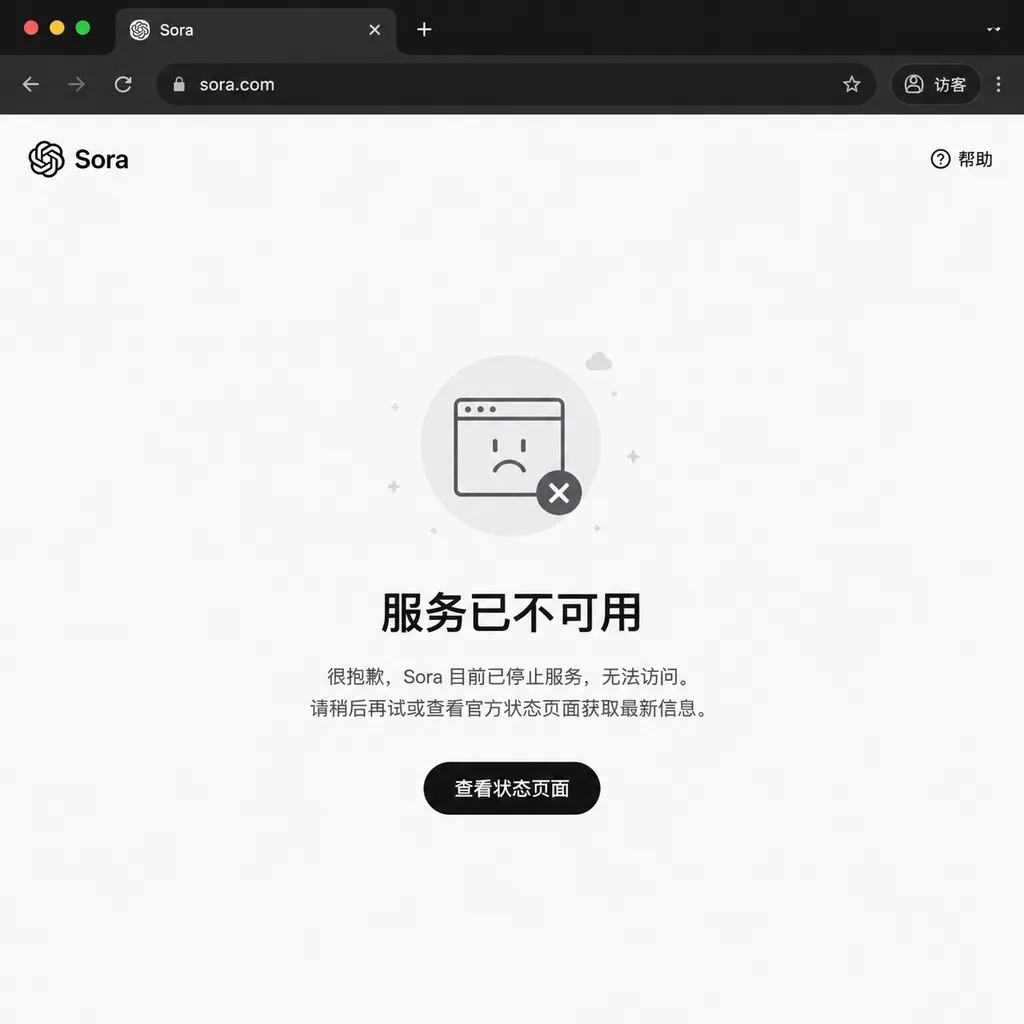
On April 28, 2026, when you open sora.chatgpt.com, you’ll find that there’s no longer any interactive content on the page.
Sora Web has gone offline. Originally scheduled to shut down on the 26th, it managed to hold on for two more days, but the outcome is the same. The OpenAI video generation model that once took the industry by storm has now reached the end of its lifecycle as a consumer product.
A Product That "Peaked on Launch"
Looking back on the life of Sora, there’s perhaps no better description than “high start, slow decline.”
In February 2024, OpenAI released a technical preview video of Sora. A short clip of “a woman walking through the streets of Tokyo” instantly went viral on social media. It was the “iPhone moment” for AI video generation — everyone realized that text-to-video had crossed the chasm from “watchable” to “usable.” Hollywood became nervous, short-video creators thrilled, competitors silent.
But it took more than half a year for the product to go from preview to launch.
Between September and October 2025, the Sora app officially launched. The performance was indeed impressive: a generous free plan, top-tier generation quality at the time, and more than one million downloads within five days. For a while, it topped Apple’s App Store charts.
And then? Nothing happened after that.
From Free to Paid, From Millions of Downloads to No One Caring
The problem emerged in the months following Sora’s launch.
On January 10, 2026, OpenAI canceled Sora’s free plan. The decision itself wasn’t unreasonable — video generation consumes a lot of computing power and can’t be free forever. The real issue was that, while removing the free tier, Sora failed to offer enough compelling reasons to pay.
Slow generation speed, long queue times, poor controllability, unclear commercialization use cases — shortcomings users could tolerate during the free phase became fatal in the paid era.
The data tells the story: by February 2026, Sora’s monthly downloads had dropped to about 1.13 million. Sounds okay? But compared to its explosive launch period, the decline was steep. More worrying was the drop in retention and active usage — many downloaded it, tried it once, and never opened it again.
Meanwhile, competitors didn’t sit idle.
Runway had iterated to Gen-4.5, Google’s Veo was in its third generation, Kuaishou’s Kling 3.0 had solidified its presence in the domestic market, and ByteDance’s Seedance and MiniMax’s Hailuo Video both had their loyal users. The AI video generation landscape shifted from Sora’s dominance to fierce multi-player competition — and Sora’s iteration speed simply couldn’t keep up.
March Announcement, April Execution
On March 24, 2026, OpenAI officially announced the complete shutdown of the Sora video generation app and API.
The Sora team posted a farewell message on X, promising to release a timeline and user data export plan soon, and stating that team members would continue collaborating with other AI platforms. The phrasing was diplomatic, but the insiders could read between the lines — this wasn’t a “temporary adjustment”; it was a full termination.
OpenAI allowed roughly a one-month buffer between the announcement and the actual shutdown. The official help center stated:
We recommend that you export your Sora content before the shutdown date. After shutdown, we are still evaluating whether a limited-time final export window can be provided. Once that export window expires (if we are able to offer one), we will permanently delete all data related to your use of Sora.
Pay attention to the wording — “still evaluating whether.” Translation: most likely not. So if you’ve ever created something worthwhile in Sora, head to sora.chatgpt.com/exports/me and see if it can still be retrieved — though it’s probably too late.
Why Did OpenAI Kill Sora?
That’s the question everyone is asking. Why would a project once seen as “OpenAI’s next killer product” get axed so abruptly?
I think there are three layers of reasons.
The first is economic. Video generation requires far more computational power than text or image generation. Each video consumes tens to hundreds of times more GPU resources than GPT-4 text inference. During its free phase, OpenAI was essentially burning cash to build hype. Once the free tier was gone, the paid conversion wasn’t enough to cover costs — no business case could justify that.
The second is strategic focus. OpenAI’s core battlefield now lies in AGI and enterprise AI services — the GPT model series, ChatGPT subscriptions, enterprise APIs — these drive revenue. Sora, as a consumer-level video tool, wasn’t a critical node in OpenAI’s technological roadmap and didn’t show a sustainable business model. With limited resources, cutting non-core business makes sense.
OpenAI itself said shutting down Sora was to “streamline the product line.”
The third is the competitive landscape. When Sora’s technical preview launched in early 2024, its lead was overwhelming. By 2026, that lead had largely evaporated. Runway Gen-4.5 scored 1247 ELO on Artificial Analysis’s video quality leaderboard, with Google Veo 3 right behind at 1226. Sora was no longer “the only choice” — and not even “the best choice.”
Continuing to invest in a race you’re no longer leading is less rational than pulling back to reinforce your existing moat. That’s OpenAI’s logic.
The API Channel: A Hollow Shell?
Here’s an important clarification.
Based on available references, the situation is complex. When OpenAI announced the shutdown in March, it explicitly said both the app and API would be discontinued. Some sources confirmed the API would be permanently closed. However, community developers reported that API calls still hadn’t been fully interrupted as of now.
Regardless, one thing is clear: as a continuously maintained product, Sora no longer exists. Even if the API still responds, there will be no new versions, no features, no model upgrades. It has become a “legacy interface” — usable, but with no future.
For developers who have integrated Sora’s API, the most practical move now is to start planning for migration.
Where to Migrate? The Current AI Video Generation Landscape
With Sora exiting, what alternatives do developers have?
The major players and options in the AI video generation space:
- Runway Gen-4.5: Currently ranked first, ELO 1247, official API available, mature ecosystem — the most direct replacement. Downside: not cheap.
- Google Veo 3 / 3.1: Accessible via Gemini API, close in quality to Runway, backed by Google’s compute and ecosystem. If you’re already on Google Cloud, migration cost is minimal.
- Kuaishou Kling 3.0: Top choice for Chinese developers — good Chinese context understanding, easy API integration, cost-effective.
- Luma Ray 3: Distinct visual style, fits specific aesthetic needs, accessible via third-party APIs.
- ByteDance Seedance 2.0: Still in testing but promising — ByteDance’s expertise in video understanding and generation shouldn’t be underestimated.
- MiniMax Hailuo Video: Another competitive domestic option, rapid iteration.
- Pika: More consumer-oriented but API-accessible, suitable for lightweight use cases.
My quick and dirty recommendation:
- Want best quality → Runway Gen-4.5
- Want ecosystem integration → Google Veo 3
- Domestic first → Kling 3.0 or Hailuo Video
- Budget-conscious → Luma Ray 3 or Pika
A Bigger Issue
Sora’s shutdown isn’t an isolated event.
It reveals the tension within the entire AI industry between “technical brilliance” and “commercial sustainability.” Over the past two years, we’ve seen too many cases of “stunning demos, disappointing products.” Widely praised during the preview phase, then disappointing after launch — poor user experience, non-viable business model, ending in transformation or shutdown.
Sora’s story is especially telling because it’s backed by OpenAI — one of the most resource-rich and technically advanced AI companies on the planet. If even OpenAI couldn’t make video generation into a sustainable consumer product, what does that mean?
It means that commercializing video generation is far harder than people imagined.
Compute costs are one part. The deeper issue: how much are users actually willing to pay for AI-generated videos? In what scenarios is AI video generation a “must-have” rather than a “nice-to-have”? The industry still hasn’t found clear answers.
Runway is doing well, but its main users are professional creators and film industry workers — a niche group with strong willingness to pay. Sora tried to play in the mainstream market and found that ordinary users simply don’t have the same demand for video generation as they do for text and image creation.
In Closing
R.I.P. Sora, 2024.9 – 2026.4.
As a product, it failed. But as a technological milestone, its significance won’t be erased. Sora’s technical preview was the turning point where AI video generation evolved from “toy” to “tool.” It forced competitors to accelerate, and forced the industry to rethink its technical and commercial direction.
In a sense, Sora’s departure made the race more vibrant.
For developers, sentiment aside, migration planning still needs to happen. The good news: there are far more alternatives now, with solid quality. The bad news: none are as generous as Sora’s once-free plan.
After all, the most expensive product is the free one — and OpenAI proved that with Sora.
References
- Sora Web Officially Offline - Linux.do — Community users confirm Sora Web was shut down on April 28
- OpenAI to Halt Sora Video Generation Service to Streamline Product Line - Zhihu — Analysis and discussion on OpenAI’s decision to discontinue Sora


