
Alipay launches "AI Pay": The checkout counter for the Agent era has arrived

Alipay has officially launched the “AI Pay” settlement system, enabling AI service providers to receive per-use automated payments when their intelligent agents are invoked, without the need to build their own payment systems. Individual developers will enjoy a 0% service fee until the end of the year. This may be the first payment infrastructure in China specifically designed for the agent economy.
Alipay Launches “AI Pay-In”: The Checkout Counter for the Agent Era Has Arrived
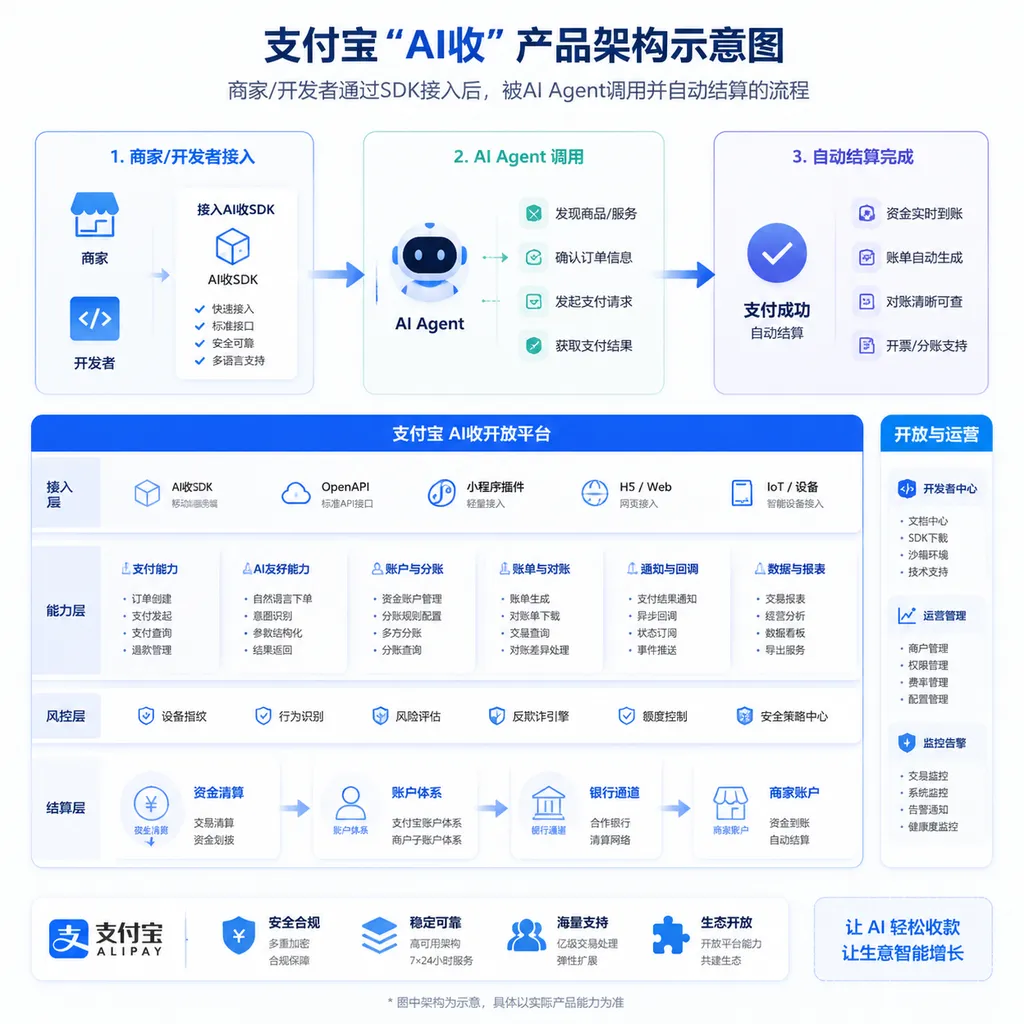
Today, Alipay officially launched a new tool called “AI Pay-In.” In short: if you’re a developer or business providing AI services, you no longer need to build your own payment system—just connect to “AI Pay-In,” and when an AI Agent calls your service, the money will automatically be settled per use to your account.
One order, one payment.
It sounds simple, but the implications behind this move are substantial.
First, What Problem Is It Solving?
Over the past year, the term Agent has been used to exhaustion. But those actually trying to commercialize Agents have run into a very real issue: After an Agent invokes an external service, how is payment handled?
Let’s take an example. Suppose you’ve built an AI service that helps users optimize résumés, priced at 2 RMB per invocation. Now, a job-hunting Agent (say one running on OpenClaw) wants to call your service within its conversation flow to polish a user’s résumé.
Here come the questions:
- How does the Agent know your service charges a fee?
- After the call finishes, who triggers the payment?
- From which account is the user charged, and who receives the money?
- If the call fails, how is a refund processed?
- As an independent developer, do you have to integrate a payment gateway yourself, handle clearing, and manage refund disputes?
These problems were already annoying in the traditional SaaS era, and they become worse in the Agent era—because the call chain is automated, and there may be no human action to “confirm payment.”
“AI Pay-In” is designed to solve this entire set of issues.
Three-Step Integration — Truly Lightweight
According to currently available information, integrating “AI Pay-In” only takes three steps:
- Sign Up — Complete identity verification and agreement on the Alipay Open Platform as a business or individual developer
- Create an Application — Register your AI service and configure pricing rules (per call, per usage, etc.)
- Install the SDK — Integrate Alipay’s SDK into your server to enable metering and settlement connection
Once integrated, when an Agent calls your service, the SDK automatically handles metering, deduction, and payout. Developers don’t need to worry about payment logic—just focus on their AI service itself.
This design is reminiscent of early WeChat Pay and Alipay mini-program payment logic: turning payment into a plug-and-play infrastructure layer to lower the threshold for monetization. The only difference—this time, the “caller” isn’t a human user but an AI Agent.
About OpenClaw: The Unavoidable “Lobster”
OpenClaw—called “Lobster” by Hong Kong and Taiwan media—is an AI Agent protocol/platform launched by Ant Group. You can think of it as both an Agent runtime and a service marketplace: Agents run on it and discover or invoke third-party services via the OpenClaw protocol.
Currently, “AI Pay-In” first connects with the OpenClaw ecosystem. So, if you want your AI service to be invoked by OpenClaw Agents and get automatically paid, “AI Pay-In” is the most direct path.
But note this: “AI Pay-In” is positioned for “AI Agents represented by OpenClaw”—that word represented matters. It implies that the platform likely won’t be limited to OpenClaw; it may open up to more Agent frameworks and protocols in the future.
That’s important. If “AI Pay-In” were just OpenClaw’s internal settlement tool, it would be a platform feature. But if it grows into a cross-platform Agent payment standard, it becomes true infrastructure.
0% Rate: A Sweet Deal for Individual Developers
For individual developers, the most practical news is: “AI Pay-In” charges a 0% fee rate until December 31, 2026.
That’s significant. Normally, third-party payment fees are around 0.6%, sometimes higher depending on the industry. A 0% rate means that for the remaining eight months of this year, every cent you earn through Agent calls is yours—Alipay takes no cut.
Obviously, this is a strategic move to capture the ecosystem early. Alipay needs as many developers as possible to list their services, building a rich supply side so that Agents have things to call. A 0% rate is the bait for onboarding.
As for the rate after January 1 next year, there’s no public info yet. But based on Alipay’s pricing logic in other areas, it’ll likely remain competitive—WeChat Pay won’t stay out of this race for long.
From “AI Pay-Out” to “AI Pay-In”: Alipay’s Bigger Play
It’s worth noting that “AI Pay-In” isn’t Alipay’s first move in Agent payments. Previously, Alipay launched “AI Pay-Out.”
The difference between the two is clear:
| | AI Pay-Out | AI Pay-In | |---|---|---| | Problem Solved | Agents pay on behalf of users | Developers get paid after an Agent call | | Money Flow | User → Merchant | Agent caller → Service provider | | Core Scenario | Users authorize Agents to pay | Developers’ AI services collect payment automatically after being called |
“AI Pay-Out” handles the consumption side—letting Agents spend money for users. “AI Pay-In” handles the supply side—letting developers earn money through the Agent ecosystem.
Together, they form Alipay’s vision of a complete funds flow loop for the Agent economy: user money flows out via “AI Pay-Out,” through the Agent call chain, and ends up in service providers’ accounts via “AI Pay-In.”
That’s an ambitious layout.
Why the Timing Is So Subtle
In early 2026, the Agent field is shifting from the demo phase to the commercialization phase.
Some major context signals:
- The MCP (Model Context Protocol) has been spreading quickly, with more tools and services now supporting standardized Agent invocation
- Model vendors are launching their own Agent platforms and plugin markets
- But most Agent services are still free or subsidized by platforms; fully operational “call-and-pay” loops are extremely rare
What the Agent ecosystem lacks most right now isn’t model capability or tools—it’s commercialization infrastructure.
It’s like early mobile internet: the App Store’s significance wasn’t just as an app directory—it provided an end-to-end distribution, payment, and settlement system that let developers live off making apps. Without that, mobile internet prosperity couldn’t have happened.
The Agent world lacks that system today, and Alipay’s “AI Pay-In” is, in a sense, trying to play that role—at least for payment and settlement.
Keep a Cool Head: A Few Concerns
Of course, it’s not perfect. Developers should consider a few things carefully:
1. Ecosystem lock-in risk.
Right now, “AI Pay-In” is deeply tied to OpenClaw. If your monetization depends solely on it, you’re effectively placing your commercial lifeline inside Ant Group’s ecosystem. If OpenClaw’s traffic underperforms or policies change, your income could be impacted directly.
This worry isn’t unfounded. Over the past decade, policy shifts in ecosystems like WeChat Mini Programs, Douyin Shops, or Apple’s App Store have heavily influenced developers.
2. Pricing transparency.
Per-call billing sounds flexible, but in automated Agent calls, pricing becomes tricky. An Agent might call your service ten times in one conversation or just once. Users’ perception of “how much I paid for this chat and to whom” could be very blurry.
That ambiguity might not matter early on, but as transaction volume increases, pricing transparency and user trust will be key issues.
3. Competition still wide open.
Alipay moved first, but WeChat Pay, Douyin Pay, and even UnionPay could launch their own Agent payment tools soon. Overseas, Stripe is already experimenting with Agent-to-Agent payment protocols.
Who ultimately becomes the “default payment method” for the Agent economy will depend on whose ecosystem hosts more Agents and services—not just payment capability. This is an ecosystem battle, not a payments battle.
What It Means for Developers
If you’re building AI services, “AI Pay-In” is worth at least half a day of your time to explore. Here’s why:
- If you already have a functioning AI service (e.g., text processing, image generation, data analysis), integrating “AI Pay-In” adds a new distribution channel—not by acquiring users yourself but by letting Agents find you
- If you’re planning a new AI service, “AI Pay-In” offers a new monetization approach—you don’t have to build a consumer product; make an Agent-callable atomic service and charge per use for a lighter model
- The 0% fee window is real leverage—eight free months are plenty to test a minimum viable business model
But don’t rush to go all in. First, check the number and activity level of Agents in the OpenClaw ecosystem. Estimate your likelihood of being called before deciding.
The Bigger Picture
Stepping back, the launch of “AI Pay-In” marks the domestic Agent ecosystem’s transition from “technical feasibility testing” to “commercial infrastructure building.”
In the past two years, discussions around Agents focused on model intelligence, tool stability, and multi-step reasoning reliability. These remain important—but now that Alipay is building a settlement system for the Agent economy, it shows the industry’s focus is shifting toward “how to make the ecosystem self-sustaining.”
That’s a healthy sign.
No matter how cool the tech, if developers can’t make money, the ecosystem won’t thrive. The App Store proved that, the mini-program world proved that, and now it’s the Agent ecosystem’s turn.
Will Alipay’s “AI Pay-In” become the “App Store payment system” of the Agent era? Too early to tell. But at least someone is taking the initiative to build it.
And for the industry as a whole, when payment infrastructure starts falling into place, it usually signals that true commercialization is about to begin.
Published on April 28, 2026.
References
(Note: The following information is compiled from multiple public media reports. Original source links are omitted due to domain restrictions. Readers can search “Alipay AI Pay-In” for more details.)


