
Xiaomi issues 100 trillion tokens—MiMo is vying for a seat at the open-source ecosystem table.
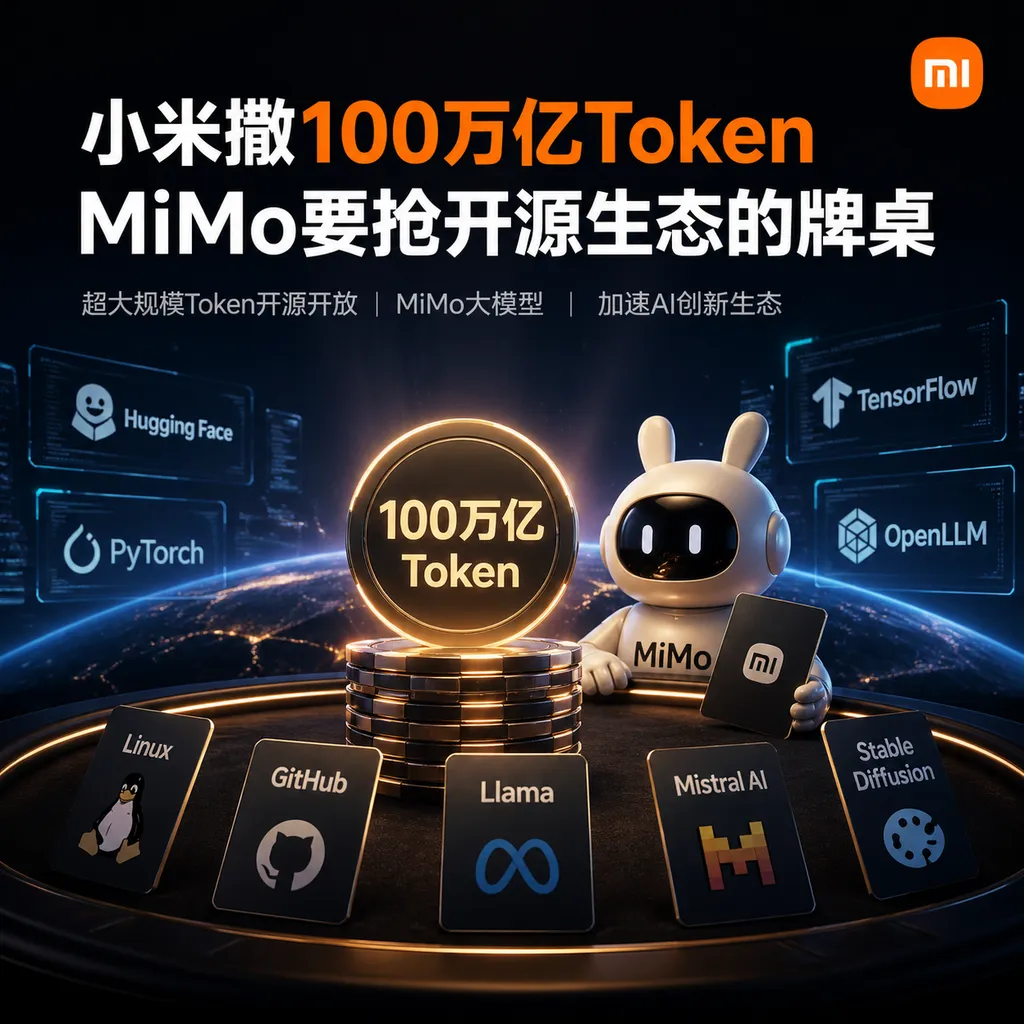
Early this morning, Xiaomi simultaneously open-sourced the MiMo-V2.5 series models and launched the Orbit Trillion-Token Creator Incentive Program, distributing 100T Tokens free of charge to developers worldwide within 30 days. Under the MIT license, all model weights are fully open, aiming to enter the AI developer market through a “model + ecosystem” combined approach.
Midnight Big Move: Open Source + 100 Trillion Tokens Together
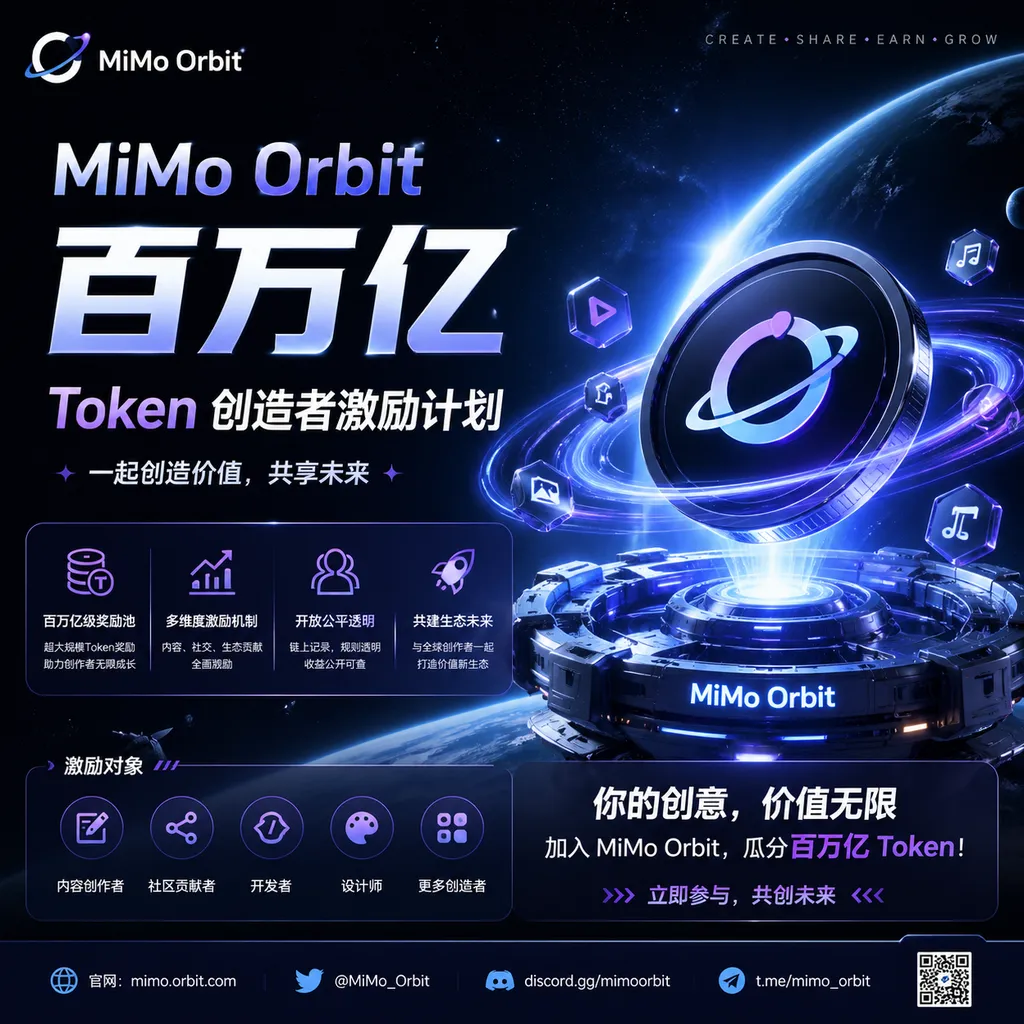
Early this morning (April 28), Xiaomi’s technical team did two things in one go: officially open-sourced the MiMo-V2.5 series models and launched a “MiMo Orbit” 100-trillion-token creator incentive program.
Simply put — you get all the model weights, and they’re giving you tokens for free. 30 days, 100 trillion tokens, available while supplies last.
The signal is clear: Xiaomi doesn’t just want to make a strong open-source model—it wants to build a developer ecosystem around MiMo. And the most direct way to attract people is to “throw tokens.”
MiMo-V2.5: Two Models, 1 Million Context Window
Let’s look at the models themselves. The MiMo-V2.5 series opened for public testing on April 23, and it’s now officially open source. The series includes two models:
- MiMo-V2.5-Pro: Targeted for complex task scenarios, deeply optimized for Agent and Coding applications. Ranked first among open-source models globally on the GDPVal-AA and ClawEval leaderboards.
- MiMo-V2.5: A fully native multimodal model supporting text, image, video, and audio understanding, also equipped with Agent capabilities.
Both models support a 1-million-token context window—a top-tier specification among open-source models. For reference, mainstream open-source models typically have context windows between 128K and 320K; reaching a million tokens is rare.
Xiaomi’s tech team made a noteworthy comment in the announcement: “The true value of a model lies not in its ranking, but in whether it effectively helps developers solve real problems.” It sounds like standard PR talk, but given MiMo-V2.5’s performance on ClawEval, they’ve earned the confidence—MiMo-V2.5 ranks at the forefront for both task completion rate and token efficiency.
In other words, it’s not just about “being able to do it,” but “doing it with fewer tokens.” For developers, token efficiency directly impacts costs—that’s more practical than benchmark scores.
MIT License, Fully Open, No Tricks
How do you measure sincerity in open-sourcing? Look at the license.
The MiMo-V2.5 series uses the MIT License—one of the most permissive open-source licenses. It means:
- Free for commercial use, no extra authorization
- Allows retraining and fine-tuning
- Base model weights are fully released
In contrast, many Chinese “open-source” models either restrict commercial use, only release the Chat version without base weights, or use custom licenses full of caveats. MiMo’s approach is straightforward: with the MIT License, it’s truly “use however you want.”
For teams building vertical fine-tunes based on open-source models, this is great news. Access to base weights means deeper customization is possible—not just LoRA tuning on top of a Chat model.
Breaking Down the Orbit Plan: Two-Pronged Approach
The MiMo Orbit program is divided into two parts, each targeting different developer groups:
1. 100 Trillion Token Creator Incentive Plan
For all AI builders. Core details:
- Time window: April 28, 2026, 00:00 – May 28, 2026, 00:00 (Beijing time)
- Total: 100 trillion (100T) tokens
- Format: Application-based; distributed upon approval
- Top tier: Max level, includes 1.6 billion credits, officially valued at RMB 659
- Claim site: 100t.xiaomimimo.com
What’s 100 trillion tokens? Roughly speaking, using current API pricing (GPT-4o as reference, about $2.5 per 1M input tokens), 100T tokens would be worth hundreds of millions of dollars. Of course, Xiaomi’s own pricing differs, but the number itself makes for a powerful marketing signal.
Based on community feedback, some developers have already received their Token Plan. On Linux.do, users say credits have arrived and are testing whether “a month’s quota can feed 2 horses and 1 shrimp”—community slang for running multiple Agent apps simultaneously. Others are sharing application tips—showing the program has just started and processes are still being figured out.
2. Agent Ecosystem Co-Building Plan
This targets Agent framework teams. Xiaomi offers free MiMo token support, allowing framework users to access MiMo models for free.
It’s a smart move. Instead of pushing the model directly, Xiaomi integrates MiMo as a selectable default in existing Agent frameworks. Users gradually get used to it, and the ecosystem grows naturally.
It’s similar to cloud vendors providing free credits to open-source projects—get people using it first, then handle the rest later.
Hardware Ecosystem: Day-0 Adaptation Is Not Just Talk
The worst thing that can happen with open-source models? You release them, and they don’t run.
Xiaomi put serious effort into hardware adaptation. MiMo-V2.5-Pro was compatible with multiple chip vendors on the very first day of open-source release:
- T-Head Zhenwu 810E: Fully adapted using T-Head’s in-house AI software stack
- AWS Trainium2: Adapted via Neuron SDK + vLLM inference framework, achieving “open source = global availability”
- AMD: Day-0 adaptation through the open-source ROCm software stack
At the same time, major inference frameworks SGLang and vLLM have also completed Day-0 integration.
What does that mean? If you have an AMD GPU, an AWS Trainium instance, or a T-Head chip, you can run the model right away—no waiting for community ports, no debugging on your own.
Such “Day-0 adaptation” is rare for domestic open-source models. Typically, community support for non-NVIDIA hardware takes days or weeks after release. Xiaomi’s pre-launch collaborations with chip vendors show a deeper understanding of open-source ecosystems—it’s not just about “dropping weights online.”
Industry View: What’s Xiaomi’s Game?
By 2026, the open-source model race is extremely crowded—Qwen, DeepSeek, Llama, Mistral, GLM… everyone’s in. Xiaomi, a “non-typical” player in this space—its main business being smartphones and IoT—so why invest so heavily now?
A few observations:
-
Xiaomi has scenarios. Phones, cars, smart homes, wearables—its hardware ecosystem is among the most comprehensive in China. A capable in-house model could become the “brain” connecting all devices. It’s not about competing with OpenAI’s AGI, but making Xiaomi’s ecosystem smarter.
-
Open source accelerates validation. Instead of testing internally, Xiaomi lets global developers test it for them. 100 trillion free tokens are essentially money spent to buy user feedback.
-
Agent applications are hot. MiMo-V2.5-Pro is deeply optimized for Agent and coding, and the Orbit plan includes an Agent co-building section—Xiaomi clearly believes Agents are the key path to model adoption. The judgment aligns with the 2026 industry trend: shifting from “chatbots” to “task-performing Agents.”
-
1 million context window is essential for Agents. Agents handle massive context—codebases, documents, chat history, tool logs—short-context models can’t handle that complexity. MiMo’s targeted investment here makes sense.
Comparing MiMo with Competitors
Frankly, MiMo might not yet be the absolute best general model among open-source options. Qwen and DeepSeek still lead in ecosystem maturity and iteration pace. But MiMo has distinct strengths:
- Native multimodal support (text + image + video + audio), not post-stitched
- 1-million-token context window, top-tier among open-source models
- Deep optimization for Agent and coding tasks, not just general-purpose
- MIT license + full base weights = maximum commercial friendliness
- Backed by Xiaomi’s hardware ecosystem for deployment
Weaknesses are clear too: the community ecosystem is still nascent, developer tooling immature, and few tutorials or shared experiences yet (some Linux.do users even joke, “Where are the newbie guides?”).
In essence, the 100-trillion-token incentive plan is Xiaomi’s way of buying time with money—rapidly bootstrapping a community.
For Developers: Is It Worth a Try?
If you’re working on Agent-related projects, MiMo-V2.5-Pro deserves close evaluation. A 1M context window + Agent optimization + free tokens is an appealing combo.
If you’re developing multimodal applications, MiMo-V2.5’s native multimodal ability is also compelling—no need to piece together multiple models for different inputs.
If you just want a general open-source model for daily dev, Qwen and DeepSeek still offer more mature ecosystems, more documentation, and more community support. MiMo is in an “early-adopter” phase—meaning lots of free benefits, but fewer people to help if you hit issues.
Application site: 100t.xiaomimimo.com
The campaign runs until May 28. Apply early—100T sounds like a lot, but not when global developers are all claiming it.
A Larger Trend
Viewed in context, Xiaomi’s move is another sign of Chinese open-source model makers shifting focus to ecosystem competition.
For two years, the battle was about model capability—who scored higher, had more parameters, or supported multimodality first. Now those gaps are narrowing, and attention is turning to ecosystems: who has more developers, better toolchains, and richer deployment scenarios.
100 trillion tokens for free, fully open MIT license, Day-0 hardware compatibility, Agent framework co-building—these all share the same logic: lower the barrier for developers and get more people using the model.
The model itself is infrastructure; the ecosystem is the moat. Xiaomi clearly understands this. Whether MiMo can actually build a thriving developer community—and whether users stay after the 100T tokens run out—remains to be seen after May 28.
Sources:
- ITHome: Xiaomi MiMo-V2.5 Series Open-Sourced & Orbit 100T Token Plan Launch — Detailed coverage of Xiaomi’s MiMo-V2.5 open source and Orbit plan
- Linux.do: Xiaomi MiMo Orbit 100 Trillion Token Creator Incentive Program — Community post sharing activity info and claim links
- Linux.do: “The MiMo token plan has arrived” — Developer feedback after receiving the Token Plan
- Linux.do: “No MiMo application experience posts yet?” — Community discussion on the application process


