
NVIDIA’s all-around edge performer: Nemotron 3 Nano Omni is here
NVIDIA releases Nemotron 3 Nano Omni, a long-context multimodal model designed for edge deployment. It natively supports document, audio, and video understanding, is specifically designed for agent scenarios, and is open source for commercial use.
NVIDIA has released another key member of the Nemotron 3 family over the past two days — Nano Omni. This isn't a simple version update, but rather an integration of document understanding, audio processing, and video analysis into a model that can run on edge devices. For developers building multimodal agents, this might be one of the most noteworthy open‑source options currently available.
Clarifying the relationship within the Nemotron 3 family
In December last year, NVIDIA officially introduced the Nemotron 3 series in three configurations:
- Nano: a hybrid‑inference model with roughly 30B parameters; optimized for high throughput and long context, aimed at on‑device and edge deployment
- Super: about 100B parameters, with up to 10B active parameters per token; designed for multi‑agent collaboration
- Ultra: a larger configuration for the most complex reasoning tasks
Nano was released first, with Super and Ultra scheduled for release in the first half of 2026. The newly announced Nano Omni builds on Nano by extending full multimodal capabilities — not just image analysis, but video, audio, and document comprehension as well. And these capabilities are natively integrated, not stitched together through external pipelines.
That distinction is crucial. Pipeline‑based multimodal systems (e.g., transcribing speech with Whisper before feeding text into an LLM) lose substantial contextual information and suffer from latency. Nano Omni, in contrast, fuses the vision encoder, audio encoder, and language model at the architectural level for end‑to‑end processing.
Architecture: Mamba‑2 + MoE + limited self‑attention
The Nemotron 3 architecture design is one of this release’s most interesting technical points. Instead of using a pure Transformer, it adopts a hybrid structure:
- Mamba‑2 layers handle long sequences efficiently with linear complexity and high throughput
- MoE (Mixture of Experts) layers control per‑token computation cost so that large parameter counts don’t imply excessive compute requirements
- A few self‑attention layers are interleaved to ensure global information exchange at critical positions
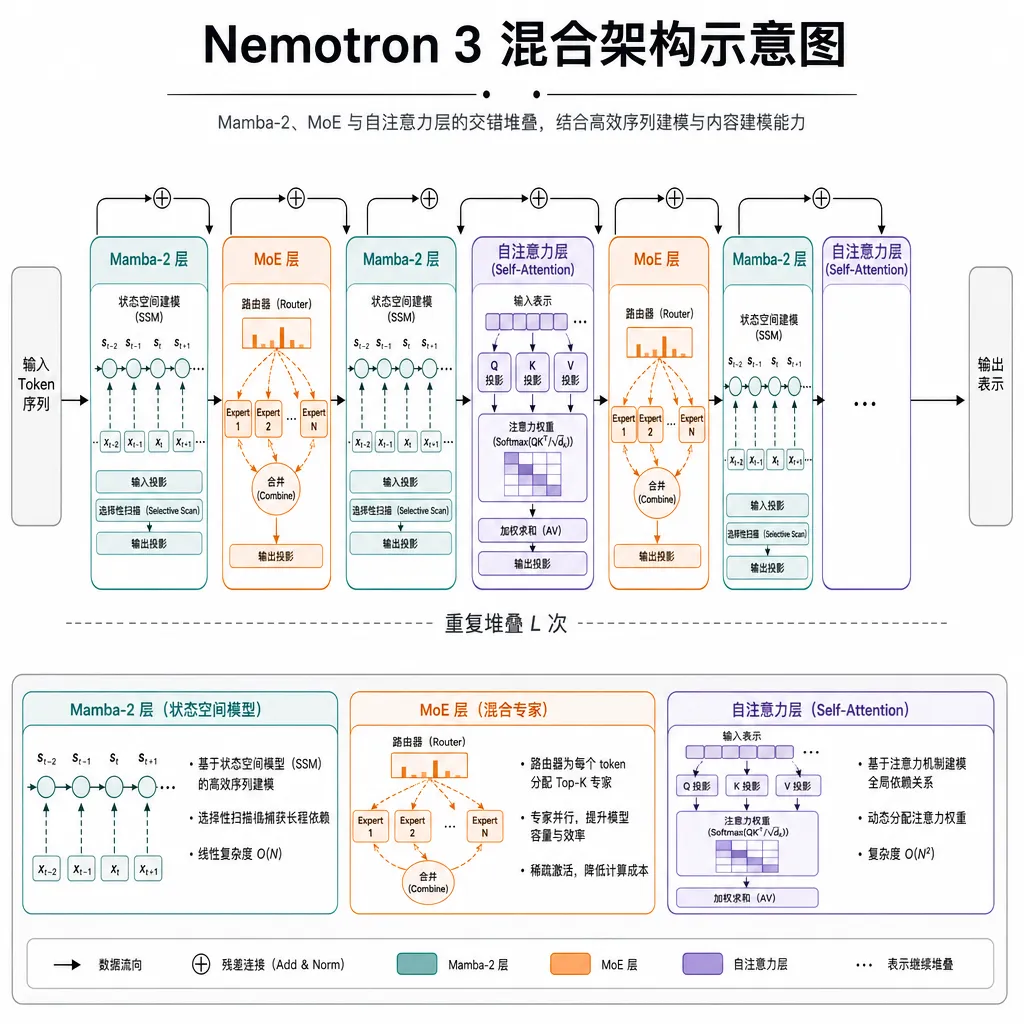
This design enables the model to handle up to 1 million tokens of context while maintaining reasonable inference speed. For agent scenarios, that means you can feed in entire 500‑page PDFs, 30‑minute meeting recordings, or surveillance video clips directly — without manual chunking or summarization.
Traditional long‑context approaches typically rely on “fragmented chunk‑heuristics”: cutting a long document into smaller pieces and processing them separately before patching results together. This method is barely adequate in RAG scenarios but breaks down for cross‑paragraph reasoning and temporal understanding (such as causal relationships in videos). Nano Omni’s 1M‑token window, combined with the efficiency of Mamba‑2, can theoretically perform these tasks within a single context window.
Of course, theory and reality differ. The effective utilization rate of a 1M‑token window and the actual quality of long‑range recall still need further community validation. But at least architecturally, this is the right direction.
Breakdown of multimodal capabilities
The “Omni” in Nano Omni isn’t just a marketing tag — it truly covers the perceptual dimensions agents need most.
Document understanding
This refers to more than OCR plus text comprehension. Nano Omni can directly process document page images, interpreting tables, charts, and flow diagrams — structured and semi‑structured elements alike. Combined with Llama Nemotron Embed VL (a 1.7B‑parameter multimodal embedding model) and Llama Nemotron Rerank VL, it enables a complete visual document retrieval pipeline.
Embed VL takes a clever approach: based on the Eagle visual–language model (Llama 3.2 1B backbone + SigLip2 400M vision encoder), it uses contrastive learning to map page images and text into a shared vector space. It supports Matryoshka embeddings (truncating vector dimensions for speed trade‑offs). On the ViDoRe V3 benchmark, it sits at the Pareto frontier — meaning no open model currently offers better trade‑offs between accuracy and throughput.
That’s good news for enterprise document‑intelligence teams. Complex documents mixing text, tables, and graphics used to require heavy multi‑stage pipelines: OCR → layout analysis → table recognition → text extraction → LLM ingestion. This process can now be greatly simplified.
Audio understanding
Nano Omni natively supports audio input, requiring no external ASR module. This allows it to directly extract semantic information from raw waveforms — including cues like tone, pause, and emphasis that traditional text transcripts lose.
Within the Nemotron 3 family there’s also a VoiceChat model, which ranks in the “upper‑right quadrant” of Artificial Analysis’s voice‑to‑voice leaderboard — excelling at conversational dynamics and acoustic reasoning. While Nano Omni serves a different role (general multimodal rather than specialized voice dialogue), its audio comprehension complements VoiceChat: Omni “understands,” VoiceChat “speaks.”
Video understanding
Video has the most demanding contextual requirements. A 1080p 30fps video yields 30 frames per second; even after key‑frame extraction, a 10‑minute clip easily results in hundreds of thousands of tokens — an ideal case for Nano Omni’s 1M‑token window.
Potential use cases include content moderation, surveillance analysis, meeting‑record summarization, and instructional video comprehension. Historically, such tasks either depended on specialized video models (often weak at language reasoning) or frame‑by‑frame analysis (which loses temporal flow). Nano Omni offers an end‑to‑end solution.
GUI understanding
This is often overlooked but could prove most practical for agents. Nano Omni can interpret screenshots and app interfaces, recognizing buttons, menus, and input fields. That’s a foundational capability for “computer‑operation” agents — enabling AI to use software interfaces like a human.
Training method: NeMo Gym + reinforcement learning
Nemotron 3’s post‑training isn’t simple SFT (supervised fine‑tuning) but is done through multi‑environment reinforcement learning in NeMo Gym — NVIDIA’s open‑source RL environment library for simulating agent tasks.
The key difference is that SFT trains a model to produce the best single‑step answer, whereas RL teaches it to execute continuous action sequences, such as:
- Generating correct tool‑call chains
- Writing executable code
- Creating and executing multi‑step plans
This makes Nano Omni inherently suited for agent tasks, not just Q&A.
Also noteworthy are precision innovations. The Super and Ultra models use NVFP4 (NVIDIA’s proprietary 4‑bit floating‑point format) during pre‑training, not just post‑training quantization. Across 250T tokens of pre‑training data, NVFP4 achieved stable training while slashing cost. Although Nano itself wasn’t pre‑trained in NVFP4, the technology opens possibilities for later compression and edge deployment.
Performance
On the Artificial Analysis Intelligence Index v3.0, Nemotron 3 Nano scored 52, leading among open models of similar (≈30B) scale. For context, this performance tier matches some 70B‑parameter models (e.g., Qwen2.5, Llama‑3.1‑70B).
In short, half the parameters, comparable intelligence — a clear efficiency gain from the hybrid architecture plus MoE layers.
In terms of openness, Nemotron 3 Nano maintains the same score on the Artificial Analysis Openness Index as its predecessor Nano V2. Model weights, training methods, and datasets are all open, released under the NVIDIA Open Model License.
Do note, however, that Nano Omni — being Nano’s multimodal extension — currently relies on evaluation data for the Nano base. More multimodal benchmark results await third‑party testing.
Ecosystem and tooling
NVIDIA isn’t just releasing a model — it’s providing a full tooling suite:
- NeMo Gym: open‑source RL environment library for agent behavior training
- NeMo Data Designer: data generation and augmentation tool
- NeMo Evaluator: model evaluation framework
- Nemotron 3 Content Safety: content‑safety model auditing multimodal inputs, retrieved data, and outputs
This toolchain completeness is rare in open‑source. Most model releases offer only weights and a README, while NVIDIA covers training, data, evaluation, and content safety. For production users, these tools may be as valuable as the model itself.
Content Safety, in particular, can audit every step of an agent workflow — input checks, retrieval checks, output moderation — a compliance requirement for enterprises that often consumes more effort than model tuning.
Comparison with competitors
In the on‑device multimodal space, key players include:
- Qwen2.5‑VL (Alibaba): strong vision–language capability, lacks native audio support
- Phi‑4‑multimodal (Microsoft): supports vision and audio but limited context
- InternVL 3 (Shanghai AI Lab): exceptional vision understanding, active community
- Gemma 3 (Google): lightweight but with basic multimodal abilities
Nano Omni’s distinctive advantages:
- True full‑modality: vision + audio + documents + GUI — all covered in one model
- 1M‑token context: virtually unmatched among models of its scale
- Agent‑native design: from training methodology to tooling built around agent tasks
Its downsides are equally clear: NVIDIA’s modeling ecosystem is still young, with less community maturity and fine‑tuning experience than established players like Qwen or Llama. Also, Nano Omni is still marked “coming soon” — weights have not yet been released, so real deployment experience remains unknown.
What this means for developers
If you’re working on any of the following, Nano Omni merits your attention:
- Enterprise document intelligence: contract review, financial‑report analysis, technical document Q&A — especially with heavy tabular or graphical content
- Audio/video content understanding: automatic minutes generation, content moderation, podcast/stream analytics
- Multimodal RAG: retrieval systems that must handle text, image, and audio simultaneously
- Desktop/mobile agents: automation requiring GUI comprehension and interaction
- Edge deployment: local or edge‑device multimodal inference
A 30B‑parameter scale means it can run on a single consumer GPU (e.g., RTX 4090), possibly smaller devices after quantization. For enterprises with privacy requirements prohibiting cloud data transmission, that’s a key advantage.
Some sober reflections
Having said all this, a reality check is in order:
- Weights not yet released. NVIDIA’s blog lists Nano Omni as “coming soon.” Until it actually runs, performance promises remain just promises.
- Effective context use. 1M tokens sounds great, but real usable length is another matter. Many “long‑context” models underperform at mid‑sequence recall in needle‑in‑a‑haystack tests. Nano Omni’s design should help, but results must confirm it.
- A young ecosystem. Compared to Meta (Llama) or Alibaba (Qwen), NVIDIA’s community is newer. Fine‑tuning guides, deployment recipes, and troubleshooting records are still limited. Teams lacking strong engineering capacity may face higher onboarding costs.
- Immature evaluation systems. Multimodal benchmarks often conflict. A model may top benchmark A but lag behind in benchmark B. Don’t rely solely on official numbers — wait for independent evaluations and community feedback.
Summary
Nemotron 3 Nano Omni signals NVIDIA’s clear direction in the open‑model domain: not merely base models, but comprehensive agent‑oriented solutions. From architecture (hybrid Mamba‑Transformer), to training method (RL‑driven behavioral learning), to tools (the full NeMo suite), to safety review (Content Safety) — it’s a systemic deployment strategy.
For developers, the next step is to monitor Nano Omni’s release date, experiment with the existing Nano base model to learn the Nemotron 3 architecture and toolchain, and be ready to test Omni once weights drop. NVIDIA’s GitHub and Hugging Face pages remain the best sources for updates.
The on‑device multimodal agent race in 2026 is poised to be intense. Whether Nano Omni can hold its ground will ultimately depend on how the community votes with its feet.
References
- Introducing NVIDIA Nemotron 3 Nano Omni - Hugging Face Blog — NVIDIA’s official Nano Omni technical blog detailing architecture and capabilities
- NVIDIA releases Nemotron 3 Nano - Reddit r/LocalLLaMA — community discussion on Nemotron 3 Nano performance and deployment
- Nvidia just dropped Nemotron 3 - Reddit r/AgentsOfAI — agent‑developer community commentary and evaluation of the Nemotron 3 series


