
OpenAI models land on AWS — the multi-cloud era has arrived

Just one day after Microsoft gave up its exclusivity rights, AWS announced the launch of OpenAI models and a joint Agent service. OpenAI officially became a multi-cloud provider, marking a pivotal turning point in the AI industry landscape.
OpenAI no longer belongs exclusively to Microsoft.
On April 27, Microsoft and OpenAI announced a rewritten partnership agreement, with Microsoft relinquishing exclusive sales rights to OpenAI’s models. Just one day later, AWS hurriedly unveiled a complete plan to list OpenAI models on its services, along with a jointly developed Agent offering. The speed of this move suggests the deal had been in discussion for a long time—Microsoft’s signature was simply the final approval.
The significance of this goes beyond “another cloud provider can now run OpenAI models.” It marks the AI industry’s shift from the “exclusive era” to the “multi-cloud era,” a change that will profoundly affect how developers choose their infrastructure.
What Happened
AWS CEO Matt Garman and OpenAI CEO Sam Altman jointly announced several items:
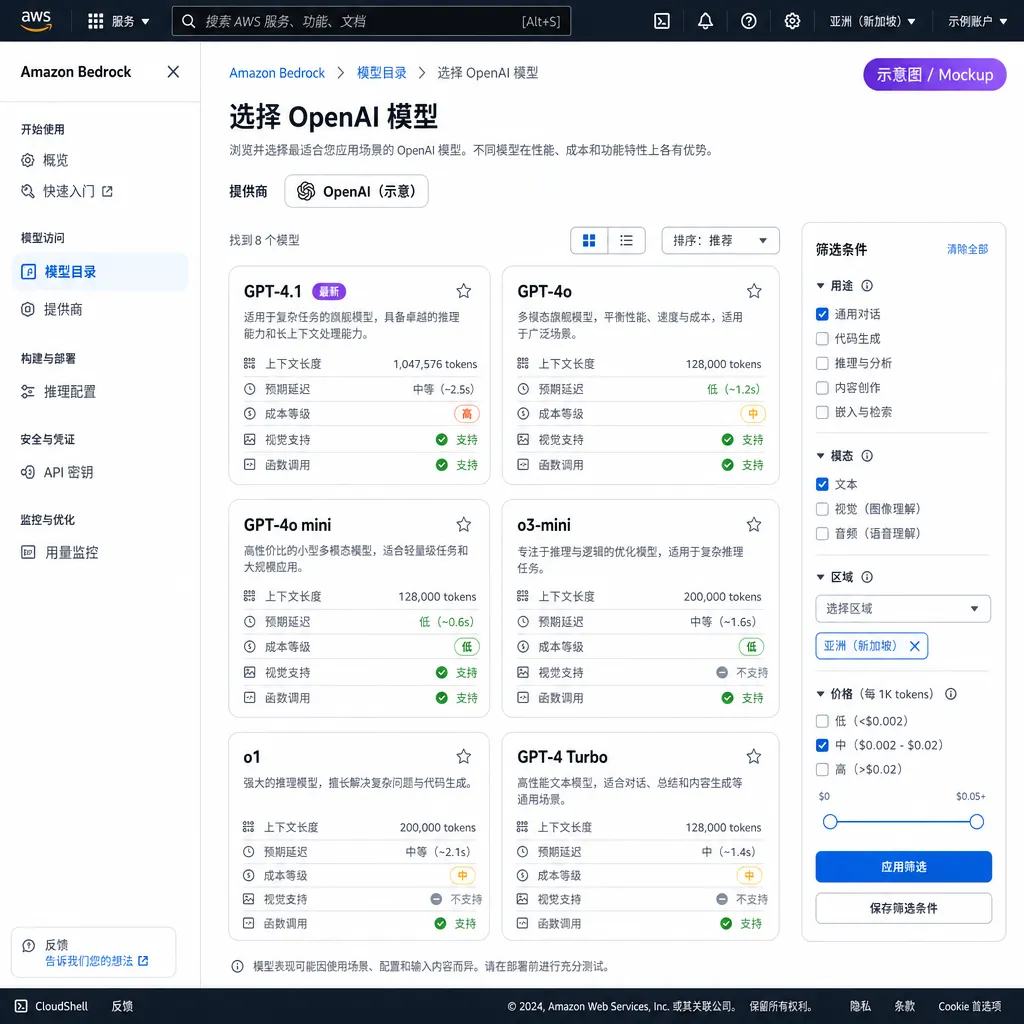
- OpenAI’s open-weight models gpt-oss-120b and gpt-oss-20b are available starting today on Amazon Bedrock and Amazon SageMaker AI
- The two companies will jointly build a “Stateful Runtime Environment” driven by OpenAI models, delivered via Bedrock
- AWS becomes the exclusive third-party cloud distribution channel for OpenAI Frontier (the enterprise AI platform)
- OpenAI will consume about 2GW of Trainium computing power through AWS infrastructure
- Their previous $38 billion collaboration expands to $100 billion, lasting eight years
Meanwhile, Amazon is investing $50 billion in OpenAI—$15 billion has already been injected, with the remaining $35 billion to come over the next few months.
This isn’t a trial run—it’s a full-scale marriage.
How Microsoft’s “Exclusivity” Ended
To understand the weight of today’s event, let’s revisit the intricate relationship between OpenAI and Microsoft.
Five years ago, Satya Nadella secured exclusive distribution rights to OpenAI’s models for $13 billion. Azure was the only cloud where commercial OpenAI models could run, giving Microsoft a unique advantage in enterprise AI. For a long while, if an enterprise wanted to use GPT models, it had just one option—the Azure OpenAI Service.
That exclusivity officially ended on April 27, 2026. The key changes in the new agreement:
- Microsoft’s license changed from exclusive to non-exclusive, valid until 2032
- Revenue flow direction flipped: Microsoft used to pay OpenAI for reselling its products; now OpenAI pays Microsoft 20%, capped by a maximum amount, until 2030
- The previous “AGI clause”—which revoked Microsoft’s rights once OpenAI achieved artificial general intelligence—has been deleted
In short, Microsoft goes from being “the sole channel” to “one of OpenAI’s biggest customers.” Azure remains the preferred cloud for OpenAI products, but the monopoly window has closed.
This change also removes a crucial legal obstacle: if the exclusivity had remained, Microsoft could have sued over Amazon’s $50 billion investment in OpenAI. Now, that path is open.
What AWS Got
From AWS’s perspective, the deal is rich in value.
First, the models. gpt-oss-120b and gpt-oss-20b are OpenAI’s newest open-weight models, placing among the top in inference capability. AWS claims that gpt-oss-120b on Bedrock delivers three times the cost efficiency of Gemini, five times that of DeepSeek-R1, and double that of OpenAI’s own o4 model. The numbers surely benefit from AWS’s internal benchmarks—but even discounted, they show Trainium’s cost advantage for these workloads.
Next, the Agent service—the most noteworthy part of the partnership. Traditional API calls are stateless: you send a request, get a response, and the model forgets who you are. A stateful runtime allows a model to maintain context, manage sessions, and stay consistent across turns of interaction—essential for production-grade AI Agents.
This environment will deeply integrate with Amazon Bedrock’s AgentCore—AWS’s framework for Agent orchestration, tool calling, and memory management. Combining it with OpenAI’s models gives enterprises a complete Agent tech stack from model to runtime to orchestration.
Then, the distribution channel: AWS becomes the exclusive third-party cloud distributor for OpenAI Frontier. That means if enterprises want OpenAI’s enterprise platform outside Azure, AWS is their only option. Google Cloud is temporarily out of the picture.
Finally, compute commitment: OpenAI pledges 2GW of Trainium consumption—a huge endorsement of AWS’s custom chip business. Trainium has long sought to prove competitive against NVIDIA GPUs; landing a customer like OpenAI changes everything.
What It Means for Developers
Now, what does this mean for those who write code?
First, more choices. Previously, using OpenAI models for enterprise apps meant being locked into Azure. Now, you can use them on AWS while keeping your familiar stack—S3, Lambda, DynamoDB, VPC—without moving house for one model.
Second, lower barriers for Agent development. Stateful runtime + AgentCore + OpenAI models make building production Agents far easier. You no longer need to manage session state, implement tool calls, or handle memory persistence yourself—the platform takes care of it.
Third, the cost structure may change. Multi-cloud competition means Azure and AWS will pressure each other on pricing. That’s good news for enterprises running large-scale workloads.
Fourth, greater flexibility in model selection. Bedrock already hosts over 100 models; adding OpenAI expands the lineup so you can compare Claude, GPT, Llama, Mistral, DeepSeek—all in one place—to find the best fit.
Still, some limitations apply. Currently, AWS offers OpenAI’s open-weight models, not closed-source flagships like GPT-4o or o4. There’s no timeline yet for those. The Stateful Runtime Environment is also under development, expected to launch in the coming months.
How the Industry Landscape Changes
Zooming out, this event marks a major turning point in the AI industry’s structure.
Over the past two years, model companies and cloud providers operated in a “binding” model: OpenAI with Azure, Anthropic with AWS (and Google Cloud), Google with Gemini. That exclusivity gave clouds differentiation—but limited model distribution.
Now things are loosening up. OpenAI unbinds from Microsoft and goes multi-cloud. Anthropic, despite its AWS ties, also runs Claude on Google Cloud. Model companies increasingly resemble traditional ISVs (Independent Software Vendors) distributing products across multiple clouds.
Impact on the big three clouds:
- AWS is the biggest winner—it gets OpenAI’s models, Agent service, and exclusive third-party distribution rights, plus continues developing its Nova model line. Bedrock now has the richest model diversity among all clouds.
- Microsoft faces short-term pain—Azure OpenAI Service loses its monopoly—but remains OpenAI’s largest investor and preferred provider. And since OpenAI now pays Microsoft 20% of revenue, Microsoft still profits even when clients use OpenAI models on AWS.
- Google Cloud is excluded from OpenAI Frontier for now, but it has Gemini and also Anthropic’s Claude. The three-way race remains intact, just with slight rearrangement.
Fundamentally, models are becoming part of the infrastructure, not the differentiator. Once every major cloud can run every major model, competition shifts to inference cost, latency, Agent orchestration, compliance, and integration depth—all beneficial for developers who no longer have to pick clouds based solely on model access.
A $100 Billion Bet
Finally, the money.
The partnership expands from $38 billion to $100 billion over eight years, plus Amazon’s $50 billion investment—the largest single collaboration in AI history.
The spending focus? Compute. OpenAI’s 2GW Trainium commitment equals roughly two major datacenter campuses. AWS must build massive infrastructure, while OpenAI secures a second large-scale compute source beyond Microsoft.
For OpenAI, this mitigates dependency risk. Previously all compute came from Azure; any strain in that relationship would hit operations directly. With AWS, OpenAI gains a second leg to stand on.
For AWS, this is Trainium’s biggest customer deal yet. Whether its in-house chips can compete in AI training and inference hinges on landing marquee clients—and OpenAI’s endorsement beats any benchmark.
Final Thoughts
The “exclusive era” of AI models is ending. OpenAI’s arrival on AWS isn’t the destination—it’s the beginning. We can expect OpenAI models on Google Cloud soon and more model firms embracing multi-cloud distribution.
For developers, that’s good news: more choices, less lock-in, and continued price declines as competition intensifies. Of course, managing models, APIs, and costs across clouds will grow more complex—hence the rising value of aggregation services like OpenAI Hub, which let you call every model with one key.
As for Microsoft, losing exclusivity may look like a concession, but it yields a clearer commercial relationship and sustained revenue sharing. Nadella’s $13 billion bet from five years ago has already paid off handsomely. It’s just that, starting today, there are more players at the table.
All information referenced here comes from official company announcements and public reports. Some external links may be inaccessible domestically; readers can search relevant keywords for original sources.


