
OpenAI Lands on AWS: The First Shot Marking the End of the Exclusive Era

Only one day after ending its exclusive partnership with Microsoft, OpenAI has brought its latest models, Codex programming agents, and the new Bedrock Managed Agents service to AWS, pledging to invest over $100 billion in AWS over the next eight years.
OpenAI Lands on AWS: The First Shot After the End of an Exclusive Era
The speed was almost suspiciously fast—as if it had been negotiated long ago. Just one day after revising its exclusive cloud partnership with Microsoft, OpenAI launched an entire suite of products on Amazon Bedrock. Not just a symbolic model listing, but three services simultaneously entering limited preview: cutting-edge reasoning models, Codex programming agents, and a brand-new managed Agent service.
This isn’t a routine model deployment. It marks the formal start of OpenAI’s multi-cloud strategy and sends a clear signal that the AI cloud landscape is being reshuffled.
What Happened
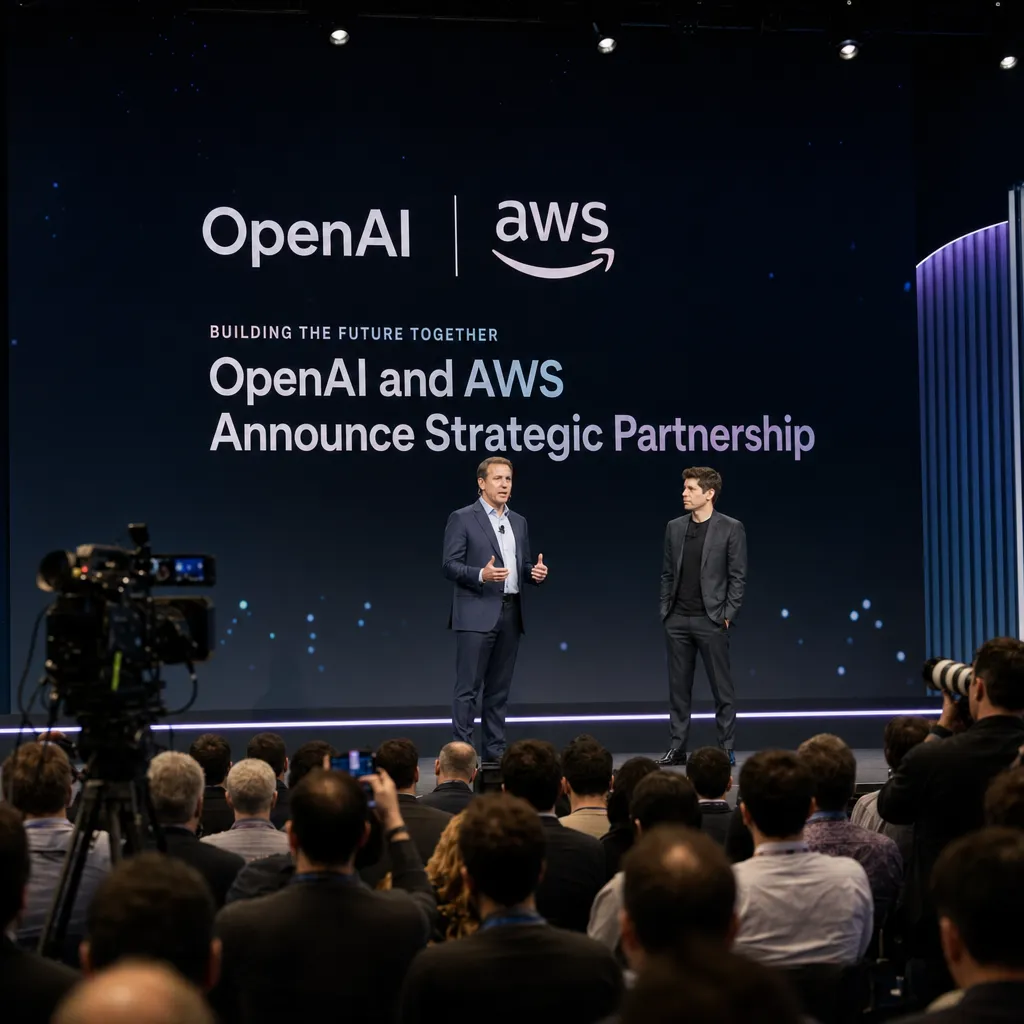
On April 27, OpenAI and Microsoft revised their partnership, ending Microsoft’s exclusive rights to distribute OpenAI models in the cloud. On April 28, AWS held an event in San Francisco, announcing that three OpenAI-related services were entering limited preview on the Amazon Bedrock platform:
- OpenAI Frontier Model Access: Latest reasoning models accessible directly via the Bedrock API
- Codex Programming Agent: OpenAI’s AI programming agent, integrable with Codex CLI, desktop applications, and VS Code extensions
- Bedrock Managed Agents: A new managed agent service tailored for OpenAI reasoning models, with intelligent scheduling, security protection, and independent audit logs
All three services are currently in limited preview mode, not yet publicly available. But the message is already clear enough.
Just One Day
This timeline is fascinating.
Microsoft’s ink was barely dry before AWS unveiled a complete product lineup. What does this imply? It means the negotiation process was far longer than the public timeline suggests. OpenAI and AWS probably finalized technical integration, business terms, and product design well ahead of the Microsoft agreement revision—just waiting for the starting gun.
AWS CEO Matt Garman was direct at the event: “Our customers run their applications on AWS and store data on AWS. In recent years, to use OpenAI’s excellent models, they had to go elsewhere. Now, they can do it all within the AWS ecosystem.”
Translation: We’ve been waiting for this day for a long time.
OpenAI’s Chief Revenue Officer Dennis Dresser made an equally telling comment: “While the Microsoft partnership has been crucial, it limited our ability to engage customers where they are—and that need is enormous.”
In other words, the exclusive deal kept OpenAI from reaching many enterprise clients running on AWS, or forced them into multi-cloud setups. For a business aiming to maximize revenue, that meant significant losses.
The $100-Billion Bet
This partnership goes far beyond “listing a few models.”
OpenAI has pledged to spend more than $100 billion on AWS over the next eight years, using AWS’s in-house Trainium AI chips to power its workloads. In return, Amazon is investing $50 billion into OpenAI.
These numbers need context. OpenAI’s current inference infrastructure runs primarily on Microsoft Azure with NVIDIA GPUs. Shifting part of that to AWS’s Trainium chips shows a deliberate diversification in its compute supply chain—no more putting all eggs in one basket, whether cloud or chip.
For AWS, the strategic value is equally immense. The Trainium chip has long lacked a high-profile customer to prove its worth. Landing OpenAI as a flagship user gives Trainium a huge credibility boost.
$100 billion for $50 billion—both sides get what they need. But who needs whom more might take years to see clearly.
Bedrock Managed Agents: The Real Breakthrough
Among the three services, model access and Codex integration were expected if you’re going multi-cloud. The truly interesting one is Bedrock Managed Agents.
It’s a dedicated managed service designed for OpenAI reasoning models, providing:
- Intelligent Scheduling: Automatically selects appropriate models and compute resources based on task complexity
- Security Safeguards: Each agent has independent identity and full operation tracking
- Audit Logs: Meets enterprise compliance needs—essential for finance, healthcare, and government clients
- Production Readiness: Not an experimental playground, but a deployment-ready managed solution
Why is this worth attention? Because it represents the next phase in AI infrastructure competition.
For the past two years, cloud AI rivalry has focused on “who has better models.” But models themselves are quickly becoming commodities—GPT, Claude, Gemini, DeepSeek, all have strong contenders. The next battleground is: who can provide better Agent infrastructure.
Agents aren’t just API calls. A production-grade agent must handle state management, error recovery, access control, cost optimization, multi-step reasoning orchestration… those engineering challenges are tougher and less standardized than modeling itself. AWS launching an exclusive agent service alongside OpenAI integration suggests it knows exactly where the next frontier lies.
Codex on Bedrock: What It Means for Developers
Codex programming agents landing on Bedrock—what does that mean for developers?
Most directly: if your team already builds in the AWS ecosystem—CI/CD pipelines, code repos, deployment environments—you can now use Codex natively, without separate API integration or routing through Azure.
Codex currently supports three access modes:
- Codex CLI: Command-line tool for scripting and automation
- Desktop App: Standalone client
- VS Code Extension: Embedded in the developer’s most-used editor
All three can now operate through AWS’s Bedrock API. For enterprises with strict data compliance policies that forbid code data leaving AWS, this addresses a real pain point.
However, keep in mind these are still in limited preview. Pricing, SLAs, and regional availability aren’t finalized. Wait for GA before migrating production workflows.
The Cloud AI Triopoly Takes Shape
Zooming out, this partnership makes the AI cloud landscape far clearer.
AWS: Already hosts Anthropic’s Claude (via a $4B investment), now adds full OpenAI product support, plus open-source models like Meta Llama, Mistral, and DeepSeek. Bedrock’s model lineup now exceeds 100 options—the richest of any cloud platform.
Azure: Still OpenAI’s deepest partner with the most mature deployment experience—but its exclusivity is gone. Azure must find new differentiators.
Google Cloud: Has its own Gemini and actively integrates third-party models. Yet, its Agent infrastructure (Vertex AI Agent Builder) hasn’t shown clear advantages so far.
Interestingly, all three major clouds can now offer OpenAI models. This means OpenAI is no longer a decisive factor in choosing a cloud. Competition will shift to infrastructure—faster inference, stronger agent orchestration, more robust enterprise features, and more competitive pricing.
For OpenAI, this is classic platform strategy: make models ubiquitous, maximize model-layer revenue, and avoid dependence on any single provider. The risk: once your models are everywhere, your leverage with each platform weakens.
What It Means for Developers
Let’s talk practical implications.
If you’re building AI apps on AWS, the biggest win is more choice. Previously, to use OpenAI models you either called OpenAI’s API directly or went through Azure. Now, you can manage GPTs inside Bedrock, just like Claude or Llama.
For teams doing A/B testing across models, or dynamically routing workloads, Bedrock’s unified interface saves considerable time.
But don’t get carried away yet. Limited previews usually mean quotas, region restrictions, and unstable APIs. For production-grade reliability, direct OpenAI API access or multi-model hubs (like OpenAI Hub, which offers GPT, Claude, Gemini, etc. under one key) remain safer until GA.
Another thing to watch is cost. AWS previously stated that running OpenAI’s open-weight model gpt-oss-120b on Bedrock achieves three times the cost efficiency of Gemini, five times that of DeepSeek-R1, and twice that of OpenAI o4. But that’s for open-weight models—closed-source frontier models’ pricing hasn’t been revealed yet. Given AWS and OpenAI’s revenue split, Bedrock may not end up cheaper than OpenAI’s own API.
Laying the Groundwork with Open-Weight Models
Worth noting: this partnership didn’t start from scratch. Back in August 2025, AWS listed OpenAI’s open-weight models gpt-oss-120b and gpt-oss-20b. That early deal was a test run—to validate technical integration and business processes.
From open-weight to closed-source models, from model access to agent services—the trajectory is clear. AWS spent months proving it could run OpenAI models smoothly, ready to move the moment exclusivity ended.
That explains the lightning speed. The technical groundwork was done long ago; all that was missing was a signature.
How Microsoft Might Feel
This is likely Microsoft’s least favorite scenario: after pouring tens of billions into fostering its AI partner, OpenAI is now teaming with its biggest cloud rival.
But Microsoft isn’t unprepared. The revised agreement still grants Azure certain integration privileges—earlier model access, deeper product embedding, and exclusive use across Microsoft 365 and other in-house platforms.
Moreover, Microsoft’s AI strategy goes far beyond OpenAI. With its Phi-series small models, partnerships with Mistral, and support for many open models, Azure’s catalog is also expanding rapidly.
Still, OpenAI remains AI’s strongest brand. Losing exclusive rights dents Azure’s AI narrative. Expect analysts to ask about it on upcoming earnings calls.
The Bigger Picture
In perspective, OpenAI’s multi-cloud strategy marks the AI industry’s maturation.
In the early days, exclusivity made sense—OpenAI needed Microsoft’s capital and compute; Microsoft needed OpenAI’s models to catch up to AWS in cloud dominance. Mutual benefit.
But as AI models become infrastructure-level products, exclusive distribution becomes a growth bottleneck. To maximize revenue, OpenAI must reach enterprise customers on every major cloud, mirroring the path of databases and middleware before it. Oracle doesn’t sell on just one cloud, nor does Snowflake.
AI models are turning into the next generation of enterprise infrastructure software. And the distribution logic of infrastructure software is always multi-platform, multi-channel, everywhere.
What to Watch Next
Key things to follow:
- GA Timeline: Limited preview to general availability usually takes 3–6 months. Watch AWS re:Invent 2026 (expected Nov–Dec) for official release.
- Pricing Details: Closed-source models’ pricing on Bedrock will directly affect adoption choices.
- Google Cloud's Next Move: With AWS securing OpenAI, will Google follow suit or double down on Gemini?
- Agent Maturity: Can Bedrock Managed Agents truly solve production-grade challenges? Time will tell.
- Trainium Performance: How well OpenAI workloads run on Trainium will shape future collaboration dynamics.
The AI landscape changes almost monthly. But this shift might be the most structurally significant one in the past year—the exclusive era is over, and the multi-cloud era has officially begun.
References:
(Note: This article references external coverage from TechCrunch, Sina Finance, NetEase News, and AWS official announcements. Due to domain restrictions, links are omitted; readers may search by headline to find original sources.)


