
Warp Terminal is now open source: Agent programming officially goes mainstream
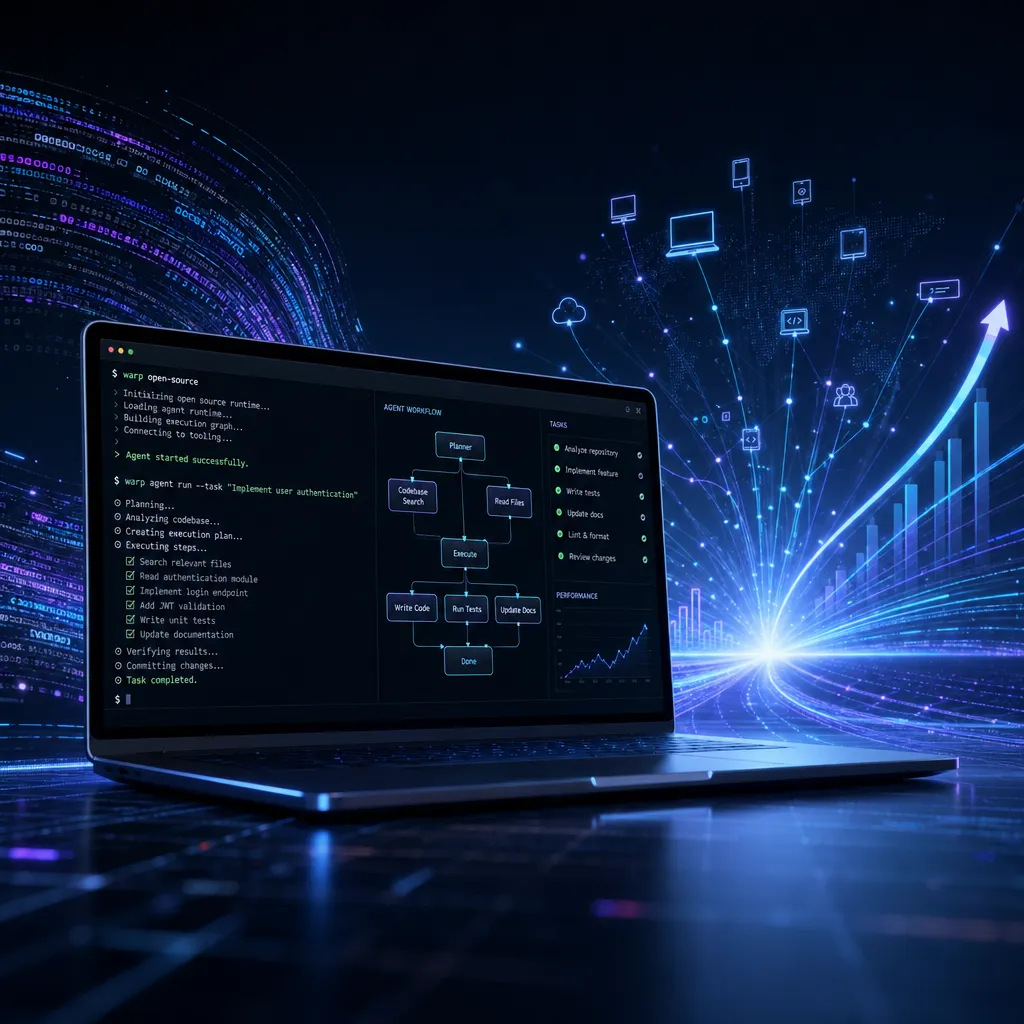
The well-known AI terminal Warp announced the open-sourcing of its client code and launched the cloud-based Agent orchestration platform, Oz. OpenAI has become the first sponsor, marking the transition of Agent-driven development environments from experimental to production.
Warp Terminal Goes Open Source: Agent Programming Enters the Mainstream
The well-known AI terminal Warp announced yesterday that its client code is now officially open source, while simultaneously launching its cloud-based Agent orchestration platform Oz. OpenAI has joined as a founding sponsor—marking another milestone, after Cursor and Windsurf, in deeply integrating Agent capabilities into the developer toolchain.
Unlike other terminals that treat AI as a chat assistant, Warp has treated Agents as first-class citizens from the very beginning. This open-sourcing effort is not just a code reveal—it opens up the entire Agent orchestration capability to the community. Developers can use the Oz platform to customize Agent behavior, integrate their own models, and build dedicated workflows.
Why Warp
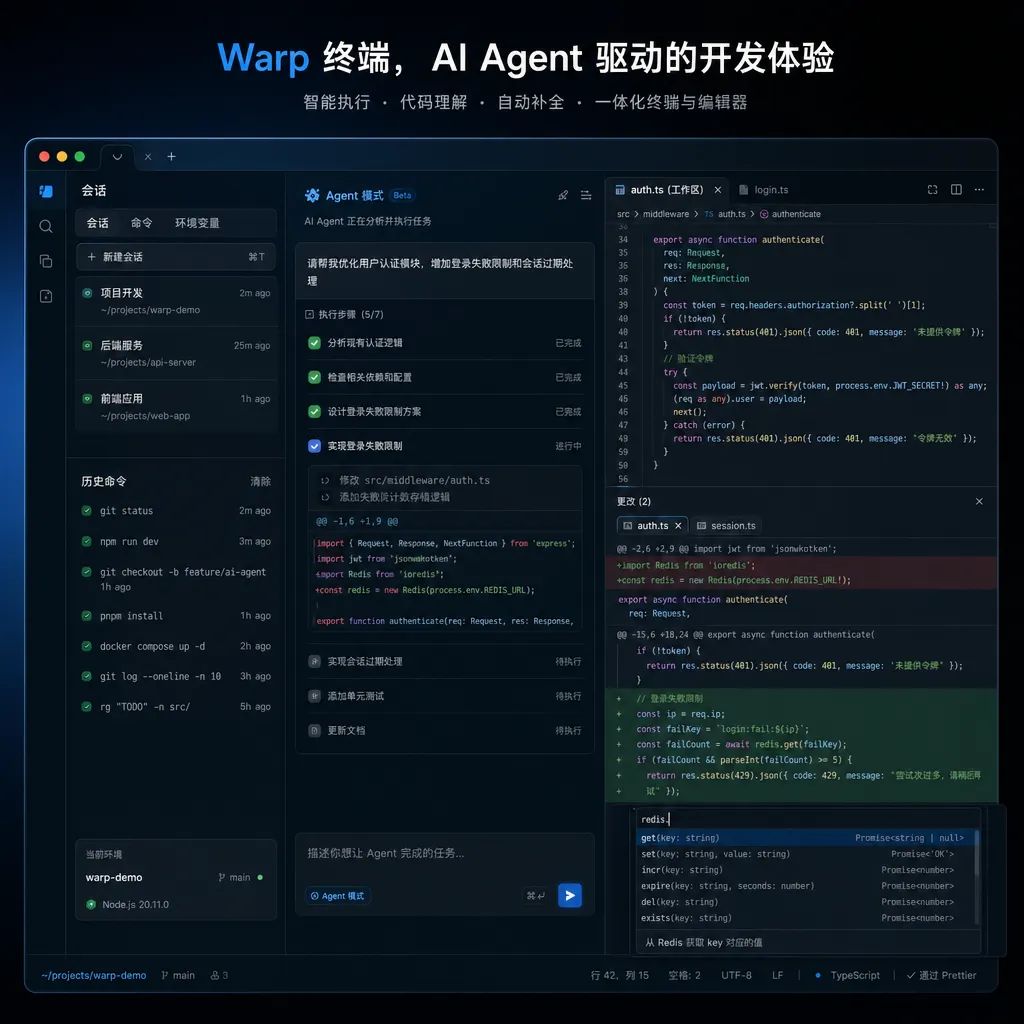
When Warp launched in 2022, it wasn’t a traditional terminal. Rewritten entirely in Rust, it transformed the command line into an editable document interface—you could select, copy, and edit any output just like in an IDE. It seemed radical at the time, but in hindsight, this turned out to be exactly the kind of interaction model the Agent era needs.
Agent-generated commands and code require human review, modification, and iteration. The streaming output model of traditional terminals simply doesn’t fit such collaborative scenarios. Warp’s block-based editor allows you to annotate, modify, and provide feedback directly on Agent output, then send it back to the Agent in one click for continued iteration. This “human-AI collaborative editing” experience is something traditional terminals like iTerm2 or Hyper cannot achieve.
Even more critical is permission management. Warp 2.0 introduces enterprise-grade permission controls for Agents—you can set which Agents can access which resources, perform which actions, and call which APIs. This is essential for production use. No one wants an Agent accidentally deleting a database or committing API keys to a public repo.
Oz Platform: A New Paradigm for Agent Orchestration
It’s not just the terminal client that’s open source—the cloud-based Agent orchestration platform Oz is launching alongside it. Its positioning is similar to LangChain or AutoGPT but more focused on development scenarios.
Oz offers several core capabilities:
- Multi-Agent Collaboration: Define multiple specialized Agents (e.g., one for writing code, one for testing, one for review) and have them collaborate according to a workflow.
- Context Management: Oz automatically collects context such as terminal history, file changes, and Git status and feeds it to the Agent—no more manually copying error messages or file content.
- Model-Agnostic: Supports OpenAI, Anthropic, local models, and even custom-trained ones. This matters for teams with data compliance requirements.
- Observability: Every Agent action is logged, reviewable, and auditable—essential for enterprise adoption.
With OpenAI joining as a founding sponsor, Oz will prioritize integration with the GPT model family’s latest capabilities. However, the Warp team emphasizes that they won’t lock users into a single model—their goal is to become infrastructure for Agent development, not just a front-end for any one model.
The Actual Agent Programming Experience
Warp’s Agent mode isn’t just about “natural language to command.” It’s more like a capable coworker who can code, debug, and look up docs.
For example, suppose you want to add a CI/CD process to your project:
- In the terminal, you type: “Help me configure GitHub Actions to run pytest and lint, and send a Slack notification on failure.”
- The Agent inspects the project structure, detects it’s a Python project using pytest and ruff.
- It generates a
.github/workflows/ci.ymlfile, with steps configured and a Slack webhook set up. - You can review the file directly in the terminal, annotate changes (e.g., modify a branch name, adjust notification format).
- The Agent updates accordingly, and you can commit in one click.
Throughout this process, there’s no window switching, copy-pasting, or opening docs in the browser. The Agent lives within your workflow—not in a separate chat window.
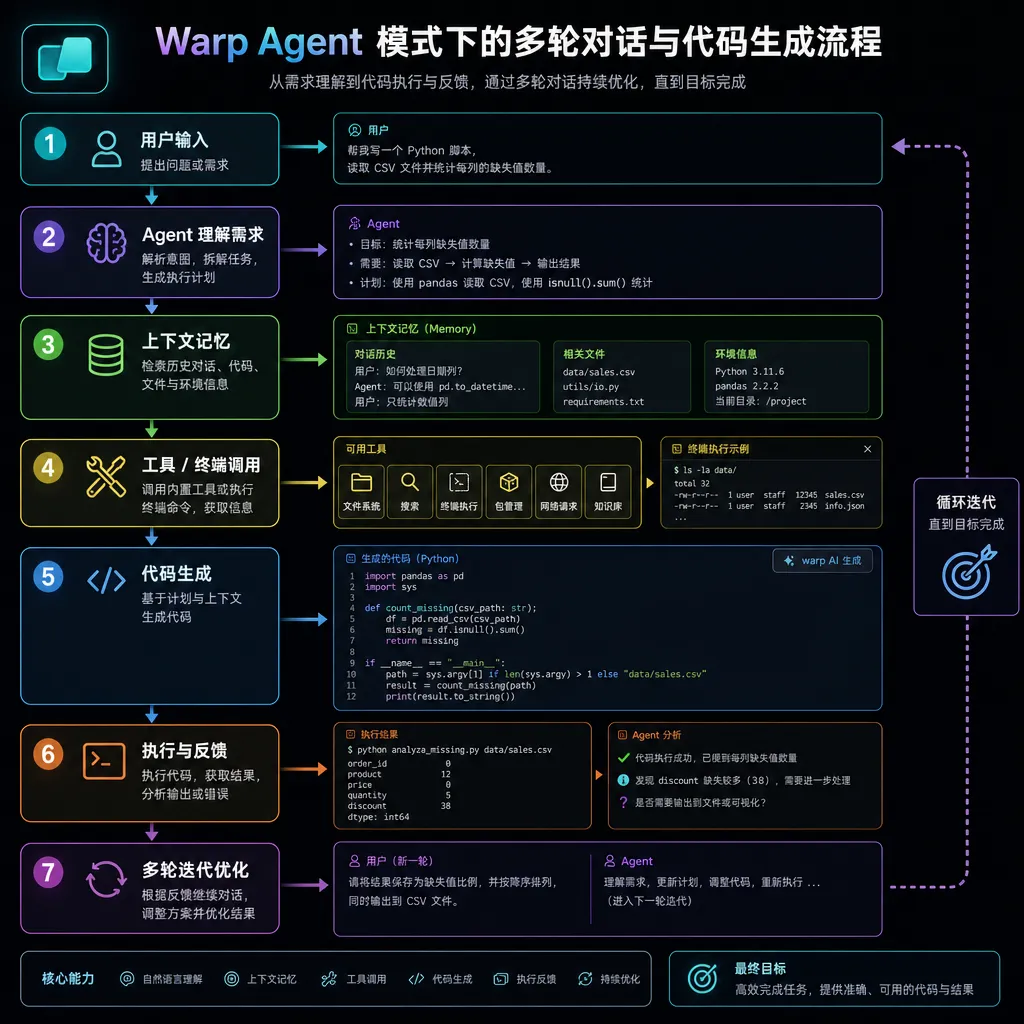
Even more importantly, Warp’s Agent has memory. It remembers previous issues you encountered when configuring CI, the tools your team uses, and your coding style preferences. This context persists—next time you configure something similar, the Agent will act according to your established habits.
What Open Source Means
Warp is open-sourcing its client code but keeping the Oz platform commercial. This strategy is smart—the open-source client will attract community contributions and accelerate feature iteration, while the Oz cloud service remains a viable business model.
For developers, this means:
- Customizability: Fork Warp, tweak the UI, add shortcuts, integrate your own toolchain. The community already released localization patches.
- Transparency: Audit the code to ensure there’s no data leakage or backdoors—critical for security-conscious teams.
- Extensibility: Write plugins, integrate your own Agents, and build customized development environments.
There are, however, limitations. Warp’s core Agent capabilities depend on the closed-source Oz service. To fully self-host, you’d need to build your own orchestration logic. Fortunately, Oz provides APIs, and you can replicate parts of the functionality with open-source tools like LangChain or AutoGPT.
Comparison with Competitors
Warp isn’t the only product exploring AI terminals. Tools like Fig (acquired by AWS) and Wiz (acquired by GitHub) pursued similar directions but didn’t quite succeed. The reason is straightforward—they treated AI as “enhanced autocomplete,” rather than redesigning the interaction paradigm.
Cursor and Windsurf went further—deeply integrating Agents into IDEs so they can edit across files, understand project structure, and perform complex refactoring. However, these tools are heavy. Cursor, essentially a modified VSCode, is slow to start, memory-hungry, and ill-suited for quick command-line tasks.
Warp strikes a sweet spot: more powerful than traditional terminals, yet lighter than IDEs. For developers who frequently switch between terminal and editor (DevOps, backend, infrastructure engineers), Warp provides a smoother experience.
Another differentiator is collaboration. Warp natively supports real-time multi-user collaboration—you can share your terminal session with teammates, who can watch, take control, or leave comments. This is extremely useful for remote pair programming or on-call debugging. Cursor and Windsurf do not yet offer this capability.
Challenges in Agent Programming
Warp’s open-sourcing is a positive sign, but for Agent programming to truly go mainstream, several challenges must be addressed:
Cost Control: Agent token usage far exceeds that of basic code completion. A complex task may require dozens of dialogue rounds, reading many files, and generating thousands of lines of code—expensive with GPT-4. Warp’s solution is hybrid modeling—using smaller models for simple tasks and larger ones for complex cases. But this demands fine-grained task classification and routing.
Reliability: Agents make mistakes. They may misinterpret instructions, generate buggy code, or run dangerous commands. Warp’s permission system limits potential damage but doesn’t prevent errors completely. Developers must learn to review Agent output rather than trust it blindly.
Learning Curve: Agent programming requires a new mindset—you no longer “write code” but guide the Agent to write it. This demands clear requirements, effective feedback, and proper task decomposition. Many developers haven’t yet adjusted to this mode of collaboration.
Data Privacy: Agents need access to your code, configurations, and environment variables. With cloud-based Agents, this data is uploaded to servers. Warp promises not to train models on user data, but enterprise clients will still have concerns. Local models are one solution, but they introduce trade-offs in cost and performance.
Industry Impact
Warp’s open-sourcing will accelerate the maturation of the Agent toolchain. In the coming months, expect to see a flood of Warp-based forks and plugins—Agents specialized for particular languages, workflows, and industries.
For AI model providers, this presents an opportunity. With OpenAI sponsoring Oz, Warp becomes a key distribution channel for GPT models. Anthropic, Google, and Mistral may follow, offering tighter integrations, lower API pricing, and better enterprise support.
For developers, this is a signal: Agent programming is no longer experimental—it’s a productivity tool. If you’re still using a traditional terminal, it’s time to try Warp. If you’re building dev tools, Agent capabilities should be standard, not optional.
The Road Ahead
In its blog, the Warp team outlined its vision: a platform where developers and AI Agents collaboratively deliver software. This isn’t just a terminal—it’s an integrated development environment encompassing editor, debugger, testing tools, and deployment pipelines—all driven by Agents.
It sounds ambitious, but technically, it’s already feasible. Cursor proved that Agents can write complex code, Devin showed they can complete end-to-end development tasks, and Warp demonstrates they can integrate seamlessly into everyday workflows. The remaining challenges are engineering ones: improving reliability, reducing cost, and enhancing usability.
Open-sourcing is key to solving these problems. Community power accelerates iteration, exposes edge cases, and unveils new use cases. Warp’s open source release isn’t the finish line—it’s the starting point of the Agent Programming era.
Upcoming developments to watch:
- The Oz platform’s API documentation and ecosystem growth
- Community-contributed Agents and plugins
- Whether other terminals (iTerm2, Alacritty, Windows Terminal) will add Agent capabilities
- Enterprise adoption and feedback
If you’re a developer, you can now clone Warp’s code from GitHub and try Agent mode. If you’re building developer tools, the open-source Warp code is a great reference—it shows how to design Agent-friendly interfaces, manage permissions, and handle multi-turn conversational context.
The era of Agent programming has arrived, and Warp’s open source move brings it closer to the mainstream.
References
- Warp GitHub Repository – Open source client code of Warp Terminal
- Well-known AI client Warp officially goes open source – Linux.do – Chinese community discussion
- Warp open source with localized patch – Linux.do – Community localization patch
- Next-gen AI terminal Warp – Zhihu – Feature introduction of Warp


